




Abstract
Summary
The current health-care infrastructure is generally considered to be inadequate to meet the needs of an increasingly older population. We have investigated the feasibility of a passive in-home monitoring system based on wireless accessible sensor populations (WASP). In an EU-funded project we have identified the system architecture and the sensors required to gather data from elderly patients by continuous monitoring. Data from biological variables (heart rate, accelerometers, body temperature and galvanic skin response) and everyday habits (body position, movements) will be transmitted to a central monitoring centre. A Body Sensor Network (worn by the patient and able to communicate with a personal mobile hub) and an Ambient Sensor Network (a number of wireless sensors incorporated into the patient's home) are envisaged. The system will be tested by using it in the telemedicine activities of the Health Telematic Network, which manages home help projects for elderly patients.
Introduction
As people age, they depend more heavily on outside support for health assessment and medical care. The current health-care infrastructure is generally considered to be inadequate to meet the needs of an increasingly older population. One approach to this problem is to enable aging in place, in which elderly people live independently and safely in their own homes for as long as possible, i.e. avoiding the transition to a care facility. This helps to keep people happy and socially connected, while reducing the demand on the health-care infrastructure.
In the last few years many studies have demonstrated that elderly patients are the most fragile class in society. For these reasons elderly care is characterized by multidisciplinary and multiprofessional evaluation. 1
WASP project
An EU project to develop intelligent wireless sensor networks started in September 2006. The work concerns wireless-accessible sensor populations (WASP) and will last for 42 months. Three possible areas of use are: elderly care, road transport and herd control. In the elderly care field continuous monitoring of patients will be possible using wireless sensors. This will allow information on body position to be gathered, as well as information about movements, everyday habits and certain biological variables.
Needs analysis
Using a questionnaire, we collected information about the possible level of acceptance of the WASP technology from approximately 100 general practitioners (GPs) and specialists. Ninety-five replies were collected. Some examples of the needs identified are shown in Table 1. Following the needs analysis, four applications in the elderly care area were chosen for further analysis:
monitoring chronic diseases using wearable vital-signs sensors; detection of activities of daily living using wearable and ambient sensors; monitoring social interaction using wearable and ambient sensors; interoperability with implantable devices for long-term monitoring.
Results of the needs analysis
The area ‘Detection of activities of daily living using wearable and ambient sensors’ was selected as the first application to be used for the prototyping. 2 Monitoring the Activities of Daily Living (ADLs) is an important surrogate for assessing the functional status of a person. It is widely used in medicine for assessing the elderly and those with chronic diseases, mental illness and other health problems. Many ADL indices are used by health professionals, especially occupational therapists. Deviations from regular patterns of activity can indicate whether or not the person being monitored is experiencing deterioration in health and/or wellbeing.
Recent studies have demonstrated the feasibility of passive in-home monitoring to collect information about patients' habits, to improve their quality of life, to increase the level of the provided health care and to reduce the caregivers' strain level. 3,4
System architecture
The needs analysis identified the system architecture and the sensors to be used in the future service. A Body Sensor Network (BSN) and an Ambient Sensor Network (ASN) will be used to gather the necessary information. The BSN and the ASN will record various signals and transmit information to a remote data centre about the patients' health and lifestyle (Figure 1).
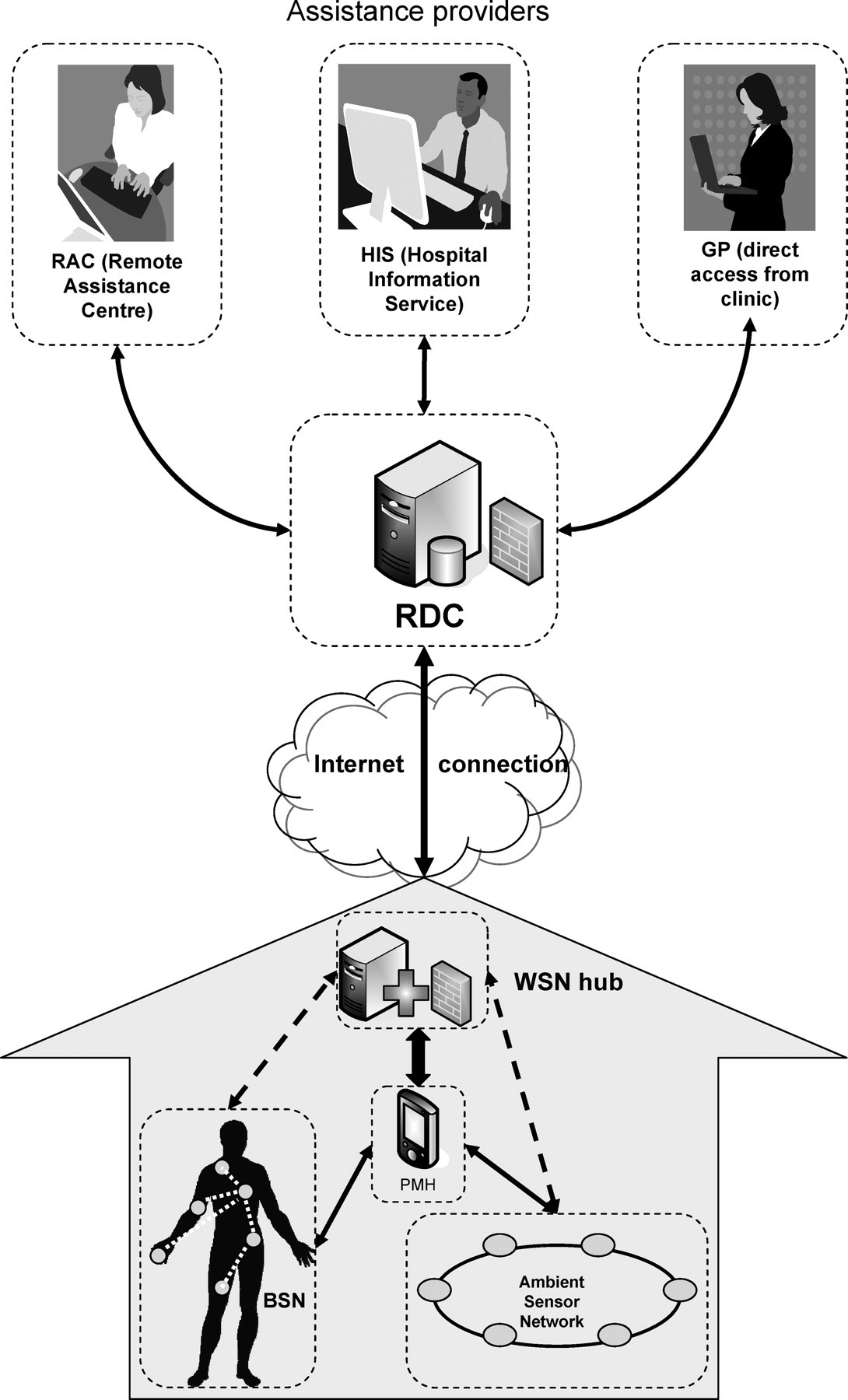
Proposed health-care scenario
Body sensor network
The BSN will be a network of wireless wearable sensors, which will collect data on biological and physiological variables. Important requirements for the wearable BSN nodes include: ease of use and operation, unobtrusiveness to the patient, durability, lightweight and the ability to perform real-time data monitoring. BSN sensors will communicate with a personal mobile hub (e.g. a PDA or a mobile phone) that will allow mobility of the patients.
The following sensors provide signals that can be measured: ECG or HRV (heart rate variability), motion (3D accelerometers), respiratory rate, blood pressure, near-body and skin temperature, SpO2 sensor (oximetry), GSR (galvanic skin response), implantable blood glucose sensors.
Ambient sensor network
The ASN will be made up of a number of wireless sensors that will be incorporated into the patient's home. The particular sensors to be employed will be guided by the condition being monitored. Only the minimum number of sensors which can provide the necessary information will be used.
Potential ambient sensors include, for example: ‘Blob’ motion sensors, 5 sensors for ambient temperature, appliance usage, bed pressure, door usage, medication compliance and bodyweight measurement. The sensors will be tested by using them in the telemedicine activities of the Health Telematic Network, which manages home help projects for elderly patients. 6
Discussion
The scenario described above is the result of the modelling done by the WASP consortium. The choice was determined by an analysis of the potential market for the proposed technology. Elderly care applications have a high level of societal relevance, given the demographic changes occurring in Europe and elsewhere. To gain an overview of the likely level of acceptance of the WASP technology, a survey was conducted among potential health-care staff in the Health Telematic Network. The results provide an idea about how wireless sensor networks might be employed in future and the advantages for patients and GPs. In general the results of the survey showed that for most of those interviewed, the WASP technology would improve the efficacy of telemedicine services, improve home care for elderly patients and improve the relationship between patients and caregivers. As a consequence, hospitalizations and other contacts with the health-care system would be reduced. Another interesting finding in the survey was that 85% of those interviewed felt that the WASP technology could be used by more than 25% of elderly people. 7
The WASP project is still in progress and the real potential of the new technology will not be available for some years.