




Abstract
Summary
We examined the emergencies arising on fishing vessels in Scottish Coastal Waters which required ship-to-shore radio medical advice. All calls to the service were identified for the 12-month period from August 2005. A total of 186 calls were received; 38% of calls were from fishing vessels. During the study period 53% of the calls were trauma-related, while 47% were medical emergencies. Our data suggest that there are many fishermen working offshore with chronic medical conditions. Overall, 85% of calls from fishing vessels resulted in evacuation as the outcome. Improved occupational health screening, compliance with health and safety legislation, and an evidence-based approach to remote medical care may improve seafarer self-care and reduce emergency evacuations.
Introduction
Commercial fishing represents a potentially hazardous working environment. 1 The geographical isolation of vessels offshore, combined with limited medical resources available onboard, places the emphasis on crews to be self-caring. UK-registered vessels are encouraged to carry ‘The Ship Captain's Medical Guide’. This provides a diagnostic and treatment guide for seafarers with basic first aid skills. However, many offshore emergency conditions require additional decision support with regard to suitable onboard treatment and the need for evacuation.
The Maritime and Coastguard Agency provides an emergency radio medical advice service to sea-going vessels. 2 This service is provided by two emergency departments in the UK. One department is in Scotland at the Aberdeen Royal Infirmary and the other is in England at the Queen Alexandria Hospital in Portsmouth. A database is maintained of all radio medical advice calls. The emergency department at Aberdeen Royal Infirmary deals with the majority of calls from fishing vessels.
The aim of the present study was to examine the emergencies arising on fishing vessels in Scottish Coastal Waters which required ship-to-shore medical advice. Such information may be useful in determining the scope of first aid training courses for mariners and the type of medical equipment to be carried on board. 3
Methods
Information from the standardized form used by all agencies to record details of emergency calls was entered into a database. All calls to the service were identified for the 12-month period from August 2005. Those calls identified as originating from fishing vessels were further analysed for the nature of the medical emergency and the need to evacuate. With regard to evacuation, all cases resulting in evacuation were reviewed by a panel of four emergency medicine consultants.
Results
A total of 186 calls were received by the service during the study period. The type of vessel involved was recorded in 96% of the cases. The most common type was fishing vessels (Figure 1). During the study period 53% of these calls were trauma-related, while 47% were medical emergencies. It appeared that many of the seafarers requiring emergency care had active pathologies, including epilepsy and ischaemic heart disease (data not routinely collected at time of call). The types of medical emergencies are shown in Figure 2.
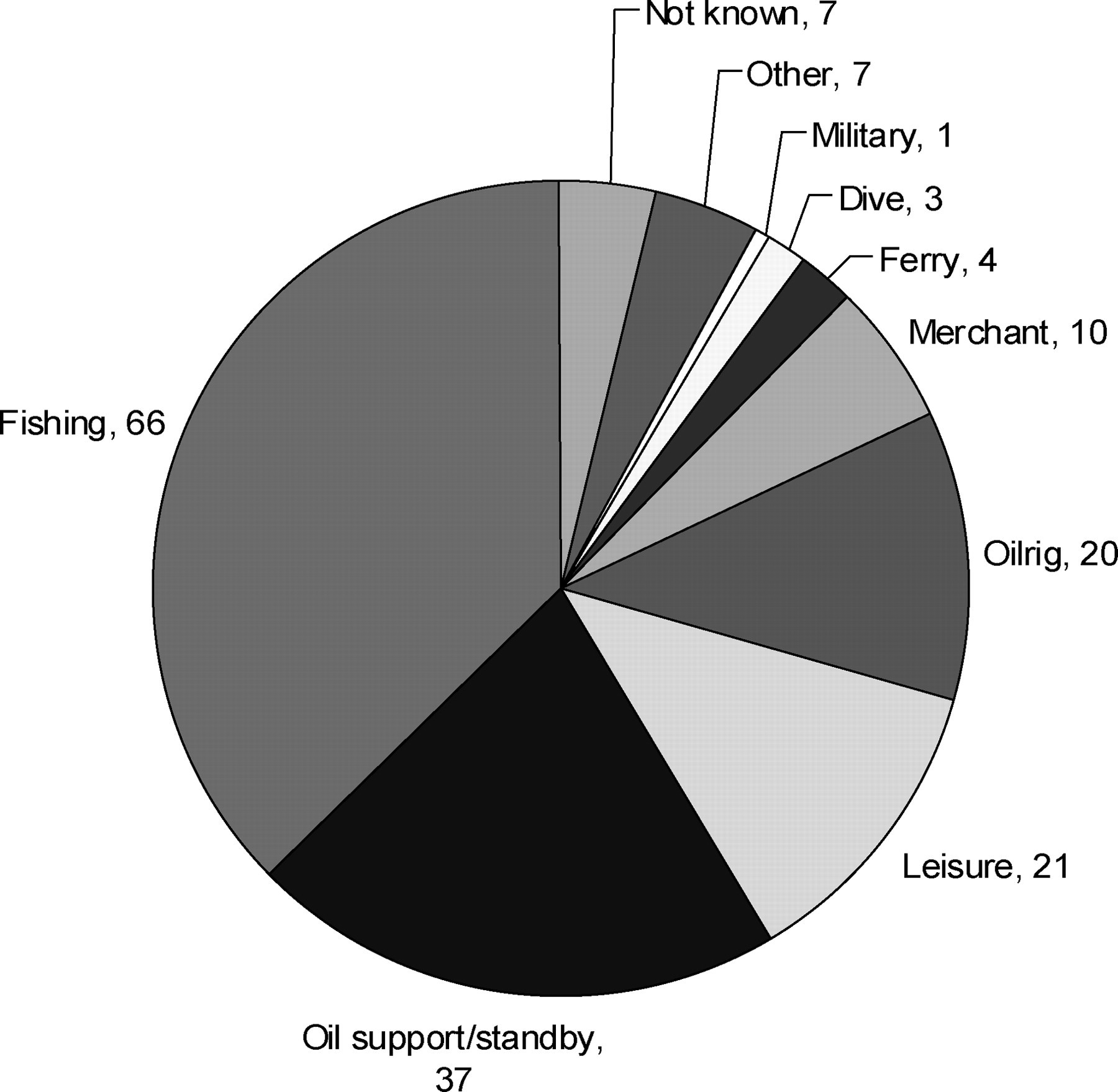
The relative proportion of different vessels (n = 176)
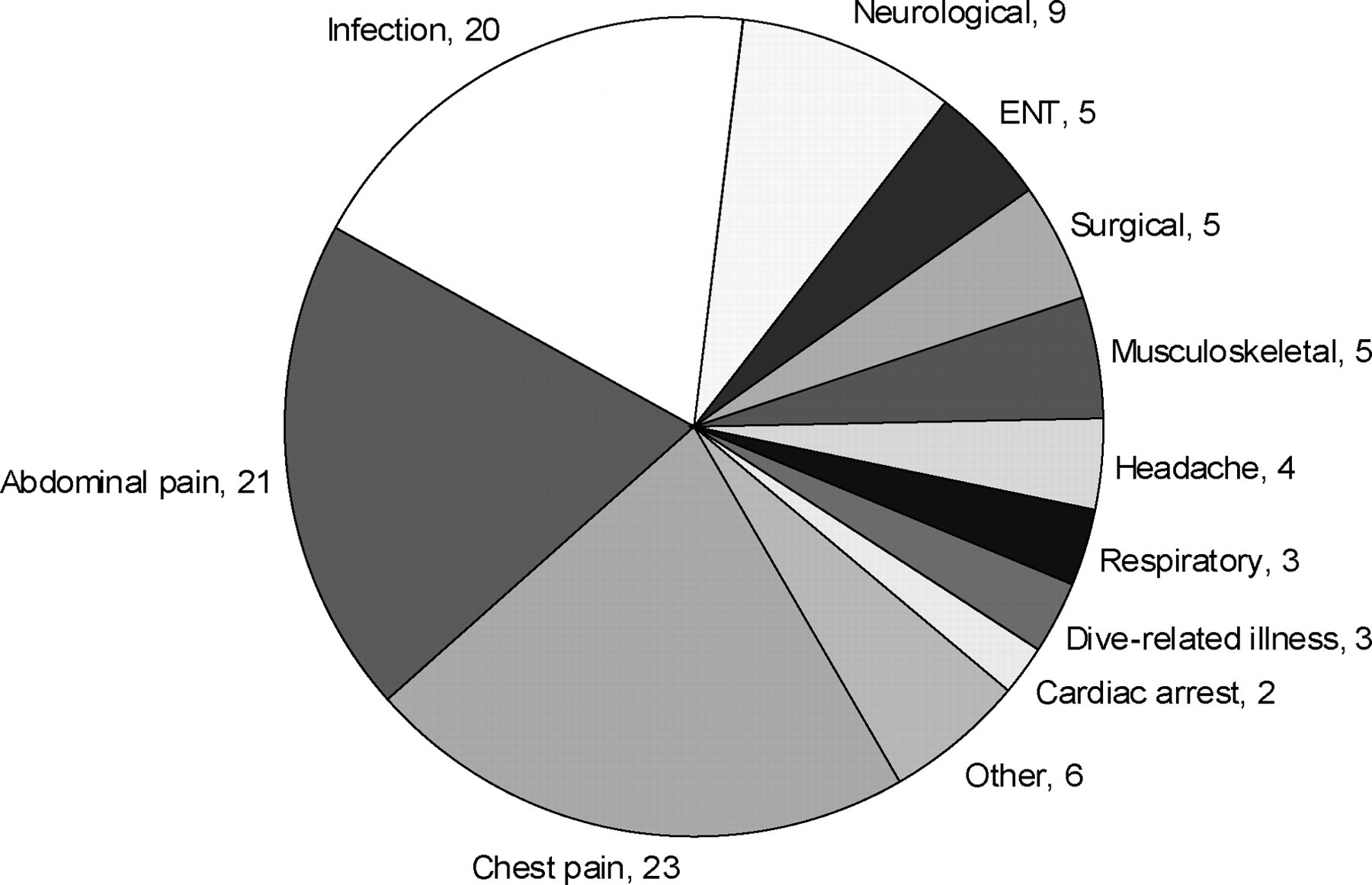
The types of medical emergencies (n = 106)
The decision to evacuate, based on the information available to the advising doctor and the medical resources on the vessel, was felt to be appropriate by the panel in all cases. Overall, 85% of calls from fishing vessels resulted in evacuation as the outcome. The overall evacuation rate for all other vessels was 73%. Of the calls relating to traumatic emergencies, 27% were successfully treated on board. However, of the 30 calls for medical emergencies, only one (3%) avoided evacuation.
Discussion
The large proportion of emergencies of a medical nature arising on fishing vessels is remarkable. Medical emergencies occurring on fishing vessels have previously been assumed to be traumatic in origin. 4 A fishing vessel is a workplace and should be subject to Health and Safety standards. It is an offence under UK regulations to employ a seafarer who does not hold a certificate of medical fitness. 5 However, in the commercial fishing industry the crew are considered to be self-employed and are thus exempt from these checks. Our data suggest that there are many fishermen working offshore with chronic medical conditions.
It is clear that medical emergencies are common among fishermen. 6 Exacerbation of a chronic condition or first presentation of symptoms, while in a remote environment with limited medical expertise and equipment, may expose these individuals to risk of significant adverse outcomes.
The overall rate of evacuation from fishing vessels was 12% higher than for other offshore vessels. The majority of these evacuations were by helicopter (48%). Evacuations are expensive and consume large amounts of resource. In addition, any emergency evacuation, by any means, in the offshore environment carries inherent risks which are increased in bad weather. Therefore, circumstances which result in a high frequency of emergency evacuations place both patient and rescuers at higher risk of an adverse event and should be minimized.
In regard to the management of acute medical emergencies on fishing vessels, several measures could be taken to improve outcome. Medical training for seafarers could be tailored for their specific environment allowing more patients to be treated without emergency evacuation. Medical equipment for fishing vessels might be improved. Combining these measures with effective communications may allow greater numbers of unwell or injured crew to safely remain on their vessels, either to complete their recovery or to facilitate a safe, non-urgent evacuation.
In terms of reducing overall medical emergencies on fishing vessels, improved health and safety measures on board might reduce the incidence of injury. Our data suggest that many emergencies occur as exacerbations of chronic medical conditions. More robust occupational health monitoring of the fishing industry might significantly reduce the number of medically-related incidents occurring on fishing vessels. Improved occupational health screening, compliance with health and safety legislation and an evidence-based approach to remote medical care may improve seafarer self-care and reduce emergency evacuations.
Footnotes
Acknowledgements
We thank the Maritime Coastguard Agency and the Scottish Centre for Telehealth.