




Abstract
Step counting is an important index of motion in telemonitoring. We have developed a wearable system based on a device with a force-sensing resistor. This is affixed at the calf gastrocnemius level to monitor the muscular expansion related to the gait. The gastrocnemius expansion measurement unit (GEMU) was tested on three subjects at Level 2 of the Tinetti test of unbalance, who performed five repetitions of 100 steps at two different speeds (normal and slow). The mean error was less than 0.5%. The GEMU also performed better than an accelerometer unit, which is normally considered to be the best solution for this disability. The system can be integrated into a routine home-care application based on a GSM home-care unit.
Introduction
Step counting is an important index of activity and is used in the prevention of obesity and cardiovascular problems, in diabetes care and more generally in physiotherapy and rehabilitation. 1–3 Although commercial pedometers are widely used for this purpose they suffer three principal limitations which hamper their use in telemedicine, i.e. for telemonitoring or for telerehabilitation. The first limitation is their accuracy. Schneider et al. 4 tested 13 models of pedometers on healthy subjects and found that many of them underestimated (by about 25%) or overestimated (by about 45%) the number of steps recorded. The second limitation is that commercial pedometers may be confounded by motion style. Keenan and Wilhelm found that in the case of a subject with a degree of unbalance, an accelerometer performed better. 5 The third limitation is that they are not interoperable. Most of the commercial pedometers analysed by Schneider et al. 4 were closed systems that could not be integrated with a telemedicine system.
The aim of the present study was to examine the feasibility of a new method for step counting which would be suitable for use in telemedicine.
Step counter
The principle of the step counter was to monitor calf-pump muscle activity. There were three problems. The first was to identify the best position for monitoring muscular expansion. The second was to design and construct a sensor to monitor the pressure variation during calf muscle expansion. The last problem was the optimization of the counter for use in home care.
Wearable system
The system consisted of a wearable sensor with a belt to monitor the force exerted by the gastrocnemius muscle during muscular expansion. The reference point for fixation was the pit between the two gastrocnemius muscles (Figure 1). This position was also chosen as reference by Lyons et al. to monitor the calf-pump electrical activity by means of an EMG. 6 This position is easily detected by palpation.

Position for fixing the device between the two gastrocnemius muscles
The wearable system was based on a force-sensing resistor (CP0152, Interlink, USA) and a microcontroller (μP PIC 16F877, Microchip, USA). The microcontroller was programmed to allow step counting. Once a variation of pressure was detected by the force-sensing resistor, the step counter was incremented by a trigger mechanism based on a threshold of 50% of the supervised maximum signal excursion mediated on three consecutive steps. The power supply was three rechargeable batteries with a capacity of 160 mA × h. The gastrocnemius expansion measurement unit (GEMU) is shown in Figure 2.
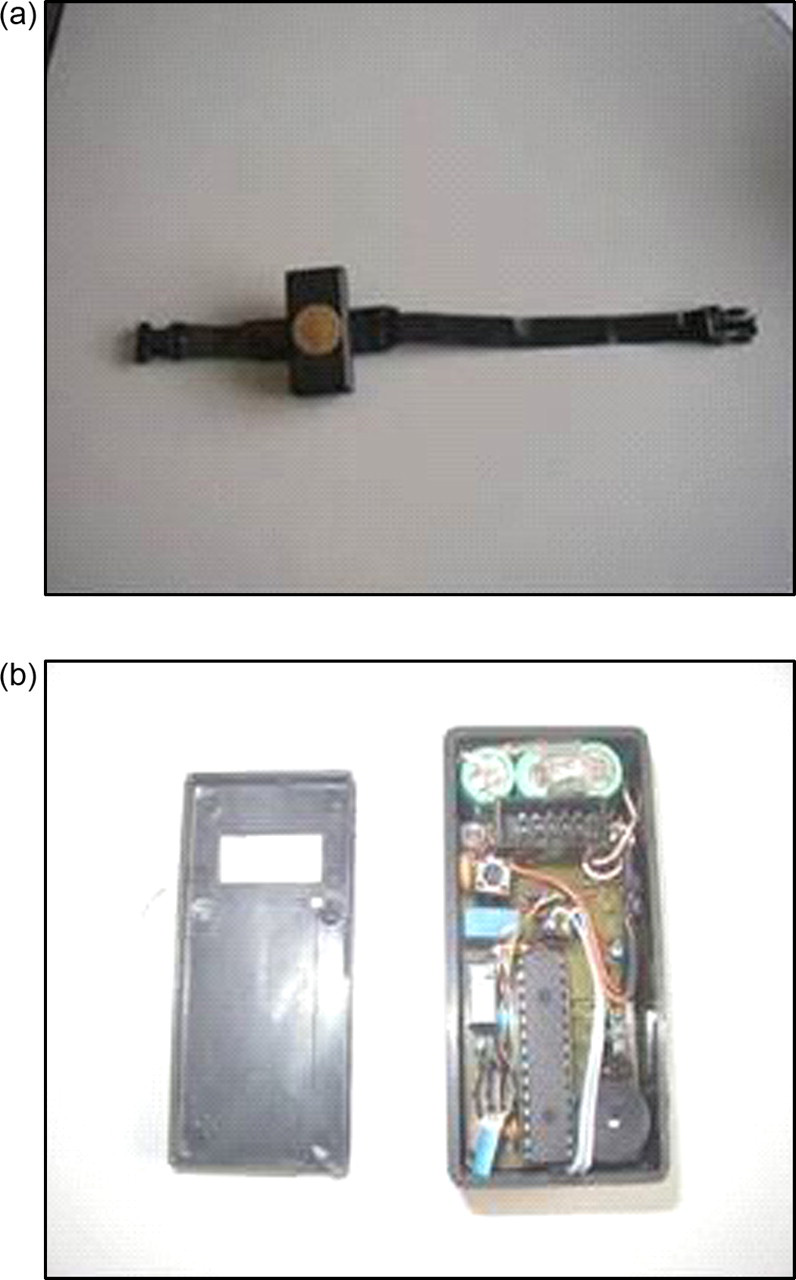
GEMU with belt (a); an internal view of the GEMU (b)
Data exchange
The device was designed to be connected to a unit for re-charging (Figure 3) and for both data transmission (step counting) and receiving (for software to upgrade the microcontroller). This GEMU service unit was similar to those used for re-charging mobile phones. It was designed for daily monitoring. As soon as the subject put the device on the unit, for example before going to sleep, the number of steps was transmitted from an internal register, which was then re-set.
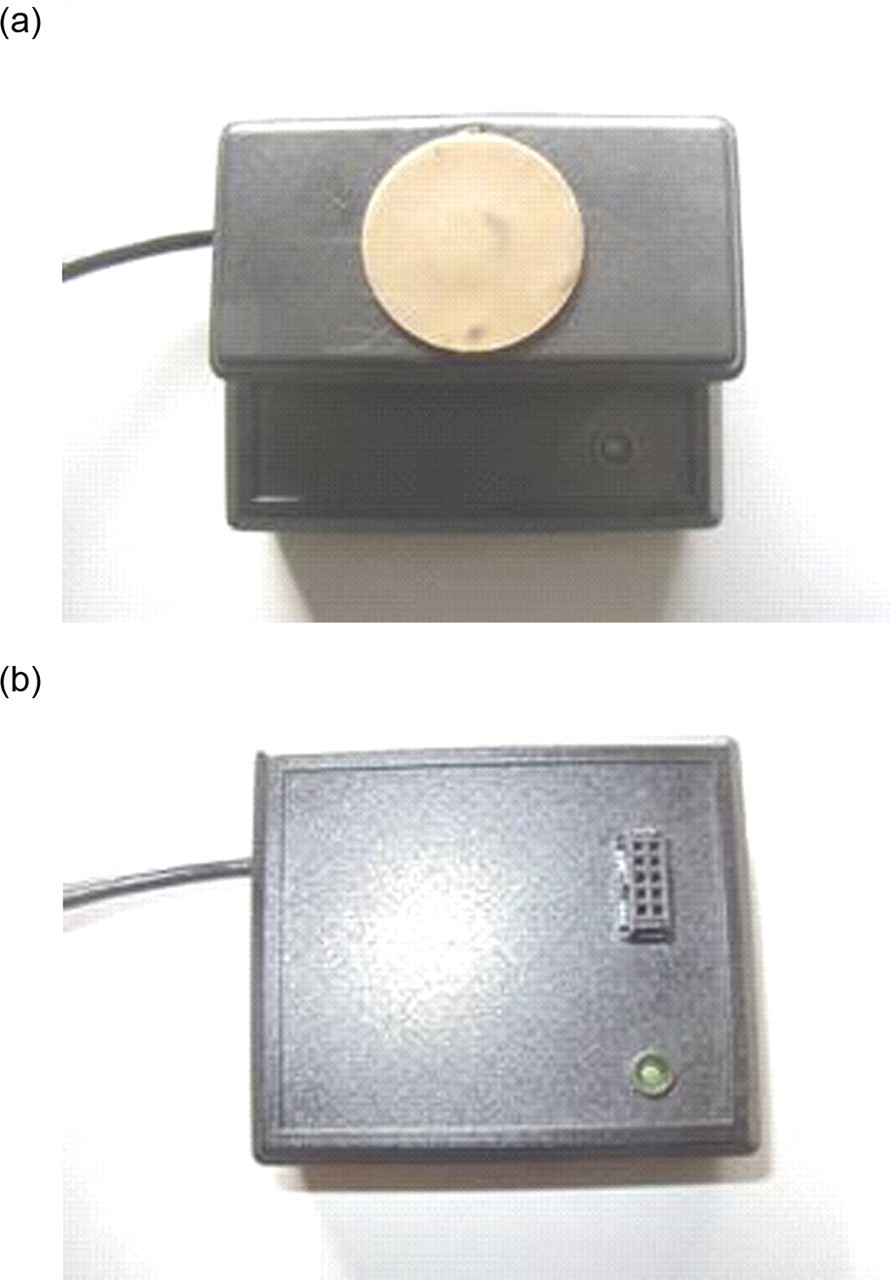
The device sensor on the service unit (a); the service unit (b)
User-oriented aspects
The user interface was modelled on those used for mobile phones with indications such as calibration in progress, re-charging needed, ready for use, re-charging in progress, failure and correct positioning on the service unit of the GEMU. The belt was fixed on the calf during unloaded muscular status. Calibration was obtained after three supervised steps.
Recognition of step events
Commercial pedometers are based on mechanical components to detect step events (e.g. they employ a mechanical lever sensitive to movements along the vertical axis, which activates a gear to increase the step count). Such pedometers use simple algorithms to discriminate non-step events. These algorithms, for example, are based on the assessment of the pseudo-periodicity of the transitions. Usually commercial pedometers set this parameter to 2 or 3. We set it to 2, since a different value did not improve the results, as shown by applying optimization methods using the Matlab R12 optimization package (Mathworks, USA).
Furthermore the increment of the step counting on the basis of the signal transition (trigger mechanism) during each gait cycle avoided errors in the long plateaus caused by postures such as standing, lying and sitting. Postures of comfortable sitting or lying are characterized by long plateaus of unloaded status of the gastrocnemius muscle, whereas postures of standing are characterized by long plateaus of loaded status of the gastrocnemius muscle. The transitions from sitting and/or lying to standing, were eliminated by recognition of the unloaded status of the gastrocnemius muscle (corresponding to sitting or the lying before the transition) associated with a small value of resistance of the wearable system's force-sensing resistor.
Tests
Testing of the GEMU was performed on three subjects at Level 2 of the Tinetti test of unbalance. 7 Each subject was asked to perform five repetitions of two tasks of 100 steps on level ground. The two tasks consisted of normal and slow instruction. The exact number of steps actually carried out was ensured by visual inspection. The study was authorized by the appropriate ethics committee.
The step counts from the GEMU were compared to the step counts obtained by an inertial measurement unit (IMU) which contained three accelerometers (3031-Euro Sensors, US) and three gyroscopes (Gyrostar ENC-03J-Murata, Japan). This device, described in detail elsewhere, 8,9 was affixed in the same position as the new unit.
A test on five healthy subjects was performed with the aim of investigating the power supply duration. Each subject recorded more than 10,000 steps under controlled laboratory conditions.
Results
The percentage error in the recorded step count was lower for the GEMU than for the IMU (Table 1). This was significant, as assessed by ANOVA (P < 0.04). The errors were higher for the trials with slow instruction; for this particular instruction mode the motion style may confound the IMU. 5
Percentage error in recorded step count for the gastrocnemius expansion measurement unit (GEMU) and the inertial measurement unit (IMU)
The mean number of steps performed during the power supply tests was 13,946 (range 12,423–14,777). At the end of the daily monitoring the minimum residual battery charge was 31%, thus permitting correct operation of the device.
Discussion
The present study showed the feasibility of the new wearable system for step counting and thus its potential for telemonitoring applications. Particular care was devoted to the optimization of the user-oriented aspects (e.g. the LED and sound-based monitoring of the status) as well as of the technical aspects, which should permit long-term daily usage in future.
When the system was tested on three subjects at Level 2 of the Tinetti test of unbalance, the mean error was lower than 0.5%. Results also showed that the GEMU performed better than an accelerometer unit (which is normally considered to be the best solution for this disability).
The present study makes three contributions to the literature. The first is the availability of a new method for step counting, based on monitoring the calf muscular expansion. The second is the outcome of the study for subjects with a degree of unbalance, whose motion style causes errors in conventional pedometers. The third is the comparison with a unit based on accelerometers and gyros, normally considered to be the best method of step counting for subjects with unbalance. 5 The system can also be integrated into a routine home-care application based on a GSM home-care unit. This unit, described in detail elsewhere, 10 can be used to collect daily information about variables of cardiovascular interest, as well as the motion data collected by the GEMU, and sends this information to a remote server. The GEMU has been adopted as the physical activity monitor in a pilot study on patients following a stroke.
Footnotes
Acknowledgements
This work was carried out as part of a project on the continuity of care funded by the Italian Ministry of Health.