




Abstract
We propose a technique in which elderly people can be monitored non-intrusively. The information is kept in an ‘active’ health record which becomes alive when attention or action is necessary concerning the condition of the elderly person. The proposed system consists of three main components: a sensor/actor loop, sensor records and associated active services, and a Grid middleware platform. Information is captured in realtime within a collaborative health-care Grid. The Grid connects elderly people, caregivers and medical service providers in ways that reduce unnecessary calls on expensive medical services through an intermediate local service centre (which can be virtual) assisted with Internet communications and monitoring technologies. The proposal should support preventive health-care programmes for reducing the cost of caring for the elderly.
Introduction
In 2002, nearly 13,000 people aged 65 years and older died in Australia because of fall-related injuries. 1 More than 60% of people who die from falls are aged 75 years and older. 2 It has been stated that the chances of surviving a fall, heart attack or stroke are six times greater if the person receives help within an hour. 3,4 Gururajan et al. 5 observed that most health-care information is both time and life critical, so it must be captured and/or delivered whenever and wherever needed. To address these matters, we envisage a solution where a non-intrusive front end is used to capture critical health information and suitable infrastructure is employed to disseminate the information, make appropriate decisions and provide a timely response to emergency situations.
In this paper we describe an Active Grid Infrastructure for Elderly Care. Currently we are researching, designing and implementing the infrastructure. Part of the infrastructure has been implemented. The work is still in progress.
Active wireless-grid infrastructure for assistive health care
We propose a technique in which the elderly are monitored non-intrusively to provide essential health information about them. The information is kept in an ‘active’ health record which becomes alive when attention or action is necessary concerning the condition of the elderly person. Both caregiver and the elderly person can move freely, but their interaction through the active health record and the infrastructure can happen anywhere and at any time. Resources in the system can be shared by multiple caregivers or organizations (bound by an authorization policy) allowing them to collaborate.
Our infrastructure is based on three concepts which differentiate it from other work:
mobile sensing and actuating; active health records; a collaborative Grid.
A Grid can be thought of as a distributed computing infrastructure for creating and operating virtual environments. It provides a common basis for sharing, controlling and managing cross-organizational resources.
6
A collaborative Grid adds a layer of middleware over a Grid to allow distributed participants to perform tasks such as medical decision-making and collaborative reasoning (Figure 1).
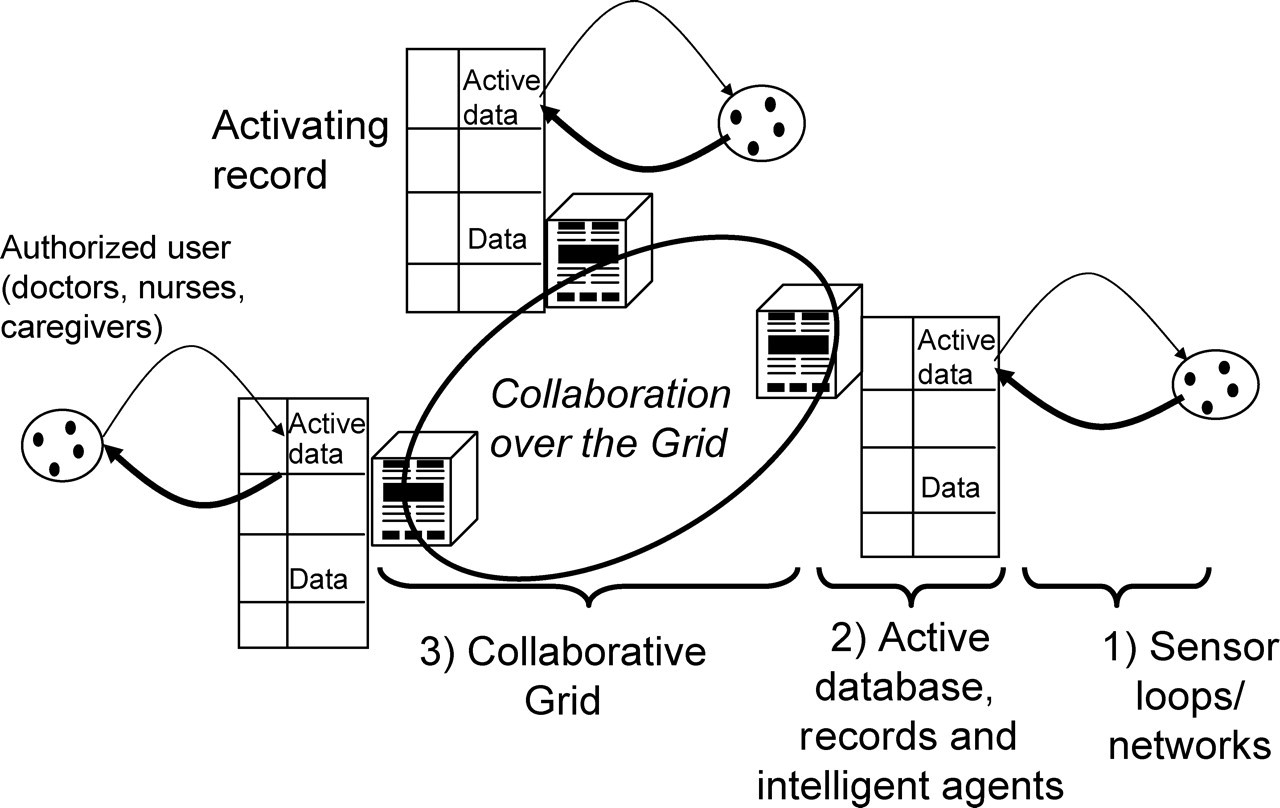
Overall infrastructure
The overall framework of the proposal consists of three main components: a sensor/actor loop, sensor records and associated active services, and a Grid middleware platform:
the sensor/actor loop consists of various body sensors, actuators, PDA devices and servers. A sensing communication link is established between the sensors through the PDAs to the servers. In the reverse direction, a communication link is established from the servers to the actuators for delivering assistive actions to the user. This link may utilize the same medium as the sensing communication link or it may utilize other media such as mobile phone links. The loop is for collecting relevant sensed data and to ensure that there is an appropriate means to deliver assistive advice regardless of the nature of the communications link; the active health sensor record component consists of relevant electronic records and various active services. The records inherit a generic record which is extensible to accommodate different types of sensors and data. Selective components of the records are linked to appropriate active services which are intelligent agents that can be invoked automatically (as well as manually) to take appropriate actions and deliver relevant responses to the user; the collaborative Grid platform houses the middleware component and various collaborative services. The Grid platform can be connected with other Grid platforms over the Internet to form a virtual organization in which all components can collaborate and share their resources. The middleware component encapsulates specific sensor/actor components into services that can be used by all types of applications. The middleware is also responsible for interpreting application requirements into specific actions to be performed by the underlying sensor loop.
Mobile sensing and actuating component
Monitoring an elderly person's condition provides vital information to caregivers about the elderly person's wellness, but equally important is the caregivers' diagnosis, advice and/or instructions on some corrective measures for the elderly. In our proposal, sensors and actuators will be used to complete this closed monitoring action loop.
A sensor is a device that detects the presence and/or the variation of some physical phenomenon and converts the sensed quantity into a signal that can be measured and processed, such as voltage or current. A smart sensor is a sensor that provides extra functions beyond those necessary for generating a correct representation of the sensed quantity. Often they possess processing, storage and decision-making capabilities. Sensors can measure physical properties such as pressure, temperature, humidity and flow; motion properties such as position, velocity, angular velocity and acceleration; contact properties such as strain, force, torque, slip and vibration; presence by tactile/contact, proximity, distance/range and motion; biochemistry by biochemical agents; identification by personal features.
For health monitoring, wearable medical sensors are of particular interest. These devices are used to monitor ambulatory variables such as heart rate for cardiac function; acceleration during walking and running for activity; body temperature for illness; vital capacity for severity of airway obstruction in chronic obstructive pulmonary disease; blood glucose for vascular or neurological complications; EEG for seizure disorders, confusion, head injuries, brain tumours, infections, degenerative diseases and metabolic disturbances that affect the brain; ECG waveform for cardiac arrhythmias; blood pressure; arterial oxygen saturation for sleep disorder; and body weight (Figure 2).
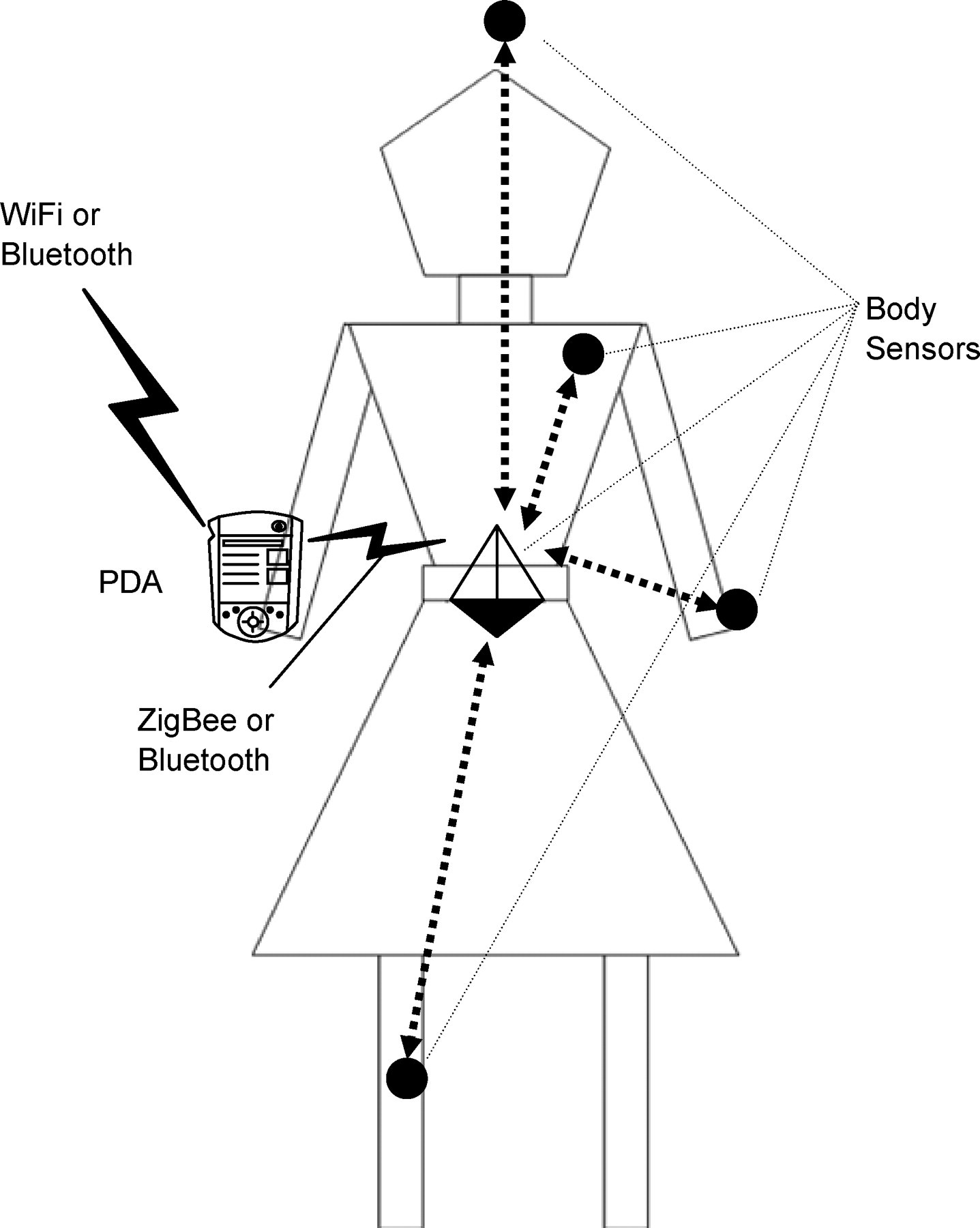
Body sensors and communications
The concept of caregiving to an elderly person requires that person to be mobile within their own environment and able to conduct their daily activities at will. The wireless, context and mobility management component of our proposal allows this.
Sensing and actuating can be achieved with on-body and off-body sensors and actuators. Wearing on-body sensors allows the subject to be mobile and the on-body sensors can form a body area network (BAN) which reacts when the conditions detected imply that the person needs immediate assistance. Together with off-body sensors, context information can be collected and if the context confirms that fact, the BAN will contact a rescue team or other health-care provider, giving them the exact location of the person and all the information they need to establish a diagnosis while on their way to attend to them.
An actuator, on the other hand, converts information into actions such as moving itself or initiating actions in other items in its environment. Sensors and actuators often go together as the means of physical interaction between an entity and its surrounding.
A health record provides a uniform, standardized set of information about an elderly person. This type of electronic record allows secure and consistent information about an elderly person to be presented to suitably authorized caregivers. An active record is an enhancement of an existing health record whereby a chosen item can be active so that it is updated continually to reflect the elderly person's condition, and it can be activated to provide guidance and other assistive measures when some condition or a combination of conditions is met.
Our concept of an ‘active’ sensor data record is different from others because it allows the data components of a record to become alive when certain conditions are met. A data record consists of multiple individual components. A component can be made ‘active’ in a similar way that a hyperlink in a web page can be clicked on, which produces a change in the link's status (e.g. a change in the colour of the underlined link text) and a new web page being fetched. In our context, when a data item is made active, it means that some conditions associated with a data component have been met and some actions have been triggered (e.g. execution of a program). As a result of the execution, some assistive instructions, commands or responses may be sent from the server to the actuator which then delivers an appropriate response to the user. With our proposed active sensor record, there are no bounds to the way that novel active services can be created. Our health record can also include the information that the elderly persons provide about themselves and extra information coming from the sensors and contextual information attached to it (Figure 3).
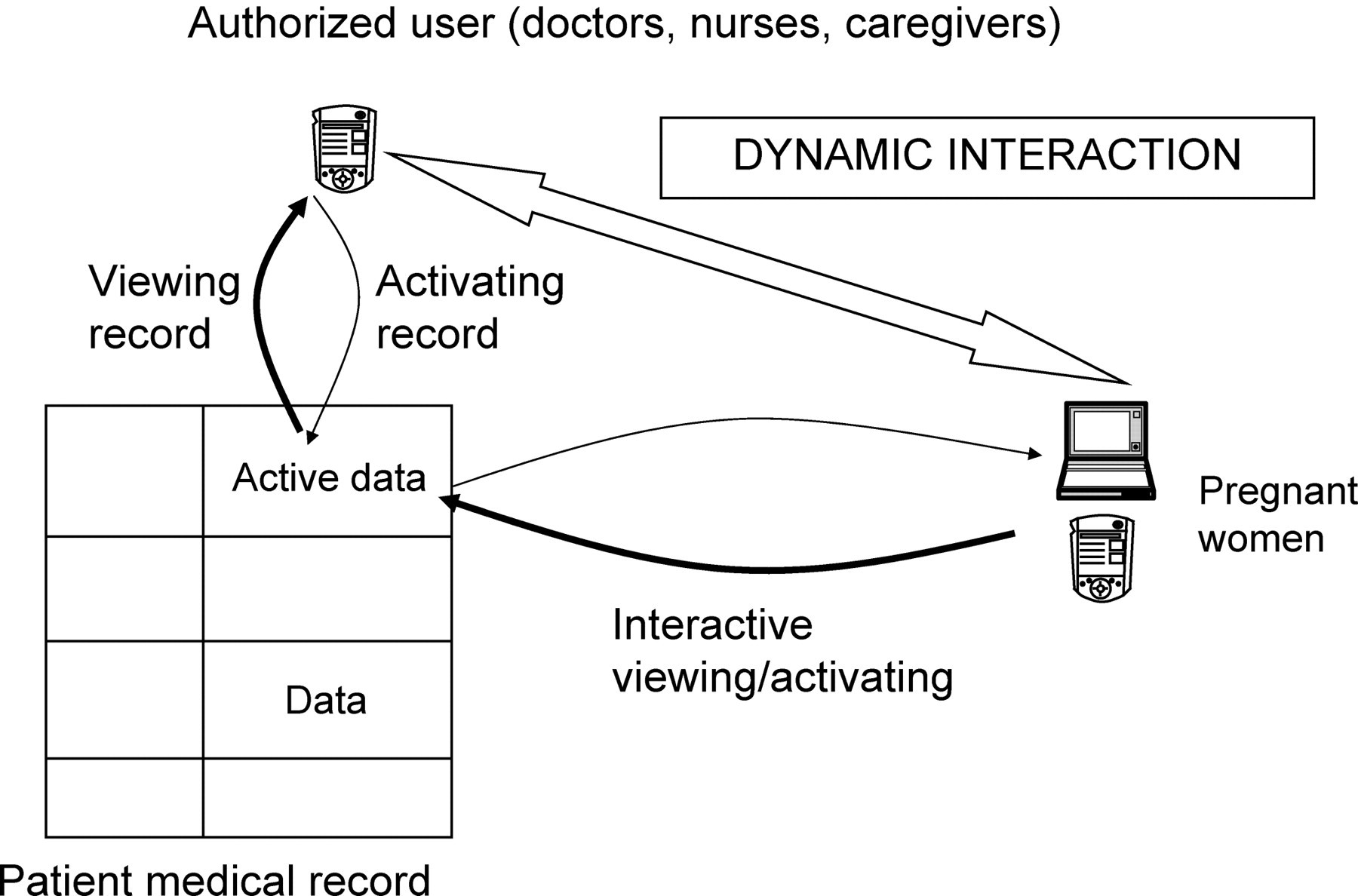
Active records and interaction between users
An active database system (ADS) is a database in which the operation is automatically executed when certain conditions arise. An ADS extends the functionality of a passive database with active rules. Active rules allow an ADS to monitor the stored data, to respond automatically to the events and to execute defined actions. Active rules can be achieved through trigger and event functions.
Collaborative Grid component
An elderly person's wellness is a concern of various caregivers and health organizations. The person's record needs to be shared by multiple authorized caregivers. Often, these caregivers have to collaborate to provide adequate care as well as to be accounted for by funding authorities. Without this type of collaboration, the overall system is isolated, not effective, not economical and may be subject to abuse. In order to establish such a collaborative Grid, wired and wireless network technologies are necessary to build the required operational and communication infrastructure.
Health monitoring architecture
Most monitoring architectures have three layers:
a data acquisition layer, which is responsible for sensing and collecting information concerning health conditions; a data distribution layer, which is responsible for distributing relevant data to components for analysis; a processing and control layer, which is responsible for processing and interpreting summarized data, and making appropriate controls or responses.
Beyond this three-layer architecture, we envisage a collaboration layer that is responsible for negotiating, coordinating and sharing resources of multiple domains. The ultimate application determines the overall purposes of the applications and policies governing its operation, including security, degree of collaboration and interaction.
In reality the functionalities of a layer are usually carried out by groups of components simultaneously at different levels (Figure 4). In the lowest level of a practical architecture for health monitoring, sensors operate within a confined area (for example, over the body of a person) and form a wireless body area network so that they can rely on one another to relay sensed information to a more powerful sensor, which then relays the information (possibly filtered) to a local server. Wireless technology is often used to form such a BAN. The local server acts as a bridge between its sensor network and a central server, which may also serve as a gateway to a wide area network such as the Internet or a mobile wide area wireless network. 7 The central server has more power, in order to process data and extract information for diagnosis and/or initiate appropriate responses. It often communicates with the local server through either Bluetooth and/or 802.11 wireless transmission.
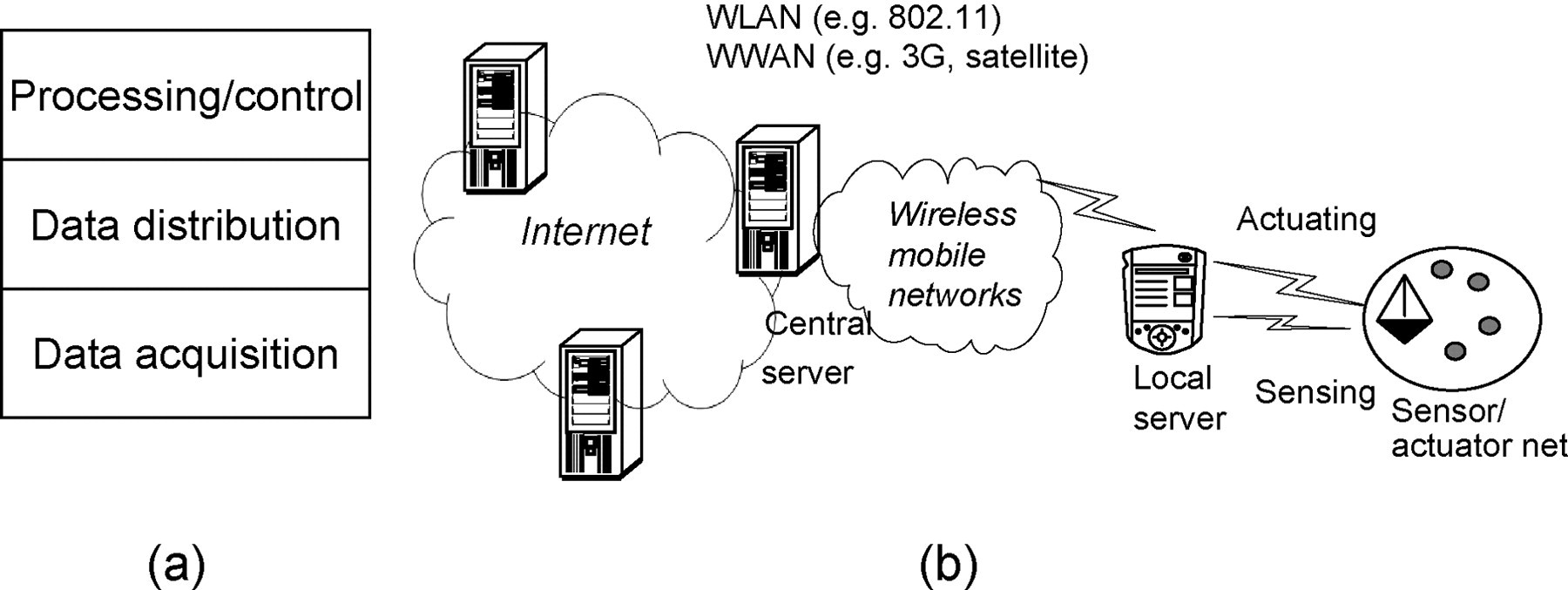
Monitoring system architecture with wireless sensor networks
At the top layer, the central server may distribute its data to other servers and obtain from them additional data relevant to the monitored health conditions for forming better responses. 8 The communications between central servers can take place via the wired or wireless Internet.
A collaborative Grid
An active elderly person's record can be monitored and activated by any users if they are properly authenticated and authorized in accordance with an appropriate policy. Accessing and collaborating aspects are both available in the proposed system. Access across the Internet allows users with appropriate authorization to perform measures on the elderly person's active record. The collaborating Grid aspect of the system allows various organizations to form a virtual organization (based on needs) to collaborate on a particular solution concerning health. A collaborative Grid framework which relies on the Internet and wireless infrastructures is shown in Figure 5.

Collaborative Grid over the Internet and wireless infrastructures
The assistive maternity care system
The sensor/actor loop of the overall infrastructure is composed of two portions, one from the sensors to the local server (the PDA) and the other from the PDA to the active database (Figure 4). The portion that deals with the interaction between the PDA and the active database has been implemented in our Assistive Maternity Care (AMC) system. The AMC implements an electronic maternity record (EMR), an active database system and an active pregnancy care loop. 9 Our AMC system is based on an existing paper-based patient-held record that is being implemented in the New South Wales Health Service. 10 The AMC system can be accessed through a web browser. With the implementation of the EMR, the AMC system provides a means for the pregnant woman to interact with her carer. The woman does not have to wait until the next visit to discuss her concerns. She can enter her queries whenever she desires through the client interface and her clinician can view and respond to them as necessary. Although the system works asynchronously, the average response time is much faster than waiting until the next visit.
In addition, the AMC system can send reminders to the woman about certain forthcoming events. For instance, a reminder about a scheduled visit date or about a re-test date can be sent to the women automatically, based on the EMR record (Figure 6). The system is being extended with sensors for monitoring elderly people and supplying inputs to the sensed components of an Electronic Health Record. The AMC constitutes part of our overall infrastructure when we replace the EMR with an Electronic Health Sensor Record.

Assistive care loop between pregnant women and clinicians/midwives
Conclusion
The long-term aim of our work is to develop a reliable evidence base about an elderly person's wellness in the context of daily life. The active record permits early intervention by caregivers, particularly for those already at risk, e.g. those with a chronic illness. Society and the elderly person benefit as their health and independence are maintained. Information is captured in realtime within a collaborative health-care Grid. This information can be analysed for subsequent policy development. Notes and records of caregivers in the person's health record are maintained through interaction, via the collaboration Grid.
The Grid connects elderly people, caregivers and medical service providers in ways that reduce unnecessary calls on expensive medical services through an intermediate local service centre (which can be virtual) assisted with Internet communications and monitoring technologies. The caregiver is part of a service centre that provides an intermediate service to its elderly clients. The clients would be monitored through sensor devices, customized to a client need.
Footnotes
Acknowledgements
This work was supported by the Australian Research Council's Discovery Projects funding scheme (number DP0774207) and a UTS Challenge Grant (number 2006001132).