




Abstract
Wireless telemedicine using GSM and GPRS technologies can only provide low bandwidth connections, which makes it difficult to transmit images and video. Satellite or 3G wireless transmission provides greater bandwidth, but the running costs are high. Wireless networks (WLANs) appear promising, since they can supply high bandwidth at low cost. However, the WLAN technology has limitations, such as coverage. A new wireless networking technology named the wireless mesh network (WMN) overcomes some of the limitations of the WLAN. A WMN combines the characteristics of both a WLAN and ad hoc networks, thus forming an intelligent, large scale and broadband wireless network. These features are attractive for telemedicine and telecare because of the ability to provide data, voice and video communications over a large area. One successful wireless telemedicine project which uses wireless mesh technology is the Emergency Room Link (ER-LINK) in Tucson, Arizona, USA. There are three key characteristics of a WMN: self-organization, including self-management and self-healing; dynamic changes in network topology; and scalability. What we may now see is a shift from mobile communication and satellite systems for wireless telemedicine to the use of wireless networks based on mesh technology, since the latter are very attractive in terms of cost, reliability and speed.
Introduction
Wireless telemedicine can be used to deliver medical expertise to patients in remote areas. The main wireless telecommunication technologies that have been used include GSM, GPRS, 3G and satellite. 1 GSM and GPRS can only provide low bandwidth connections, which makes it difficult to transmit images and video. Satellite or 3G wireless transmission provides greater bandwidth, but the running costs are high. Wireless networks (WLANs) appear promising, since they can supply high bandwidth at low cost. They have been used in wireless telemedicine to provide services like ECG monitoring, 2 telementoring of surgical procedures, 3 mobile emergency management, 4 preoperative information management 5 and emergency telemedicine. 6
However, the WLAN technology has its limitations. For example, the wireless coverage has finite range: one access point can only cover a few hundred metres. Even within one building, several access points are likely to be required to provide satisfactory network coverage. At the same time, mobility between access points is also likely to be limited, so that certain services like VoIP will not be handled smoothly. These limitations hinder the use of WLANs in large areas, and therefore, it is difficult to use them on their own for telemedicine, without the support of other telecommunication technologies. Thus the potential of WLANs for low cost and high bandwidth in telemedicine has not yet been realized.
Recently a new wireless networking technology named the wireless mesh network (WMN) has been developed to overcome some of the limitations of the WLAN. A WMN combines the characteristics of both a WLAN and ad hoc networks, thus forming an intelligent, large scale and broadband wireless network. A WMN can be deployed in places such as homes, hospitals, towns or cities, to provide broadband services. It is conceivable that the WMN may become one of the most important communication technologies in the 21st century. Because of the advantages of a WMN, it may be useful in telemedicine.
WMN technology
The architecture of a typical wireless mesh network is illustrated in Figure 1. The network is formed by a collection of wireless access routers and static or mobile users. The network depends on some form of wireless communication between the nodes, which is often in accordance with the IEEE 802.11 network standard. However, other technologies like ZigBee, ultra-wideband (UWB) and WiMAX can also be used to form wireless mesh networks. 7 Because wireless mesh networks based on WLAN technology have been the most commercially successful to date, the term wireless mesh network often refers to this kind of network. The traditional definition of WMN reflected this: wireless mesh networking is mesh networking implemented over a wireless LAN. 8
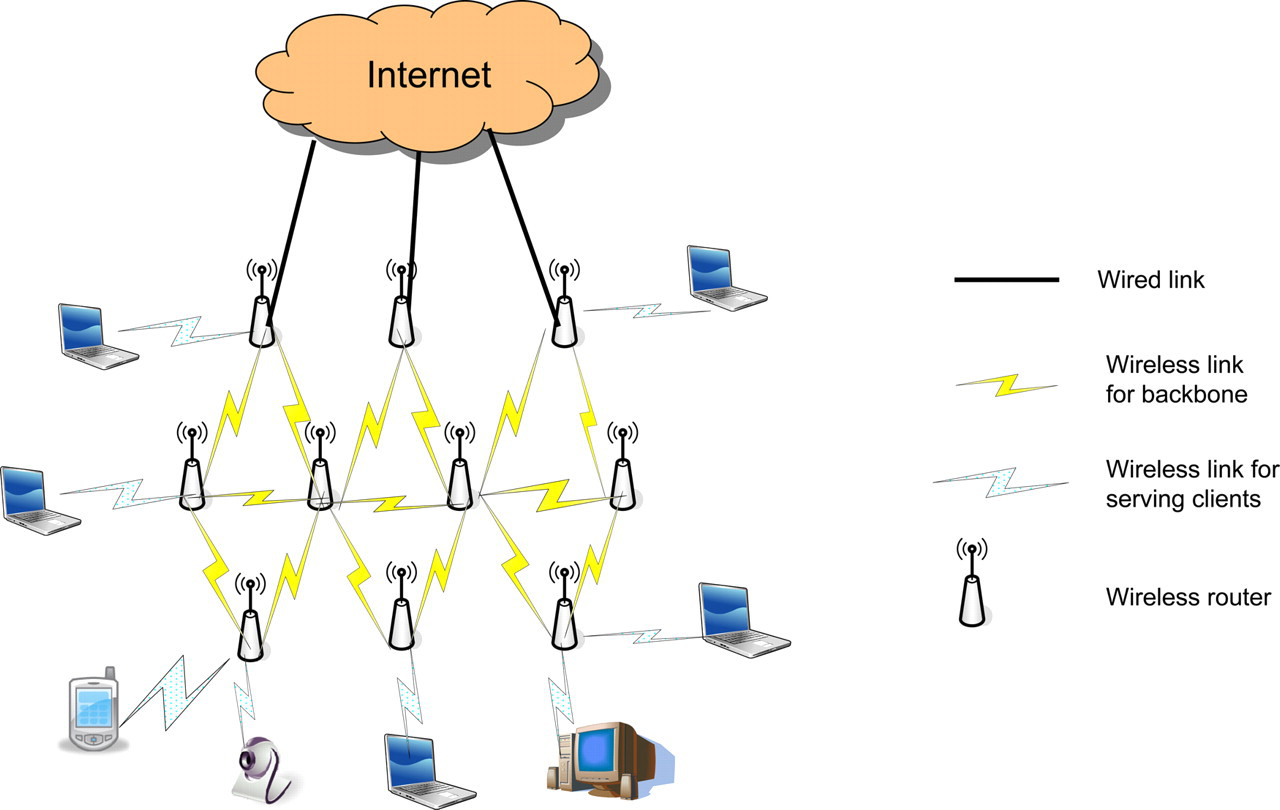
Architecture of a WMN
Figure 1 shows a three-tiered architecture. The first tier comprises the gateway wireless routers that are connected to the Internet as a network gateway. This is similar to a traditional WLAN. The second tier comprises the repeater wireless routers that extend the network coverage and form the mesh network backbone. The most important characteristic is that these wireless routers can form and manage the network automatically. The users, who may be static or mobile, can associate with any wireless router to form the third tier. The users can communicate with other users across the Internet via network gateways and with each other within the same WMN.
The above architecture inherits the characteristics of a high bandwidth WLAN and the intelligent organization of an ad hoc network. In summary, there are three key characteristics:
self-organization, self-management and self-healing: each node works out the routing itself to form the network automatically. When any node in the network fails, other nodes will remove the routes to it and establish new routes to automatically manage the network; dynamic changes in network topology: because of the self-organization of the network, the mesh topology changes dynamically when nodes are added, removed, replaced or relocated; scalability: to increase the size of the network, more nodes are added. The routing configuration is automatic, and there is no exponential rise in complexity as the network grows. less need for Internet gateways than conventional WLAN networks; large coverage area; rapid deployment. Establishing a network does not require extensive cabling to be laid; lower cost of infrastructure than a wired network; high reliability and robustness. Each node is connected to several other nodes and if one drops out of the network, its neighbours simply find another route. Users can always find a route to keep connected; the ability to configure routes dynamically.
The above architecture of a wireless mesh network has several advantages, including:
Current WMNs provide a very high level of performance in terms of bandwidth and delay by using two or more radio signals. The latest results from a dual-radio WMN show that the bandwidth fell by about 15% after first hop, but was stable after further hops.
9
This guarantees the broadband access throughout the network and provides high-speed data transmission for multimedia services. The delay also remained within a few milliseconds after three hops, thus guaranteeing smooth delivery of VoIP services.
Applications in telemedicine
WMNs may be useful for wireless telemedicine because of the intelligent and scalable organization of the network, high bandwidth network access and low-cost operation. Several projects have demonstrated the value of operating wireless mesh networks in hospital, 10 community patient management 11 and disaster care. 12
One successful wireless telemedicine project which uses wireless mesh technology is the Emergency Room Link (ER-LINK) in Tucson, Arizona, USA. 13 The first phase of the project was designed to improve the management of trauma. A video camera on the outside of each ambulance and one in each patient compartment transmitted realtime video pictures of a patient's condition, patient data and images such as ECG information, vital signs such as blood pressure readings, and other critical care information. These data were transmitted from a moving ambulance to telemetry units at a trauma centre through wireless mesh technology with radio receivers attached to traffic signals or street lights.
The aim of the technology was to allow the hospitals to mobilize their response to trauma based upon what they could see in the patient from the field. The medical experts could see and talk to the patient and view the accident scene. The live video on an accident scene showed the degree of damage to the vehicles and how that mechanism was transferred to the patients. Thus there was a better look at what the paramedics saw in the field. The primary advantage of the technology was the ability to better prepare the hospitals for the patients they were about to receive.
Another telemedicine project, called the AirJaldi network, was implemented in Dharamsala in northern India. 13 The network has eight long-distance directional links ranging from 10 km to 41 km with 10 endpoints. In addition, the network has over 100 low-cost consumer access points that use a variety of outdoor antennas. Three of the nodes are solar-powered relay stations at remote places. All other antennas are installed on low-cost masts less than 5 m in height; the masts are typically located on the rooftops of subscribers. The network provides Internet access and VoIP telephony services for teleconsultation to about 10,000 users within a radius of 70 km in rural mountainous terrain.
Future expectations
Although WMN is a relatively new technology, it is developing very quickly. Wireless broadband networks based on mesh technology have been deployed in many cities around the world. Recent developments in 802.11n technology provide bandwidth of up to 248 Mbit/s and 802.16 (WiMAX) technology for longer distance networking of tens of km. These technologies can be easily integrated into a mesh architecture to provide high bandwidth and large area wireless broadband services. Health-care providers can use this infrastructure for telemedicine. What we may now see is a shift from mobile communication and satellite systems for wireless telemedicine to the use of wireless networks based on mesh technology, since the latter are very attractive in terms of cost, reliability and speed.