




Abstract
We conducted a pilot telerehabilitation study with post-stroke patients with arm motor impairment. We compared the degree of satisfaction of patients undergoing a virtual reality (VR) therapy programme at home (Tele-VR group) to satisfaction experienced by those undergoing the same VR therapy in a hospital setting (VR-group). The rehabilitation equipment used a 3D motion tracking system to create a virtual environment in which the patient's movement was represented. In tele-therapy, the patient equipment was installed in their homes, connected to the hospital by four ISDN lines at a total bandwidth of 512 kbit/s. Rehabilitation data were transmitted via one line and videoconferencing via the other three. Ten patients with mild to intermediate arm motor impairment due to an ischaemic stroke, were randomized into VR or Tele-VR groups. A questionnaire was used at the end of treatment to measure each patient's degree of satisfaction. Tele-VR treated patients showed median values equal to or higher than the VR group patients in all 12 items investigated, except one. In motor performance, the Tele-VR group improved significantly (P ≤ 0.05), while the VR group showed no significant change. Patients assigned to the Tele-VR group were able to engage in therapy at home and the videoconferencing system ensured a good relationship between the patient and the physical therapist whose physical proximity was not required.
Introduction
Telerehabilitation can be defined as the use of communication technologies to provide rehabilitation services at a distance. 1–3 Restorative telemedicine has already been trialled in a variety of medical-related interventions at a distance, including clinical assessment, counselling, adequate care planning, education of professionals and caregivers. 4–10 The results of previous studies predict an earlier discharge from the rehabilitation hospital, the possibility of treating outpatients living far from rehabilitation facilities, and the opportunity of providing home-based long-term therapy. 1,3,11
However, various medical and technical problems in telerehabilitation need to be solved before it can be used for disabled people. Remedial efficacy, technical reliability, user-friendliness of equipment, cost-effectiveness, data protection and patient satisfaction are matters that have either been ignored or given only cursory attention.
Satisfaction is an important indicator of the efficacy of therapeutic interventions and a high level of satisfaction improves the patient's motivation to engage in rehabilitation aimed at restoring abilities that have been compromised by brain lesions. 12 The degree of satisfaction has been determined in patients practising physical therapy, but has been given scarce attention in those exploiting telemedicine applications such as telecounselling, teleneurology and teledermatology. To our knowledge, satisfaction with telerehabilitation has not been studied previously. 13–15
We conducted a pilot virtual reality (VR) telerehabilitation study with post-stroke patients with arm motor impairments, who were living in the community. 11 We compared the degree of satisfaction of patients undergoing the telerehabilitation VR therapy programme (Tele-VR group) to satisfaction experienced by those practising the same VR therapy in our rehabilitation facility (VR-group).
Methods
We selected 10 patients with mild to intermediate arm motor impairment, due to an ischaemic stroke in the area of the middle cerebral artery and without cognitive problems that could interfere with comprehension. Using simple randomization, the subjects were assigned to two different groups of five patients. Three men and two women carried out a VR rehabilitation programme with the physical presence of a therapist (VR group). Their mean age was 65 years (SD 11) and the mean interval from stroke was 13 months (SD 2). Two men and three women performed the same rehabilitation treatment at home (Tele-VR group). Their mean age was 53 years (SD 15) and the mean interval from stroke was 10 months (SD 3). In the tele-therapy group, the patient–therapist interaction was facilitated by a videoconferencing unit beside the telerehabilitation equipment (Figure 1). The same physical therapist managed the rehabilitation sessions for both groups while the examining physician was blind to the type of treatment given and evaluated arm motor performance in all patients, both before and after therapy.
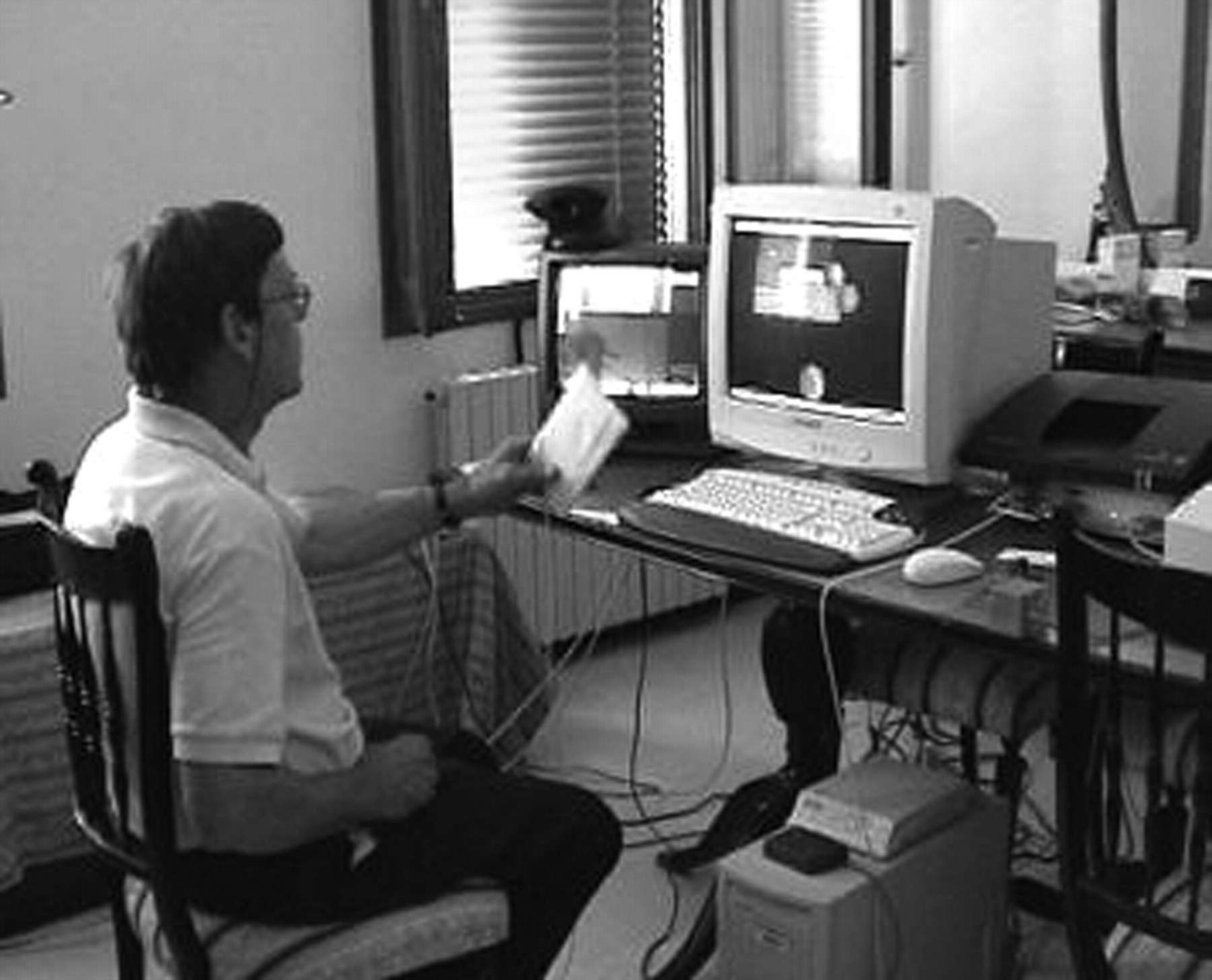
Home telerehabilitaiton equipment
All patients underwent one hour of rehabilitation daily for about one month and a satisfaction questionnaire was then mailed to the patients. Written consent was obtained from all participants and the study was approved by the local ethics committee.
VR rehabilitation
The technical and the theoretical basis of the VR and Tele-VR rehabilitation has been described elsewhere. 11,16 In brief, treatment at the hospital was provided by a workstation equipped with a 3D motion tracking system (Polhemus 3Space Fastrak, Vermont, US) which recorded the patient's arm movements. This system generated a virtual environment in which the patient's movement was represented. The therapist created a sequence of virtual tasks for the patient to complete with the compromised arm. During the performance of these tasks, the patients could see their movement trajectory on a computer screen, together with an ideal trajectory pre-recorded by the therapist. Hence, the VR system provided visual feedback involved in motor learning, i.e. knowledge of performance and of results.
The Tele-VR therapy was the same for each patient. The patient–therapist interaction was conducted via two PCs, one located at the patient's home and the second at the hospital. The same set of patient equipment was used in the five different patient homes. The data connection used a TCP/IP protocol via an ISDN connection at a data rate of 128 kbit/s. The telerehabilitation software also managed the patient's PC console by remote control. A high quality videoconference system permitted monitoring of the rehabilitation sessions using three ISDN lines at a data rate of 384 kbit/s. We installed three ISDN lines to each patient's home for the videoconference plus another line for the rehabilitative data transfer. In the Tele-VR therapy group, patients and their relatives were briefly trained to operate the Tele-VR system, even though the equipment was entirely controlled from the remote hospital workstation.
Outcome measures
We used a multidimensional, disease and treatment specific satisfaction questionnaire. The questionnaire, derived from a validated scale measuring patient's satisfaction with physical therapy, was modified to suit VR and Tele-VR treatments. 17 Our version of the satisfaction questionnaire investigated the patient's attitude towards the VR or the Tele-VR therapy (items 1–3), the patient–therapist relationship (items 4–10) and global opinion about the treatment performed (items 11 and 12). Each item was measured with a Likert scale ranging from 1 (strongly disagree) to 5 (strongly agree) which represented the patient's judgment in response to specific assertions.
In addition to the satisfaction assessment, patients underwent a clinical evaluation of arm motor performance, according to the Fugl-Meyer scale, Upper Extremity (Fugl-Meyer UE) score. 17
The chi-squared test was used to evaluate the difference in the level of arm motor impairment between the patients allocated to the two treatment groups, at the beginning of the study. The Mann-Whitney U test was used to evaluate the significance of the difference of each item-score between the two treatment groups. The Wilcoxon test was used to determine the significance of the differences in the Fugl-Meyer UE mean score before and after the treatment.
Results
All patients completed the assigned rehabilitation programme and all of them completed the questionnaires they had been given. There were no significant differences in the level of arm motor impairment (Fugl-Meyer UE score) between the two groups at the start of the study (chi-squared = 0.8, P ≤ 0.05) which confirmed homogeneity of the sample from the motor perspective.
The questionnaire item-scores for each patient belonging to the two treatment groups are shown in Table 1. Tele-VR treated patients showed median values equal to or higher than the VR group patients in all items investigated, with the exception of item number 9. In this item, the median value was 3 for the Tele-VR group, whereas the VR-Group had a median score of 4.
Questionnaire responses
1 = strongly disagree; 2 = disagree; 3 = neutral; 4 = agree; 5 = strongly agree
There was a significant intergroup difference only for item number 5: ‘the therapist thoroughly explains the treatment(s) I receive’ (Mann-Whitney U = 2.50, P ≤ 0.05). In motor performance, the Tele-VR group improved significantly in the Fugl-Meyer UE mean score from 51.2 to 56.6 (Z = –2.0, P ≤ 0.05), while the VR group showed an improvement in the Fugl-Meyer UE mean score from 49.4 to 56.0, which was not significant (Z = −1.8, P ≤ 0.05).
Discussion
In the present study we assessed the degree of satisfaction with care in post-stroke patients undergoing a programme of VR rehabilitation therapy. Satisfaction represents an aspect of the patient's motivation to persist with treatment in an attempt to regain function. 12,18 Previous studies of patient satisfaction with a range of telemedicine applications have suggested that teleconsultation is acceptable, but there is limited information about satisfaction in telerehabilitation. 19
To measure satisfaction we used a 12-item questionnaire that was modified from a version used in previous studies. The earlier version evaluated satisfaction with physical therapy for a variety of clinical conditions, but not for post-stroke patients undergoing a programme of VR and Tele-VR treatment. Such treatment is largely based on the patient–machine–therapist interaction. At first there may be obstacles to the successful establishment of this triangular interaction which consequently may not be immediately acceptable to the patient. Therefore, the first three items of the questionnaire were designed to investigate the subjects' satisfaction with the technology. The following seven items examined the patient–therapist relationship which, reportedly, was strongly associated with the quality of perceived care. In particular, we aimed to assess how the presence or absence of the therapist affected patient satisfaction in the VR sessions as compared to patient satisfaction experienced in the Tele-VR sessions. In accordance with previous surveys investigating satisfaction with physical therapy, the last items evaluated the overall feeling of the patients about the rehabilitation programme. This part of the evaluation included an assessment of the level of patient satisfaction with the technology and the assistance given. 12,18,20
The main finding of the present investigation was of similar satisfaction in the two groups of patients treated with VR and with Tele-VR therapy. There were no differences between groups in almost all the item-scores exploring comprehension of treatment, user-friendliness of the equipment and the patient–therapist relationship. The only significant difference was confined to the item ‘the therapist thoroughly explains the treatment(s) I receive’. In this item the Tele-VR group mean score was significantly better than that of the VR group. This may have been due to the fact that the physiotherapist tended to go into greater detail while training the Tele-VR patients because the telemedicine interaction allowed only verbal instructions for the description of motor tasks. In addition, the patient–physiotherapist interaction may have been enhanced by the videoconferencing system because it was an interactive one and not a store-and-forward interaction. The above difference does not alter the observation that the patients in the Tele-VR group perceived the services provided with the same satisfaction as the patients in the VR group. This view is also supported by the fact that the last two item-scores measuring general satisfaction were almost the same in the two groups.
We attributed the improvement of arm motor performance of all patients to the rehabilitation strategy, which was the same in both groups. This rehabilitative approach (reinforced feedback in a virtual environment) was based on the amplification of salient visual information presented to the central nervous system in order to promote motor learning. Visual information is expressed by the ‘knowledge of performance’ and the ‘knowledge of results’, that are supplied by the VR rehabilitation system. 11,16 Our findings appear to support a clinical rationale focused on visual feedback.
The present work was a pilot study with a small number of subjects. We analysed the degree of patient satisfaction which was high in both groups, but the results may be viewed as preliminary data in this field. The results indicate that the patients assigned to the Tele-VR group were able to engage in therapy at home by means of a user-friendly system. The data confirmed that the videoconferencing system ensured a good relationship between the patient and the physical therapist whose physical proximity was not required.
The above observations, along with the previously reported clinical efficacy of telerehabilitation, 9,11,21,22 support the need for a trial in a larger group of post-stroke patients in order to provide effective therapy for reducing motor deficits of the upper arm. At present, we are conducting a randomized controlled study using a new telerehabilitation system. This consists of integrated tele-therapy and web-based videoconferencing equipment suitable for low-cost Internet connections. 23
Footnotes
Acknowledgements
The project was supported by the Veneto Region, Italy.