




Abstract
We have developed a mobile pharmacy service system (MPSS) to deliver individualized pharmaceutical care via text messages sent to the mobile phones of patients. The text messages were: (1) reminders about medication – from the day following discharge, reminder messages were automatically sent to patients approximately 10 minutes before their medication was due to be taken. The system stopped sending messages when the prescription ran out and suggested that patients should come to hospital to renew any prescribed medicines; (2) practical information about medicines, such as information about methods of administration; (3) information about adverse drug reactions. In a 3-month trial in a general hospital, 100 patients were provided with pharmaceutical care using the MPSS for an average of 3.5 medicines per patient (range 1–9). They received pharmaceutical care for an average of 12 days per patient (range 3–19). A survey was then conducted which indicated that most patients were satisfied with the pharmaceutical care provided by MPSS through text messages, and that they had positive attitudes despite some limitations. The use of the MPSS should improve pharmaceutical care, widen the knowledge of pharmacists, reduce the burden on pharmacy staff, improve pharmacist–patient interaction, and improve the effect and safety of medication.
Introduction
Pharmaceutical care is the integration of pharmacy knowledge, skills and attitudes with the aim of providing the best patient care and therapeutic outcomes in various settings ranging from health-care institutions to the home. Many factors affect therapeutic outcomes, such as medication compliance, especially for patients out of hospital. Some 20–50% of patients do not adhere to therapy, and medication compliance in patients who have left hospital is particularly unsatisfactory. 1 In addition, patients often have concerns about their medicines, so there is a strong demand for professional consultation. In a large country like China, telemedicine may be useful in facilitating individualized pharmaceutical care and encouraging good compliance through better pharmacist–patient interaction.
Mobile phones have become easily available and highly popular since the 1990s. The short message service (SMS), in which text messages are sent and received by mobile phones, is increasingly being used for access to information. There are many reports of the use of the SMS in medicine. It has been used for patient reminders, psychological support, chronic disease management, behaviour modification, reporting of critical medical events or laboratory results and even for surveys. 2–9
We have developed a mobile pharmacy service system (MPSS) to deliver individualized pharmaceutical care via the SMS, with the aim of improving medication compliance and safety.
Methods
A pilot study was conducted in three phases.
Phase one
In the first seven months of 2007, a mobile pharmacy service system (MPSS) was developed. MPSS is an SMS-based system which can be run on a computer and facilitates pharmaceutical care by sending mobile phone text messages to patients. It was designed to fulfil four functions:
to allow pharmacists to input, browse, query, inspect, modify and store medication information; to allow medical staff to browse the evidence-based drug information database and update it rapidly; to extract medication information and generate various kinds of text message automatically; to send text messages to patients' mobile phones automatically at predefined times, and to receive text messages and save them in a database for subsequent browsing.
The MPSS comprised a pharmaceutical care database, a database application system and the SMS equipment which was linked to a computer. In order to set up the pharmaceutical care database, we collected the evidence-based drug information for our hospital formulary by searching drug instruction sheets, the MIMS Reference System and the Micromedex Healthcare Series information resource.
In China, the limit of a text message is 70 Chinese characters or 140 English letters. If the number of characters exceeds this limit, an SMS message will be automatically divided into pieces before transmission. Because of the length limit, any evidence-based drug information to be transmitted by SMS must be simple, practical and easily understood. Such information mainly includes administration methods, common adverse effects and precautions. For example, precautions might include the relationship between medication and food intake, whether the drug would affect driving, whether food and drink could be taken at the same time, what were appropriate antidotes in the case of over-dosage and so on.
The database applications involved the main MPSS program, which could execute operations such as data input, editing, modification and query, collect relevant medication information, generate text messages with a certain format and drive the SMS equipment to send out text messages at the predefined time.
Phase two
After the MPSS had been developed, it was trialled in a general hospital. The trial was approved by the appropriate ethics committee and subjects were fully informed about the trial. Hospitalized patients were recruited during a 3-month period starting in August 2007. After a period of treatment in hospital, patients were discharged and required to take their medicines. Our pharmacists introduced the MPSS to patients prior to discharge, and recruited them into the trial with their agreement.
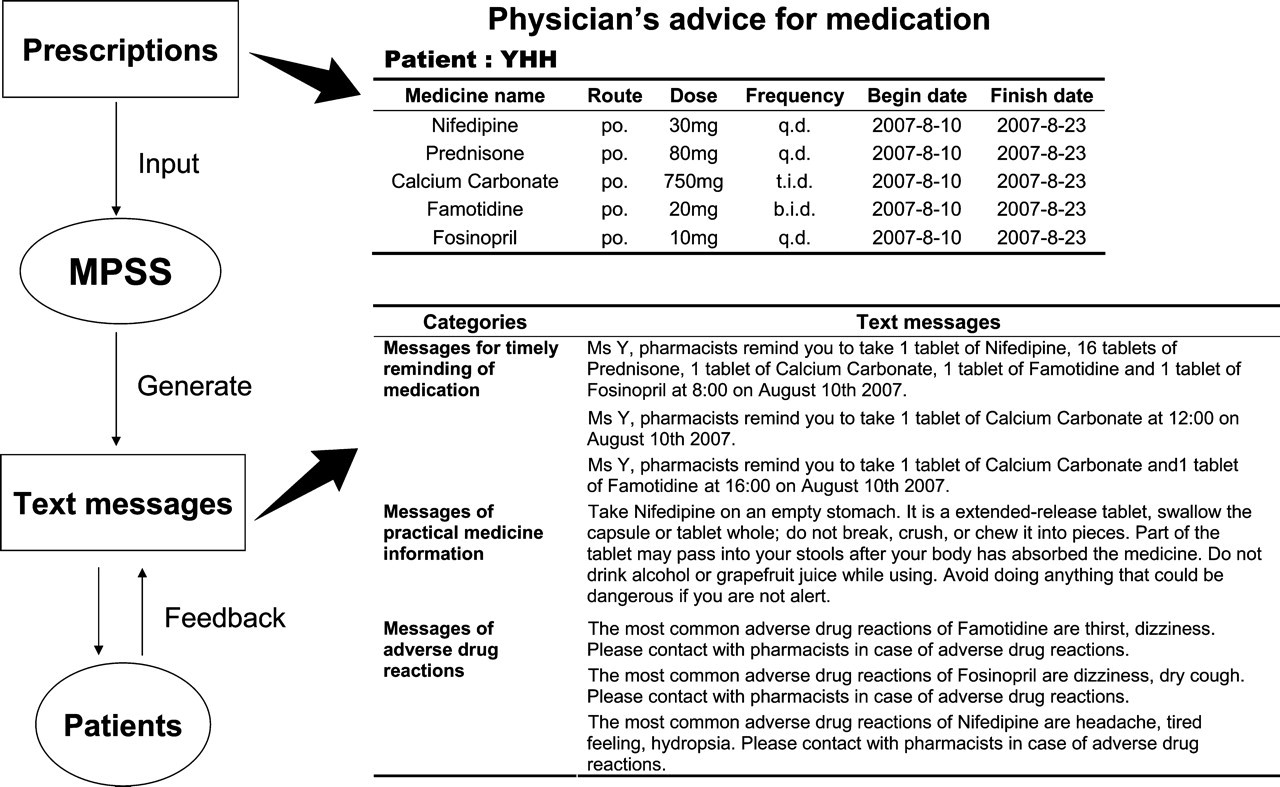
The participants' medications were recorded in the MPSS in accordance with their physicians' advice. Each day following discharge, the system checked information about the patients' prescriptions, generated corresponding text messages and sent them to the patients automatically. The text messages were:
reminders about medication. From the day following discharge, reminder messages were automatically sent to patients approximately 10 minutes before their medication was due to be taken. The system stopped sending messages when the prescription ran out (in China, patients generally take home no more than 14 days' dosage). The last of the messages also suggested that patients should come to hospital to renew any prescribed medicines; practical information about medicines. The MPSS sent messages about methods of administration and some precautions, with easily understood words; information about adverse drug reactions. Text messages containing the most common adverse drug reactions were automatically sent to patients. Patients were also reminded to contact a pharmacist if an adverse drug reaction occurred. MPSS flowchart
The MPSS could also receive text messages from patients. Patients used this function to report their medication status, raise questions about medications and consult a pharmacist. When the pharmacists read these text messages, they would reply to the patients by sending text messages. The information flow in the MPSS is shown in Figure 1.
Phase three
After using the MPSS, patients were surveyed. The survey was conducted using a standardized questionnaire, administered either by text message or mobile phone call. The questionnaire contained four questions:
When did you take your medicines after receiving the reminder messages? The choices were: immediately; within 10 minutes; within 0.5 h; 0.5 h or later; Which type of messages do you want to receive most? The choices were: messages for timely reminders about medications; messages about administrative matters; messages about precautions; messages about adverse drug reactions; If it became an official paid service of the hospital, how much could you afford for pharmaceutical care by text message every day? The choices were: ¥0.5; ¥1; ¥1.5 (¥1≈€0.09≈US$0.15); Please give a mark (maximum mark 100) to the pharmaceutical care you received via text messages.
Patients were encouraged to answer these questions by text message. The pharmacists telephoned any patients who did not complete the questionnaire via SMS.
Results
A total of 100 patients were enrolled in the trial. Most of them came from the departments of haematology, orthopaedics and dermatology. All patients completed the trial, i.e. none were lost to follow-up.
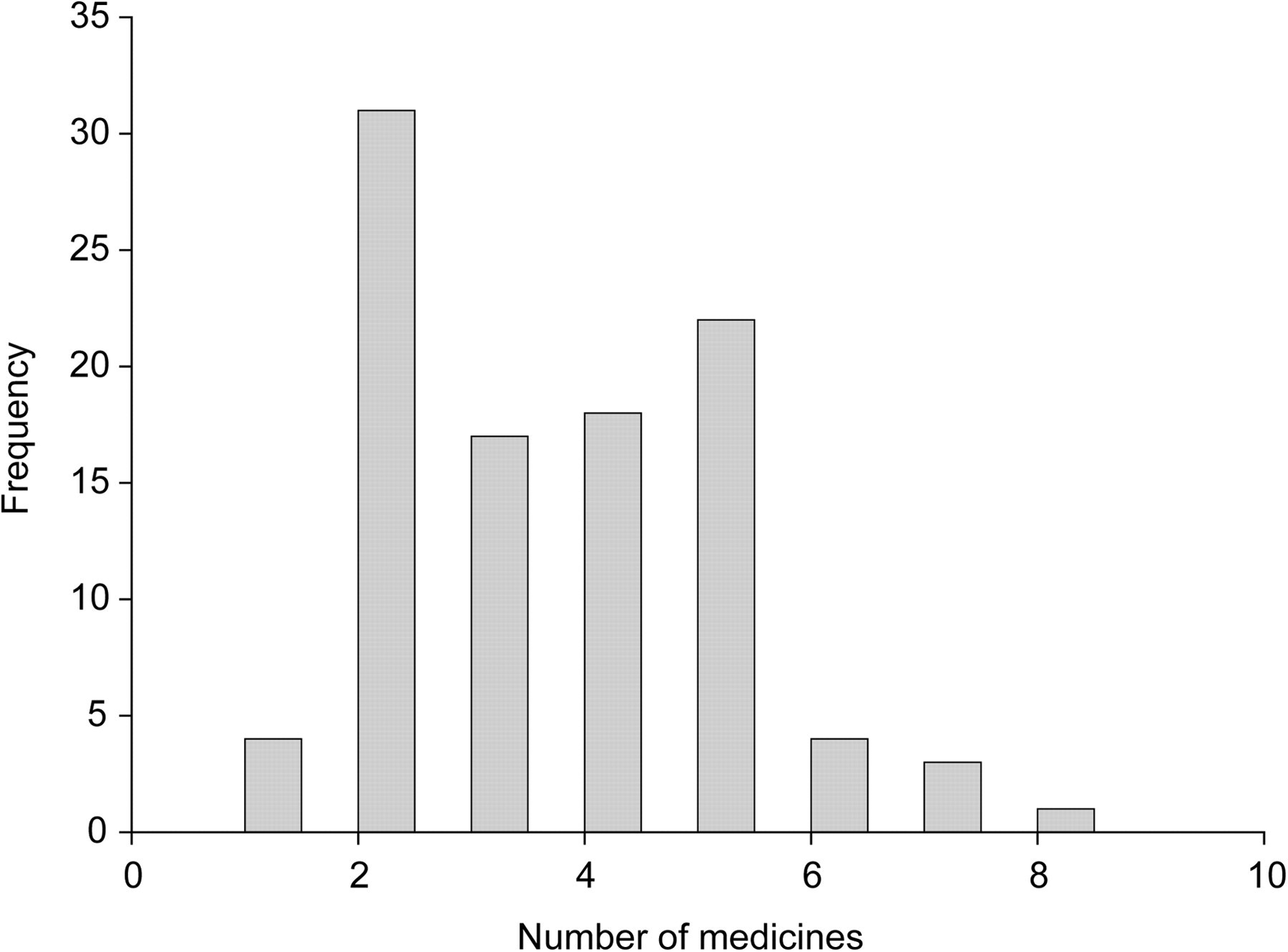
Among the 100 subjects, there were 57 men and 43 women. Their average age was 46 years (range 12–92) (Figure 2). Each patient was provided with pharmaceutical care for an average of 3.5 medicines per patient (range 1–9) (Figure 3). They received pharmaceutical care for an average of 12 days per patient (range 3–19) (Figure 4).
Patients' ages (n = 100) Numbers of medicines per patient (n = 100) Pharmaceutical care time for each patient (n = 100)

Patients' feedback and interaction with the pharmacists
Survey
Survey results (% shown in parentheses). More than one response was possible per person
Discussion
In the present study, mobile phones were used for pharmaceutical care, and pharmacists were able to provide patients with medication guidance by text message. This allowed pharmacists to extend their reach to patients who had been discharged; patients felt that through the improved access to pharmaceutical care they became more closely linked to the pharmacists. Compared with face-to-face guidance about medications, patients found that the mobile phone-based system allowed them to review and remember the guidance more clearly.
In our hospital, the pharmacists have a heavy workload: nearly 9000 prescriptions need to be dispensed each day. If SMS-based medication guidance could be substituted for face-to-face medication guidance in the future, there would be time savings for the pharmacy staff. In addition, because of the virtue of its immediacy and the high ownership of mobile phones, pharmaceutical care using text messages may be more effective than Internet-based pharmaceutical care.
During the development of the MPSS, our pharmacists set up an evidence-based drug information database, which covered more than 1200 medicines. The pharmacists were able to expand their knowledge through searching the database. The MPSS also has the potential to integrate with the hospital information system (HIS) and thus provide more effective and individualized pharmaceutical care.
Many elderly people could not be recruited into the trial despite their high demand for pharmaceutical care, because they were not able to read text messages by themselves. With the availability of voice messaging, people who are visually impaired or not able to read text messages can still receive pharmaceutical care by mobile phone. We look forward to widening the application of the MPSS for pharmaceutical care.
The survey indicated that most patients were satisfied with the pharmaceutical care provided by text messages and that they had positive attitudes to it. However, there were some unresolved problems:
for about one-third of the patients, there was an interval of more than 30 minutes between the arrival of a reminder message and the medication being due. This allowed the possibility for patients to forget about their medication during this period. This aspect could be improved in future; the survey results showed that 43% of patients wanted to receive messages about precautions. This confirmed that patients valued the information about precautions. Further work should be done to complete the evidence-based drug information database, and messages about precautions should be sent earlier than other messages; the answers to the third question in the questionnaire showed that most patients preferred low-cost pharmaceutical care by text messages, and some of them hoped for free access to it. We believe that a low cost would enable more patients to accept the service.
Telemedicine systems have been proposed for nearly two decades as a means of supporting hospitals to achieve improvement. The present study employed text messaging for pharmaceutical care and it was effective and popular with the patients. The text messages provided patients with rapid, effective medication guidance and pharmaceutical care after discharge. The use of the MPSS should improve pharmaceutical care, widen the knowledge of pharmacists, reduce the burden on pharmacy staff, improve pharmacist–patient interaction, and improve the effect and safety of medication.