




Abstract
We evaluated a care-coordination project assisted by a screen-phone to support and educate caregivers. A total of 113 caregivers of home-dwelling veterans with dementia were recruited to the study: 72 were white, 32 were African American and nine were Hispanic. Caregivers were assessed for burden, depression, coping, quality of life, knowledge and satisfaction. None of the outcome measures changed significantly after 12 months. Forty care-recipient and caregiver dyads responded to the 12-month telephone satisfaction survey. The respondents were more satisfied with the care-coordination (90%) aspect of the programme than the education (77%) or the monitoring (50%). The pilot project suggests that care coordination aided by screen-phones may be a useful model for caregiver support in a managed-care setting. A systematic study is now required.
Introduction
High levels of burden and depression have been reported in those caring for people with dementia. 1 Several strategies seem to mitigate caregiver burden and depression, including approaches that combine support, education and practical counselling about common caregiving stresses and community resources. 2 Most interventions are both resource- and time-intensive and require individualized or group sessions, leading to high rates of rejection of treatment, absences from sessions and drop-outs before completing treatment. 2,3 Time constraints and transportation have been cited as barriers to the participation of caregivers in support activities. 4
Few published studies have examined the efficacy of technology-based care-coordination interventions for individuals with dementia and their caregivers in a managed-care setting. Some telephone-based interventions such as the REACH trial have successfully used screen-phones (CTIS, computer-telephone integrated system) to provide caregivers with information, conferencing capability and links to community resources, supplemented with educational and group support sessions. 5,6
We have conducted a pilot trial of our clinical programme called Telephone-Linked Care (TLC) for dementia. This programme was modelled on the REACH programme. 5,6 TLC offered access to resources, as in the REACH trial, and also provided caregiver education and periodic monitoring questionnaires using a screen-phone. The hypothesis was that this would reduce the caregiver burden and depression of family caregivers.
Methods
Care-recipient and caregiver dyads were recruited from inpatient and outpatient settings in the Miami Veterans Affairs medical centre. Care-recipients were required to be home-dwelling veterans over the age of 60 years, with a diagnosis of dementia or related disorders (Mini Mental State Examination [MMSE] score 0–24). The caregiver had to live with the veteran; identify himself or herself as the principal person providing daily care to the care-recipient; have an existing telephone line; and be able to use the screen-phone. If the patient or caregiver was about to be institutionalized, they were not enrolled in the project. The project was approved by the appropriate ethics committee.
The intervention was delivered via a CTIS screen-phone, previously found to be well accepted by caregivers (Figure 1). 6,7 The system allowed users to make and receive calls and messages.
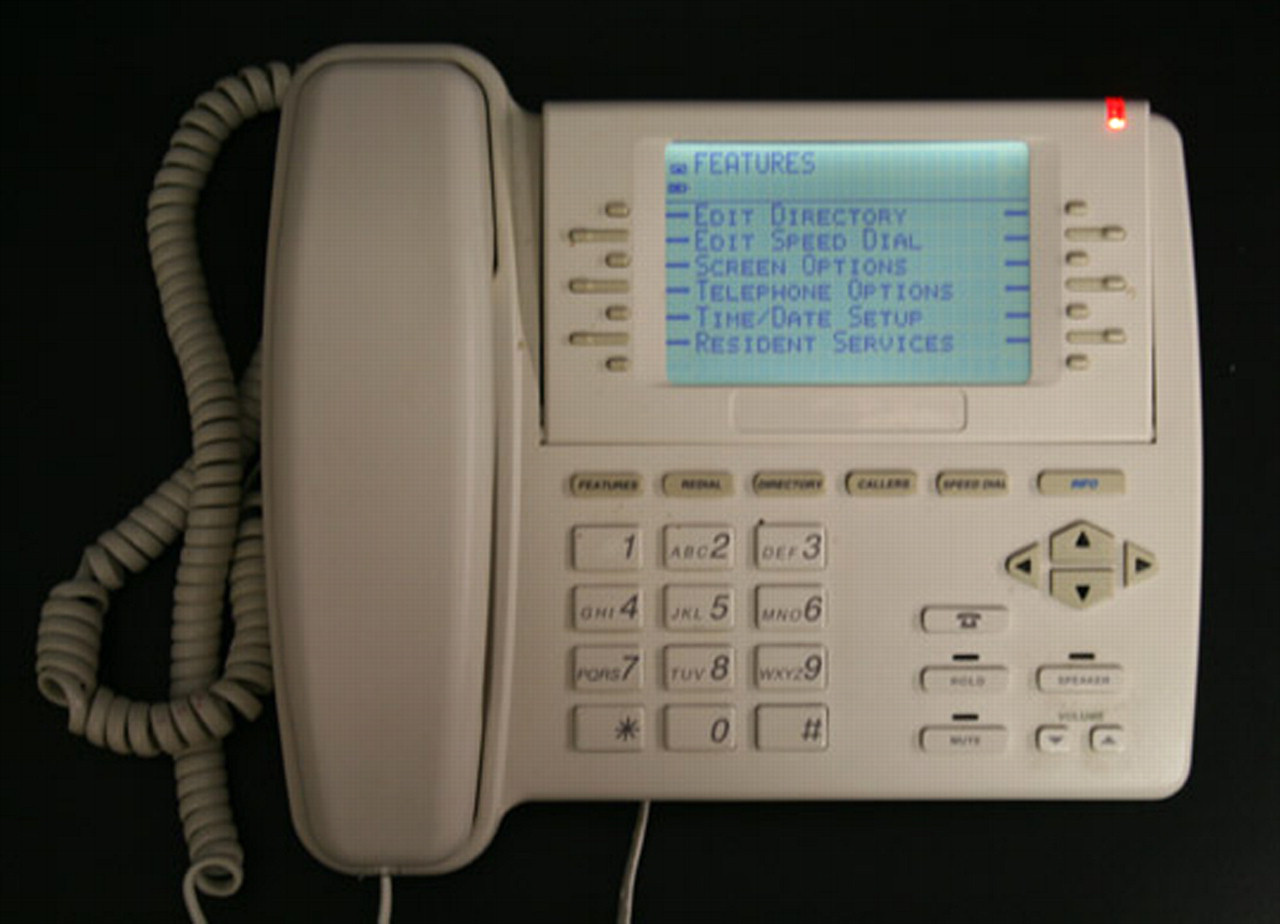
The TLC screen phone included a speakerphone, handset, base unit and display capable of showing eight lines of text
Education and monitoring
The TLC system provided communication, support, education and monitoring of caregivers, supplemented by access to the care coordinator and to a wide variety of community and VHA resources. Caregivers were able to access resources simply by pressing a button. For example, one menu option led to caregiver education on seven core competencies for taking care of individuals with dementia, which had been identified through an expert consensus process in Florida. 8 These included understanding dementia, communication, distress behaviours, understanding the needs of loved ones, promoting independence in activities of daily living, the environment, ethics and advance directives. The caregivers were asked to complete automated follow-up surveys via the TLC telephone system.
Care coordination
A nurse care coordinator and a support person were responsible for screening, patient enrolment, care coordination and data collection. Enrolment usually occurred during a visit to the home of the patient, when informed consent was obtained, the screen phone was installed and training was provided in its use. The care coordinator provided education and emotional support to caregivers and helped them with problems concerning the care-recipients, such as medication refills, appointments, coordinating care within and outside the VHA, respite and advance directives. The care coordinator was able to leave reminders for caregivers, e.g. regarding appointments. The care coordinator called the dyads at least monthly.
Care coordination was facilitated via the VA's computerized patient record system, which provided access to medical information about the care-recipients. Using the record system, the care coordinator communicated with the care recipients' providers regarding prescriptions, reminders, appointments and other matters. For urgent matters the care coordinator spoke directly to the relevant doctor.
Data
Caregivers and care-recipients were interviewed at baseline, when demographic data were collected. Caregivers were assessed for burden, depression, coping, quality of life, knowledge and satisfaction using the Zarit Burden Interview (ZBI), 9 Center for Epidemiologic Studies Depression Scale (CES-D), 10 Brief Cope (COPE), 11 SF-36, 12 knowledge about dementia and resources (local questionnaires), and a satisfaction survey, respectively. Repeat outcome surveys were collected via the screen-phone after 12 months.
The data were analysed using a standard statistical package (SPSS 14.0, SPSS Inc., Chicago, Illinois). All outcome variables were compared before and 12 months after enrolment in the programme. Analysis of variance (ANOVA) was used to compare the differences in mean ZBI scores between different ethnic groups. Repeated-measures ANOVA was used to examine the effects of TLC on caregiver burden, depression, quality of life and coping skills.
Secondary data on utilization were based on the administrative data from different VHA databases for care-recipients who had been in the TLC programme for at least six months. Data were matched and analysed for patients at six months pre- and post-enrolment in the programme.
Results
A total of 113 dyads were enrolled in the TLC programme. The majority were white (Table 1). The only significant difference at baseline was income level, which was lower in the African American (AA) patients compared to the white patients.
Baseline demographic profile of caregivers and their patients
*The mean difference in patient average annual income between AA and white patients, and between AA and Hispanic patients, was significant (P = 0.004 and 0.012, respectively)
Outcome variables at baseline and 12 months
Sixty of the 113 dyads (53%) performed 12-month assessments. The others were not assessed because of staffing problems or because the patient/caregiver refused. The mean ZBI scores for white patients were significantly higher than the mean ZBI scores of the AA patients, both at baseline and 12 months (P = 0.008) (Table 2). The mean ZBI score did not change after 12 months. Although not significant, the depression (CES-D) scores of whites were higher than those of AA patients at both time-points. For other measures – the COPE, SF-36 and local questionnaires on dementia knowledge and community resource scores – there were no significant ethnic differences in the mean scores and no significant change in the scores at 12 months (Table 2).
Outcome variables by ethnicity at baseline and 12 months
CES-D = Center for Epidemiological Studies Depression Scale; COPE = Brief COPE; SF-36 = Short-Form Health Survey 36; MMSE = Mini Mental State Examination; IADL = instrumental activity of daily living
*One-way ANOVA showed that the mean difference in burden between AA and white patients was significant (P = 0.008)
†The SD was zero because data were available from only one patient or caregiver. Collecting the MMSE was not possible by telephone. Most other sample sizes were as indicated at the top of each column, especially for burden and depression. SF-36 scores were collected most diligently, since those were mandated by the Veterans Integrated System Network (VISN)
There were no significant differences between ZBI, CES-D and COPE scores at baseline and 12 months. The baseline to 12-month ZBI score showed a 0.80-point decrease. Baseline to 12-month score CES-D showed a 0.1-point increase. Baseline to 12-month COPE score showed a 1.2-point decrease.
Satisfaction
Forty dyads responded to the 12-month telephone satisfaction survey. The respondents were more satisfied with the care-coordination (90%) aspect of the programme than the education (77%) or the monitoring (50%). Eighty-five percent of respondents felt that the screen- phones were reliable and easy to use. Approximately 75% believed that the programme improved communications with their VA providers and helped them feel more secure, while 92% said they would recommend the programme to other veterans.
Health-care utilization
Secondary data on utilization were analysed for 81 patients who had been in the programme for six months. Hospital admissions were reduced from 18 admissions to 11 and hospital bed-days of care were reduced from 282 to 71. Clinic visits decreased from 1614 to 798 and emergency-room visits decreased from 32 to 17. However, the number of outpatient prescriptions increased from 2180 to 2303. The total facility cost for the 81 patients in the six months pre-enrolment was $718,881, which decreased to $364,046 in the following six-month period. The average facility cost per TLC patient decreased from $8875 to $4494 ($1 ≈ €0.71).
Discussion
The present pilot project suggests that a care-coordination intervention assisted by technology may help to stabilize both burden and depression in multiethnic dementia caregivers. It may also be a suitable model for enhancing access and improving user satisfaction, while potentially reducing health-care utilization in dementia patients in a managed-care setting. 13 The use of screen-phones to provide most of the education and monitoring for caregivers of veterans with dementia is, to our knowledge, the first such demonstration in a real-life clinical setting. 7,14 Caregivers accepted the intervention well but used the technology sparingly. Based on the survey responses, caregivers were more satisfied with the coordination aspect of the programme than the technology aspect.
There was no change in the caregiver burden or depression scores from baseline to 12 months. This lack of change is consistent with most evidence from other caregiver interventions, including large multisite trials like the MADDE trial. 15–17 In contrast, some previous studies have reported an increase in caregiver burden over time in the control group. 2,18 Similar increases have been reported in caregiver depression scores. 2,18 Other studies have shown that while caregiver depression levels for the control group increased, depression remained stable in the caregivers in the intervention group. 19 Therefore, no change in the level of caregiver burden and depression during a 12-month period may be evidence of an effective intervention.
Caregivers showed no improvement in knowledge. This may be because the caregivers predominantly used the screen-phone to contact the care coordinator, and not for information retrieval. However, the positive satisfaction results demonstrated that the availability of the care coordinator assisted by technology, irrespective of usage, can have a positive effect on caregiver satisfaction as they may feel that the health-care system is watching over them. 20
Limitations
The present study suffered various limitations, including the lack of a control group. Hence, it could not be definitively determined if the stabilization of depression and burden was related to the intervention or to other factors (e.g. a ceiling effect or more experience as a caregiver). Second, many possible variables could not be collected due to the reluctance of the caregivers to answer the surveys, the frail nature of the dementia population and limited staff. The number of non-responders raises the possibility of responder bias. To examine this possibility, we compared characteristics of the baseline sample of 113 dyads to the 60 responders at 12 months and found no significant differences between the two groups in key demographic or clinical characteristics.
Because screen-phone use was limited, no conclusion could be drawn about usability in specific ethnic or income groups, or about the effect of the use of the technology and the frequency and duration of contact with the care coordinator. The VA, though similar to other large managed health-care settings, differs in some ways, which may limit the generalizability of the model. The lack of significant findings may be due to an under-powered study. Although a preliminary economic analysis showed that such a programme may result in cost savings, a formal cost-effectiveness analysis of the intervention remains to be performed.
Future work
Although the TLC technology was available on demand, its use by the caregivers to access educational information or respond to questionnaires was rather low: approximately 80% of dyads made six or fewer calls and used the screen-phone for less than 30 min. We believe that caregivers appreciate the help provided by such a care-coordination programme, but are often too busy to engage in any activity that is not mandatory and not perceived to provide them with immediate benefits. When a dementia caregiver is dealing with a patient having a specific difficulty, they may be too busy to access the resource.
The use of the technology might be improved by integrating it into the care-coordination process. This might be done by making its use scheduled; increasing the frequency of reminder phone calls; increasing the reinforcement effort by the care team; supplementing tele-education with written educational material; regularly adding new material to maintain caregiver interest; and pairing education with mailing and monthly care-coordinator contact. Intensive training and support of both caregivers and the care-coordination team are known to be important for full utilization of such technology. 7,20
The pilot project suggests that care coordination aided by screen-phones may be a useful model for caregiver support. A systematic study is now required.
Footnotes
Acknowledgements
We thank Dr Bernard A Roos, Dr Enrique J Aguilar, Dr Jorge G Ruiz, Annette Portales, Elba Maymi, Geetanjali Kelkar and Virginia Roos. We also thank Drs Sara Czaja, Mark Rupert, Adam Bank, Sankaran Nair, Pat Ryan, Sarita Figueroa and Steve Emory. Part of this work was presented at AGS annual meetings and at the 2007 VHA Annual Care Coordination and Caregiver Forum.