




Abstract
We developed a virtual clinic to assist patients who use insulin pumps in the management of their diabetes. The virtual clinic offered access to information, communication with health professionals and interaction with peers. Seventeen patients were recruited from three hospital clinics. Participants completed questionnaires before and after using the clinic for a six-month period. Usage was initially high but then declined. In the first two months 1691 page-views were recorded, but in the final two months only 355 page-views were registered. Users found participation reassuring. They rated peer interaction as the most desirable and the most useful of the features available. Using an Internet-based clinic to support the self-management of diabetes is feasible and acceptable to patients.
Introduction
The Internet has created new opportunities for health-care provision, including aiding patients in the self-management of diabetes. In the UK there are about two million people diagnosed with diabetes and approximately 1% of people with type 1 diabetes use insulin pumps. 1 Insulin pump therapy is a method of administering insulin continuously to the patient via a needle inserted under the skin. 2 Recent Internet interventions to support the management of diabetes have shown feasibility and effectiveness but are often based on complex systems. 3–5 We have developed a pre-existing virtual clinic system specifically for insulin pump users following extensive stakeholder consultation 6 and preliminary testing. 7 We report here on user satisfaction and usability of the Internet-based virtual clinic.
Methods
The virtual diabetes clinic offered three main functions: access to information, communication with health professionals and interaction with peers. Information on diabetes was provided on the site and via web-links to relevant sources, such as Diabetes UK. 8 Participants were able to communicate with their own health-care professionals through email links and with other diabetes specialists through a series of ‘ask an expert’ sessions. Interaction with peers was available through discussion boards. For the purposes of a pilot study, 17 participants were recruited from three hospital clinics. The inclusion criteria ensured that all participants were over 18 years of age, had used an insulin pump for at least six months, could communicate effectively in English and self-reported a basic computer literacy. Prior to using the virtual clinic participants were asked to complete a questionnaire regarding their expectations of the system. After using the clinic for six months a questionnaire was completed on satisfaction and usability. Usage statistics were recorded in page views per month. Approval for the study was obtained from the appropriate ethics committee.
Results
Of the 17 patients who joined the virtual clinic, 12 (71%) completed both questionnaires. One patient withdrew from the clinic and four patients did not complete the post-test questionnaire. The age range of participants (6 males and 11 females) was 22–70 years. The mean length of time with diabetes was 24 years (SD 14). In terms of Internet use, 11 (65%) used the Internet everyday and most used it more than once a week.
Usage
Participants' expectations of the system were that they would use it regularly, with 14 (82%) anticipating that it would be used at least weekly. However, according to post-test questionnaires this was only true for 50% of users.
The system usage statistics showed that use of the virtual clinic declined over time. In the first two months 1691 page-views were recorded, in months three and four this decreased to 1159, and in the final two months only 355 page-views were registered.
Usefulness
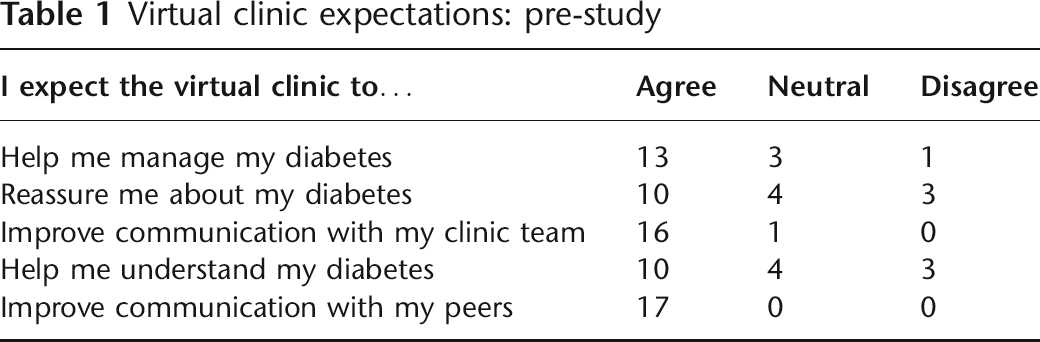
Before the study participants were asked to list the features of the virtual clinic they expected to be most useful. Nine (53%) listed interaction with peers, seven (41%) listed communication with health-care professionals and only four participants (24%) listed access to information. In general, participants expected the virtual clinic to help them manage their diabetes, reassure them about their diabetes and help them understand their diabetes (Table 1).
Virtual clinic expectations: pre-study
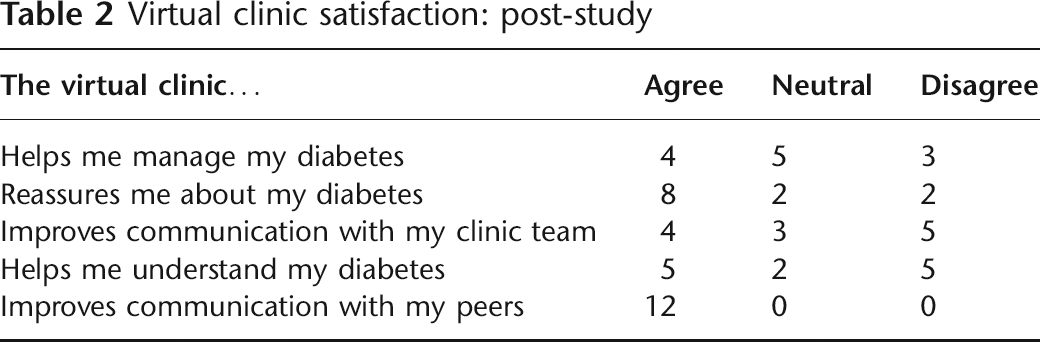
After the study, the majority of participants stated that they had joined the clinic to facilitate interaction with peers and this had been the most useful component. Although participants found participation reassuring there was no consistent finding regarding the effect of the virtual clinic on their diabetes self-management (Table 2).
Virtual clinic satisfaction: post-study
Usability
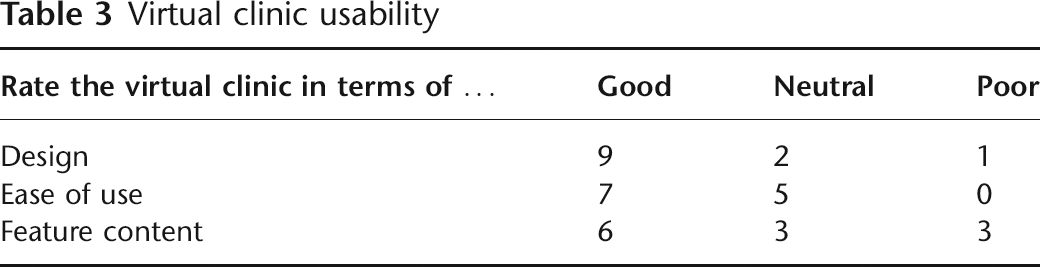
There was better agreement about usability with users rating the virtual clinic highly in terms of design, ease of use and feature content (Table 3).
Virtual clinic usability
Discussion
Usage of the virtual clinic was not as high as expected prior to the study and declined over the subsequent six months. This is a common characteristic of Internet-based health interventions as participants have the option to discontinue use very easily or to use the system sparingly. 9 We found that there was high usage in the first two months and then a phase of gradual decline. This may indicate that the system did not meet patient needs or became less helpful, engaging or relevant over time. The small sample size may also have had a critical effect. It is likely that a minimum number of active users is required to sustain a system such as this, particularly the discussion forums.
It was anticipated and agreed by users that interacting with peers was the most useful component of the virtual clinic. This is promising as it has been shown that involvement in peer discussions promotes behaviour change and self-care. 10 Peer discussions are likely to be the reason why users gained reassurance from using the virtual clinic. One user commented in their questionnaire that ‘It was comforting to find out that other people found it just as difficult as I do sometimes’. It has been shown that peer support can reduce feelings of isolation and loneliness for patients. 10
Developments are needed to improve users' communication with health-care professionals. It is not clear why these links were unsuccessful in the pilot study; perhaps the users simply did not have a need for them. Most users had been diagnosed with diabetes for a substantial period of time so would have had considerable experience of self-management and been well informed about their condition. The positive feedback we received indicated that the system was effective for straightforward queries and re-ordering pump supplies.
The pilot study demonstrates that using an Internet-based clinic to support the self-management of diabetes is feasible and acceptable to patients. The system had good usability, especially in terms of design, ease of use and content. Peer-to-peer interaction was the most well-used feature, as well as one of the most desired.