




Abstract
A system was developed to allow general practitioners in Swansea to send urgent cancer referrals electronically to consultants at the South West Wales Cancer Centre. Five practices from the Swansea area took part in a pilot trial. Information was extracted from the system to evaluate the e-referral activity of the first six months, during which a total of 99 referrals were submitted electronically; most (81%) were processed within one hour. Evaluation interviews were conducted with staff at the general practices, who were asked to rate the system on a 10-point Likert scale (1 = completely dissatisfied to 10 = completely satisfied); the lowest satisfaction rating given by the practices was 8. The staff agreed that the use of a standard form was beneficial and improved the quality of the referral information submitted to consultants.
Introduction
The South West Wales Cancer Network (SWWCN) serves a population of almost one million people. Cancer services are provided at the Singleton hospital and the Morriston hospital in Swansea. The hospitals are part of the Abertawe Bro Morgannwg University (ABMU) NHS Trust. To improve the referral process from primary care, a system was developed to allow general practitioners (GPs) in Swansea to send suspected cancer referrals electronically to consultants at the South West Wales Cancer Centre, via the hospitals’ admissions offices.
E-referral system
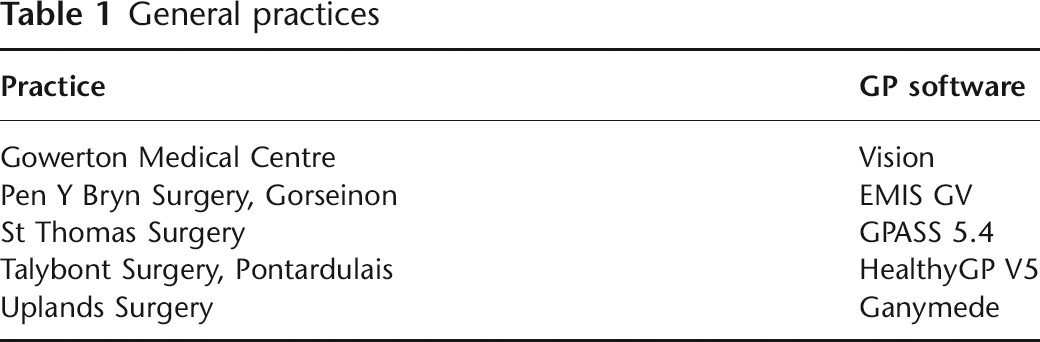
Standardised referral templates were developed for each tumour site and made available to GPs via the SWWCN website. Five practices from the Swansea area agreed to be included in the pilot trial (Table 1).
General practices
The standardised referral templates were adapted for electronic use (Microsoft Word forms) and then uploaded into the GP systems. The electronic referral forms could then be completed as necessary and saved in a chosen location on the GP's server.
The e-referral system was designed by software developers from the ABMU NHS Trust. A web application enabled the GPs to log into the e-referral system and transmit a completed referral to the Trust via a secure server (Figure 1). The portal was available from any location within the NHS Wales computer network.
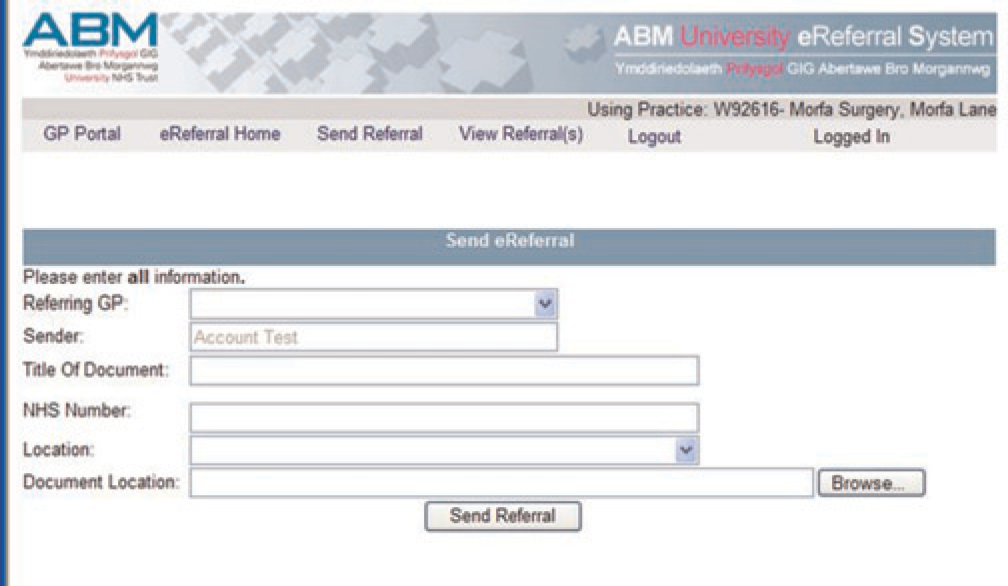
Sending an e-referral via the GP portal
Admissions staff in the Morriston and Singleton hospitals were also given access to the e-referral system, which alerted them by message and alarm when a referral was sent by a GP. The referrals could then be viewed and printed, before being processed according to the agreed protocols. GPs could also view the referrals they had submitted via the portal. A colour coding method allowed to them track whether or not they had been printed by the Trust (Figure 2).

Viewing previously submitted referrals via the GP portal
Methods
All GP practices were using the pilot e-referral system by the end of January 2007. In July 2007 information was extracted from the system to evaluate the e-referral activity over the first six months. Additional information was collected in September 2008.
Evaluation interviews were conducted in June 2007 by two Appointment Officers from the ABMU NHS Trust. Staff at the GP practices, including practice managers, IT managers, administrative staff and GPs, were asked to rate the system on a 10-point Likert scale (1 = completely dissatisfied to 10 = completely satisfied).
Results
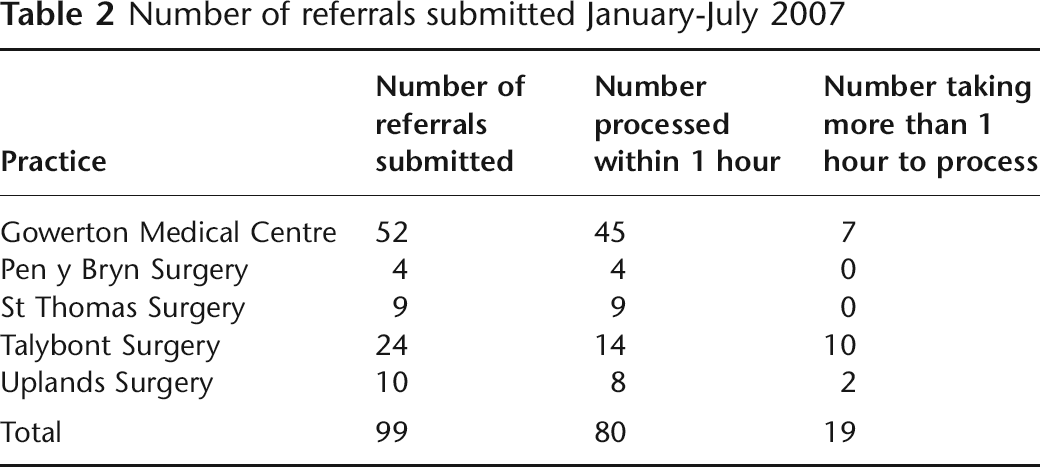
A total of 99 referrals were submitted electronically in the period January to July 2007 (Table 2). Most (81%) were processed within one hour. Of the 19 referrals that took more than one hour to process, six took more than a day to deal with. Half of these were processed over a weekend.
Number of referrals submitted January-July 2007
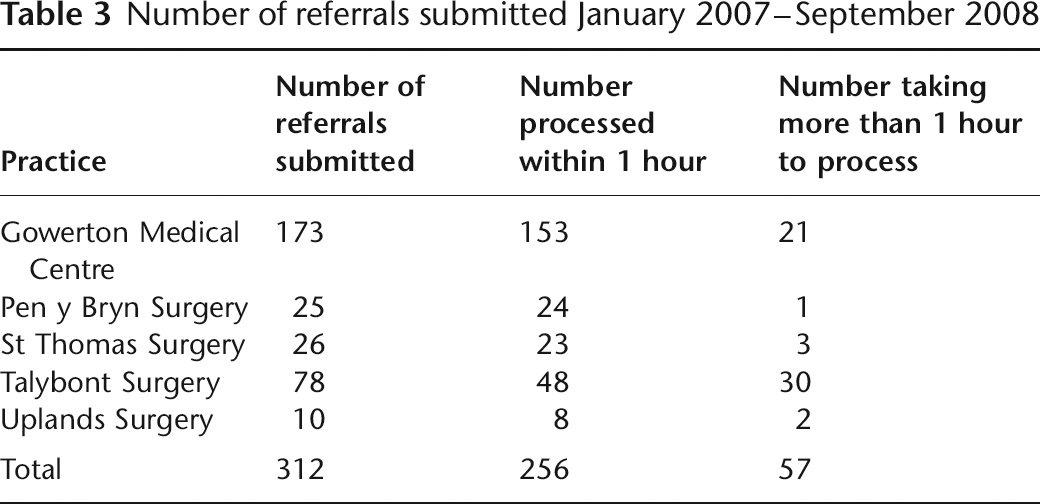
The second audit in 2008 showed that there had been continued usage by all but one of the pilot practices (Table 3).
Number of referrals submitted January 2007–September 2008
System evaluation
There were no major problems with the system itself. One minor technical problem arose where some versions of the operating system required an update for the SSL software. One practice encountered problems in adapting the templates for use with their system. This was resolved by using a simplified version of the templates, rather than the developed form with check boxes and dropdown lists.
GP evaluation
Internal referral procedures had to be adapted in most practices to make use of the system. The method of using the system varied from practice to practice, and from GP to GP. Some GPs found the system sufficiently simple that they could submit the e-referrals whilst the patient was with them. However, generally one or two members of staff at the practice submitted the completed referrals after the patient had seen the GP.
Staff at the practices commented that some of the templates were cumbersome to use. However, it was agreed that the use of a standard form was beneficial and improved the quality of the referral information submitted to consultants.
Improvements were noted in the speed with which the e-referrals were sent to the Trust and also the speed with which they were processed once received. The referral status tracking facility was found to be particularly valuable. This avoided having to confirm receipt with the Trust. The ability to track the patient up to the appointment of a clinic date was suggested by GPs as a desirable future development.
The lowest satisfaction rating given by the practices was 8. All agreed the system was easy to use, that they would like the system on a permanent basis and would have no concerns about recommending it be used by other practices.
Trust evaluation
The Trust's Appointment Officers found the system very easy to use. The facility to print multiple copies, thus saving time on photocopying, was particularly valuable.
Discussion
Following the success of the Swansea pilot project, the SWWCN and the ABMU NHS Trust helped to establish a pilot in another region, allowing five more general practices to send e-referrals to Bronglais General Hospital in Aberystwyth using the Swansea system. The system was also further developed for e-referrals between GPs and consultants in the Bridgend area for patients suffering transient ischaemic attack.
These projects remain pilots, but have provided valuable lessons for the staff of the Informing Healthcare project 1 who are currently engaged in a trial of the SCI Gateway electronic referral system. 2 The latter has been used successfully in Scotland for a number of years, and is now being tested in Wales. It provides a secure electronic messaging system for clinical communications between clinicians working in different services, with the potential to manage messages between any health-care setting in Wales and elsewhere.
The Swansea e-referral pilot provided a simple, structured solution to improve the quality and speed of communication between primary and secondary care. The project demonstrated that improvements in the patient pathway and working practice could be achieved through the use of information technology and standardised referral protocols. This was helpful to the future use of electronic referrals in Swansea and Wales.
Footnotes
Acknowledgements
The author would like to thank Simon Davies (Swansea NHS Trust), Glynis Tranter (South West Wales Cancer Network), Delyth Lewis (South West Wales Cancer Network), Rob Keatley (Abertawe Bro Morgannwg University NHS Trust) and Mark Hodson (Abertawe Bro Morgannwg University NHS Trust).