




Abstract
We investigated the validity and feasibility of online delivery of the Lee Silverman Voice Treatment (LSVT) for the treatment of the speech disorder of a patient with idiopathic Parkinson's disease. The treatment was delivered in 16 sessions to the participant's home, 90 km from the speech language pathologist. A PC-based videoconferencing system was used, operating at 128 kbit/s over the public telecommunications network. The patient achieved substantial improvements in vocal sound pressure levels during sustained vowel phonation (6.13 dB), reading (12.28 dB) and conversational monologue (11.32 dB). There were improvements in the duration of sustained vowel phonation (4 s). Improvements were also perceived in the degree of breathiness and roughness in the voice, and in overall speech intelligibility in conversation. The patient was very satisfied with the audio and video quality of the conferencing, and with the online treatment overall. He reported a preference for online sessions for the future management of his condition, rather than face-to-face treatment. Remote LSVT delivery was found to be feasible and effective.
Introduction
Home telecare is increasingly being used to help elderly and infirm people remain independent within their homes by improving their access to health care. 1,2 Home telecare is ideal for people with Parkinson's disease (PD) as it can reduce barriers to service access such as the travel difficulties associated with the large distances to specialised health-care facilities that are frequently encountered in Australia and in other countries. 3 Idiopathic Parkinson's disease (IPD) is a chronic degenerative disease. The motor speech disorder associated with IPD is known as hypokinetic dysarthria and is characterised by reduced loudness, monotony of pitch and loudness, inappropriate silences, variable rate and short rushes of speech, imprecise articulation, and a harsh and breathy voice. 4,5 Hypokinetic dysarthria can affect a high proportion of people with PD and progresses in severity over time. 6–8 As a result of the reduced speech intelligibility, people with PD often experience communication difficulties which may lead to isolation and may reduce their quality of life. 8,9
At present, the most effective, evidence-based treatment for PD and hypokinetic dysarthria is the Lee Silverman Voice Treatment (LSVT). This is a structured programme which is delivered intensively in 16 treatment sessions and promotes increased respiratory drive, vocal fold adduction and increased vocal loudness in everyday communication. 10,11 Improvements following traditional face-to-face delivery of the LSVT have been reported in vocal loudness, quality and speech intelligibility, with these positive effects maintained up to 12 12 and 24 months post-treatment. 13
Despite the effectiveness of the LSVT in the management of dysarthria in PD, patient access to face-to-face speech pathology services for this treatment remains limited due to restricted availability of trained clinicians, conflicting caseload priorities and patient access barriers. 3 The aim of the present study was to investigate the validity and feasibility of remote online LSVT delivery for a single case of IPD using PC-based videoconferencing over the Internet. Our hypothesis was that LSVT can be effectively delivered remotely, with treatment outcomes similar to those for traditional face-to-face LSVT.
Methods
Mr B, a 65-year-old retired man living in a regional city, 90 km north of Brisbane, was recruited to the study. Ethics approval was obtained from the appropriate committee. Mr B had been diagnosed with IPD six years prior to the study and was classified as Stage I on the Hoehn and Yahr Scale. 14 In the previous few years, the participant and his wife had noted a reduction in his vocal loudness and speech intelligibility, as well as a breathy speech quality. As a result, Mr B was finding it more difficult to be understood in group situations, where there was background noise and occasionally while speaking by telephone. His speech and voice difficulties were beginning to affect his duties as a coordinator of a community group. In daily life, Mr B began to avoid speaking by telephone and would often spend the greater part of his day at home, where he did not have to talk to anyone. Mr B had not previously received any speech pathology services. There were also no public or private speech pathology services offering the LSVT in his local community at the time of the study. The intensive nature and commitment of the LSVT programme, and participant fatigue when driving, made it difficult for Mr B to seek treatment for his speech and voice difficulties outside his local area.
Prior to treatment, the participant's speech was classified by the principal investigator as demonstrating mild hypokinetic dysarthria. This classification was based on Mr B's pre-LSVT assessment results on acoustic measures of vocal volume for sustained vowel phonation (81.96 dB), a monologue (68.13 dB), and a perceptual rating of mildly reduced overall speech intelligibility in conversation (using a 5-point rating scale). A videolaryngoscopic examination, conducted by an ear, nose and throat specialist, revealed some vocal fold bowing, a feature consistent with IPD. Mr B wore bilateral hearing aids for his mild-moderate bilateral hearing loss. He remained on a constant drug regime for IPD throughout the study.
Procedure
The online treatment was delivered by a LSVT-certified speech language pathologist (SLP). The SLP was located in Brisbane, and delivered the treatment to the participant's home via a PC-based telerehabilitation system. One PC was located at the SLP site, while the other was a laptop computer located at the participant's home.
The telerehabilitation system was able to: (1) provide videoconferencing; (2) present reading material for the participant; (3) manipulate the web cameras at the participant site via a robot arm to maintain a clear view of the participant throughout the session; (4) obtain average measures of sound-pressure level (SPL), duration and peak frequency via the system's acoustic speech processor; and (5) capture high quality video (640 × 480 pixel resolution) and audio, compressed at 384 kbit/s for later examination. The acoustic speech processor was connected to the laptop computer via a USB port. A 128 kbit/s Internet connection was established between the two videoconferencing systems using the public telecommunications network (ADSL). The connection enabled videoconferencing at 320 × 240 pixel resolution between the two systems.
Prior to treatment, the participant's system was set up in a quiet room of his home by the principal investigator. This took approximately 10 minutes to complete. The participant was shown how to perform the basic functions required for treatment, including turning on/off the PC, activating/closing the application and positioning the headset microphone. Once the set-up was completed, the microphone distance was adjusted to 5 cm from the corner of the participant's mouth. This helped to reduce sound distortion, maximize visibility of the participant's face, and allow for accurate recordings of pitch and SPL. To verify the positioning of the microphone, the SPL (dB-C) data generated by the system's acoustic speech processor was then confirmed against a conventional Digital Sound Level Meter (Model No. 23–553, Radio Shack) during three sustained phonations of the vowel /a/. The participant was instructed to avoid adjusting the microphone arm over the course of treatment and to take care where he placed the headset microphone when not in use. During the treatment, the SLP communicated with the participant via a headset microphone during videoconferencing. The SLP controlled all displays on the participant's screen, without the need for the participant to operate the system.
LSVT programme
The LSVT sessions were delivered according to standard clinical practice, for one hour per day, four days a week, for four weeks. 10,11 The daily sessions included maximum duration of sustained vowel phonation, fundamental frequency range, functional speech loudness drills and hierarchical speech loudness tasks. The tasks were performed at high intensity and with maximum effort to promote increased respiratory drive, vocal fold adduction and carryover of the louder voice into functional communication. Homework reading materials were emailed to the participant at the end of each session.
Outcome measures
Pre- and post-LSVT assessments were conducted in the traditional face-to-face manner in Brisbane by two SLPs who had not taken part in the treatment. A battery of acoustic and perceptual measures was used in these assessments. The acoustic measures were obtained using the LSVT Evaluation Protocol 10 and included: (1) average SPLs of the participant's speech during six phonations of the vowel /a/, reading of the standard ‘grandfather passage’, 15 and during a 30 s monologue about a topic of interest; (2) the average duration of six sustained vowel phonations; and (3) the pitch range obtained from the average of the highest and lowest frequencies from a series of six vocal glides, that was then converted to a maximum range in semitones. 16 The acoustic measures were obtained using the online system's acoustic speech processor.
Perceptual measures of voice and speech included ratings of voice variables (breathiness, roughness, loudness level, loudness and pitch variability), overall articulatory precision and overall speech intelligibility in conversation. The variables of breathiness, roughness and overall articulatory precision were determined from pre- and post-LSVT readings of the standard ‘rainbow passage’. 17 A 30 s monologue was used to determine the loudness level, pitch, loudness variability and overall intelligibility in conversation.
The ratings on all of the perceptual variables were made using Direct Magnitude Estimation (DME), a scaling method that allows the rater to assign any numerical value to the variable and rate the sample against a ‘standard’ or a representation of a midrange impairment of that variable for improved reliability. 18–20 A set value of 100 was used to represent the standard. 18,21 For the variables of loudness level and variability, pitch variability, overall speech intelligibility in conversation and overall articulatory precision, a rating of 50 suggested that the sample was only half as clear as the standard, while a rating of 200 indicated that the sample was twice as clear as the standard. 20 For the variables of roughness and breathiness, however, a sample that was rated lower than 100 represented an improvement in quality. DME ratings were made by two experienced SLPs who were blinded to the study intent. For each variable, the raters listened to the standard followed by the pre- and post-treatment speech samples in random order. 21 A different standard was used for each variable. 20 An average pre- and post-treatment value was calculated for each variable, which was then converted to a logarithmic value and represented as a geometric mean. 19,22
The participant also completed a satisfaction questionnaire (5-point scale) relating to the online treatment modality. The questionnaire determined his satisfaction with: (1) the online treatment sessions (responses ranging from would not participate again to would prefer these types of sessions to face-to-face sessions for future management of PD); (2) the audio and video quality during the sessions (poor to excellent); and (3) overall satisfaction with online treatment (not at all satisfied to very satisfied).
Results
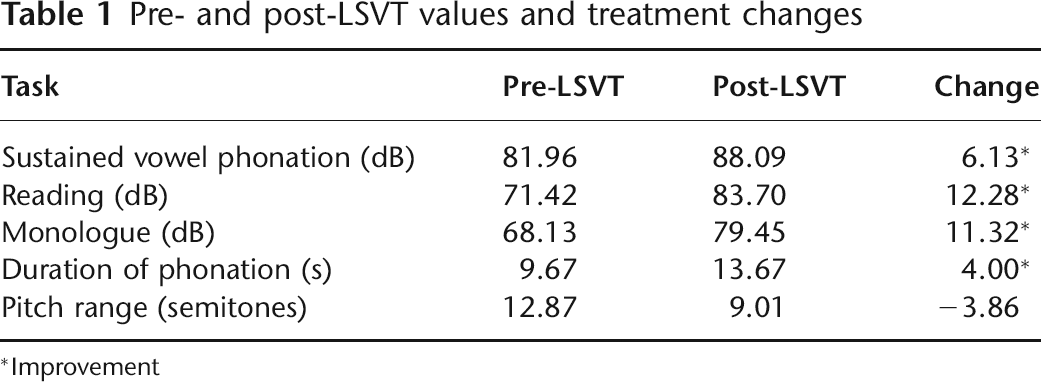
Descriptive comparisons and degree of change were determined between the pre- and post-LSVT acoustic and perceptual measures. For the acoustic variables, substantial treatment gains were made on all SPL tasks (6.13 dB improvement on sustained vowel phonation; 12.28 dB on reading and 11.32 dB on monologue loudness), and on the duration of sustained vowel phonation variable (4 s improvement). Pitch range failed to show an improvement with treatment. The results are summarised in Table 1.
Pre- and post-LSVT values and treatment changes
*Improvement
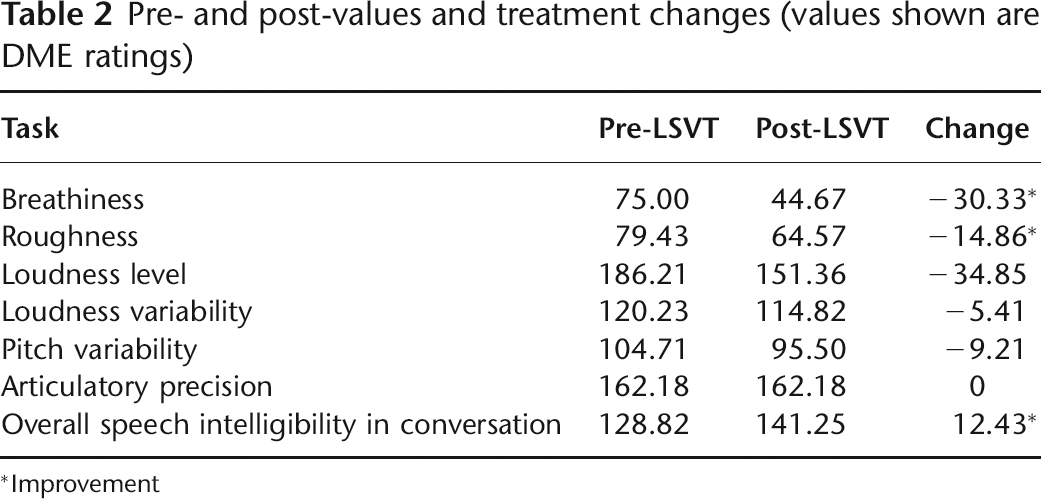
For the perceptual variables, treatment gains were observed for measures of breathiness (a 30.33 DME value reduction), roughness (14.86 DME reduction) and overall speech intelligibility in conversation (12.43 DME improvement). No treatment changes were evident for overall articulatory precision, with this variable remaining at the high pre-treatment DME value of 162.18. Lower performance with treatment was evident on the remaining variables of loudness level (a 34.85 DME reduction), loudness variability (5.41 DME reduction) and pitch variability (9.21 DME reduction). The pre- and post-LSVT values and treatment changes are summarised in Table 2.
Pre- and post-values and treatment changes (values shown are DME ratings)
*Improvement
On the participant satisfaction questionnaire, Mr B rated the audio and video quality as excellent. He was very satisfied with the online treatment overall and indicated that he would prefer online sessions to face-to-face for future management of his condition. Overall, there were no failed treatment sessions and the majority (n = 13) of the sessions ran very smoothly, without technical difficulties and with adequate audio and video quality for treatment delivery. During the remaining three sessions, some networking difficulties considerably reduced the audio and video quality. These problems were solved by disconnecting and re-establishing the videoconferencing connection between the two telerehabilitation systems.
Discussion
The present case report demonstrates the feasibility of remote online delivery of the LSVT via a PC-based videoconferencing system operating on a 128 kbit/s Internet connection and supports the study hypothesis. On the whole, Mr B showed substantial improvements with remote LSVT for most of the acoustic and perceptual variables, and these were similar to the treatment outcomes reported in the literature for IPD participants with mild to moderate hypokinetic dysarthria following face-to-face LSVT. 11,12,23–26 The post-treatment values for the SPL variables were also consistent with the average values reported for two groups of healthy older adults speaking at a comfortable loudness level, in studies with similar assessment procedures. 27,28 It is possible that the lack of perceived improvement in some speech and voice variables (pitch range, loudness level and variability, and overall articulatory precision), was related to the participant's mild degree of hypokinetic dysarthria which made it difficult for the raters to perceive changes in these variables following treatment. It is recognised that the perception of speech and vocal changes is more difficult in milder degrees of speech impairment 29 and may not be as accurate as objective measurement. Despite the lack of substantial improvements in some specific speech and voice variables, the participant demonstrated improved speech intelligibility in conversation and reported improved performance in everyday speech activities following treatment.
Participant's perspectives
Overall, Mr B benefited from remote LSVT and found the treatment useful for increasing his loudness to pre-morbid levels, and for integrating and maintaining the treatment gains of improved loudness level, vocal quality and speech intelligibility in daily life. As a result of these positive treatment changes, Mr B felt that his speech sounded natural and close to how he remembered it prior to PD. He regained his confidence in talking to his family and friends, gave a speech at his daughter's wedding, and began speaking again by telephone and in group meetings.
Overall, Mr B was very satisfied with the online treatment and rated the video and audio quality of the online application as excellent. His level of hearing loss, which was corrected by hearing aids, did not interfere with his ability to hear instructions over the videoconferencing link. Interestingly, on the satisfaction survey, Mr B reported that he would prefer online sessions to face-to-face for the future management of his condition. He felt that the online method provided: ease of access to treatment without the nuisance of travelling and the need to leave his own home; time-savings from not having to travel; and a friendly technical interface for treatment using reliable technology. The convenience of remote online LSVT proved to be a highly motivating factor for Mr B. Similar findings have also been reported in other telehealth studies where patients were motivated and accepting of the technology used when they could be treated in their natural or least restrictive environment. 30,31
Clinician's perspectives
The real-time videoconferencing feature of the application and the ability to capture and display SPL and frequency data and display therapy materials online were important to the successful delivery of the treatment, allowing the clinician to: provide timely instructions to the participant and assist with shaping correct voice productions and overall calibration; monitor the loudness level, pitch level and vocal quality; and maintain good rapport with the participant. From the clinician's perspective, the online application was user-friendly and allowed effective delivery of remote home-based LSVT via the public network. There were no failed treatment sessions and the majority of sessions ran very smoothly, with adequate audio and video quality for treatment delivery. On only three occasions was the SLP required to disconnect and re-establish the videoconference connection due to networking difficulties.
Although occasional audio delays were also encountered during treatment, they were effectively managed by the participant and clinician who waited until the other had clearly finished speaking before replying, and by the clinician using shorter and more precise instructions. Strategies, however, were needed to maximise the video quality, as the frame rate and pixelated video image especially during movement made it more difficult for the clinician and participant to clearly view each other during the session. Useful techniques to improve the video quality included: sitting relatively still in front of the PC during the sessions; the SLP using easy to detect hand-cues for quick input; relying more heavily on specific verbal directions and participant feedback rather than on visual information; and using the store-and-forward modality to record the desired task when necessary. These strategies were easily adopted in the sessions and aided the smooth delivery of treatment. The use of higher Internet bandwidth would improve the interface and thus more closely resemble the face-to-face modality, reduce the audio and video difficulties and lessen the need for compensatory strategies.
Other procedures necessary to ensure the smooth delivery of treatment in the home environment were identified during the study. The sessions were conducted in a quiet room of the participant's home, which reduced any household distractions and noise, and telephone calls were not taken during the sessions. Furthermore, the microphone distance from the participant's mouth was kept constant, to ensure that the acoustic levels were constant between sessions. The participant also took great care to ensure that this distance was maintained. It would be useful in future for the SLP to be able to provide audio-recordings of the participant's performance as a form of feedback for them. This additional capability would make online LSVT even more similar to face-to-face treatment.
In conclusion, the treatment gains, the high participant satisfaction and motivation with remote LSVT illustrate the potential of this type of service delivery for people with PD. Remote treatment may assist in reducing the effects of physical disability, transport and travel difficulties, and distance for those with PD, which at present represent substantial barriers to service access. Remote treatment may also facilitate earlier access to intervention, thus allowing individuals to remain independent and active within their own homes and communities. Because the present report concerns a single case, the findings cannot be generalised to the wider PD population. Future large-scale studies are needed to investigate the effectiveness of remote online LSVT with a larger number of participants with PD and dysarthria severity levels and greater numbers of treating clinicians.
Footnotes
Acknowledgements
This research was funded by a National Health and Medical Research Council Project Grant 301029. The work forms part of the doctoral thesis of Gabriella Constantinescu at the University of Queensland. We thank Parkinson's Queensland Incorporated, the participant, Roy Anderson, Anne Hill, Monique Waite, Jasmin Cowles and Christina Iezzi for their contribution to the research. LSVT is a registered trademark.