




Abstract
We established a medical education website to deliver real-time, clinical case-based education to sites in Somaliland from the UK. The website was based on a web 2.0 social networking concept in order to recreate, as nearly as possible, the clinical bedside teaching experience. A survey showed that medical students in Somaliland had sufficient computer access to exploit the website. Teaching began in December 2008 and the teaching programme has developed into a regular weekly teaching session involving up to seven different student groups in Somaliland at different locations. As well as north-south teaching, the website has been employed to support a study module in London. Small groups of UK-based medical students have been partnered with intern tutors in Somaliland. Forty UK students have taken part in this teaching, which is now in its second year. Feedback from those involved has demonstrated that a collaboration in which both north–south and south–north teaching occurs can strengthen partnerships in which both parties contribute and benefit.
Introduction
The organisation Réseau en Afrique Francophone pour la Télémédecine (RAFT) facilitates exchange of medical expertise between French-speaking countries in Africa and the Geneva University Hospitals. The experience of RAFT and others have highlighted a number of problems about telemedicine, such as security, confidentiality, incompatibilities between resources and the differences in disease spectrum between north and south. 1–5 We have established a medical education website to deliver real-time, clinical case-based education to sites in Somaliland from the UK. The structure of the site is built around social networking. It aims to address the need articulated in the UK government's report from Lord Crisp for a greater contribution of NHS staff to the health care of developing countries. 6,7 The present paper describes the assessment of the pilot phase of the online education.
Methods
We developed a CD to assess the potential for an e-learning programme in Somaliland. The CD contained lectures, learning modules, reading materials and assessment resources. It was given to all 4th year medical students (n = 13) at both of the Somaliland medical schools in May 2008. The students were encouraged to use the CD to supplement their didactic learning and to evaluate the experience. Focus groups were held to gather quantitative and qualitative feedback on this style of e-learning. In addition, a survey was conducted to determine the feasibility and structure of a prospective online distance learning application. A further questionnaire was circulated in order to ascertain the components of the teaching programme which were the most useful to students and interns and therefore those which should be recreated online.
Website development
The website was designed to recreate, as nearly as possible, the clinical bedside teaching experience. It was developed to allow simultaneous teaching at different locations. The site was based on a web 2.0 social network structure using AJAX programming. The software was designed to operate in a low-bandwidth setting. During an online meeting, communication speed is critical and therefore parts of the processing take place on the user's computer in order to reduce the load on the server. In addition, information is continually pre-calculated, cached and compressed to reduce the computational load on the server. The site is compatible with all major Internet browsers and can be used on any computer connected to the Internet without preloading software and without any special hardware requirements.
Teachers and students create an online identity through a profile, which holds their basic demographic information. Students then upload medical cases onto the website using a standard format through the history, observations, examination, laboratory data and imaging sections. Individual cases are then collated by the teacher into a clinical meeting. Once the medical cases have been collated for a lesson, the teacher can supplement the cases with complementary teaching material. This material takes the form of slides (PowerPoint) which can be accessed and controlled during the teaching session in addition to photographs, videos and documents. The teacher then sends an electronic invitation to the appropriate students specifying the date and time of the lesson. Participants convene in a virtual tutorial room with instant messaging linked to the cases and the multimedia resources required for the lesson. A tutor can lead students through the cases while making reference to the resources. The quality of teaching can be continually assessed by the students and tutors.
Results
The students had sufficient computer access to exploit the website. Only five students (40%) had access to home computers, and only two (15%) had access to the Internet at home. Nonetheless, all of them had daily access to the Internet at the medical school, which enabled them to receive streamed video. However, the network would not support VOIP (voice over Internet Protocol) telephony. All students had sufficient IT skills to use social-networking applications.
The students demonstrated a strong preference for clinical bedside teaching over didactic teaching and static information resources. In addition, they requested a higher teacher to student ratio, smaller group sizes and broader specialty coverage as the priorities for future north-south exchange.
Website
The website developed into a stable and reliable platform for learning. In a typical meeting, the tutor controls discussions using the instant messaging board and a virtual pointer (Figure 1). The tutor can toggle between different aspects of the case including the history, observations, examination, laboratory data and images. In addition to the case itself, the tutor can show slides from previously loaded PowerPoint presentations in the slideshow section.
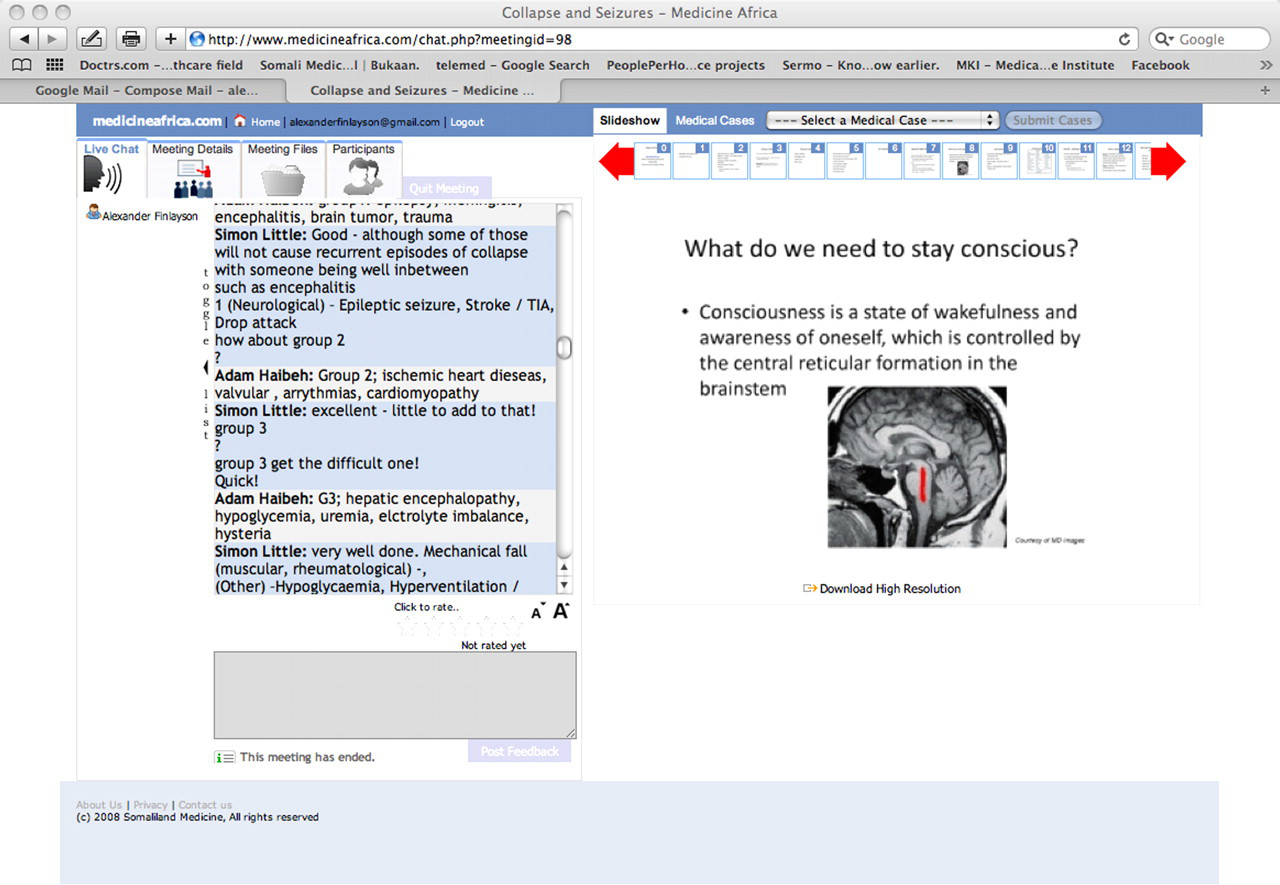
Screenshot of a MedicineAfrica teaching session, demonstrating the interactive case-based structure
Virtual faculty development
Two senior interns in Somaliland handled the educational programme for the students in Somaliland. The UK teaching faculty was established in London and in Oxford. The website was designed so that a tutor could log on and teach from any computer connected to the Internet. The teaching programme developed modules across different faculties medicine, neurology, surgery and mental health, and is developing a new module for professional development. Each module has a designated faculty leader and faculty members. With the introduction of each new speciality, a preparatory online teaching training session was conducted.
North-south teaching
The first teaching session was delivered on 12 December 2008 between a group of four doctors, an educational administrator in the UK and two interns in Somaliland. The programme was then further developed. At present the site hosts profiles for 95 students, 43 of whom were active in the preceding week, and 17 tutors. The teaching programme has developed into a regular weekly teaching session rotating between the different specialties. These teaching sessions have involved up to seven different student groups in Somaliland at different locations at the same time. Tutors in the UK continue to develop their teaching skills for this new environment.
South-north teaching
King's College School of Medicine instituted a special study module in the field of Global Health in the 2008–2009 academic year. The website has been employed to support this. Small groups of UK-based medical students have been partnered with intern tutors in Somaliland. Each tutor identifies an interesting clinical case and then uses the website to teach the UK students at a distance. In order to assess the attainment of the learning outcomes set out for these sessions, each group is required to produce a poster and abstract presentation from the presented clinical material.
To date, 40 students have taken part in this teaching which is now in its second year. Students found the website easy to use (Table 1) and reported that real-life cases improved their learning experience. In addition, all students felt that the real-time exchange via the website was superior to that which could be achieved using email (Table 2). Fifteen of the 16 students felt that they had been well taught by their tutors in Somaliland. However, the feedback identified the need for a clearer structure to the format of the tutorial.
Feedback from 16 King's College students taking the 4th-year student-selected component
Feedback on the usability of the website from 16 King's College students who received teaching from Somaliland
Discussion
The results of the initial study showed that the levels of IT knowledge and Internet availability in Somaliland were sufficient to support long distance, instant text-based teaching. The assessments of the teaching sessions via the website showed that such a method of teaching was rewarding and valuable to students and interns. It demonstrated that a collaboration in which both north–south and south–north teaching occurs can strengthen partnerships in which both parties contribute and benefit. The ability of the website to connect different groups at different locations in Africa without the need for expensive hardware appears to be an exciting development in medical education. There is potential for expansion to other regions of Africa. It is hoped that the social networking structure of the site 7 will facilitate this expansion.
Footnotes
Acknowledgements
Funding for the website was provided by a grant from the International Development Unit at King's College Hospital.