




Abstract
We have attempted to quantify the benefit to both patients and professional users from introducing ‘self-service’ kiosks into the waiting rooms of general practitioners (GPs). We conducted a series of interviews with practice managers, GPs and patients in practices where kiosks had been used. We then estimated the time savings and other benefits. There were significant time savings both for nursing and GP staff, and similar time savings for patients. We estimate that the total time savings would be equivalent to one health-care assistant for a practice size of 10–12,000. Practice income was enhanced as a result of the improved information gathering made possible by the kiosks. These effects resulted in improved patient outcomes. The key to successful implementation appears to be strong support, particularly from reception staff to encourage and facilitate the use of kiosks. To maximise the benefits, GPs and nurses must be prepared to change their ways of working.
Introduction
Kiosks can be used to encourage patient self-service in general practices. The devices comprise a strong, touch-sensitive screen and there are usually two peripherals: scales and a sphygmomanometer (see Figure 1). A third peripheral, a pulse oximeter, is sometimes used. Kiosks are normally integrated into the practice management system, and can generate diagnostic and treatment terms (Read Codes) and transmit them directly to a patient's electronic patient record (EPR). In addition, if a reading exceeds a pre-set threshold, a message can be displayed inviting the patient to make an appointment and simultaneously alerting the receptionist.
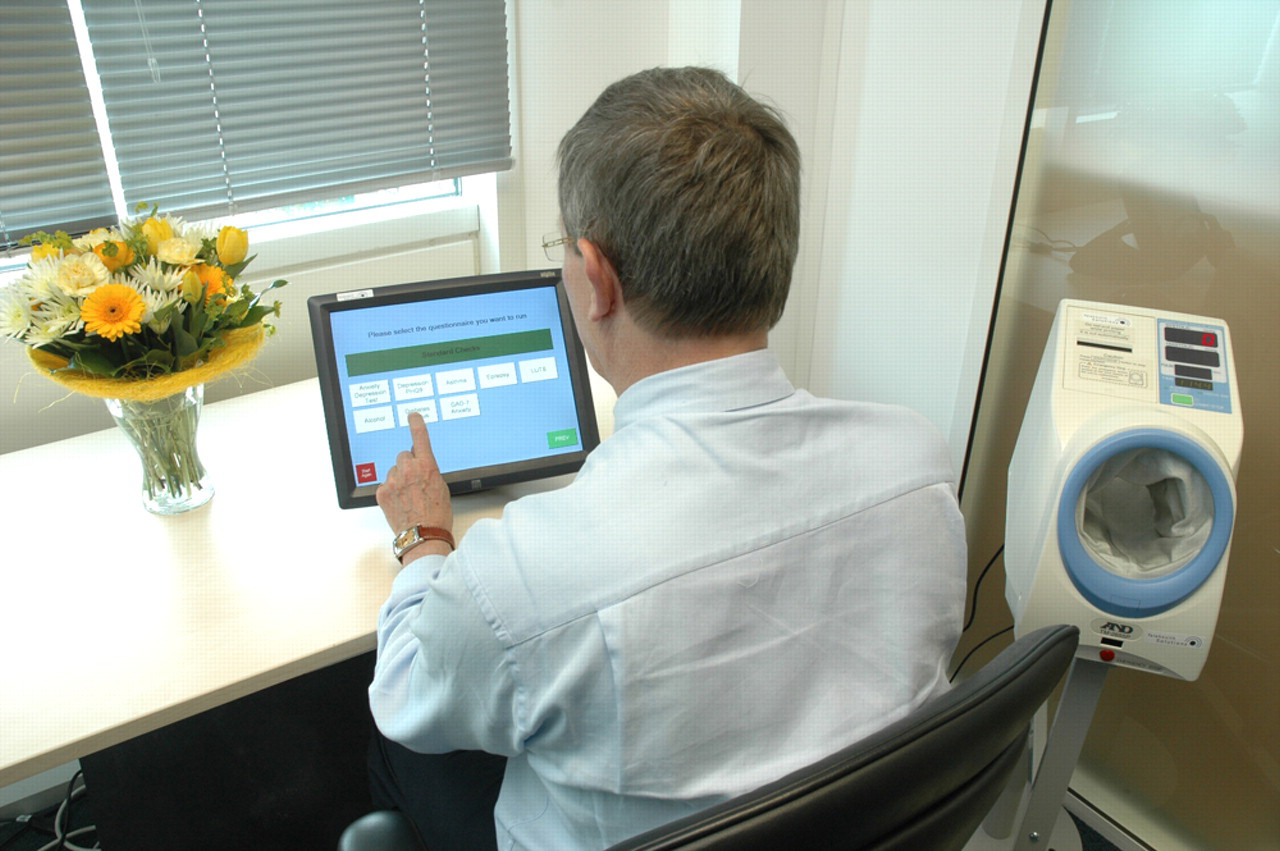
Kiosk in use
Patients are encouraged to use the kiosks:
To provide information when signing up as new patients; To carry out a short check covering blood pressure, bodyweight and answering a few relevant questions before the appointment with their general practitioner (GP); When checking their blood pressure, bodyweight or completing a patient health questionnaire at the GP's request, instead of seeing a nurse or health-care assistant (HCA); When seeking a repeat prescription, e.g. for hypertension medicine or oral contraceptives, instead of seeing a GP.
Interviews with 18 practice managers suggest that kiosk usage depends critically on the attitude of staff at the practice. Kiosk usage appears to depend on the willingness of receptionists to assist first-time users, the extent to which GPs encourage patients to participate in a short check before seeing them, how much local publicity about kiosks has been conducted and the siting of the device in the waiting room. As with all information technology, it is necessary to change the way the practice works to gain the greatest benefits. Therefore, the practices that require patients to use the equipment to measure their blood pressure before giving them a repeat prescription, and those that will only allow nurse appointments for routine blood pressure readings for disabled patients seem to have greater usage. Once the kiosks are actually being used, the practices see improved patient outcomes. Likewise, providing bonuses for the receptionists according to kiosk usage typically increases their usage.
Benefits
The interviews suggest that immediate benefits to the health-care provider come in three main forms:
More time to care, because unnecessary nurse/HCA/GP appointments are eliminated and GPs have immediate access to relevant vital signs information in consultations; More accurate data, because ‘white coat syndrome’ is reduced for blood pressure measurement and both patient-health and alcohol questionnaires, in particular, are answered more honestly; Improved, or easier-to-achieve performance indicators (QoF scores), because of better gathering of relevant information. This in turn increases the earnings of GPs.
In the longer term, the ability to monitor patient health more closely, and to detect problems early, should result in a healthier population with all that implies for lower patient management costs. In addition, encouraging patients to take responsibility for and manage their own conditions, should significantly reduce the cost of providing care. Less tangibly, reducing ‘white coat syndrome’ in blood pressure measurements also reduces the risk of unnecessary medication, benefiting both health-care provider and patient.
The two other main benefits are that patients no longer need to wait to see a nurse or GP, and that they no longer need to make the appointments or turn up at inconvenient times for simple checks. For example, at least one practice now opens their kiosk in time for commuters walking to the station to drop in and carry out a routine health check on the way to, or from, the office.
The benefits of health kiosks appear to increase with time, as clinicians and patients become more familiar with the technology. We estimate that the time savings are equivalent to one HCA for a practice size of 10–12,000, equivalent to about 3.5 hours saved per week per thousand patients. However none of the 18 practices we consulted in depth, or the others we spoke to briefly, were able to provide the detail behind their assertions, which leads us to believe that the topic is ripe for research. In discussion with a senior GP with significant experience of such matters, we produced a weekly breakdown of how a saving equivalent to one HCA might be achieved (see Table 1). We also calculated the saving of patient time on the assumption that patients wait, on average, 15 min more for an appointment than they do to use the kiosk. This comes to a total of 33 hours per week, at least some of which time will be converted into additional output by those in work. Clearly every practice will be different, but at least it demonstrates that such a claim is plausible.
Weekly time savings anticipated in a 12,000-patient practice, assuming that the average waiting time is 15 min per patient (see text)
The future
Kiosks have only begun appearing in GP surgeries in the past two years and so there are relatively few in use at present. However the scope for developing the concept is huge: kiosks could become an essential part of coping with the rising demands on GP time as the population ages. Particular opportunities include:
Sending selective reminders for specific groups, e.g. for those needing chlamydia screening or flu vaccination; Positioning a kiosk in each residential care home/nursing home managed by the practice to enable regular check-ups on patients; Integrating with home telehealth usage so that once patients are no longer acutely ill they can pass their (relatively expensive) individual telehealth equipment to another patient and revert to regular kiosk usage; Allowing patients to change their personal details, such as address or telephone number, without needing to trouble the receptionist; Accessing selected parts of a patient's EPR to personalise the questions asked of them, i.e. so as not to ask questions for which answers are already known. This would also allow prompting of patients for specific check-ups required by their condition, such as retinopathy scans for diabetics; Facilitating occupational health, since kiosks could be sited in work premises to enable employees to obtain guidance about safe working practices and healthy living options.
There is at least one further potential future use: for NHS Health Check follow-up. The recently introduced NHS Health Check is designed to encourage behavioural change early enough to reduce the incidence and severity of long-term conditions. However, achieving appropriate behavioural change requires a substantial dialogue with the patient, involving encouragement, setting and achieving short-term goals; information alone cannot do this for most people.
1
Kiosks therefore offer a new way in which patients can measure goal achievement, especially through bodyweight and blood pressure change, and questionnaire responses, and in turn receive additional encouragement, advice and reset targets.
Kiosks have only recently begun to appear in GP waiting rooms but from initial reactions they clearly have an important role to play in the future.