




Abstract
We have developed a personalised self management system to support self management of chronic conditions with support from health-care professionals. Accelerometers are used to measure gross levels of activity, for example walking around the house, and used to infer higher level activity states, such as standing, sitting and lying. A smart phone containing an accelerometer and a global positioning system (GPS) module can be used to monitor outdoor activity, providing both activity and location based information. Heart rate, blood pressure and weight are recorded and input to the system by the user. A decision support system (DSS) detects abnormal activity and distinguishes life style patterns. The DSS is used to assess the self management process, and automates feedback to the user, consistent with the achievement of their life goals. We have found that telecare and assistive technology is feasible to support self management for chronic conditions within the home and local community environments.
Introduction
The increased incidence of chronic conditions and their associated ailments presents a huge worldwide challenge. If these conditions are not successfully managed, they will become the most expensive problem for health and social care systems. 1 Alternative approaches to hospital outpatient or physician visits are required. Supporting self management for users with chronic conditions within their own home environments is an accepted and important part of addressing the disease burden, 2 encouraging those suffering from a health problem to actively engage in managing their own health. 3 Home-based assistive technology and tele-monitoring of chronic conditions can produce accurate and reliable activity data, influence the attitudes and behaviours of patients, and have the potential to improve their medical conditions. 4,5
We have studied three chronic conditions: chronic pain, stroke and congestive heart failure (CHF). These conditions require different intervention models: accommodative (chronic pain), restorative (stroke) and preventative (CHF). We have used assistive and telecare technologies to develop a personalised self management system (PSMS) to support self management of chronic conditions in the home.
Personalised self management system
The PSMS has been designed to monitor user activities unobtrusively using home-based and mobile sensors. It also comprises a knowledge base engine which can monitor the information collected and provide recommendations to users to help them understand their condition. The goal of the system is to promote behaviour change, thereby enhancing health and wellbeing.
The PSMS consists of sensing devices capable of monitoring activity levels and vital signs, a decision support module to process recorded data, a portal for health-care professionals to access data and touch screen driven interfaces configured with appropriate information to allow users to interact with the system and receive automated feedback 6 (see Figure 1.)
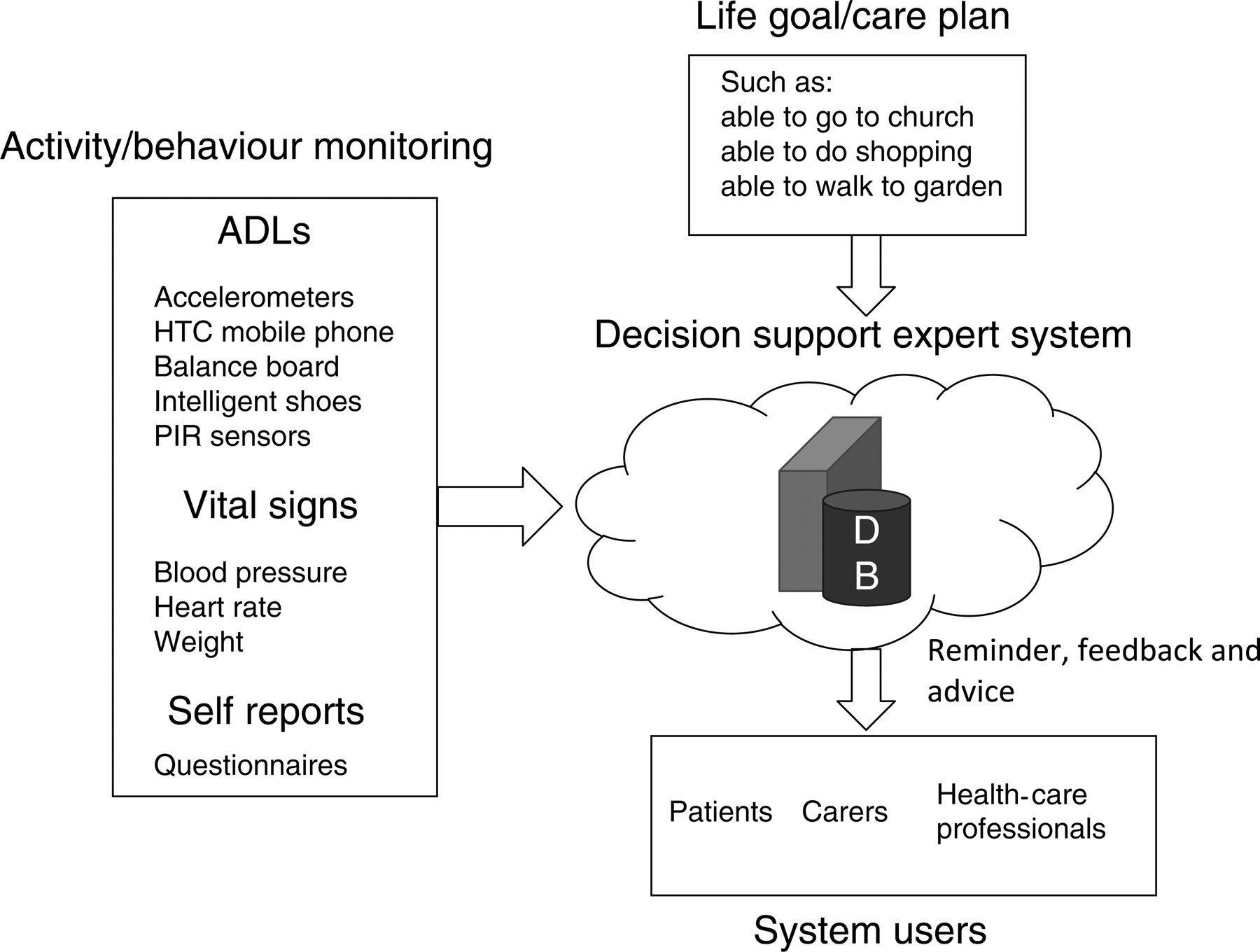
Infrastructure of the personalised self management system
From the user's perspective, the key element of self management is the personalisation and management of life goals. Life goals are targets which users should strive to achieve and which will assist in managing their chronic condition. The targets are jointly agreed between user and therapist.
The PSMS supports three types of activity and lifestyle monitoring: activities of daily living (ADLs), vital signs and self reporting. The user's ADLs are monitored by sensing devices, such as accelerometers, passive infrared (PIR) motion sensors, bed pressure sensors and ‘intelligent’ shoes. We have previously used accelerometers to monitor upper limb rehabilitation exercises and the hand position appropriate for post-stroke users. 7 In the present prototype, accelerometers are used to measure gross levels of activity, for example walking around the house, and used to infer higher level activity states, such as standing, sitting and lying. A smart phone containing an accelerometer and a global positioning system (GPS) module can be used to monitor outdoor activity, providing both activity and location based information. Heart rate, blood pressure and weight are recorded and input to the system by the user. Self reporting has been widely used in pain assessment as an approach to obtain users' subjective feedback on the self management of their condition. 8
The information collected from the peripheral devices is sent to a computer (‘home hub’) in the home and relayed to a server for later access by health-care professionals (see Figure 2). This provides a portal for health-care providers who can then access patient data such as the life goals, self reported data and information related to activities. The design of the PSMS has been guided by therapists and patient-led focus groups. 9 Currently the PSMS for CHF is under evaluation by both health-care professionals and user groups.
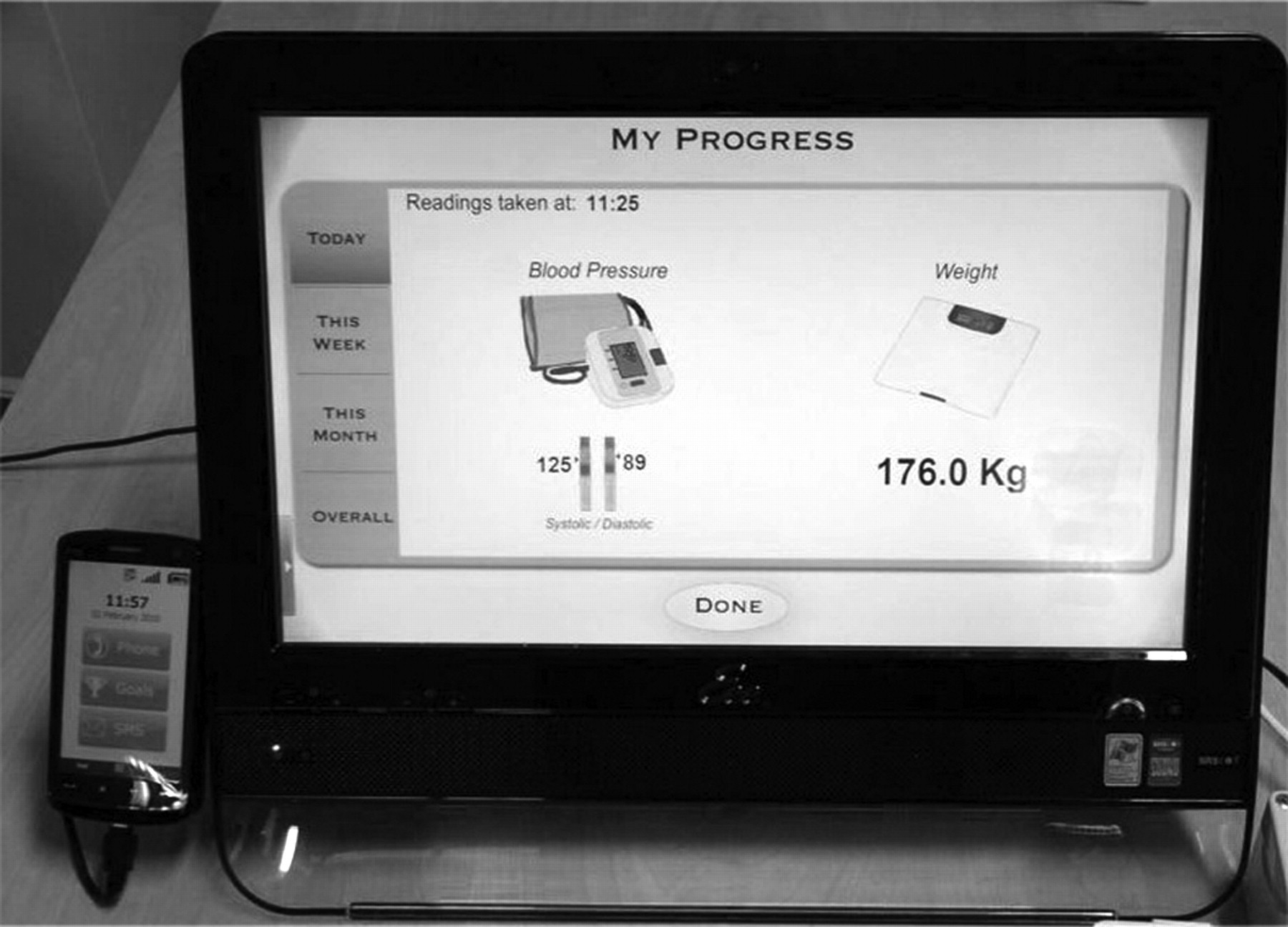
The PSMS home hub interface and mobile phone interface
Decision support system
The decision support system (DSS) comprises software tools to detect abnormal activity and distinguish life style patterns. It is used to assess the self management process, and automates feedback to the user, consistent with the achievement of their life goals.
User feedback is provided via texts, graphical images, graphs and trend analyses. Feedback is provided to users, their health-care providers and informal caregivers (usually family members). The DSS provides two types of support (Figure 3): first reminders and alerts; and second advice on the life goals which depends on further analysis of data. The user's ADLs, vital signs and self reports are pre-processed and stored in the database (DB1) and form the user's profile. The rule engine is a set of rules for sending reminders or triggering alerts. Information including location, activity, time and care plan is integrated in the context awareness module to provide feedback according to the rules provided by the rule engine. For example, the DSS compares the data collected from the smart phone (such as steps and walking time) related to the amount of walking with the targets previously stored in the care plan. Using the rule engine the DSS then provides feedback to the user, such as ‘You have reached today's goal, well done!’. The DSS also analyses, using a set of decision support algorithms, the user's activity profile over a period of time with the incorporation of the user's health history and related health-care knowledge pre-stored in the database (DB2), and provides suggestions such as changing a life goal from ‘being able to walk into garden’ to ‘being able to go to church’.
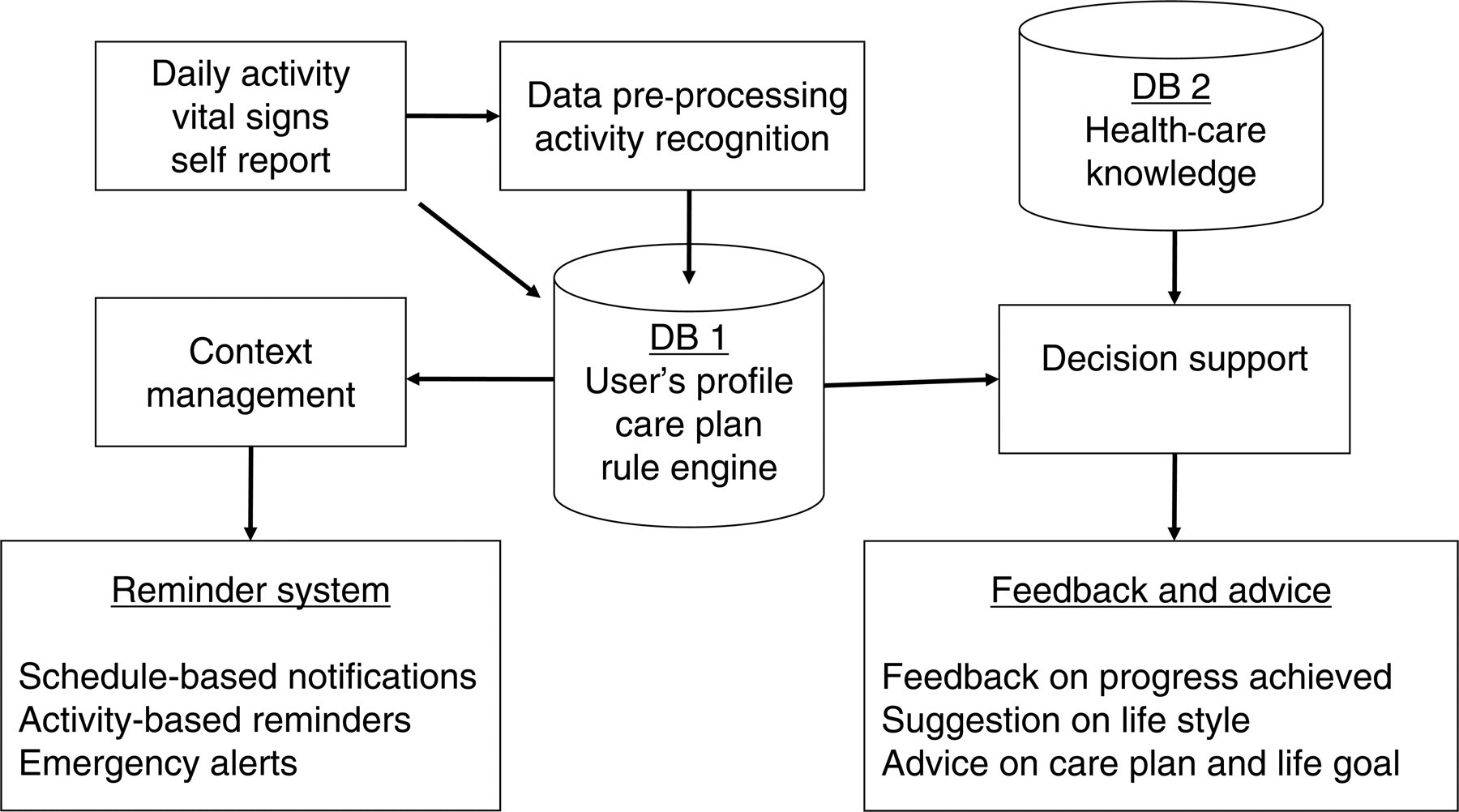
Context management and decision support system in the PSMS
Discussion
The first prototype of the PSMS has been developed. The functionality offered included monitoring of indoor activity patterns, indoor balance measurement and outdoor location tracking along with facilities to support self reporting through touch-screen interfaces. In addition, the first level of the DSS was implemented and tested. 10,11
To establish the user's activity profile, a set of data analysis tools was developed for activity recognition, to distinguish between walking, being motionless (standing, sitting and lying) and the sit/stand transition. Fall detection was also implemented. To differentiate the standing status from sitting, a data mining approach using a support vector machine (SVM) was implemented. Two types of sensors have been tested for monitoring indoor activity: a tri-axial inertial sensor (the MTx sensor, Xsens, Enschede, the Netherlands) and a smart phone with embedded accelerometer (HD2, HTC, Taiwan). Data were collected from 13 healthy control subjects. The results showed that the average classification accuracies of activity data obtained from the MTx sensor 12 and the HTC phone were 90% and 85%, respectively. In particular, the use of a ‘consumer’ mobile phone promotes acceptability and usability. The phone can unobtrusively provide an indication of activities, enabling appropriate reminders to be delivered to the appropriate person (the patient, carer, therapist), so that the care plan can be monitored, assessed and revised and life goals achieved. The mobile phone provides an accelerometer for activity monitoring and a means of receiving feedback.
In addition, we investigated patient self reporting. The following two research questions were considered: (i) Can self reporting be used as an indicator of the self management result? (ii) What questions should be included in a self report questionnaire within the PSMS system? A self reporting questionnaire consisting of 329 questions collected from each of 187 subjects with chronic pain at three treatment stages (pre-treatment, post-treatment and 6 week follow-up) was considered. The classification results from various machine learning algorithms showed that there was sufficient information contained in the questions to differentiate between the pain treatment stages. 10 A further study applied feature selection techniques to identify the optimum subset of questions from the questionnaires. The results showed that a much smaller set of questions could achieve similar levels of accuracy to the full set. 11 Thus it may be possible to use a smaller set of questions in the DSS to assess the progress of the user's self management, which will improve the feasibility for longer term use.
Conclusion
We have found that telecare and assistive technology is feasible to support self management for chronic conditions within the home and local community environments. Our system can record activity levels both within and outside the home environment along with facilitating the capability for users to self report on their perceived health and wellbeing. Larger scale testing is now required to obtain feedback from users including the usability, reliability and accessibility of the system, and the outcomes from using the system.
Footnotes
Acknowledgements
This work was supported by an EPSRC SMART project grant (No. EP/F002815/1).