




Abstract
We have conducted a pilot trial of a home telemonitoring system involving 60 adult patients with cystic fibrosis (CF) enrolled at four Italian CF centres. Thirty randomly selected patients received a home device to perform spirometry and to measure oxygen saturation. The data were transferred to a data centre which forwarded them to the patient's CF clinic. The telemonitoring system was evaluated using questionnaires completed by patients and their doctors. The doctors reported that telemonitoring was useful in monitoring their patients' health status and in decreasing the CF centre workload. The data transfer procedure posed no particular problems for the patients. The major difficulties reported by the patients were night-time saturimetry measurements, and in the first week of the study, data transmission to the data centre. The pilot trial was positive and therefore merits a larger study.
Introduction
Patients with chronic diseases often find hospital visits, for routine health checks or to review therapies, inconvenient and tiring. Home telemedicine may be a better alternative for patients who live far from health-care centres, who are homebound, or have severe chronic diseases that necessitate frequent hospital visits. Using telemedicine, staff can obtain functional data enabling them to make decisions about the appropriate therapeutic actions to take. 1 Telemedicine may result in early diagnosis, and more effective and timely therapeutic assistance, than conventional health-care models. 2
Patients with cystic fibrosis (CF), a generally fatal genetic disease, have a progressive multiorgan disease primarily affecting lung function which determines their prognosis and quality of life. Hence, from the first years of life, the primary therapeutic goal in patients with CF is to prevent respiratory complications. The complex therapeutic strategies available entail frequent (about every three months) clinical and instrumental check-ups at specialized centres, high intake of medications (especially antibiotics), daily chest physiotherapy and, in some cases, frequent and prolonged hospitalizations. 3
In the last few years the prognosis of patients with CF has markedly improved, and median survival has now reached 35–40 years. 4 The improved prognosis has led to new clinical problems linked to the progression of the disease (chronic respiratory insufficiency requiring home-based oxygen therapy or ventilation, double-lung transplantation), in addition to new social commitments (study, work, family obligations) that most adult patients must manage. 5 Adult patients with CF could therefore reap considerable benefits from a direct communication link from their home to the specialized centre responsible for their care, 6 so that their health status could be monitored perhaps daily by checking lung function and oxyhaemoglobin saturations, which are indicators of disease progression.
To our knowledge, there has been no published study of home monitoring with spirometry, pulse oximetry and an electronic symptom diary in adult patients with CF. 7,8 We are planning a multicentre randomized study to evaluate the effectiveness of telemonitoring in patients with CF. The present trial is a pilot study on 60 patients. The objective was to verify the feasibility of home-based telemedical care.
Methods
In 2007, 60 patients were recruited according to our inclusion/exclusion criteria (Table 1) from the Regional CF Centres of Rome (La Sapienza), Parma, Ancona and the Bambino Gesù children's hospital of Rome. The patients were randomly allocated to use the telemonitoring system (treatment group, n = 30) or the conventional health-care approach (control group, n = 30). In the latter, patients had periodic follow-up visits at a CF centre during which they underwent spirometry and oximetry tests, and a blood sample was collected where necessary. The study was approved by the appropriate ethics committee and a consent form was signed by each patient prior to being enrolled in the study.
Inclusion and exclusion criteria
Each patient in the treatment group received a digital recording device (SALLY Junior, QBGROUP, Padova, Italy) (see Figure 1). The device allowed them to perform spirometry tests, record oxygen saturation levels and complete an electronic symptom diary (Table 2). The device collected the data and sent the information via telephone line to a data centre. The medical staff could access the database via the web using the HTTPS protocol. Software was developed for the pilot study (QBGROUP, Padova, Italy) in order to allow the medical staff at the CF centres to access their patients' records, their spirometry curves and the results of their data analysis.
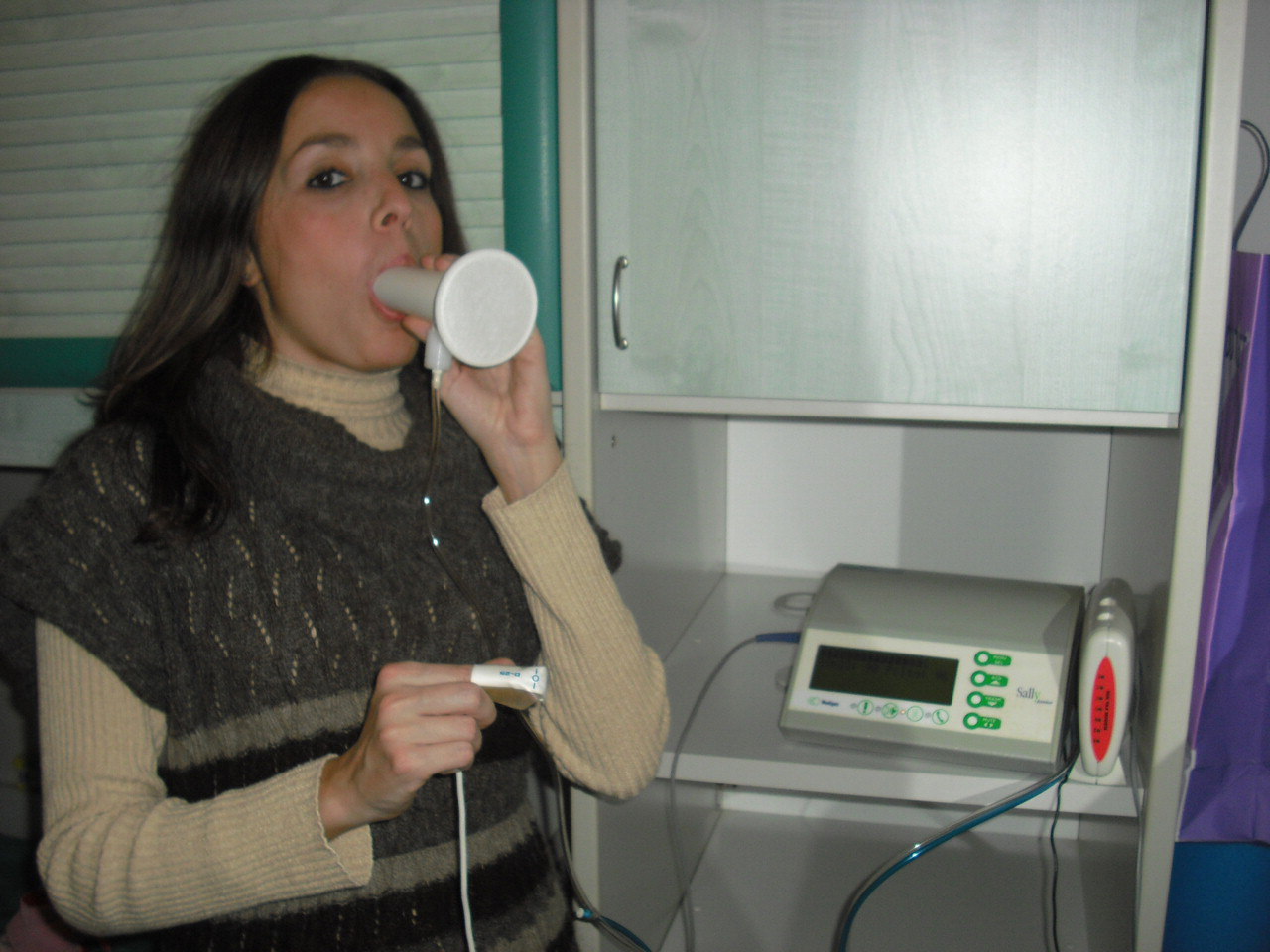
The digital recording device. The device allowed patients to perform spirometry tests, record oxygen saturation levels and complete an electronic symptom diary
Symptom diary. Patients in the telemonitoring group were asked to complete the symptom diary according to the study protocol, or whenever the patient felt his/her health conditions were worsening
A questionnaire (Q1) was completed by all patients at the beginning of the study. The questionnaire was used to evaluate patient satisfaction with the care given by their centre in the 12 months prior to the study. It consisted of closed questions and questions rated on a visual analogue scale (VAS) (0 = totally dissatisfied to 100 = fully satisfied). The questions concerned the patient's quality of life and what they felt about the disease, while VAS-rated questions concerned their perception of the quality of care received and their perceived health status.
At the end of the study, patients in the telemonitoring group completed an additional questionnaire (Q2) in order to evaluate any inconvenience encountered. All questions but one were of closed form. The aim was to find out the patients' opinions on telemonitoring and their perceptions of its usefulness and to evaluate their difficulty in managing the required procedures. In addition, at the end of the study, each doctor at the CF centre answered a closed questionnaire (Q3) about their opinion of telemonitoring and the pros and cons of the system. All three questionnaires were developed by clinicians and psychologists working in Italian CF centres.
We enrolled the patients according to the following strata: FEV1 <40% requiring daytime or night-time oxygen therapy, or both (stratum 1, n = 6), FEV1 <40% (stratum 2, n = 12), FEV1 from 40% to 70% (stratum 3, n = 20), FEV1 >70% (stratum 4, n = 22). This stratification produced balanced cohorts which reflected the Italian CF population at large, in terms of the gravity of their symptoms. Patient selection was performed so as to guarantee balanced cohorts between each CF centre.
The patients in strata 2 and 3 were considered a homogeneous group of patients from a clinical point of view, but were completely different from the patients in stratum 1 (severe clinical status) and patients in stratum 4 (good clinical status). During the first week of the study, the patients sent their data daily to the data centre in order to evaluate whether the procedure to acquire and transmit the data was correctly understood. They sent their data to the centre only twice a week from the second to the fourth week of the study (see Table 3). In addition, when the patients performed the spirometry, they also completed a simple symptom diary questionnaire (Table 2) that was sent to the data centre. Patients with FEV1 >70% sent the questionnaire only once a week.
Initial protocol. The patients could send their oxygen saturation and spirometry data to the CF centre at any time
aOn awakening
bAt the same time after inhalation therapy, physiotherapy, inhalation therapy, 15 min of rest
cAfter at least 6 h of continuous sleep
The study was to be interrupted if the number of failures was greater than 20. Any of the following was considered a failure:
If a patient at any time refused for any reason to continue telemonitoring; If in the first week a patient performed fewer than four spirometry measurements of acceptable quality; If in the first week a patient sent no oximetry data (when planned) of acceptable quality; If in at least one of the weeks following the first week, a patient sent no oximetry or spirometry data (when planned) of acceptable quality.
Results
The first questionnaire was completed by all the patients.
Characteristics of patients
The patients (50% women) were between 19 and 44 years of age (mean age 28 years). Five of them lived alone, 36 (60%) still lived with their families and 17 (28%) lived with others. Most patients had no children (90%) but 72% of them thought it was important to have some. Nearly one-third of the participants were still students: 13 attended university and 6 attended school. In the group of patients that worked (n = 37), 50% were self-employed or had executive positions. Of the employed patients, 60% said that they were not very satisfied with their jobs while the students declared that they were more than satisfied with the courses they were studying. Nearly 70% of the patients lived over 10 km from their CF centre and they usually used a car to get there; 62% of the patients commuted to the CF centre in less than one hour and only three patients lived more than two hours away. The part of the questionnaire which dealt with personal matters and the patients' rapport with the staff at the CF centre showed that all the patients were satisfied with their physical appearance, that they found it important to cultivate hobbies and interests and to inform their partners about their health status. Nevertheless, nearly one-third of the patients maintained that their illness had limited their relationships with others while serving as a way to mature. The patients also declared that they were very satisfied with the medical and nursing personnel at their CF centre, even though 50% of the patients found the treatments tiring.
An overall judgement on the perceived level of the quality of care received and the perceived state of health at the time of study recruitment was expressed using a VAS scale. The median score relative to the quality of care was 80 (range 50–100) and the median score for the health perception was 70 (range 35–90). The level of satisfaction regarding the care received as well as their state of health varied little according to the CF centre at which the patient was treated.
Evaluation of the telemonitoring system
Fifteen failures (corresponding to 15 patients) occurred during the study, only two of which were due to the patient's explicit refusal to proceed with the study. Both these refusals occurred in the first two weeks: one patient reported being disturbed during the night by the saturimeter, the parents of the other patient felt it was too demanding for their son to participate to the study. Of the remaining 13 patients, 5 encountered difficulties in collecting the night-time saturimetry measurements and sending data to the data centre, especially during the initial period, when the data transmission system was not perfect.
The data transfer procedure posed no particular problems. Most patients (90%) did not require domiciliary assistance and all the patients who sent data were able to do so without assistance. The time required to learn the procedure was less than 20 min and for nearly one-third of the patients, 10 min were sufficient. Only two patients found the procedure to be difficult to perform. The patients' opinions on the system were encouraging: 70% of the patients were glad to evaluate their own health status and thanks to the telemonitoring system they also felt safer. In fact, the patients had never checked themselves and their vital signs before and the present study was the first occasion on which they were able to do this. Before starting the study, the clinicians explained to the patients how to interpret the data they were to collect. Consequently, over 80% of them desired to continue using the system in the future.
The questionnaire administered at the end of the study contained the following open-ended question: ‘What suggestions would you like to make in order to improve the domiciliary monitoring?’ The patients' (n = 30) answers can be summarized as follows:
Reduce the frequency of data transfer, especially during the night (n = 7); Improve the technical aspect of the procedure (i.e. a longer wire for the saturimeter, more sensors for the saturimeter, more secure and faster data transfer to the data centre) (n = 8); Other/missing (n = 15).
All four doctors responsible for the study at the CF centres expressed positive opinions about the telemonitoring. Three of them thought that it was useful in identifying the worsening of disease conditions and one thought that telemonitoring decreased the CF centre's workload. They had no concerns about the feasibility of the study, and had no difficulties in using the software or the computer. Only one doctor reported some difficulties in communicating with the help-desk.
Discussion
The questionnaires completed by the patients and the data provided by the data centre revealed some matters that needed to be addressed, such as incorrect timing for completing and sending the questionnaires, difficulty in distinguishing between morning, evening and nocturnal saturimetry due to poor regard for the suggested timing of the measurements, and omission or delay in reporting the reason for failure to transmit the data (e.g. holidays, hospitalization, personal matters). Many patients (n = 10) found the frequency of data transmission excessive.
In order to address these problems it was agreed to:
Modify the software to distinguish measurements performed at different times during the day; Reinforce the instructions given to the patients to improve the poor respect of the protocol timing during the initial period of the pilot study; Reduce the frequency of the measurements to simplify the protocol and ensure compliance.
In order to identify worsening spirometry values, it was decided that a minimum acceptable FEV1 would be set for each patient. An alert signal (via SMS or email) would be sent to the doctors in the corresponding CF centre should the spirometry value recorded by the patient go below this threshold. An alert signal would also be sent if the oximetry values went below 92%. Furthermore, the data transfer protocol would be modified to render the transfer more flexible (Table 4).
Revised protocol. The patients could send their oxygen saturation and spirometry data to the CF centre at any time
aOn awakening
bAt the same time after inhalation therapy, physiotherapy, inhalation therapy, 15 min of rest
cAfter at least 6 h of continuous sleep
The minimum number of failures to stop the project did not occur during the pilot trial. All the doctors at the CF centres expressed positive opinions about the study feasibility. We therefore conclude that the pilot trial was positive and merits a larger study. However, we did not evaluate the ability of the CF centres to cope with the additional workload required by the telemonitoring, or the patients' ability to carry out the procedure for a long time. Both these aspects will be evaluated in future work.
Footnotes
Acknowledgements
We thank all the patients who participated, the staff at the CF centres and the Italian Cystic Fibrosis Society. We also thank the referee for the useful comments given on the first version of this paper. The project was supported by Lega Italiana Fibrosi Cistica.