




Abstract
Despite a re-evaluation of risks in recent years, hormone replacement therapy is still surrounded by controversy. Almost 30% of women in a recent survey sought a natural approach to combat climacteric symptoms. Nevertheless, a large proportion of patients felt that they wanted a good safety profile and strong evidence base for treatment. This article seeks to review the evidence supporting non-hormonal approaches to treatment. There is only conflicting evidence at best to support alpha-2 agonists, e.g. clonidine and limited evidence for dihydroepiandrosterone and natural progesterones. There is limited randomized controlled trial data for gabapentin, selective norepinephrine re-uptake inhibitors (SNRIs) and selective serotonin re-uptake inhibitors (SSRIs), many of these studies being related to breast cancer patients. Of the herbal medicinal products, the largest evidence base rests with phytoestrogens. A Cochrane Database review looking at all types of phytoestrogens, e.g. red clover extracts, dietary soya and soya extracts concluded that there was no evidence to support improvement in climacteric symptoms and the meta-analysis of a 178 studies on soy products was inconsistent. Nevertheless, other studies disagree. Mammographic density is not affected by soy or phytoestrogen products and recent in vitro work shows only a weakly proliferative effect of soy isoflavone on breast cancer cells and evidence that soy isoflavone blocks the proliferative effect of estradiol on these cells. There are no studies looking at clinical outcome measures for cardiovascular disease but a number of studies looking at biochemical markers including arterial wall stiffness and apolipo protein B. Recent studies have also looked at the effects of red clover isoflavone on mood and depression, using specific depression rating scales. Finally, it is important to note that herbal medicinal products should not be used without caution. Some may produce quite marked side-effects in high doses and others can interact with pre-existing medication. A strategy for which patients are suitable for herbal medicinal products is reviewed.
Introduction
The last eight years have seen a considerable amount of media coverage debating the risks and benefits of hormone replacement therapy (HRT). Although the risks have been exaggerated and the data have been extrapolated from the 60s and 70s down to much younger age groups erroneously, it has left considerable anxiety in the minds of women and confusion among general practitioners.
An online survey of 166 menopausal women 1 looked at women's perception as to their symptoms and to their management via the National Health Service (NHS), 48% were aged between 45 and 50 years and 28% aged between 50 and 55 years: the majority were symptomatic and perimenopausal. Hot flushes and sleeplessness were experienced by 70% of the respondents and mood swings by 68%. In all, 61% were concerned about night sweats and 58% about anxiety. Almost 60% of the respondents admitted that they were doing nothing to combat their menopause and 28% said they were using a natural approach, as opposed to only 10% seeking a conventional medical approach. Almost 40% of respondents did not feel the NHS took the menopause very seriously. When asked what treatment they would like to receive from their health-care professional (HCP), almost 50% said that they would like natural supplements and 39% asked for lifestyle advice as opposed to 27% requesting HRT. Other complimentary therapies were requested by 21%. The reason given for why women stopped or did not use HRT was stated by 30% as a preference for a natural approach and by 27% as concerns about safety. When asked what were the most important attributes for natural treatment 70% of the respondents said it mattered to them if the treatment was recommended by an HCP, and over 75% said it was important that there was good symptom control and safety profile. At least 70% requested a strong evidence base for the treatment.
It is very obvious from these responses that women are questioning whether there are alternatives to HRT but more to the point they are requesting a lead from HCPs and they are thinking consumers, i.e. they want to see evidence to support the case. It is therefore important that all clinicians have some idea of what alternative treatments are available and which have the strongest evidence base.
Non-hormonal treatments for vasomotors symptoms
Alpha-2 agonists, e.g. clonidine has been used for some time with varying success, although the evidence base is contradictory. An early randomized controlled trial (RCT) using oral clonidine showed no hot flush reduction. 2 Usually doses of the order of 25 µg twice daily or thrice daily are required. It can sometimes cause postural hypotension and there are side-effects in 50% of users, including difficulty sleeping. It is not particularly effective in the presence of severe sweats and flushes. Clonidine should be tailed off gradually rather than sudden cessation to prevent rebound hypertension. The transdermal modality may perhaps be more efficient. 3 Beta-blockers, e.g. propranolol have been used for palpitations and anxiety but are not helpful for sweats.
Selective serotonin re-uptake inhibitors (SSRIs), e.g. fluoxetine, paroxetine and citalopram do have some small RCT data. 4,5 The best evidence is for paroxetine, at the dose of 10 mg a day. Higher doses are not associated with improved symptom control and this is off-licence prescribing. There is an adverse affect on libido and SSRIs should not be prescribed in breast cancer patients on tamoxifen. Fluoxetine and paroxetine are known to inhibit cytochrome P450 (CYP2D6), an enzyme important in tamoxifen metabolism to the active metabolite endoxifen. Inhibition of this pathway can be associated with altered tamoxifen activity. 6
Selective norepinephrine re-uptake inhibitors, e.g. venlafaxine have also been reported to be efficacious in small studies mainly related to breast cancer patients unable to have HRT. 4 Normally venlafaxine is started at 37.5 mg a day but can be titrated up to 75 mg a day if necessary. Venlafaxine is less likely to interfere with tamoxifen metabolism than fluoxetine and therefore is more advantageous in breast cancer patients taking anti-estrogens, but can reduce libido. 7 Reports of suicide ideation have been exaggerated and do not occur at this dose. Nausea can be a side-effect, reduced by using long-acting formulation, as a once daily dose at night. Caution must be counselled with patients with cardiovascular risks, e.g. recent myocardial infarct or arrhythmias.
Gabapentin has also been used to relieve vasomotor symptoms in breast cancer sufferers. 4 Studies contain small numbers and they have been followed up for very short periods of time. In one study using gabapentin at a dosage of 900 mg/day, a 45% reduction in hot flush frequency and a 54% reduction in symptom severity were demonstrated. 8 In another randomized study, the 600 mg dose was compared with 25 µg estradiol patches, and both were effective for moderate-to-severe hot flushes, but the patches were superior. 9 The dose used is normally 300 mg thrice daily but, to reduce side-effects, the dose can be titrated up gradually, i.e. 300 mg a day for two weeks, 300 mg twice daily for two weeks and finally 300 mg thrice daily after the first month. 7 If drowsiness is an issue during the day then the total dose may be administered at night. In all, 50% of patients report side-effects, but there is good evidence for vasomotor symptom control.
Other hormonal treatments
In the USA, dehydroepiandrosterone (DHEA) has been used to relieve vasomotor symptoms, but it has not been extensively used in the UK. Some studies have shown benefits on libido, the skeleton, cognition, wellbeing and the vagina. 10 Using DHEA, an uncontrolled pilot study showed a small reduction in hot flushes 11 Norethisterone at 5 mg a day can reduce sweat and flushes and RCTs have shown a benefit for megestrol acetate against placebo in the treatment of vasomotor symptoms. 12 Patients with breast cancer who had progestogen receptor-positive tumours should avoid this. Furthermore, doses of progestogens that achieve vasomotor symptom control can increase side-effects 5 and the risk of venous thromboembolism. 13 There have long been advocates of natural progesterone creams, but there is very limited evidence to show that there is genuine relief in vasomotor symptoms, 14 one study showing no relief and a high placebo response. 15 A high placebo response is noted in all trials.
Complementary therapies
A number of complementary therapies have been used in an attempt to control climacteric symptoms without the use of HRT. These include osteopathy, reflexology, aromatherapy, hypnotherapy, yoga, the Alexander technique, counselling and meditation. Most of these approaches concentrate on de-stressing and relaxing the patient, which may have an indirect effect on wellbeing and mood but clearly will have no direct effect on biological issues such as bone mineral density, collagen composition, cardiovasculature or vasomotor symptoms. There is conflicting evidence regarding efficacy of acupuncture mainly because of trial design. In a recent meta-analysis including six ‘sham’-controlled RCTs, no beneficial effect was demonstrated for control of hot flushes. 16 Nutritional therapy has been advocated and certainly deficiency states in trace elements such as selenium, magnesium and zinc may exacerbate lethargy just as an imbalance of sodium and potassium can have a profound effect on wellbeing. But, although a healthy diet is important for general health, there is no evidence of a direct effect on climacteric symptomatology. The above techniques might be used in conjunction with a non-hormonal bone-sparing agent such as one of the bisphosphonates of which there are now preparations that can be administered three-monthly or annually. Strontium ranelate and raloxifene are also available although selective estrogen receptor modulators (SERMs) such as raloxifene can cause sweats and flushes in up to 12% of cases as a side-effect of treatment and strontium is currently under review, with regard to severe allergic reactions including drug rash with eosinophilia systemic symptoms (DRESS). 17
General lifestyle measures should always be discussed with the patient, for example, wearing cotton rather than nylon or polyester, avoiding stuffy and over-crowded environments, making sure that the bedroom is well ventilated and wearing layers. Alcohol, tiredness and stress are all known to exacerbate vasomotor symptoms, and ways in which to reduce stress levels in the working environment and at home should be considered.
Herbal medicine
The one complimentary therapy group that has the best evidence base is herbal medicinal products (HMPs). However, although osteopaths and chiropractors are regulated as professions by an Act of Parliament, HMPs are still categorized as food products and therefore do not come under the jurisdiction of the Committee on Safety of Medicines. The House of Lords Committee has recommended that acupuncture and HMPs should be legislated, and an EU Directive (October 2005) ruled only on traditional herbal remedies and did not cover products brought elsewhere. Currently, HMPs have to be registered but not licensed with the Medicines and Healthcare products Regulatory Authority in the UK. Until this happens, there is a vast array of products that can be bought over the counter, many of which try to quasi-medicalize their contents by displaying the amount of shoots or blossoms in ‘milligrams’ or do not contain the quoted chemical analysis. 18
St Johns wort
St Johns wort has been shown to be efficacious in mild to moderate depression both in peri- and premenopausal women because of its SSRI-type effect. 19 Efficacy for vasomotor symptoms, however, has not been proven. It is of concern that it interacts with other medications, e.g. it decreases the blood concentration of cyclosporin, midazolam, tacrolimus, mitriptyline, digoxin, indinavir, warfarin and phenprocoumon. Cases have been reported where decreased cyclosporin concentrations have led to organ rejection. There is the possibility of breakthrough bleeding and contraceptive failure if St Johns wort is used with the combined oral contraceptive pill. It has been reported to induce a serotonin syndrome when used in combination with SSRIs such as sertraline and paroxetine.
Agnus cactus
Although there are some data for the benefits of Agnus cactus in premenstrual syndrome, no such data exist for menopausal symptoms although it is occasionally used for this purpose.
Black cohosh
Black cohosh is certified by the German Medicines Control Agency for use in controlling climacteric symptoms for six months. Of the RCTs using black cohosh, only three were placebo controlled. They have shown benefits to vasomotor symptoms, including one where black cohosh was compared with conjugated estrogens. 20–22 A systematic review of the safety of black cohosh suggests that there is a slight risk of minor, transient adverse events, such as gastrointestinal upset and rashes, even if taken for a limited period. There have been more serious adverse events reported, however, including hepatotoxicity, and one case requiring liver transplantation. 23 There are no clinical trials assessing the effects of black cohosh on breast tissue but endometrial thickening has been assessed by ultrasound over three months of treatment with 40 mg of black cohosh and no difference was found between placebo and treatment groups. 24
Gingseng
Gingseng is a perennial herb native to Korea and China. It has been used extensively in Eastern Asia. It has not been found to be superior to placebo for vasomotor symptoms in a randomized trial, although the parameters of wellbeing and depression were improved. 25 Case reports have associated gingseng with postmenopausal bleeding and mastalgia as it has an estrogenic-like property. Interactions have been observed with warfarin, phenelzin and alcohol.
Dong Quai
Dong Quai is a perennial plant native to south west China commonly used in traditional Chinese medicine. It has not been found to be superior to placebo in one randomized trial. 26 There is an interaction with warfarin, and photo-sensitization has been reported, due to the presence of coumarin.
Gingko biloba
The use of Gingko biloba is widespread but there is little evidence to show that it improves menopausal symptoms. Some studies have shown a benefit from relief of anxiety and depression. There are claims for cognitive benefits from some studies in postmenopausal women but these require confirmation from large long-term studies. 27
Phytoestrogens
Phytoestrogens are naturally occurring plant components that interact with mammalian endocrine systems. They are less potent than conventional estrogenic compounds and have selective β receptor binding properties. 18,28 Evidence is accumulating that isoflavones, a subgroup, may have beneficial properties against chronic and degenerative diseases. 29 There is a more substantial body of evidence supporting alleviation and lowering of the rates of menopausal vasomotor symptoms and maintaining bone health. 30
Soya beans and soya-containing products are the best known and most widely consumed phytoestrogen-containing foods. Other food sources are legumes, lentils, chickpeas, beans, alfalfa shoots and red clover.
Dietary isoflavones exist in two forms as glycosides, attached to a sugar unit, or as aglycones, free forms. Controversy exists as to the bioavailability of isoflavone glycosides compared with aglycones in humans. Setchell et al. 31 reported that the glycoside form is not absorbed intact and their bioavailability requires initial cleavage of the sugar moiety by gut flora for uptake. Isoflavones from soya are generally in the glycoside form, genistein and daidzin, whereas those from red clover are generally aglycones, formononetin and biochanin A.
A consumer survey was conducted among postmenopausal women in four European countries, 32 including 465 respondents. The acceptability of isoflavones differed significantly between countries (P < 0.001) and also the preferred form of administration. Acceptability was highest in Germany (80%) where the preferred administration was soy food (80%). Italy had a 75% acceptance, but 86% preference for capsules or pills. Acceptance rates were much lower in the UK (59%) and Denmark (55%).
A Cochrane Database review of 30 randomized trials (lasting at least 12 weeks and involving a total of 2730 participants) assessed the efficacy, safety and acceptability of foods and supplements including high levels of all phytoestrogens (i.e. red clover extracts, dietary soy, soy extracts and other types of phytoestrogens). The reviewers concluded that there was no evidence that phytoestrogen treatments helped to relieve menopausal symptoms, 33 echoed by a systematic review 5 but other studies differ.
Soya
A meta-analysis of 178 studies published in 2005 found that the effects of soya products on menopausal symptoms were inconsistent.
34
Evidence of benefit was strongest for RCTs data on soy isoflavone supplements but not other soy products. These effects were not seen among perimenopausal women or women with breast cancer. Mammographic density was not affected by soya preparations even after two years of use.
35
The effects of soy isoflavones on MCF-7 breast cancer cells were investigated
36
in the presence and absence of estrogen, directly and in a metabolized form by testing sera of postmenopausal women supplemented with isoflavones as follows:
Untreated; Isoflavone extract 200 mg for two weeks; Estradiol 2 mg for two weeks; Estradiol 2 mg plus isoflavone extract 200 mg for two weeks. Effects of soy isoflavones on 17β estradiol-induced proliferation on MCF-7 breast cancer cells. MCF-7 cell culture model – serum samples. Only weak proliferation with isoflavones despite the absence of estradiol. Isoflavones protect against the proliferation induced by estradiol (confirmed by Gene Chip Assay)
36
Serum samples were collected and incubated in the MCF-7 breast cancer cell culture model and proliferation of cancer cells assessed by the affymetrix gene chip assay. In the absence of estradiol, isoflavones produced very weak proliferation compared with controls, with estradiol producing a greater effect. However, if isoflavones and estradiol had been taken together, the former negated the proliferative effects of the latter (Figure 1). This study supports the safety of isoflavones in relation to breast cancer and demonstrates a possible protective effect against its development. A risk of endometrial hyperplasia has been questioned in one study.
37

Red clover isoflavones
A meta-analysis and systematic review of 17 RCTs of soy and red clover isoflavones showed significant reduction in hot flush frequency, particularly in the women who had frequent flushes.
38
One RCT showed a decrease in hot flushes of 60%, and 73% of women experienced a significant reduction in hot flushes within six weeks.
39
Jeri
40
reported a reduction in frequency by 48.5% and severity by 47% of hot flushes, and Nachtigall et al.
41
reported a reduction in night sweats in 52% of cases. This has given rise to a clinical treatment algorithm where red clover isoflavones have been recommended for mild-to-moderately symptomatic women combined with lifestyle modifications.
42
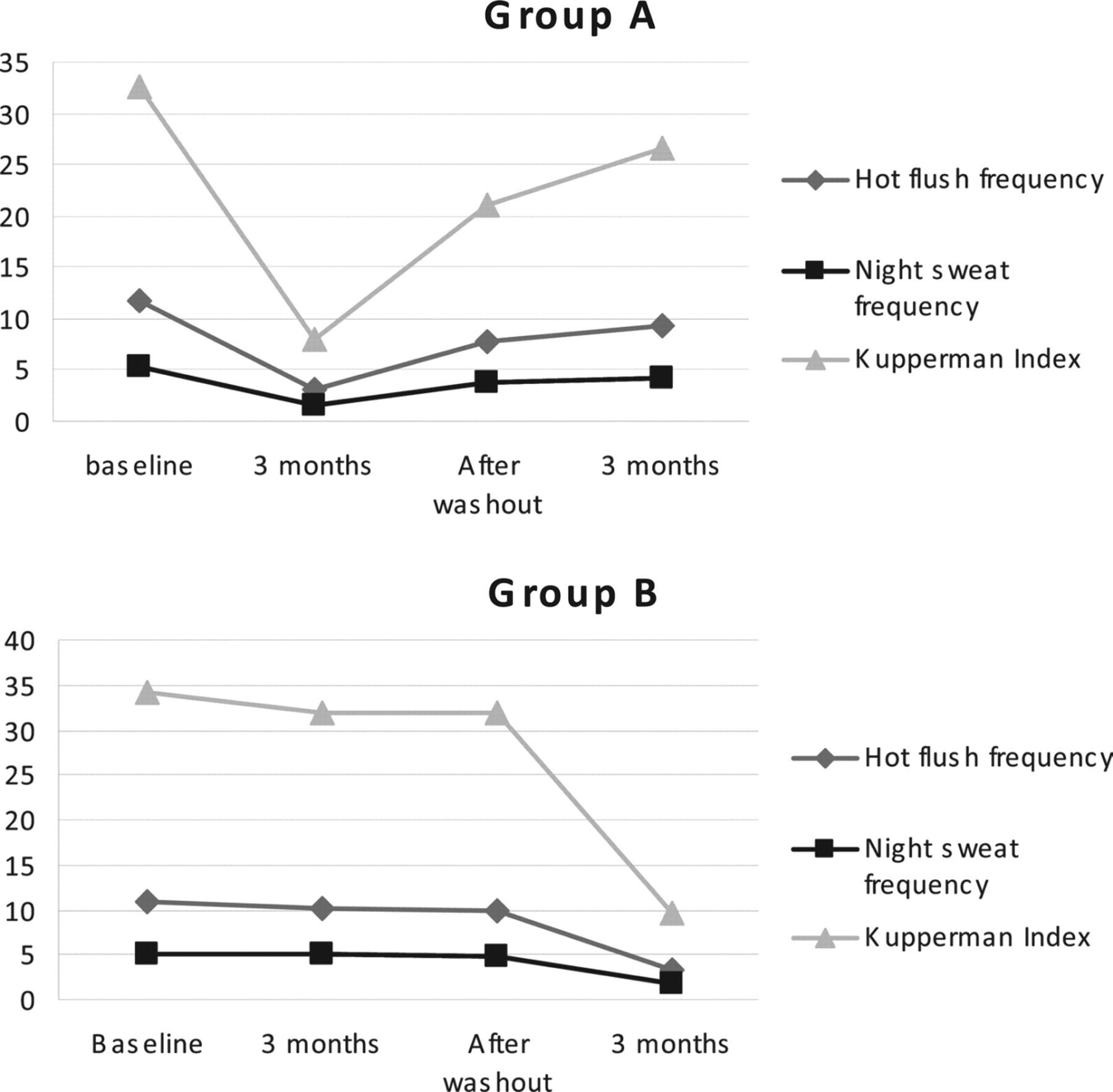
An RCT of crossover design was conducted on 109 postmenopausal women over 40 years for six months to evaluate the effect of red clover isoflavone over vasomotor symptom frequency and overall symptom intensity. Group A commenced on 80 mg red clover isoflavones and crossed over to placebo at three months. Group B did the reverse. Endpoints measured were hot flush and night sweat frequency and the Kupperman index. Group A demonstrated a significant drop (P = 0.0001) in the Kupperman index at three months, which rose steeply once switched to placebo. This change was mirrored in the fall and subsequent rise in hot flush and night sweat frequency (Figure 2). Group B showed no change in symptoms at three months but an improvement in symptoms, i.e. decrease in severity (P = 0.0001) once the active treatment was commenced.
43
The effect of red clover isoflavone supplementation over vasomotor and menopausal symptoms in postmenopausal women. (A) Red clover isoflavones (80 mg) then placebo crossover; (B) Placebo then 80 mg red clover isoflavones
43
One of the biggest concerns with any HMP that has an estrogenic molecular structure is whether or not it produces breast stimulation and increases the risk of developing breast cancer. Increase in breast density is regarded as a surrogate marker of breast cancer. In one RCT there was no increase in breast density with red clover isoflavones over a 12-month period. 44 Powles in a three-year study has suggested that their use is safe in patients with first-degree relatives with breast cancer. 45
There are now several small double-blind RCTs that show no increased endometrial thickness on ultrasound during treatment with red clover isoflavone. 46–48 None of these studies ran for more than three months, but one trial showed no increase in endometrial thickness over six months. 49 One study reported to show a decrease of 14.7% in endometrial thickness in postmenopausal women on treatment. 50 This double-blind RCT studied 109 women for 90 days.
Regarding bone density, an RCT showed a significant improvement (up to 4.1%) in proximal forearm bone density over six months in postmenopausal women on red clover isoflavone with 57 mg/day (P = 0.02) and by 3% with 85.5 mg/day (P = 0.023). 49 A larger RCT of 177 women followed up for 12 months showed attenuation of bone loss in the lumbar spine. 44
There are no studies looking at clinical outcome measures for cardiovasculature but a number of studies have looked at biochemical markers. Three of four trials examining the effect of red clover on lipids found no benefit; the fourth trial contained too little data to interpret in a Medline search for controlled trials of red clover. 51 Mean total cholesterol, LDL-cholesterol and triglyceride levels decreased; however, only the latter was significantly lower compared with placebo in a study examining 60 women and the effects on vasomotor symptoms, vaginal cytology and lipids. 52 An RCT using 40 mg of red clover isoflavone showed a 10% reduction in cholesterol and 13% reduction in LDL cholesterol over 12 weeks 47 screening lipids at baseline and end of study. 53 A study by Nestel et al. 54 showed no effect on lipids but a reduction in arterial stiffness by 23% over 10 weeks. Clifton-Bligh studied 46 women over six months and showed a dose-dependent effect on lipids. The HDL-cholesterol rose by 15.7–28.6% (28.5 mg/day P = 0.007; 57 mg/day P = 0.002; 85.5 mg/day P = 0.027). Apolipoprotein B fell by 11.5–17% (28.5 mg/day P = 0.005; 57 mg/day P = 0.043; 85.5 mg/day P = 0.007). 49
There appears to be no significant effect on body mass index or weight after 12 weeks supplementation 52 and this has been confirmed by Atkinson after 12 months. 44 This study also looked at body composition including distribution of fat and lean tissue which was unchanged. Two studies have looked at the effect of red clover isoflavone on vaginal tissue. A small RCT eight-week study showed an improvement in vaginal maturation index compared with placebo. 48 Another Grade A evidence study showed a positive estrogenic effect with significant improvement on karyopyknotic cornification and basal cell maturation indices. 52
There appears to be a reduction in cyclical mastalgia of 44% in red clover users compared with 13% in the placebo group using a 40 mg dose; 75% of participants in the study experienced clinical improvement in breast pain compared with only 33% in the control group. Increasing the dose to 80 mg had no impact on improvement or deterioration in symptoms. This small study, however, was only run over two cycles. 55
Red clover derived isoflavones (MF11RCE) were effective in reducing depressive and anxiety symptoms among postmenopausal women
BMS, body mass index; HRT, hormone replacement therapy
*Mean = standard deviation
† P < 0.001 as compared with baseline
‡ P < 0.001as compared with placebo
Breast cancer patients
Shanghai breast cancer survival study
Comparing highest quartile of soy intake to lowest quartile 66
Soy intake (soy protein or soy isoflavones intake) associated with: hazards ratio (HR) for total mortality = 0.71(95% confidence interval [CI] 0.54–0.92); HR for recurrence = 0.68 (0.95% CI 0.54–0.87)
Cautions with HMPs
Herbal remedies should be used cautiously in women where there is a contraindication to estrogen because some of the preparations have estrogenic properties. Bleeding can occur when combined with warfarin and aspirin with some medicinal products. Hypertension, coma and a mild serotonin syndrome can occur when HMPs are combined with SSRIs and there is a reduction in efficacy with antiepileptics and oral contraceptives. St Johns wort interacts adversely with mono-aminoxidase inhibitors and SSRIs. 67 Black cohosh in high doses may cause vomiting, headaches, dizziness, low blood pressure and limb pain. G. biloba may produce mild gastro-intestinal complaints and rarely allergic skin reactions. Finally, ginseng in large doses may cause sleeplessness, oedema and hypertonia. There is good safety data for red clover isoflavones, in 15 clinical studies, totalling 1174 women there have been no adverse safety endpoints to date. Migraine and arthralgia were reported more in the placebo group and pooled adverse events data showed no difference at different doses.
Which patient is suitable for HMPs
There is clearly a range of women from those that will benefit from alternative therapies to those that would be least suitable. Women at risk of venous thromboembolism and those who want a natural approach to the menopause are best advised to avoid HRT. Some women who have been on HRT will need to stop. The International Menopause Society Consensus Statement (2008) 68 quotes that, reviewing the evidence, it is safe for the average fit and healthy woman to stay on HRT until she is 59 years of age. However, evidence suggests an increased risk of heart disease, stroke and breast cancer in the 60s and 70s age bands. HRT should never be stopped abruptly and it is recommended there is gradual reduction before cessation. These women may well want to switch to a natural preparation afterwards and it would be sensible to recommend that one best evidence base with the least side-effects and risks.
Conversely, women who have undergone premature ovarian failure (cessation of ovarian function before the age of 40 years) or who have undergone a surgical menopause, i.e. total abdominal hysterectomy with bilateral salpingo-oophorectomy, have more need of estrogen and are more suitable for HRT than herbal medicinal remedies. Bone loss is accelerated after a surgical as compared with a natural menopause and vasomotor symptoms are more dramatic with rapid onset. In these circumstances, estrogen and testosterone replacement should be considered. Young women who have undergone premature ovarian failure iatrogenically following chemotherapy and radiotherapy, have need for higher estrogen doses than older age groups and they would be best with formal HRT, at least until the average age of the natural menopause, 51 years. Finally, for women in the 50s with established osteoporosis who are symptomatic HRT is the best approach. Severe osteopenia should also be considered. There remains the dilemma of women who have had a history of breast cancer and those on anti-cancer therapy, although women on antiestrogens such as tamoxifen should be safe to have soy and red clover isoflavone.
Competing interests
JP has been on the International Advisory Panels for Servier, Wyeth, Novo Nordisk and currently Astellas. JP has received honoraria for lectures and educational grants from various sources including Novogen for her team to attend meetings.