




Abstract
Objective.
This paper describes the investigation, categorization/characterization and viewing of pelvic floor muscle exercises (PFME) on YouTube from the perspective of the ‘wisdom of the crowd’. The aim of the research was to increase awareness of the type of clips that individuals are likely to come across when searching YouTube and to describe trends and popularity. This awareness will be useful for the design of continence promotion services, especially for hard-to-reach individuals.
Study design.
Web-based videos relating to PFE were identified by searching YouTube using the snowball technique.
Main outcome measures.
Number of views; the approach taken (health, fitness, sexual and pregnancy); product promotion; and the use of music, visual cues and elements designed to encourage exercise. The number of views of each video was recorded at three points over a seven-month period.
Results.
Twenty-two videos were identified. Overall these videos had been viewed over 430,000 times during the study period. One video was viewed over 100,000 times and overall the median increase in views was 59.4%.
Conclusions.
YouTube is increasingly used to access information about pelvic floor exercises. Different approaches are used to communicate PFME information but there are no formal structures for quality control. Further research is required to identify which elements of the video clips are effective in communicating information and in motivating exercise and to establish appropriate protocols. Kitemarking is recommended in order that women obtain correct advice.
Introduction
There is little in the literature concerning health-related use of YouTube in self-care. Self-care is being increasingly emphasized to help mitigate against concerns regarding the current reactive model of health care that is unsustainable. 1 It is estimated that less than half of the adults with moderate or severe urinary incontinence (UI) seek help from healthcare providers. 2 In a previous edition of this journal, Cumming et al. 3 presented data from an online survey suggesting that UI worsened or was exacerbated by the menopause transition and that individuals may be too embarrassed to seek help despite UI having an adverse effect on health, self-esteem and relationships, with some women accepting symptoms as a normal part of the menopause or of the ageing process. Cumming et al. 4 also demonstrated how a digital story has the potential to empower women to seek help for vaginal atrophy who were similarly too embarrassed to seek help despite negative effects on their lives.
In US studies, 80% of Internet users, or 59% of US adults, look online for health information 5 and worryingly, it is known that 75% of Internet users who look online for such advice do not consistently check the source and date of the information they find. 6 Research specifically about the use of YouTube to communicate health information found that 58.3% of videos had useful information and 18.1% were misleading. 7 The authors suggested that authoritative videos by trusted sources be used to disseminate reliable information on the Internet.
Policy-makers are recognizing the role patients have in shaping their care. 8 The value of utilizing the ‘wisdom of the crowd’ is increasingly recognized in business and the pharmaceutical industry, 9 and medicine is beginning to incorporate the principles of co-production in patient care. 10
This paper describes the investigation, categorization/characterization and viewing of pelvic floor muscle exercises (PFME) on YouTube from the perspective of the ‘wisdom of the crowd’. Given the proportion of women with incontinence symptoms who currently do not approach health services for help 2 it is likely that some of these women may look to the Internet for information and support. 5 The aim of the research described in this paper was to increase awareness of the type of clips which individuals are likely to come across when searching YouTube and to describe trends and popularity. This awareness will be useful for the design of continence promotion services, 11 especially for hard-to-reach individuals.
Methods
Desk-based Internet research was used to identify YouTube videos about PFME. The words ‘pelvic floor exercise’ were entered into the YouTube search function. As clips were viewed, additional suggestions were offered by the site and these in turn led to further suggestions. The methodology replicates the ‘snow ball’ technique in social science where one source leads to another. 12 This search/navigation protocol was used to give results that women would be expected to find when searching for clips about PFME in the real world setting. Exclusion criteria included video clips that simply mentioned PFME or provided descriptive information about the anatomy of the pelvic floor, clips of a sexual nature and clips used purely to advertise a product for PFME. Clips that may be useful in motivating or supporting women to exercise were included, even when these did not include instruction or advice about exercise.
Data concerning the approach taken (health, fitness, sexual and pregnancy), the use of musical and visual clues, the use of product promotion, and whether or not there were elements designed to encourage exercise were collected from those video clips that had not been excluded. Additional data were then collected from YouTube about the age and gender of the audience. Data were collected on 8 April, and follow-up data collection took place on 12 May and 8 November 2011, after approximately one month and after a further six months.
Video clip number, title of clip, predominant approach used and which group accessed the clip most

In searching for information about PFME, the authors tried to remain open minded about different approaches
Results
The 22 videos had been viewed over 1,150,000 times up till 8 November 2011. Between 8 April and 8 November there had been 433,692 views and one video (clip 2) had been viewed over 100,000 times. The median increase in views over the study period for all the videos included in the analysis was 59.4% (Figure 1). From the information provided by YouTube, the age group of most viewers was between 35-64 years of age. In nine clips, the most common group of viewers were women between 45 and 54 years (45%) with five of these clips utilizing a fitness approach, and four a health approach (Table 1). In eight clips, the most common group of viewers was men between 45 and 54 years with the majority coming from a health approach (Table 1). Clips using a pregnancy approach attracted the youngest viewers. Feedback and comments about the clips ranged from rude and insulting to gratitude for the information provided. The percentage increase in views of video clips where it is expected that women in the perimenopausal/menopausal transition predominated (i.e. age 45-54) are shown in Figure 2.
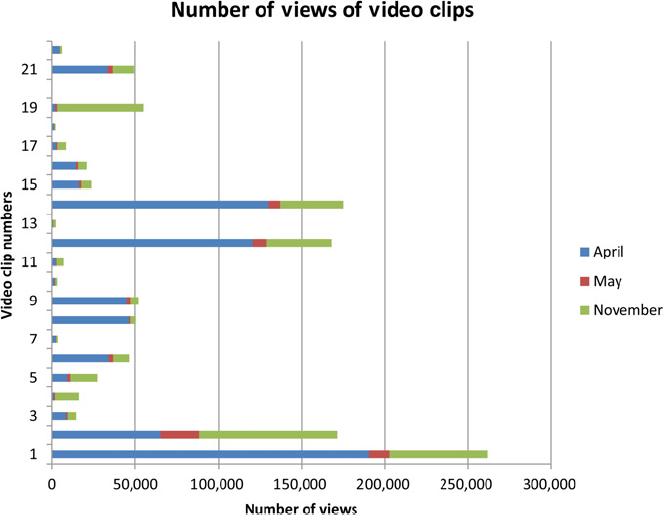
Graph showing total number of views of each video clip over the three time points of the study period

Graph showing percentage increase in views of video clips most popular with women between 45 and 54 years between 8 April and 8 November 2011
A range of ‘hooks’, including humour and flashing graphics, were used in the clips but in this study it was not possible to identify which of these elements were successful in prompting, motivating and maintaining exercise. It may be of interest to note that the video clip that showed the highest increase in views has been integrated into a smart phone application for pelvic floor exercises, which may indicate that ‘apps’ might be useful in supporting women to exercise.
The majority of videos were categorized as from either a predominantly health or fitness approach, with 14% (n = 3) primarily focusing on pregnant women (Table 1). Not surprisingly, the setting used in clips often communicated information about the approach of the contributor, e.g. where fitness was the primary approach, a gym setting was used and clinical settings and consultation rooms were more common in health clips. The validity of these settings could not be confirmed.
Motivational factors in the clips also reflected the contributors’ approach. Where sexual function was mentioned, clips ranged from a post-feminist, hippy approach, which described ‘the power of the flower’ (no longer available) to a focus on increasing a partner's pleasure. One presenter said ‘use it or lose it’ as a way to encourage exercise of pelvic floor muscles while a straight forward incontinence approach was ‘you're on your way to a dry bottom’. Other motivational factors included the endorsement by health professionals.
Music was used in 36.4% of clips (n = 8), mostly as an introduction or ambient background. In one clip, a ‘Kegel song’ was used to motivate and maintain exercise with instructional lyrics set to the ‘Hokey Kokey’ tune. In most videos, information was given by a person speaking to camera; one presenter used sign language and another used a glove puppet called ‘Victoria Vulva’. One clip used slides of text while another clip relied almost totally on graphics (concentric coloured circles) to indicate timing of contractions and repetitions.
Advice about how and why exercises should be done varied between clips. Some focused on the importance of identifying the correct muscles; models of pelvic bones were used in three clips, others described the muscles used to stop the flow of urine and the ‘elevator’ metaphor was used by some. Fitness clips mainly used instructors to give directions on how to exercise and some showed women doing the exercises. Some of the fitness clips included abdominal exercises in their advice.
Discussion
With an ageing population, 13 an increase in long-term conditions 14 and a ‘new era of austerity in the public finances’, the National Health Service (NHS) will have to ‘change dramatically in the next 10 years’. 15 Not only must there be a change in how health care is provided (from treatment to prevention), there must be an increasing emphasis on the individual to take responsibility for their own health (self-care/empowerment), if health care is to meet the needs of everyone and be free at the point of delivery (NHS core principles). 16 A new model of care is emerging in which self-care is encouraged and there is more focus on anticipatory care. 17
The NHS has been traditionally labelled as a ‘late and slow adopter of technology' 18 possibly as a result of risk averseness and deeply embedded working practices. 19 Part of the NHS's strategy for major service change to address the problems facing healthcare delivery is to optimize the use of technology. 20 In e-Health terms this is a process known as apomediation 21 where the ‘wisdom of the crowd’ (patient/public) complements the wisdom of the experts (health professional). E-Health - the delivery of health care using the Internet as a conduit 22 is becoming easier as more and more devices are capable of accessing the Internet and the use of Internet is changing the role of patients from a passive dependency model to that of an informed partner. 23
From this survey, no video clips for PFME were found originating from NHS websites even although mention is made to them in the video ‘exercising for new mums’ on the NHS Choices website. 24 No instruction was given about how they should be done but mothers and a midwife discussed why they were important. Since the study was completed, an online video commissioned by NHS Lanarkshire giving advice about PFME for pregnant women has been located. 25
YouTube is a video-sharing website, which was founded in 2005. 26 The use of podcasts (including YouTube) have been identified as a successful tool to reach, educate and inform adolescent and young adult cancer survivors 27 and empower women to seek help through digital story telling. 4 The increase in viewing of pelvic floor exercises on YouTube over the study period would suggest that there is an increasing demand for information about exercises to maintain pelvic floor muscle function. How effective these are is for further study. The observation that women between 45 and 54 years mainly viewed clips utilizing a fitness approach may indicate that they are using the Internet to support their health behaviour.
The principles underlying life coaching fit particularly well with women's health and the ethos underlying self-care/anticipatory care with the menopause being recognized as a key moment in a woman's life that potentially causes or exacerbates UI. 28 Although there is consensus that PFME are effective in the treatment of female UI, 2 the literature includes a range of protocols11,29 and a mix of methods for teaching exercise.30,31 Some elements of current good practice may be difficult or impossible to incorporate into an Internet-based programme, e.g. physical examination to ensure the correct muscles are being contracted. Issues around motivation and adherence have been identified as impacting on the effectiveness of PFME 32 and Internet-based technology may provide part of the solution in improving motivation and adherence to PFME.
The ability to access information in the format of video clips and from a home computer, laptop or smart phone may suit individuals who find their condition embarrassing and who are not prepared to seek advice from a health professional in a more traditional setting. 33
The different styles of video and approaches taken may provide a range of options which allow women to choose how and by whom the information they require is provided and this may contribute to increased compliance. In addition, women may enjoy watching the videos as a result of the use of music and graphics and this may also result in improved adherence to pelvic floor exercises. Furthermore, women may find that the ability to exercise along with the video creates a sense of companionship, which helps to improve motivation as opposed to the normally discreet and solitary nature of PFME.
In considering the use of YouTube to communicate messages around PFME, this research provides a useful example of the range of clips that individuals are likely to come across. The range in type and content of clips, as well as the lack of adherence with accepted protocols for exercise, 34 indicate that individuals have the potential to access incorrect or misleading advice 35 and to be directed to clips with explicit sexual content. The research illustrates that there is a demand for Internet-based video about PFME and this is likely to include individuals who suffer incontinence symptoms without seeking help from a health professional. YouTube should, not be ignored as a potential communication tool for teaching and supporting PFME but rather be regarded as a complementary tool, which may in fact be the first and only port of call for women who do not access health professionals. As it may be neither appropriate nor possible to apply protocols that are recommended for current service provision, 34 consideration should be made as to how best to communicate accurate information and advice in a format that fits with this media. There is an opportunity to incorporate elements of gaming 36 and digital storytelling 4 , which may help to address issues around motivation and adherence to exercise.
Utilizing the potential of both professionals and lay people is essential to identify those videos that not only provide correct council but also those that contain incorrect or misleading advice so that the public can be ‘signposted’ to websites that may do no harm. Comparisons between number of views, feedback from women and health professionals and data from the YouTube rating system would provide useful information in designing a bespoke video-clip. Further research is required to evaluate the efficacy of YouTube videos in motivating women to exercise, the role of the various ‘hook's used and whether or not clips have a role in improving UI symptoms.
Conclusion
The Internet is commonly used as a source of health information but its unregulated nature and the phenomenon of user-generated content poses challenges for quality control. There are new opportunities for creativity in the way health messages are communicated, for peer-to-peer advice and for the ‘wisdom of the crowd’ to reach individuals in the comfort of their own home or their smart phones. This research has focused on the use of YouTube for communicating messages about PFME and looked at the popularity and content of video clips.
Current protocols for teaching PFME include some elements that may be difficult or impossible to incorporate into an Internet-based programme, e.g. physical examination to ensure the correct muscles are being contracted. An alternative protocol therefore should be considered for those who do not present with their symptoms to health professionals, which aligns as closely as possible to national guidelines but acknowledges the limitations of the media and the potential impact on efficacy.
The patient is now recognized as an expert in their disease and their contribution to their health care integral to their management. Via apomediation, PFME YouTube videos have been identified that have the potential to meet the principles of quality control, empowerment, self-care and anticipatory care and fit within the NHS agenda of using technology to improve the menopause transition and positively impact on women's physical, psychological and social health especially in groups who do not access health professionals.
Further research is required to identify that elements of the video clips are effective in communicating information and in motivating exercise. Kitemarking is mandatory so that women obtain correct advice. 37