




Abstract
The aim of this short paper will be to guide the clinician through the plethora of possible interventions to help them to individualize treatment for their patients with PMS. The discussion will highlight management principles rather than evidence per se. It uses as its basis an updated version of the treatment algorithm published by the RCOG in its Green Top Guideline no. 48 on the management of PMS.
General principles of treatment
There are a number of principles that should be adhered to, when managing women with premenstrual syndrome (PMS). Even though not evidence based, there is little doubt that reduction of stress, for instance is a great help in ameliorating symptoms. Also, dietary measures such as avoidance of carbohydrate binges, limitation of alcohol and caffeine intake are often of benefit. There are data from non-randomized trials that exercise improves PMS symptoms. However, in cases of moderate to severe PMS, it is important that medical therapy is instituted sooner rather than later to avoid unnecessary suffering. Women with marked underlying psychopathology as well as PMS should be referred to a psychiatrist. Symptom diaries (e.g. the Daily Record of Severity of Problems [DRSP]) should be used to establish diagnosis and assess the effect of treatment.
Service delivery
Primary care should deal with most cases of PMS. Awareness of the condition and training in its management is essential. Ideally, women with severe PMS should be managed by a multidisciplinary team, which might comprise a hospital or community gynaecologist, psychiatrist or psychologist, dietician and counsellor. Although such services are rarely provided in an National Health Service (NHS) setting, referral to gynaecologists and psychiatrists should be reserved for women who have been fully evaluated as having severe PMS and when simpler forms of therapy have been explored. Where there is multidisciplinary provision of care, this is of benefit both from the diagnostic and from therapeutic point of view, giving the ability to offer a broad range of interventions from lifestyle interventions and cognitive-behavioural therapy to gynaecological interventions.
Complementary therapies
Most women with PMS would have tried a number of over the counter remedies before seeing the general practitioner or hospital specialist. When treating women with PMS, complementary medicines may be of benefit, but clinicians need to consider that data from clinical studies are limited and underpowered. Interactions with conventional medicines should also be considered, particularly St John's Wort and SSRIs (selective serotonin reuptake inhibitors). The referring clinician retains legal responsibility for the patient's wellbeing when they refer patients to complementary therapists. It is difficult to assess the true value of most of these therapeutic interventions owing to the fact that they are freely available without prescription or physician recommendation, with little regulation of efficacy or safety, or indeed any published research for the majority. If a complementary therapy is recommended, it is essential that the clinician is familiar with the evidence base for efficacy and safety of the product.
Medical treatment of PMS
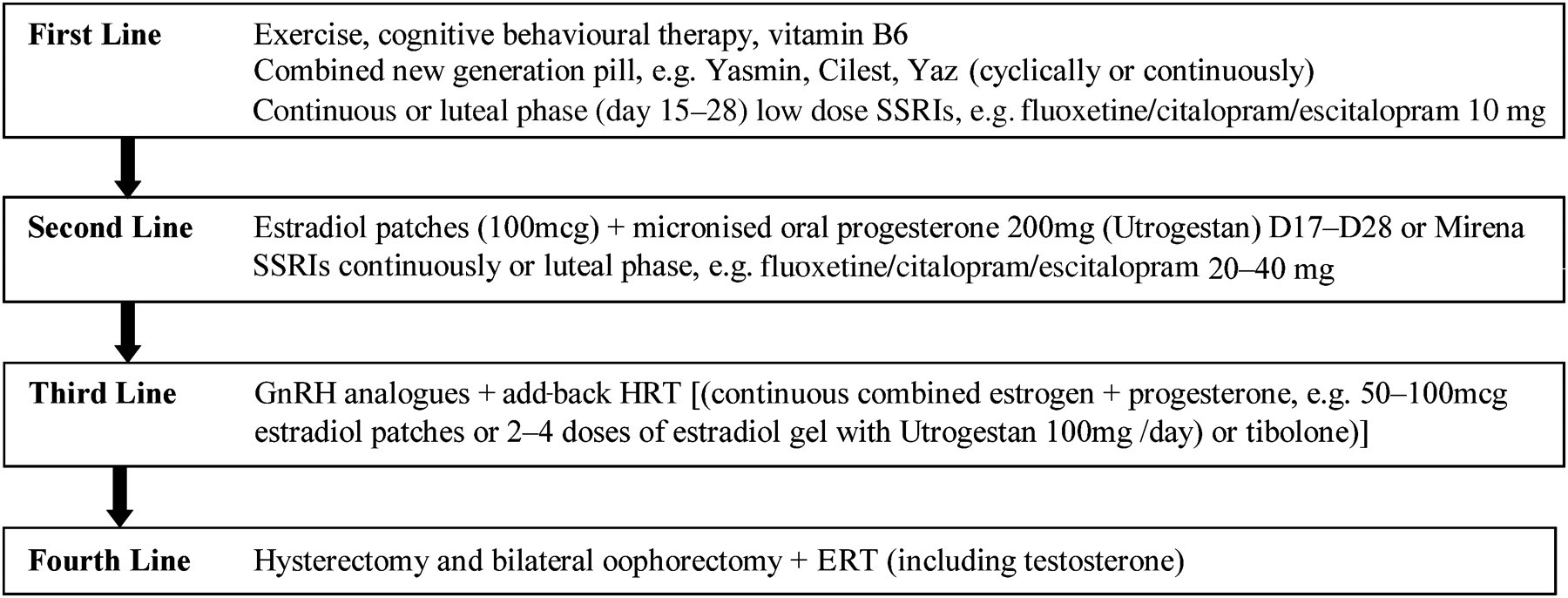
A suggested treatment algorithm modified from the RCOG Green Top Guideline for PMS is shown in Figure 1. Most of the efficacious treatments for PMS are unlicensed in the UK. However, in this situation, unlicensed treatments can be justified where a body of evidence for efficacy and safety exist. The two chief evidence-based medical treatments of moderate to severe PMS are categorized by ovulation suppression and selective serotonin reuptake inhibitors (SSRIs). In making the decision between ovulation suppression and SSRIs, the clinician should take the following into account:
Are the symptoms predominantly psychological, physical or a combination of both? If symptoms have a significant physical component, it is logical that SSRIs and cognitive-behavioural therapy may not be of benefit for these symptoms; Does the woman express a preference for a psychological or a gynaecological approach? Often, women have strong views as to what treatment they will or will not accept. Some do not wish to have the condition medicalized and avoid all but complementary therapies. Others wish to avoid psychoactive drugs and others do not want their ‘hormones messed with’. In the absence of evidence from head to head trials of different treatment modalities, it is not unreasonable to prescribe according to the patient's choice, in addition to her background characteristics. Updated algorithm for the management of severe premenstrual syndrome (modified from RCOG Green Top Guideline 48)
1
Practice points for medical treatments of PMS:
Newer contraceptive pill types may represent effective treatment for PMS and should be considered as one of the first-line pharmaceutical interventions – i.e. those that do not re-stimulate PMS-like symptoms; In view of their proven efficacy and safety in adults, SSRIs/SNRIs (serotonin and noradrenaline reuptake inhibitors) should be considered one of the first-line pharmaceutical management options in severe PMS; When treating women with severe PMS, cognitive-behavioural therapy should be considered routinely when available; Percutaneous estradiol, either as an implant or as a patch or gel combined with cyclical progestogen, has been shown to be effective for the management of physical and psychological symptoms of severe PMS; When treating women with PMS, treatment with the lowest possible dose of progestogen is recommended to minimize adverse effects; GnRH (gonadotrophin releasing hormone) analogue therapy results in complete profound cycle suppression and elimination of premenstrual symptoms. Lack of efficacy suggests a questionable diagnosis rather than a limitation of therapy; There are insufficient data to recommend the routine use of progestogens or natural progesterone; When treating women with severe PMS, hysterectomy and bilateral salpingo-oophorectomy has been shown to be curative, but it is too invasive for most patients.
Assessing response to treatment
There are a number of good clinical practice principles that should be observed in assessing response to treatment:
Response to treatment should not be assessed earlier than a minimum of three cycles. The reasons for this are as follows:
adverse events are more common with initiation of treatment e.g. nausea with SSRIs/SNRIs and bleeding problems/progestogenic side-effects with hormonal regimens; most treatments for PMS are not fully efficacious in the first few weeks, particularly hormonal regimens, which require three cycles to achieve full cycle suppression; GnRH analogues may have initial agonist action before ovarian suppression is achieved. If there is little or no response after three months, another treatment option in the same tier of the algorithm, or the next tier, should be moved onto and the diagnosis re-evaluated; There may be a need to adjust the dosage or move to the next tier of treatments over time as, some patients appear to have recurrence of their symptoms, possibly owing to breakthrough of the ovarian cycle.
Duration of treatment
The only ‘cures’ for PMS are removal of the ovaries or menopause. Most interventions are therefore ‘treatments’ and not ‘cures’ – the benefits only last for as long as the intervention continues. Indefinite treatment should therefore be described as the norm rather than the exception. Discontinuation of treatment should be considered when pregnancy is contemplated, and obviously this is essential if the method is contraceptive. Treatment should be continued during the perimenopause as this is a time associated with potentially worsening of symptoms, but can be tentatively withdrawn when the patient is thought to be postmenopausal. There may be a need to restart treatment if ovarian activity persists.
Key messages
PMS continues to be poorly understood and in many cases inadequately managed. It can be the cause of considerable morbidity and at times, even mortality; A pragmatic, evidence-based approach should be undertaken in managing patients with severe PMS, as suggested in recent reviews of the condition;
1,2
The modified version of the algorithm recommended in the RCOG guidelines, should be used as a template for achieving optimal treatment response;
3
It is imperative that a consensus on definitions, assessment and treatment is reached globally and that properly conducted research continues to be funded.
4
It is only through this work that clinicians will ultimately be able to practice in a truly evidence-based way to effectively treat this condition.
Competing interests
Nick Panay has lectured and acted in an advisory capacity for a number of pharmaceutical and nutraceutical companies. He has received research grants from a number of pharmaceutical and nutraceutical companies.