




Abstract
This presentation sets the context by providing basic statistics and considers some of the main preoccupations over the last decade which include the growth of numbers of women in prison, concern for the vulnerability of women offenders, recognition of gender-specific needs and diversion from custody. Managing women in prison involved understanding the pathways to offending, resettlement needs and risks; and the “connecting threads of life history” on the pathway to offending were described. Understanding risk meant being concerned about risk of harm to self as well as to others, intergenerational risk, as well as risk of re-offending. Options for addressing these needs and risks were discussed.
First, Barbara Treen, who is the Head of the Women's Team in the National Offender Management Service. She joined the Prison Service in 1983 and worked as a Prison Officer for a year or so at Holloway before moving to Lewes as an Assistant Governor (trainee), and then served successfully at Wormwood Scrubs, at Aylesbury Young Offenders Institution, then the prison at Woodhill and also in Prison Service Headquarters. She was seconded for a couple of years to the Thames Valley Partnership, a registered charity, whose aim is to support partnerships to reduce crime and the fear of crime. From May 2002 until December 2004 she was Governor of the Prison and Young Offenders Institution at Brockhill, which was then a women's local prison in Worcestershire. She is now Head of the National Offender Management Service (NOMS) Women's Team, and I understand the task of that team is to ensure the “gender-specific” needs of women offenders are met within the prisons and when under the supervision of the Probation Service. So I am looking forward to hearing what she has to say.
Then Caroline Stewart is Lead for Research and Specialist Interventions for Women within the NOMS Women's Team. Caroline is a principal psychologist and has worked for the last 38 years in the Prison Service and the National Offender Management Service. During that time she has been on secondment to the Immigration and Nationality Service (which must have been pretty interesting) and the Civil Service College (spending five years with each of those), and had a placement at the Missing Person's Helpline (now “Missing People”). She has worked with prisoners at prisons at Long Lartin, Wormwood Scrubs and Holloway, and trained civil servants in management skills and helped develop policy to reduce the risk to the public caused by prisoners re-offending. Since 1997 she has worked within the NOMS Women's Team championing and developing appropriate interventions to meet the particular needs of women offenders, so another very interesting speaker.
Barbara is going to kick off. Welcome. (Applause.)
These are some statistics about women's sentencing and women in prison [Slides 1 and 2]. I won't go through all of them, but some of them are quite interesting. For instance, 16% of women prisoners have no previous convictions, compared with 9% of men. One thing that occupies everybody who works in women's prisons is the amount of self-harm that you see, particularly in women's local prisons. We think around 37% of women in prison self-harm, compared with 7% of men and the even more stark statistic is that 50% of all the self-harm incidents that happen in prisons are committed by women, even though they are only 5% of the population. Few women in prison are assessed as being at very high risk of serious harm, compared with 11% of men. So women are less high risk in prison but more vulnerable. There are lots of other statistics around this that describe the vulnerability of the population in women's prisons compared with men.
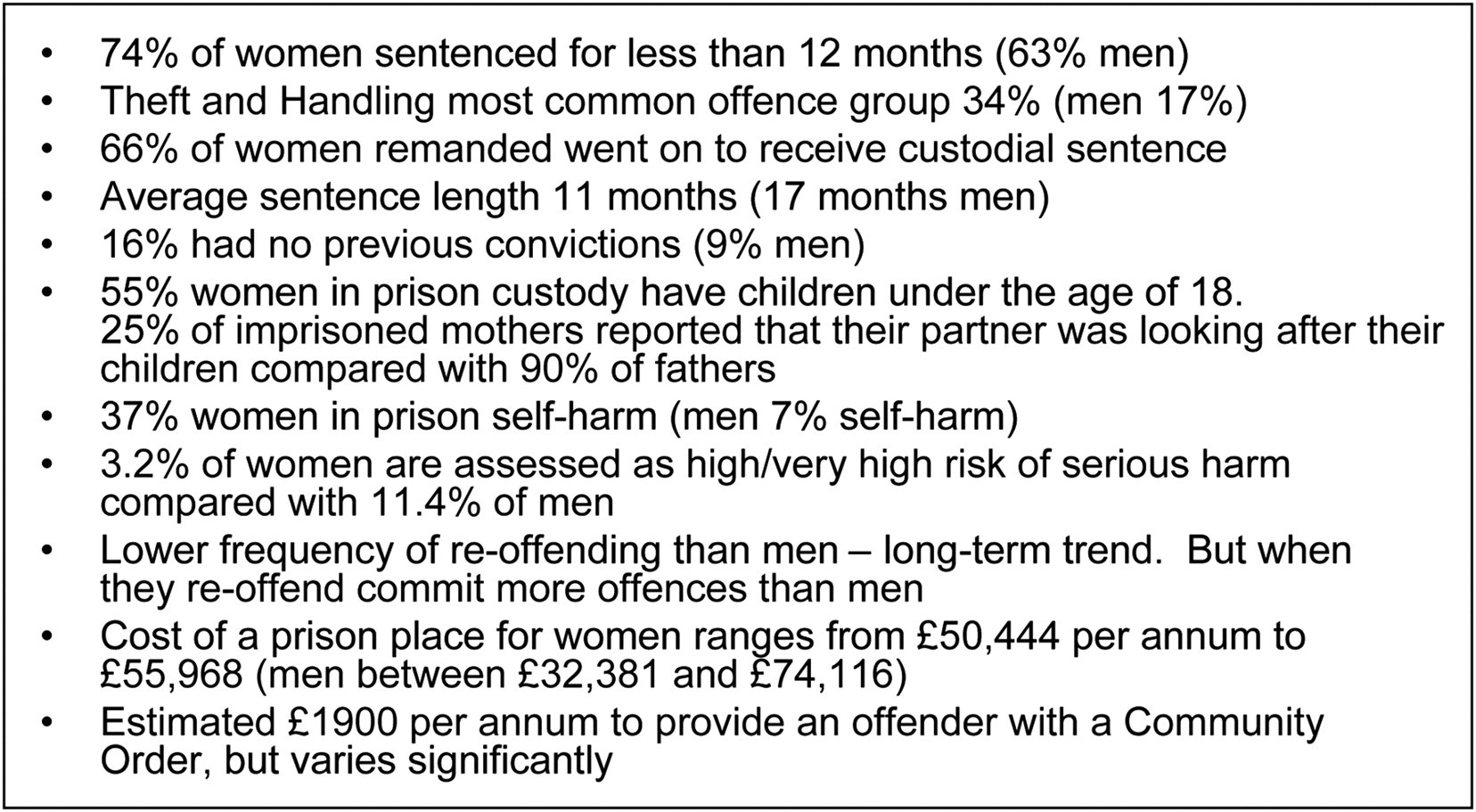
Some statistics
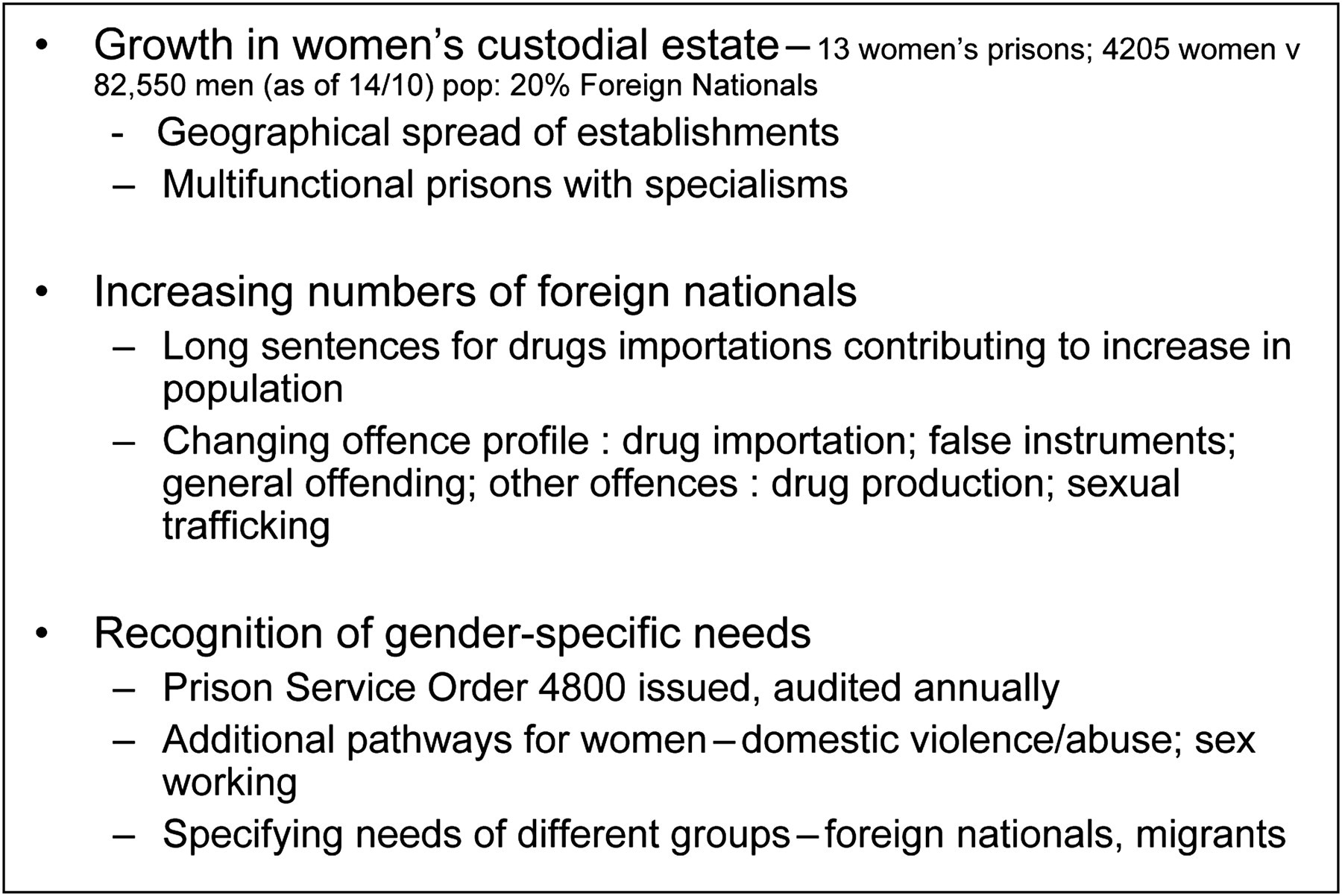
Women in prison: main preoccupations over the last decade
I am going to say something about how working with women offenders has changed over the last few years [Slides 2 and 3]. Up to about two years ago we were seeing an escalation in the number of women in prison, which was quite scary. We had male prisons re-rolled into female prisons all over the place and there seemed to be an unprecedented rise and no real understanding of why this was, although some of us suspect it was largely a reaction, in the male estate as well as in the female estate, following the sentencing of the killers of Jamie Bulger.
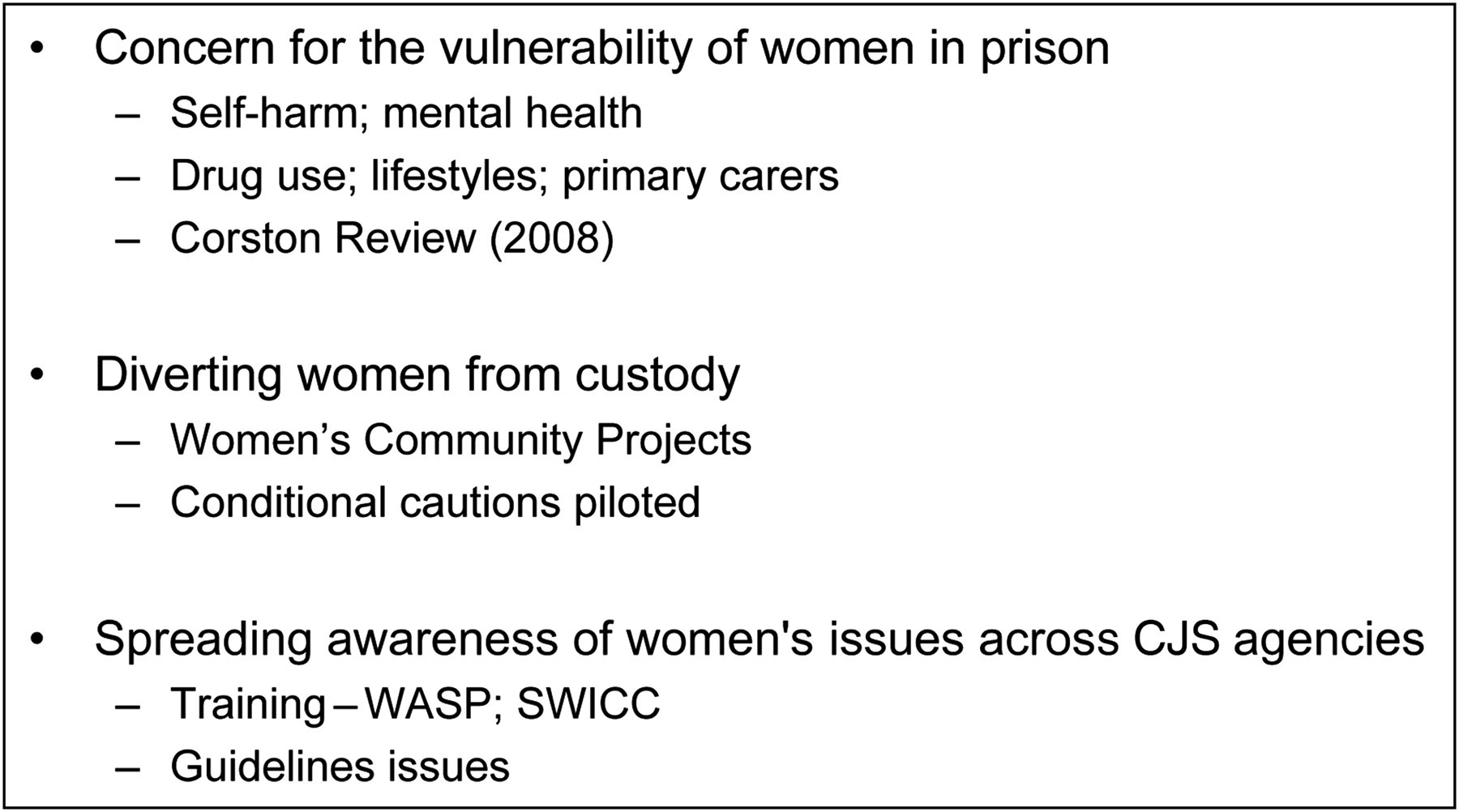
Women in prison: main preoccupations over the last decade (2)
So what we have at the moment is a geographical spread of establishments. There are only 13 women's prisons, none in Wales, and most of the prisons have a variety of specialisms. So you don't just have a prison serving the courts; you don't just have one prison serving the needs of life sentence prisoners, or anything like that; most of the women's prisons do a bit of everything, so at any one time they will be holding women for the courts, sending them to the courts, assessing them, sorting out their health-care issues, including detoxification and holding them for a while to do things to try and address their re-offending, preparing them for release. The way we are moving means that it will become more like that over time, where we have geographical spread of prisons hopefully meeting the needs of the local populations but all doing a variety of specialisms.
We have also seen an increase in numbers of foreign nationals, particularly long sentences for drug importations and “false instruments”, and the characteristic of that population is that generally speaking it is a very compliant population; women foreign nationals are nearly always first offenders and they are doing very long sentences. They have particular issues, of course, in particular, keeping in touch with their families. We also have many foreign nationals in our Mother and Baby Units.
The thing that has occupied the work of this team for three or four years, at least, is to try and nail down what exactly are the different needs of women compared with men in prison and to source evidence for what practitioners “think” are the differences. To do this, a couple of years ago we produced a very comprehensive set of what we call “Gender-Specific Standards” for how we manage women in prison and this became Prison Service Order 4800, which is a comprehensive reference guide about how women differently experience imprisonment, about how differently we should treat women prisoners. The standards range right through from how women experience reception – coming into the prison – to how their special needs should be addressed in terms of their re-offending.
We were able to do a lot of research talking to prisoners, talking to staff and talking to all the experts about what women's different gender-specific needs might be, and really spell them out for the first time. Before this, incidentally, there was only ever one instruction that specifically related to women, and that was about the running of Mother and Baby Units. Before that it was assumed that all Prison Service policy applied to both men and women equally. In some of those many other instructions there was maybe the odd reference to women, but quite often there wasn't, or women were completely overlooked, and the result was that there were just gaping holes where it was clear that the system was operating and had to operate differently with women.
When we produced the Prison Service Order we also put into that what we call two additional “pathways” for women. The NOMS had previously come up with the idea that there are pathways towards offending, and these related to: accommodation, health, employment/training/education, finance/benefit/debt, drugs and alcohol, attitudes/behaviour and children/families. Any of these might singly or collectively make someone more vulnerable to offending and needed to be tackled. Well, we basically invented two more pathways based on what we saw out there in women's prisons. One of them was the prevalence of women who had experienced domestic violence and abuse and rape, and the other one was the number of women who had been involved in sex work. Even though many women sex workers aren't in prison for working in the sex industry (although some might be in for brothel keeping etc), lots of women were in prison who had been involved in sex work and some were trapped in that existence.
So, we put our two “pathways” into the Prison Service Order and, to cut a long story short, lots of work has been done, and is still being done, by our team and prison staff to support their women prisoners in these particular areas. Staff will make referrals for appropriate treatment and support. Indeed I understand that the requirement to provide support for these issues has now even been extended to male prisons where of course there are also men who have experienced abuse and men who have been involved in the sex industry. We also thought about the needs of particular groups of women; i.e. women from BME (Black, Minority Ethnic) backgrounds, foreign nationals, younger women and older women. All these women have lots of different needs which may need to be dealt with slightly differently.
I talked about self-harm briefly. This governs a lot of people's time within prisons. Of particular concern are the extremely high levels of self-harm by women, some of which is very risky behaviour. This is a concern on everybody's mind, particularly in the local women's prisons. We know there is a correlation between self-harm and experiences of abuse. We think about half the women in prison have experienced domestic violence of some sort. We think a third of those women have experienced sexual abuse, often in childhood, or rape. It is not surprising then that one of the ways that lots of women deal with this is to “self-medicate” with alcohol and illicit drugs, which in turn brings them into custody on charges for instance, of theft to fund drug habits. There are strong links between self-harm, drug misuse, sexual abuse and physical abuse, and what we do see, when women come into prison and get off drugs, hopefully, is that often self-harm problems then begin to manifest, because they are now less able to block out memories and experiences.
We think that about 60% of women have significant problems with drugs and alcohol. We think that about 60% of women are primary carers. The issues about managing as a mother in prison again are reasonably different from the experience of being a father in prison. More women are likely to be primary carers. Because there are only a few women's prisons they are more likely to be held further away from home, and one of the sad realities is that if you go to a visiting room in a male prison and into a women's prison you will find the male prison is full of visitors; there are women bringing up their children; there are women still looking after the children at home; but if you go to a women's prison there are hardly any visitors, because most women don't leave behind a supportive domestic home in which the children will be raised and then brought up to see the mother; it isn't like that.
What we have concentrated on a lot since the publication of the Corston Report, which you have probably heard about and which I will talk a bit about in a moment, is the need to divert women from custody. The Corston Report was written after a series of deaths at Styal Prison in a very short period of time. Corston pointed out that women were different from men in prison; they experienced different things; they generally didn't pose the same level of risk as male prisoners, but many women were very vulnerable. We think about 80% of women have got some kind of mental health problem. The main recommendation from the Corston Report was that women should not be sent to custody unless it was really, really necessary. So lots of work went on, under the previous Government and this Government, to try and divert as many women as possible from custody. Fundamental to that was the funding, with about £14–15 million, of women's projects in the community that would offer a holistic, one-stop shop type approach for women, to head women off from the criminal justice path or to be there as support for when they leave prison.
The other thing that was recommended in the Corston Report was that we should train people better in issues to do with women's offending and the gender differences, and for that end we leapt enthusiastically into the fray and came up with some training courses ourselves:
Women Awareness Staff Programmes (WASP) for staff and partner agencies working with women in prison; Women Awareness Staff Programme In the Community (WASP ITC) for probation and community partners (including magistrates) working with women in the community; Sex Workers in Custody and the Community (SWICC) for all staff and partners working with women involved in the sex industry.
WASP in the community is a training course and also a forum now for community organisations and including magistrates which helps practitioners to understand the different issues that affect women's offending and address them, but also to work together locally to try and provide credible options for sentencing other than custody. Often magistrates will say to us, “There is no other option. I don't really want to send these women to prison, but there is no other option”. There are a lot of options out there, but sometimes magistrates don't know about them, and we are not good enough at making sure everybody knows about them all either.
Caroline is now going to talk more about the needs of women in prison.
One thing that struck me in the time that I have been working in the Prison Service – and I shock myself to hear long it is; I started in Holloway in 1976 and was there for about eight years before going on to the various other jobs that I did and then, returning to the Women's Team in 1997 – was how much there still needed to be done on actually understanding the needs of women. What I want to talk about now are some of the ways in which over these 10 years (the period since our team has been in place) the understanding, the sort of profiles of the needs of women, have really increased and are increasingly well understood. Barbara has indicated some of those, but there are three specific areas I want to say something about. [Slide 4]
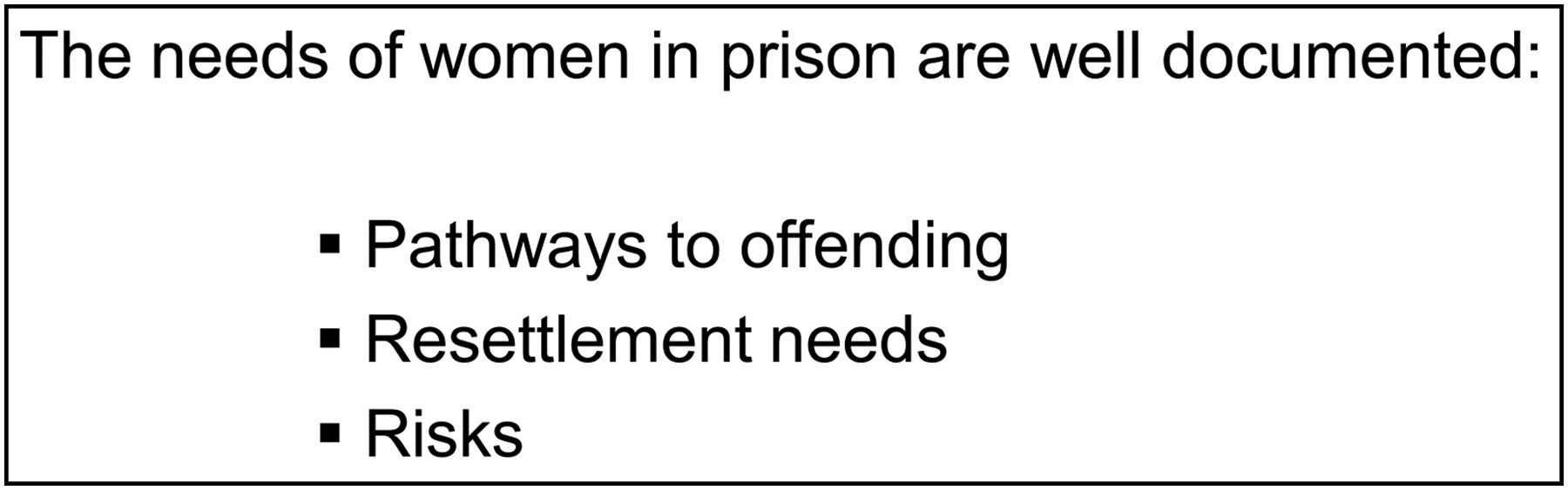
Managing women in prison
One is what do we know about the background early experiences of women, of their life events, that might increase their risk of re-offending or make them more likely to reconvict? There have only actually been a very small number of reconviction studies on women. I would like to say in passing however that one of the problems about research, and in particular reconviction studies of women, is the relatively small numbers. The cohort of women offenders in any large study (and there have been some) will probably be in their hundreds, and we'll push hard to get 500 or 600 in a particular study, whereas the sample size for men may be 5000, and this reflects the fact that the women's population is only 6% of the prison population; a similar ratio applies to the community offenders as well, so we are always a very small group, and it is actually very difficult to get the sorts of numbers needed for robust studies. But there are some studies on reconviction. I will comment on the findings of a couple of these which have looked at previous life events which are significant.
I also want to say a little bit about what assessments actually take place for women when they are in prison and how we identify their resettlement needs against the pathways that Barbara has actually referred to.
We are here primarily to consider the issue of risk, so I think we are going to be saying that for NOMS one of the core functions is reducing the risk of re-offending. But what do we really mean by risk? Are there other things as well as re-offending? I would just like to share with you some thoughts about what we actually mean when we are thinking about risk.
Starting with studies that have looked at early life events and pathways into offending: a study by Hollin and Palmer (published in 2005) is one of the few studies that actually did a long-term follow-up study of women interviewed in prison and then followed up on release, and they did have the great difficulty of actually “losing” women included in the original sample as they went along; either they “filtered out” because they didn't re-offend or they “filtered out” because we couldn't find them, or for other numerous reasons. So it was a considerably difficult area to research, and their conclusions were based on relatively small numbers; but what their study found began to help us understand the key issues and confirmed our views from my early days at Holloway and my early days in the Team.
Anyone working with women in prison knows, as Barbara has said, that domestic violence and abuse is a critical issue. You can't really think about women offenders/women prisoners and their needs without addressing the issue of the abuse they have experienced, either in domestic relationships or through sex working or through violent sexual assault. When we actually consulted our statistical colleagues, they would say, “Well, if you put abuse into the mill and run the statistical analysis it doesn't come out as a significant factor”, and this is one concern for us as gender-specific issues may be lost in the aggregate of the much larger male numbers. Hollin and Palmer's study was really helpful because it enabled us to understand that abuse and early adverse life experiences did play a significant part for women offenders.
They didn't conclude they were causally related or that there was a direct correlation to offending, but they saw them as factors that set a sort of predisposition or increased a woman's vulnerability, which then could lead to her need to seek psychological support; or to have emotional difficulties, psychological difficulties, which often may lead the women to take drugs (which in some cases will be an offence in its own right) or to misuse alcohol, perhaps as a way of self-medication to ameliorate their difficulties. In other cases it resulted in offending because it led to the action of theft, shoplifting, in order to get money for drugs or what have you. So the evidence they gave us put firmly at the centre of our considerations the significance of the experience of abuse as being something that is important to consider, to look at and to address its impact on the woman and how she actually copes with the stresses of her life at the moment and how it has played its part in her offending, and that was actually very important in that it enabled us to have the additional “resettlement” pathway that has meant we now have members of staff in each prison looking at how we best support women who have been affected by abuse as a key part of their role.
What was interesting though was that it wasn't necessarily that the woman herself as a child was abused. The critical thing was to have experienced abuse in the sense of having it happen in the house around her between her parents in another room, to hear domestic violence was in some cases sufficient to have the adverse impact on the woman. So it is a very significant and important aspect of the work we have been doing, and her misuse of drugs, her misuse of alcohol would then be seen as self-treatment really, self-medication to cope with the impact that experience of abuse had had on her earlier in her life.
I would like to mention a second example: the Cabinet Office's (then) Social Exclusion Unit, who looked at a number of women in prison, women on community sentences and women at risk of offending. Their view again reinforced the “integrated” approach we were increasingly beginning to take, and their phrase was “the connecting threads” across the life histories of the offenders [Slide 5a]. They saw that there was a relationship between individual factors and things about the woman herself, her family and the extent to which her family was supportive, or dysfunctional and potentially damaging to her, and the community factors. So those were things like poverty of expectation, deprivation; “entrenched deprivation” they talked about as well. The importance of this work is really in feeding what has been a bit of a mantra in working with women, which is that we are looking at the integration of these problems and the integration of the approaches that are needed to address them in a more holistic way. The word “holistic” has got a bit out of favour, but it is still, I think, a very useful way and it was this, again as Barbara mentioned, that underpinned the approach and recommendation of Corston, that we would have community-based projects that were actually one-stop shops, because all these factors with women are interrelated, so abuse and trauma have to be dealt with in the context of drug taking because they are related in that sort of palliative relationship that I talked about before.
Just to say a little bit more about some of those vulnerabilities of women that Barbara touched on again, that are really examples of the interconnecting threads we talked about. I am going to let you read the slides. You will receive copies of these as well after this evening. I just wanted to make some general points about each of the four boxes on Slide 5(A), and then there are a few more in Slide 5(B).
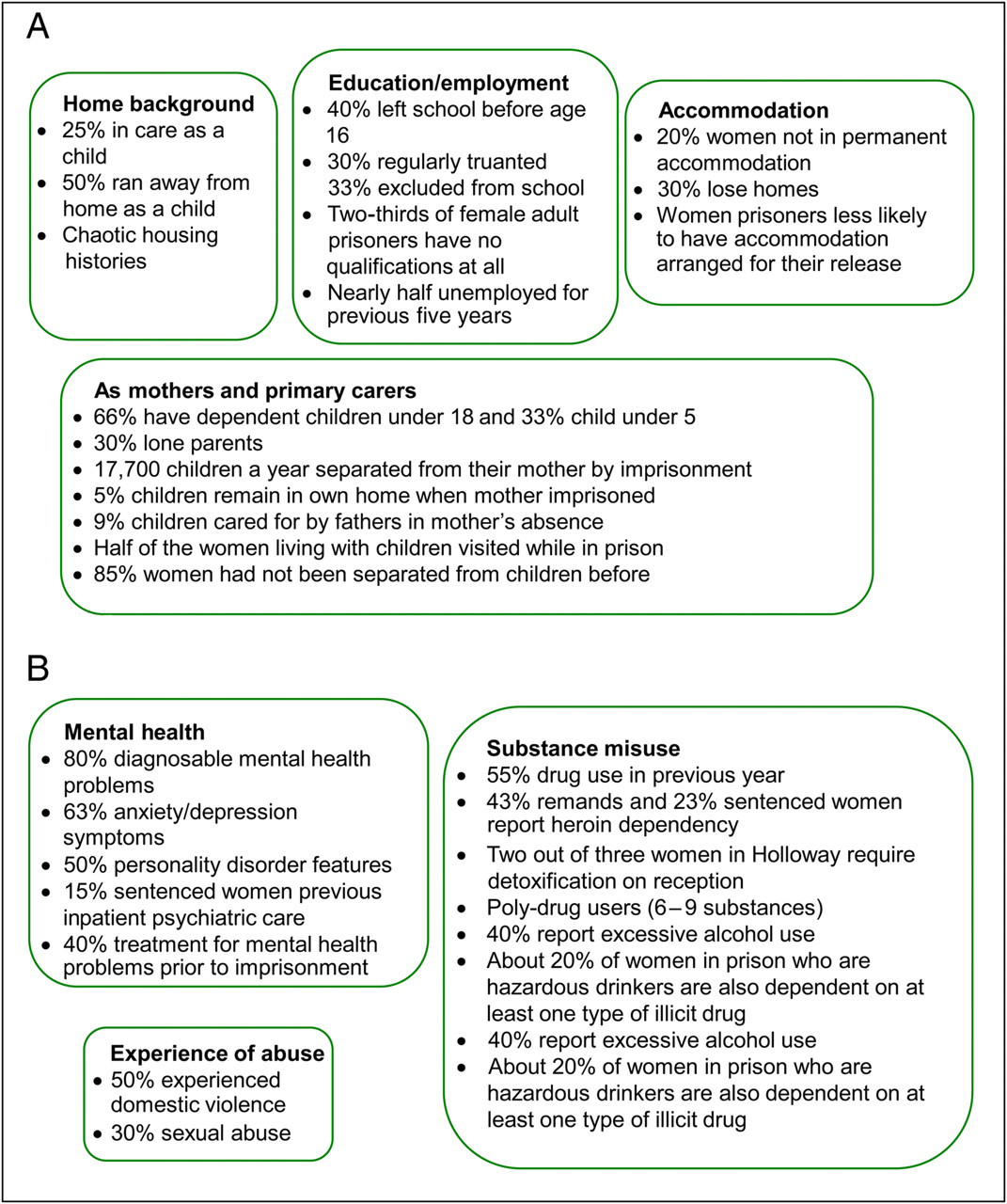
‘Connecting threads of life history…’
Home background
Thinking about home background, it is interesting that about a quarter of these women had actually been in care. The funny thing I have never understood is when we have tried to do some research and speak to these women, they “disappear into the woodwork”; we have never been able to find any who would come forward to speak about their experiences in care. Now, some think that the women maybe don't want to disclose they have been in care because they think that will work against them in some way. I don't know, but we have tried several times to do research on this population but it hasn't worked. We haven't been able to find the women to actually speak to about it. But I think what these home background features are telling us is that many, many women had a lack of family support in their lives; they did not come from loving families where there were strong attachments, where there was consistency, where there was regularity, where there were all the sorts of things that we would see as being conducive to good, strong emotional and personal development. These women also are experiencing the loss of their own children when in prison. If the home breaks up (and I will come to that again in a moment) some of the children will go into care and subsequently be adopted. Most of them are actually cared for by other relatives, but there is a separation from the mother in prison and the break up of the family home, and the concerns there, of course, are the cycles of disadvantage: the intergenerational impact, longer term impact of history repeating itself and the next generation experiencing the same lack of family support as the previous generation.
We do have a little cohort – and this is another research study that might be done some time – of women in prison who are the children of women in prison, or possibly the grandchildren of women in prison. I think the first Mother and Baby Unit opened in – I was in Holloway at the time – about 1975/1976. There were women with babies in prison years before that as well, but the first current generation of Mother and Baby Units started in the mid-1970s, so we may even have grandchildren of women born in prison. I am not sure what it is saying, but it is worth mentioning in passing.
Education and employment
Education and employment, low expectations, under-achievement, under-attainment, among women offenders is a huge issue. Inevitably, if you are not learning to read and write, you are not getting qualifications, and all the rest, so you are going to have limited life options; you are probably going to have limited expectations about your abilities and society's willingness to take you on because you have never shown you are any good at anything, all those sorts of things. What I am about to say about this will be on a sort of positive note actually: this is something that prison can fix to some extent – “given enough time”, I was going to say. I said that once before and I was slightly misunderstood that I was recommending that women got sent to prison for a certain number of minimum years. I am not. But if women are in prison, then in fact they can benefit from the sort of educational opportunities that are there, and I will come back to that in a minute.
Accommodation
Again, Barbara said they are less likely to have anyone bring the children up. They are also more likely to lose their homes, because they are less likely to have a stable partner who is going to maintain the rent and keep the family together in the family home. Children get farmed out to a sister, who has already got three children; she is phoned up and asked, would she take the children, another three, as the sister has just been sent to prison and the flat is empty and she will lose it. The implications of that are:
The loss of her children once again. This creates though, the loss of accommodation, difficulties of acquiring new accommodation on release. An increased risk of her not settling and of maybe re-offending on release because of the known association between having a stable home and accommodation and not re-offending. Also, particularly with the younger group of women, the lack of accommodation makes them much more vulnerable to (let's call them) “predators”, people who see their vulnerability, groom them, ply them with tempting offers of drink or drugs on the gate as they leave the prison, and a lift for supper to his home. There are examples of that. In fact, there was a TV documentary that showed a very painful example. That is the lack of accommodation. It is a very critical and key issue that we would want to attempt to address. More work always needs to be done.
Mothers as primary carers
Again, the statistics here are pretty much as Barbara mentioned. The 17,700 children a year separated from their mother is amazing, a huge figure. I think the issue for us there, in terms of working with women in prison is, for women as a primary carer as a mother, that is an extra layer of the pain of imprisonment and the distress she feels when she is there. But women do attempt to manage and run their families from prison, so the women actually will become quite desperate if they can't get the phone call through and hear how the little boy or the daughter has done at school, or if there has been a teacher's visit, or whatever. They are actively attempting to manage their families from prison, very different, I think, to men, who just know “the wife's” out there doing it and sort of “do their bird” and close the door. But for women there is this semi-permeable membrane, as it were, which also means actually they do suffer a bit more because they realise the impact of the things that are going wrong for the children, and because of the point Barbara made, that it is very difficult because of the 13 prisons widely distributed across the country, so the longer term women get fewer visits as time goes by. The difficulties maintaining not only relationships with children but relationships with family for any women doing long sentences, and also for our foreign national women, those difficulties are quite acute really.
Mental health
I think the thing to say about the very high rates of mental health problems among women in prison and women offenders generally is that for many of them – I hardly dare say this in front of a medical audience – they are sort of relatively low level (anxiety/depression) mental health needs. The issue for us would be, are they sufficiently needy to meet the criterion of “severe and enduring”, and there is an issue that maybe many women fall under the net because of that. That might be something we could discuss afterwards. I would like to have your views, those of you who are experienced with working with women in prison or prisoners generally. But the undercurrent of chronic mental health needs, whether or not caused by abuse – I am not going to over-argue that case – the chronic mental health needs lead to a sense of psychological not well-being, and it affects ability to cope with stress, it affects ability to cope with the pressures and it affects ability just to get on with things, and so it is sort of endemic in the lives of the women.
The point about abuse has been well made. It is now recognised as a significant issue, and I think that is really important. One of the interesting things that has happened is the development, as we would see it, in dealing with women these days, of abuse not being seen as a gender issue, because everyone says, “Well, hang on second, an awful lot of men have been abused as well, particularly the younger men”, and we'll say “Yes, that's absolutely fine. Do something about it”. But it doesn't take away from the fact that it is an issue for women. So abuse is an example of that.
Substance misuse
Again, I think we have made all the points. Again, if we have substance misuse experts in the room I'd be interested to hear their views in the debate. Our view is that the women's pattern of drug use is rather different. They tend to use more drugs, they tend to mix the drugs more, they tend to use alcohol more with the drugs; their drug taking tends to be palliative once again to just block it all out, less to do with social life, being with your mates, as it is with many male offenders (not all obviously), and the links I made before with abuse, sex working, exploitative relationships and grooming are very relevant for women, particularly women being enticed into the sex industry and groomed through their use of drugs.
Let me move on. When women come into prison, those doing sentences of more than 12 months will be assessed formally using OASys, which many of you will have heard about. Theoretically, or in principle, a prison will match its regimen, the activities it offers to address them, to the sort of profile of its prison. Now, there is always a bit of a time lag, so the reality is that most prisons will offer provision across the range of resettlement needs I just want to say something about the ones that are the front runners for women and just a couple of the ones that are the front runners for men, because there is a bit of a difference there.
Emotional well-being
That is the point I made about the high level of mental health needs, poor stress management, poor emotional control and query (if I dare use the words) borderline personality disorder. I am not sure how helpful that is or isn't, but you can tell me what you think about it.
Relationships
Very high, as well as the abusive/exploitative points I made before.
ETE
ETE is Education, training and employment. The issue there is that, while women need education and vocational skills, many of our women, because of the emotional well-being factors, are not in a state to be able to access learning. So in women's prisons you will actually find the education staff doing a lot of work trying to enable the women to get into the state of mind and the state of being able to work with other people in team work and working groups so that they can actually benefit from the opportunities they are being offered.
Thinking and behaviour
Well, that is sort of the core of all the cognitive offending behaviour programmes that as are being developed, and looks at the possibilities of decision-making and the sorts of things which again are very relevant to our women.
The two that probably are front runners for men are:
Lifestyle and associates and attitudes
Now, I don't want to stereotype men any more than I am actually stereotyping women a little bit, but those don't figure so much for the women, again reinforcing this notion that these same factors are at play with men and women, but for our women offenders the relationship patterns are a little bit different.
Risk
I did want to just spend a couple of minutes on risk [Slide 6]. As I said, our sort of whole modus operandi or reason for living, whatever it is, is the risk of re-offending. Now, Barbara has some up-to-date, complicated stats on this, but, very broadly, there is a slightly lower risk of re-offending for women. But, if women do re-offend, there is a tendency for them to re-offend with more offences, multiple offences, but they may be of less seriousness. It is rather complex, the whole business of re-offending, using that as a measure. It is clearly a priority for us, but I think that the other things on the list [Slide 6] are equally of concern when we are talking about managing risk and assessing risk and reducing risk.
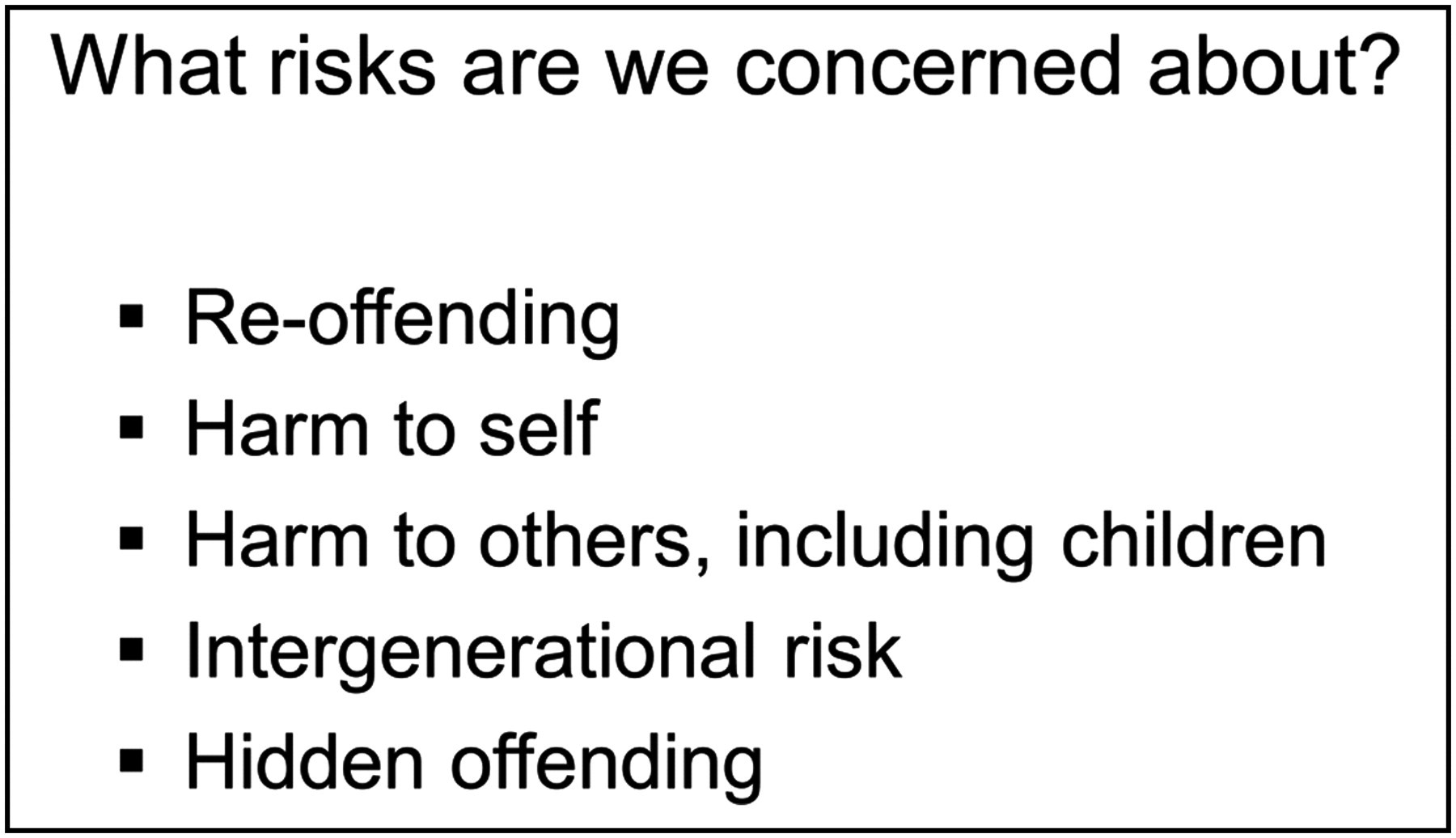
Understanding risk
Harm to self
One is harm to self, and we have already said how that is a major priority practical issue for women. The statistics that will come through in a moment are horrendous. They show a very high rate of self-harm among women.
Harm to others, including children
I think “Harm to others, including children” speaks for itself. So the issue of safeguarding and identifying children who might be at risk is very important.
Intergenerational risk
“Intergenerational risk” we have mentioned before. We may not be able to do a huge amount about it in prisons but we can perhaps through parenting courses and also just generally trying to reduce the risk of re-offending. We have other colleagues in NOMS who are working on family policies to attempt to support families that are particularly needy.
Hidden offending
“Hidden offending” is an interesting one. I do put that here because there are certain types of offences which we think are likely to be hidden – we have no evidence because actually this is an unknown question. These are offences that relate to women's traditional role – they also relate to men's behaviour, that is true – in the home and in the care of children, and I particularly have been involved over the last few years in working with women sex offenders, and they're a very good example, where the rates are, thankfully, very, very low. But it's been the question people hadn't wanted to ask, because they thought it couldn't happen. So, on the one level, we need to work to encourage people to recognise it can happen and therefore ask the question where was the woman when the man was assaulting the child in the home, for example, but, on the other hand, we have to do it in a way that is measured and doesn't have everyone throwing their hands up in horror and falsely accusing people. I remember some celebrated cases where there were terrible false accusations and a sort of hysteria developed. We were placed in a position where people said, “You can't accept sweets from your grandmother”, because any woman might be dangerous, but there are times when in fact there may be things going on but they are hidden because people don't want to ask about them.
We made the point before that risk of harm is the issue for us. We have very small numbers who are a real risk of harm to other people, but that is by no means to minimise the need to actually manage those women and work with them to try to reduce their risk.
Let's just spend the last few minutes thinking about our position in NOMS, but we're sort of focusing on custody. My focus has been always really on custody and Barbara will say something about community in a moment.
I mean, what is the range of options available to us? [Slide 7]
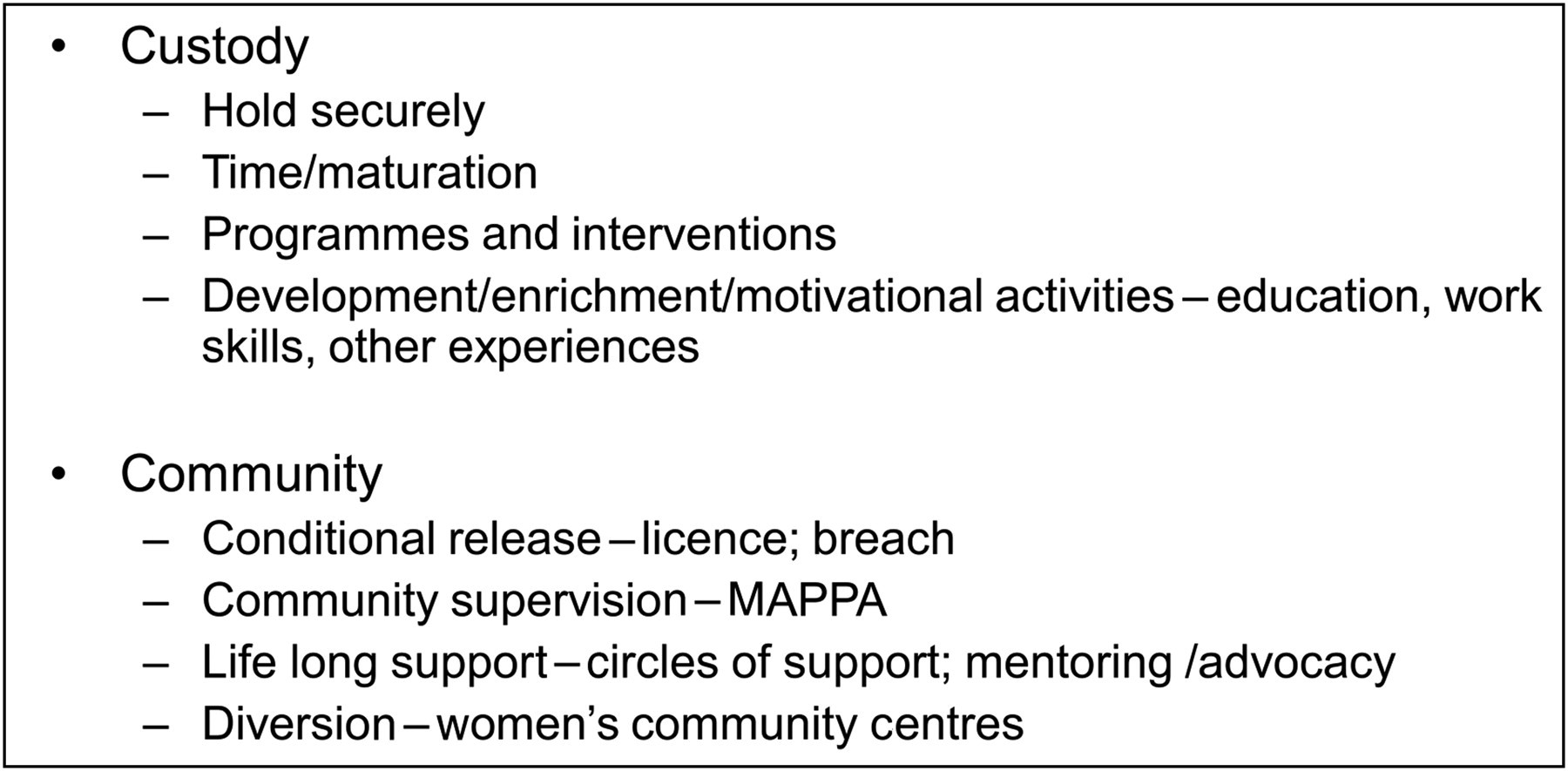
What options are available to us?
Hold security
That is our business and we actually do that rather well. Prison can be restorative. Particularly women coming in having used drugs; if they get detox and they're eating properly, they're warm, they're dry, they have their regular lifestyle while they are in the prison, it can be very restorative. We do have a very, very small number of women who are very high risk, and our job there is really to hold them securely for a very long time. I may have time to say a little bit about those women. Those are the women who might have severe personality disorder; those are the women who might just be extraordinarily difficult and dangerous to manage in the prison. The numbers are very, very tiny, but that is one of the things we need to do, to hold those sorts of people very securely.
Time and maturation
Particularly for young offenders there is increasing interest in understanding the factors that actually lead to giving up offending. What are the positive things that lead people into the “new me”? Desistance is the technical term for this. Increasingly there is an interest in exploring that, so we can start trying to think about putting in place those positive things, rather than just trying to stop the negative things, and that is an interesting area of exploration and consideration at the moment.
Really, sort of the “meat” of the prison regimen is the development of interventions and programmes and the development of enrichment activities within the prison, of which work and education and linking work to education is very important. Two general points about that, and if there is time I will come back to just saying a little bit about some specific programmes that have been developed. The issue for us has always been can we develop programmes specifically for women? Do we have to develop them specifically for women? Can we take a programme developed for the vast majority of men and adapt it, “genderise” it (awful word), put she instead of he, or whatever, and use that with women? There has been a considerable debate and actually the reality is that some programmes work equally well with men and women. I think there is a driving-while-drunk one that works equally well; it is not gender biased one way or the other. There are thinking skills programmes where we have worked with the people, developing them to put in additional sessions for the women, because it is felt that women need more time one-to-one to reflect, but the core programme is pretty much the same for men and women; you change pronouns and you change the examples, but it is effectively using the same theoretical model of change. Then there are other programmes that we have commissioned specifically for women because they really take a more holistic approach, looking at where trauma meets drug use, meets violent behaviour, and the package there is very different and significantly different from what you would want to offer to men, and so invariably we have programmes that are specifically designed for women.
I think that is enough. Barbara, do you want to say something about community?
We think there is a need probably for lifelong support for many women who really will never feel that they are part of mainstream society, and these might be in the Women's Community Centres, but there might be other things like mentoring, advocacy and Circles of Support, which some people might have heard of, which I think came from Canada originally, where you would have a circle of support around sex offenders, in particular, to provide them with human contact while also monitoring their risk in the community. That has been done occasionally with women. So that is what we would say.
Now, for those women on remand, bail is really important. There are different issues to do with granting women bail. We also have something called the BASS scheme (which is alarming in that nobody seems to know about it), which is funding for accommodation and other kinds of support for people who might be kept on bail to try and remove the damage that occurs when they are put on remand. Mike is the expert on that, if anybody wants to know about bail.
As Caroline said, most women's prisons offer a range of activities and interventions aimed at addressing the women's needs. We produced a poster for staff showing the range of needs and giving examples of how they can be addressed. It shows how the majority of women have a whole range of needs but some have greater needs requiring more specific, or more intensive interventions, but there are only a tiny number of women who are incredibly dangerous, and are a very challenging group of women to work with to reduce their level of risk. They do exist in the women's estate. There are not many of them, thankfully.
I just want to say a word about trafficking, as an example of a new issue for us and one we are dealing with at the moment. There is research going on right as I speak about the number of women in prison who are actually victims of trafficking, and quite often they're involved in sex work, cannabis production, which is a big one, or servitude/slavery, and they often get into prison through a variety of means, often through vulnerability. What often you do find, though, is that sometimes the people in charge of these criminal activities are also women who probably went through the same things themselves and had kind of come to accept that that is how it is. So, if you find women that you suspect of being trafficked, it is worth doing some investigation and getting some advice, and we know that they may well be in very poor homes and may be very frightened and very reluctant to seek help and have a total lack of control. Language is obviously an issue, and this is a big learning exercise for us really. I mean, with managing foreign nationals often what you do is put women together with other women from the area they have come from, so if you have a whole group of Chinese women, for instance, in a prison, or Serbs, you might want them in the same prison, you know, to help each other out, and often if you're not careful you use individuals for translation purposes and we've been in situations where we have actually found out that some of the women there have themselves been perpetrators of abuse.
It seems a strange place to leave it, but I think that is where we will leave it. So thank you very much for listening. (Applause.)
Discussion
Diana Brahams, lawyer. Thank you for your talk. With the high proportion of women with mental illness, it does seem to me that people are in prison when they should probably be somewhere else. Is that your view, that we are really containing these people and they are not actually getting proper treatment, and probably there could be admitted patients? Are you able to predict who is going to finish up there at a much earlier stage, given all the predictors you put up on the screen?
Note: The views expressed here are those of the speakers [authors] and do not represent official NOMS policy.