




Abstract
Child pornography is a form of sexual exploitation of children. The virtual aspect of this offence appears to be encouraged by the internet. It is important to know the profiles of the people downloading these images. The aim of our study was to identify the characteristics of people who are drawn to child pornography. Our study was based on psychiatric assessments carried out at the request of the law courts. The feeling of loneliness and poor social integration are evoked by a lot of users of child pornography. Generally they have no criminal record.
Introduction
Child pornography is a form of sexual exploitation of children. It depicts erotic or sexual scenarios with children, either explicitly or implicitly nurturing individuals' deviant fantasies or facilitating a move towards paedophilia. The use of telecommunication facilities, particularly the internet, has allowed child pornography to be distributed more widely. 1 Legislation has been passed in a number of countries to tackle the issue. However, legislative diversity between countries complicates the management of this phenomenon, which, spread mainly via the Internet, has no borders.2,3 Understanding the phenomenon of child pornography is complicated, because it is sometimes a matter of deviance without leading to actual abuse, and it is this virtual aspect that appears to be encouraged by the internet.
People with an interest in child pornography generally have a good socioeconomic level, with no criminal record.4,5 The use of child pornography is not only a means of stimulating fantasy, but also involves the exchange of material, allowing individuals to increase their collection, to disinhibit minors and thus facilitate a paedophilic act, and also to rationalize their paedophile tendencies.6,7 However, a number of studies have shown that there are individuals who are not sexually motivated. Several attempts have been made to identify their motivation, but few studies have examined the psycho-socio-demographic characteristics of these individuals.8–10 While there are clearly different categories of people interested in child pornography, their profiles require closer investigation.
The main question facing law enforcement agencies is the level of danger posed by users of child pornography. In essence, judges need to know the likelihood that sexual abuse will occur. A number of elements indicating a risk of child sexual abuse have been identified, including participation in a virtual community, sharing images and possession of new images, 8 but more information is needed for a better understanding of this problem.
The aim of our study is, accordingly, to identify the characteristics of people who are drawn to child pornography, their motivation and the likelihood that they will sexually abuse a child.
Materials and Methods
Our study was based on psychiatric assessments carried out at the request of the law courts. The main criterion for inclusion was the possession, distribution and/or production of pornographic images of minors, and that the accused acknowledged the charges. Various psycho-socio-demographic elements were studied based on evidence gathered from the psychiatric assessments and data from the literature. Data were entered on a spreadsheet and analyses were performed using Excel. A demographic analysis of the sample was carried out.
Results
The study was based on forensic reports produced between 2000 and 2009. The cohort comprised 69 individuals, 67 men and two women. The mean age was 40 years (range 15-66), with an average of 40.5 years for the men, while the two women were aged 63 and 40. The overall results are summarized in Table 1.
Sociodemographic and psychopathological data of 69 individuals charged with child pornography offences between 2000 and 2009
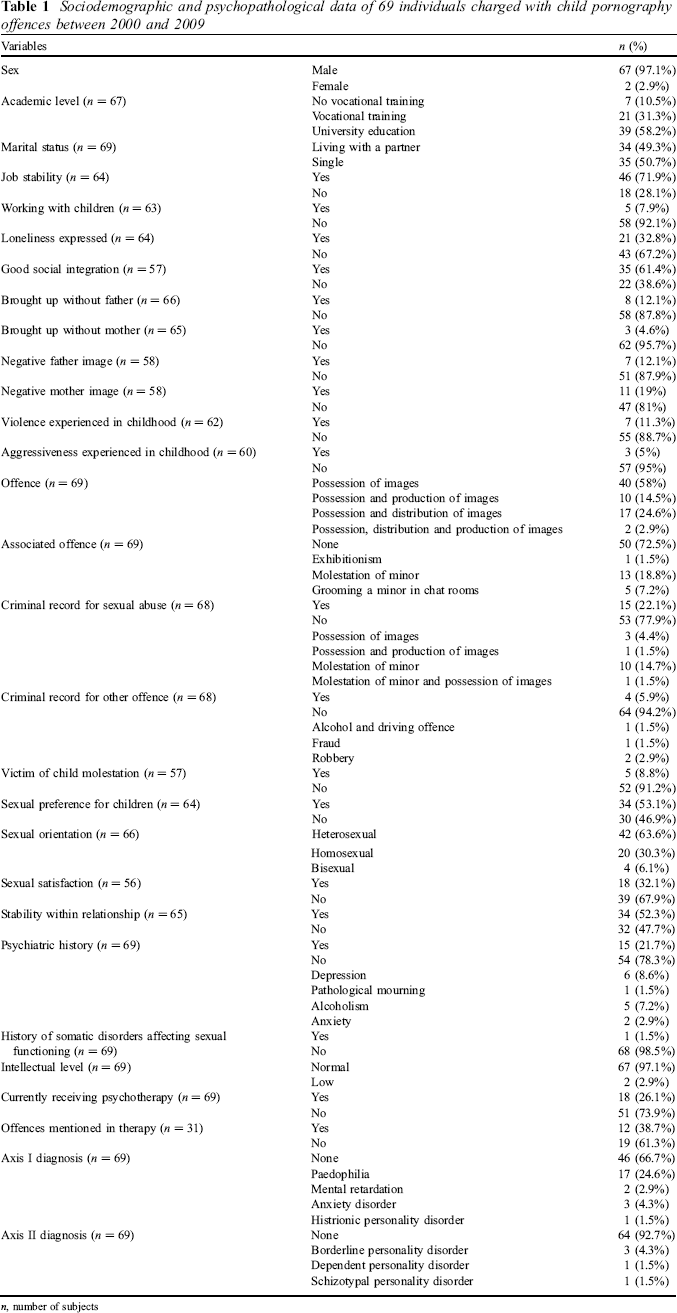
n, number of subjects
Discussion
Child pornography is a complex phenomenon. It generally fulfils a fantasy of a paedophilic nature. Different profiles of users of child pornography have been proposed4,5,8,11,12 which help understand underlying deviant motivations, not always related to paedophilia. 13 While the sociodemographic characteristics of these subjects have been identified, further psycho-socio-criminological elements are needed to determine the profiles in greater depth.
The key issue is to understand the motivation of each individual in order to evaluate the level of risk they pose, so that appropriate sentencing and treatment measures can be taken. Our sample matched the descriptions found in the literature.4,5,8,11,14–16 Subjects were almost exclusively male with an average age of 40 years, which is consistent with previous studies that generally reported an age range of 25-50 years. 4 However, the inclusion of a 15-year-old indicates that child pornography is not just about age. The presence of women in our study is also atypical, and has rarely been reported in the literature. The offences committed by the women in our sample were unusual in that they were carried out in their own home, and acted out the fantasies of their partner. Neither case involved downloading images via the internet, and both involved a perverse relationship in which the minor was used to satisfy the perverted fantasies of the two partners.17,18
The personal circumstances of our sample match the descriptions found in the literature. Over 80% had a diploma, and over 50% had studied at university. Half of the cases had a stable job. Overall, the data suggest that all the subjects had a sufficient level of education to pursue a career and fit into society. However, a third of the cases felt that they were not well integrated, although half of those had a stable job. Moreover, they did not consider that living with a partner indicated good social integration. This suggests a significant relational disorder among our subjects, which could not be predicted by their socio-professional situation that was relatively good.
In the literature, a third of online and offline sex offenders are observed to have committed a child pornography offence, 11 which is broadly similar to our sample. The number of subjects in our study with a criminal record for non-sexual offences is minimal, just under 6%. No links with organized crime or delinquency, which would reflect antisocial or impulsive personality, have been reported. One in six subjects are charged with holding images, one in six with possession and distribution of images, and more than double that number, two in five, with holding and producing images. This is understandable, because there is a different level of victimization between mere possession of images and their production. With regard to child pornography offenders, one in five is charged with possession, and four out of five are charged with possession and production. This seems logical as the production of images usually requires particular closeness with the minor, although some images can be taken without the knowledge of the minor. The majority of offences are committed using the internet, and the possession of images is the result of downloads.
There are no data in the literature about the sexuality of child pornography users. Most child pornography users are single. Most individuals in our study were heterosexual men, and most expressed poor sexual satisfaction, although more than half lived with a partner. Most of the homosexuals in our study were single and expressed more sexual dissatisfaction than the heterosexual subjects. Living with a partner does not necessarily lead to sexual satisfaction. Sexual dissatisfaction or instability within the partnership are also a motivation to seek cybersex but does not explain the reason for seeking child pornography.
Sexual preference for children is not held by all users of child pornography. Seeking child pornography is not only mediated by paedophile fantasies and explains why paedophilia is not the most common diagnosis made. In our sample, only about one in five subjects had a psychiatric history. The most common conditions were depression and chronic alcoholism. This point is significant and should be explored in therapy. The use of images is a way of reducing anxiety. Treating anxiety could reduce the virtual or actual deviant act. Image addiction was found in more than one-third of cases. Cognitive behavioural therapies can play a role in these situations, in the treatment of both anxiety and addiction.4,5,8,10,15 But the need for psychiatric follow-up is not perceived useful by all. And when the follow-up does take place some people failed to reveal their deviant fantasies to the therapist.
Various profiles have been described in the literature.4,5,10,15 Krone 8 provided a very detailed classification to clarify the motivations of users of child pornography. However, this classification does not seem useful in forensic practice. The classification of Elliott and Beech 10 seems more pragmatic, highlighting the different levels of victimization. Our study revealed several characteristics distinguishing between child pornography users. More studies must be performed to distinguish paedophile and non-paedophile child pornography users on the one hand, and between paedophile child pornography users who had had contact with a minor (on a discussion forum, indecent exposure, taking photographs and sexual assault) and those who had had no contact.