




Abstract
Hanging is one of the commonest medico-legal entities that a forensic pathologist may come across and is almost always a suicide. We report a case of homicide by hanging, masquerading as a sudden death, where a 32-year-old man was hanged by his wife, helped by her boyfriend, who nearly escaped from the grip of the law. The autopsy findings were almost in keeping with that of a suicidal suspension except for the small contusion in the inner aspect of the lower lip and multiple abrasions in the lower part of the legs, which were due to the struggle and terminal asphyxial movements. Furthermore, the victim was under the influence of alcohol, which is usually expected in a case of this nature.
Introduction
Hanging is one of the most common entities of day-to-day medico-legal practice all over the world. In spite of a few cases of accidental hanging, death due to hanging is almost always a suicide. By contrast, homicidal hanging is very rare to such an extent that not many cases have been reported globally, because killing someone by suspension is not an easy task unless the victim has already been incapacitated by some other means. The final diagnosis is often made on incompatibility of the findings of thorough autopsy examination with details of the scene of crime inspection and the history of circumstances. This paper presents a case of a homicide by suspension, where autopsy findings are almost indistinguishable from that of a suicide.
Case history
The body of a 32-year-old man was brought to the Colombo Accident Service by his relatives, with a history of sudden unexpected illness at home. He was pronounced dead on admission and the body was transferred to the medico-legal mortuary. According to the initial statement of the spouse of the deceased, he was a roadside fruit seller, habitual alcoholic, married for two and a half years and the father of an eight-month-old infant. On the day of this incident, he was found lying on the floor, apparently unconscious, when she returned home after a religious ceremony at the nearby church. Then she brought him to the Colombo Accident Service with the support of their neighbours.
Autopsy findings
The body was that of a man of average build, clad in a sarong. An abraded parchment-like obliquely placed shallow ligature mark with diagonal imprint pattern on the floor was present on the left, front and right sides of the upper part of the neck (Figure 1). The mark was horizontal, deeper and irregular in width on the left aspect and taking an obliquely upwards course on the front and right aspects of the neck (Figure 2). No mark was present on the posterior aspect of the neck. The examination of the internal neck organs revealed an intact hyoid bone and thyroid structures, and no injuries to the deep neck muscles apart from florid congestion of the thyroid gland. A small circumscribed contusion was noted on the left side of the inner aspect of the lower lip (Figure 3). The finger tips and lips were markedly bluish. Three fresh abrasions were noted on the outer aspect of the right lower limb (Figure 4). Internal examination showed bilateral pulmonary oedema and congestion of the internal organs. The musculo-skeletal dissection showed no subcutaneous injuries or injuries to other parts of the body. The histopathological examination of subcutaneous tissues beneath the ligature mark and injuries showed fresh haemorrhages. The blood sample revealed 210 mg% of alcohol. The cause of death was given as compression of the neck with a ligature, probably in the form of suspension.
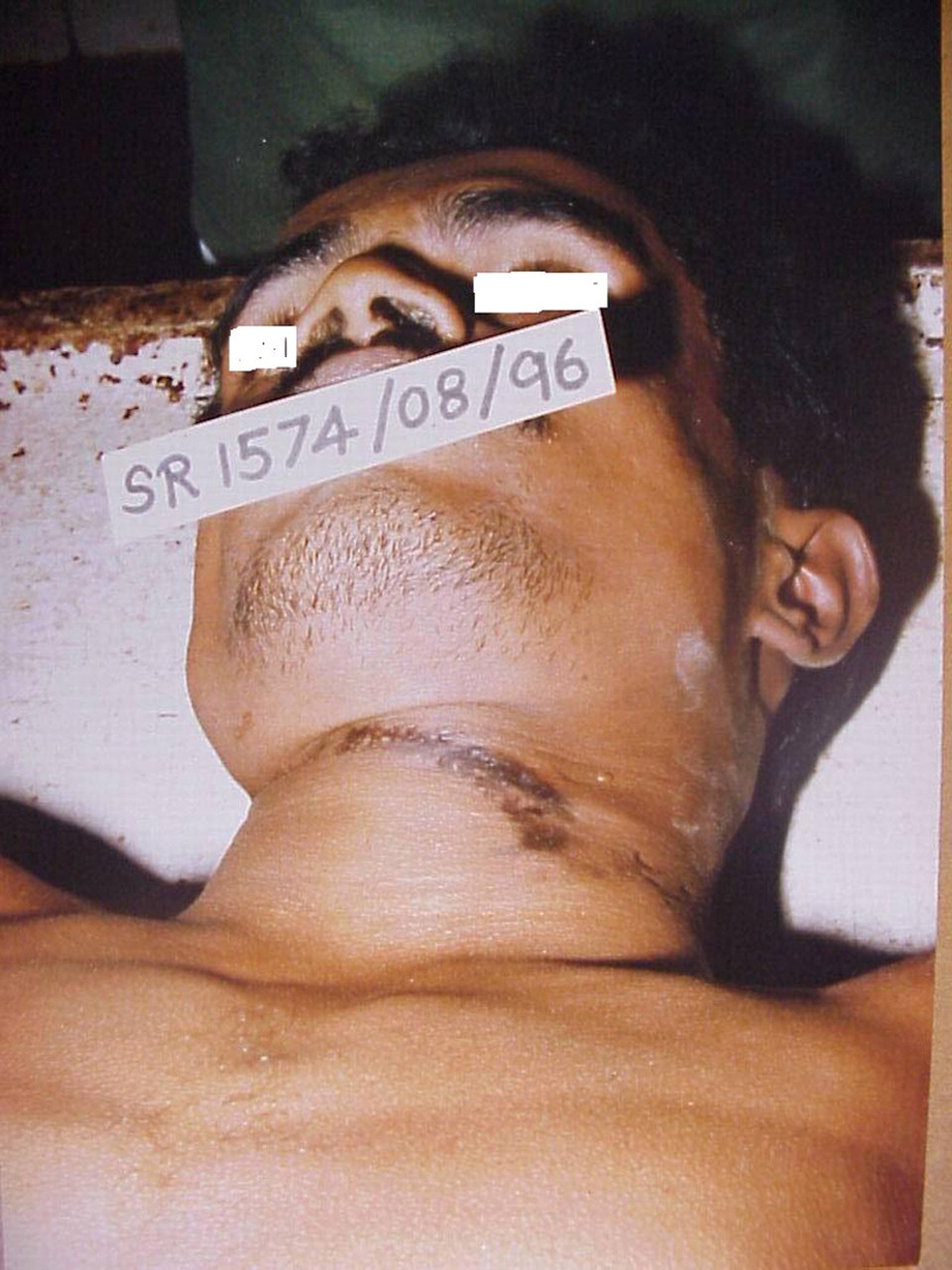
Ligature mark, front view

Right side of the neck
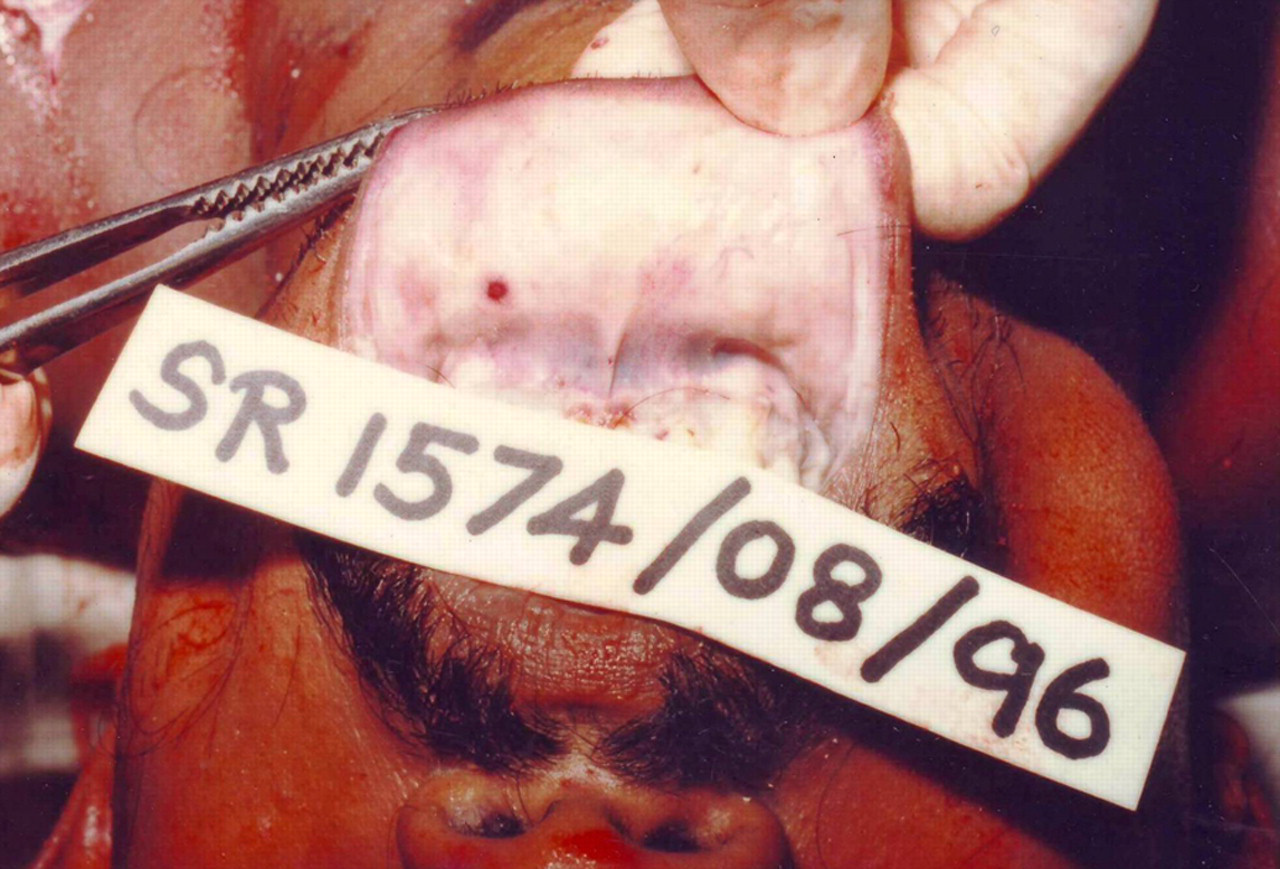
Contusion of the lower lip
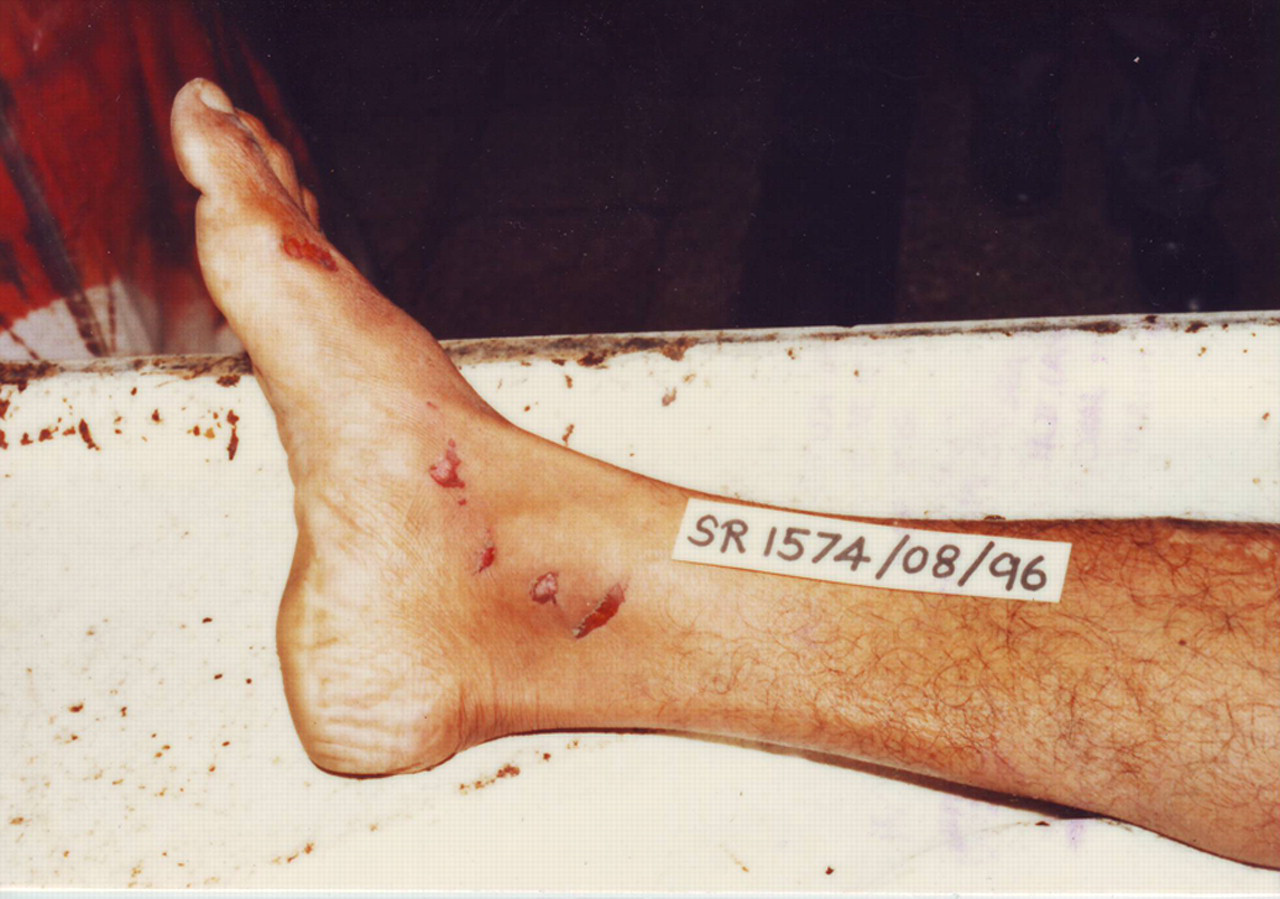
Abrasions in the right ankle region
Scene visit
The scene visit was conducted after the autopsy examination. The scene of the crime showed no items related to suspension/hanging or other types of violence. The ligature had already been removed by the time of our inspection and the spouse was unable to give any explanation for the absence of the ligature. When we repeatedly insisted that the death was definitely due to suspension, she admitted that her husband was found hanging from the roof when she returned. Then she attempted to mislead us by producing a new saree (5 × 1 m silky cloth traditionally worn by Indians) as a ligature, which was totally incompatible with the features of the ligature mark. Realizing that the spouse was trying to mislead investigators by providing inappropriate circumstantial evidence that revealed significant inconsistency with our autopsy findings, the police were instructed about the medico-legal issues arising out of this case, the possible criminal interference in the death of the victim, and directed to further investigations.
Further investigations
Subsequently the spouse was interrogated and questioned by the special investigation team. Finally, she confessed that she had killed her husband with the help of her boyfriend. On the day of the incident, the victim had returned home earlier than usual and was caught with her boyfriend at their residence. While having extensive arguments she restrained her husband in a block hold by his trunk, immobilizing his upper limbs. In the meantime, her boyfriend had stepped onto a chair, put a thin nylon rope, which had already been tied to the roof for the suspension of an infant's cot, around the victim's neck and pulled it upwards. The incident lasted for about five minutes and they then removed all the material before his body was brought to the hospital. Her boyfriend was arrested by the police within two days and agreed upon the circumstances. Subsequently, both assailants were produced before us for clinical examination and confirmed the evidence gathered by the police. Neither of them received injuries during the incident.
Discussion
The paramount medico-legal issue in deaths due to suspension is establishing whether the victim was alive at the time of suspension. The typical hanging usually produces no or minimal injuries and pathological signs other than the ligature mark. 1 The macroscopic features and presence of vital reactions beneath the ligature mark in histological slides, marked cyanosis of the finger tips and pulmonary oedema were indicative of antemortem injuries. The placement and upwards direction of the ligature mark is typical of death due to suspension, with the probable situation of a knot at the right side of the back of the head, where the knot produced no mark. Hence, the pattern of the ligature mark in this case confirms that the death is due to constriction of the neck with a ligature in a form of suspension, viz hanging. The deviation of the ligature mark from the typical obliquely upwards pattern and the presence of injuries on other parts of the body always leads to suspicion about the involvement of another party. However, the authors have personally experienced a couple of well-established cases of suicidal hanging, where there were multiple bruises on other parts of the body due to recent violence, including a unique case of the suicide of a middle-aged man following repeated assault by his wife, a martial arts expert.
Hanging generally implies suicide. Homicides by hanging and the simulation of suicide by hanging a victim previously killed or made unable to resist by other means are regarded as extremely rare events, 2,3 although in German forensic literature cases of this kind were repeatedly reported. 4 It has been noted that when postmortem suspension is preceded by ligature strangulation, manual strangulation or blunt cranio-cerebral injuries, physical signs of other types of violence are usually present on the victim's body. 5 Thorough autopsy examination with complete musculo-skeletal dissection is essential to reveal injuries of any other nature, especially with features of recent vital reactions to confirm their antemortem nature. 6 A woman is more likely to be a victim of homicidal hanging or postmortem suspension following manual strangulation; 7,8 yet there are many queries regarding reported cases of homicide solely by hanging. 9 Homicidal hanging also needs to be distinguished from unusual cases of suicidal deaths. 10
The killing of an adult man purely by suspension is an extremely rare occurrence, which is possible after overpowering him either by causing serious injuries or intoxication. 11 The ligature pattern of the present case showed no difference from that of a typical suicidal hanging. The only suspicious lesion noted in this case was a small circumscribed contusion in the inner aspect of the upper lip, which might have resulted from forcibly closing his mouth in an attempt to prevent the victim from shouting. The abrasions found on the lower limbs were due to terminal convulsive movements of the limbs as observed in many asphyxial deaths. The crime scene investigations also revealed a number of wooden objects close by the point of suspension to cause all these injuries during terminal convulsive movements.
The distinction between murder and suicide may be impossible by examination of the body alone. The failed attempts by perpetrators to conceal the crime by providing evidence, unacceptable and incompatible from the medico-legal point of view, raised suspicions and paved the way to take investigations in the appropriate direction. Though the reliability of initial statements made to the police is often subject to arguments in a Court of Law, in our experience, most assailants confess true details about the incident soon after the arrest and during clinical forensic medical examinations. In the latter stages of legal proceedings, following consultations with their legal representatives, perpetrators usually deny all previous statements hoping for acquittal on evidential and legal disparities.
Had the assailants possessed an adequate knowledge of forensic medicine and decided to leave the victim's body in a suspended position until forensic investigators had conducted the scene visit, we would most likely have concluded the case by returning a verdict of suicidal hanging. The scene visit and detailed inquiry into the circumstances allowed us to reveal incompatibility between circumstantial evidence and autopsy findings, and arrive at the correct manner of death. The estimated levels of alcohol over 200 mg% in the victim's blood could have made it easier for the assailants to overpower him. The forcible suspension of a healthy adult seems to be impossible without the participation of two or more persons, even if the victim is severely incapacitated.
Conclusions
This case once again shows the importance of crime scene investigation and comparative assessment of circumstantial data in arriving at conclusions in a case of apparent suicidal hanging. The final opinion is made on inconsistencies between circumstantial evidence, findings at the scene of the crime and autopsy details. However, it would be extremely difficult to establish the manner of death in a unique case of this nature unless some other evidential proof was available.
Footnotes
ACKNOWLEDGEMENTS
The authors acknowledge Dr Sudheera Herath FRCS for his support in the preparation of this paper.