




Abstract
Senile cataract is an important cause of preventable blindness, affecting 12–15 million people worldwide. In India, approximately 3.8 million people become blind from cataract each year. Moreover, in India, senile cataract develops at a relatively younger age than that seen in developed countries. However, during routine postmortem examination, search for cataract is often ignored, although it could be a major factor responsible for many road traffic accidents. This paper reports two cases of road traffic accident, where the judgement of the court exonerated the accused drivers based on the findings of eye examination during autopsy. Routine examination of the eye for cataract is recommended in every person involved in a road traffic accident irrespective of whether he is a victim or an accused.
Introduction
Legally, the importance of the eye is manifold. For witnesses to be able to depose valid evidence in a court of law, their eyesight must be intact. 1 The traffic rule is also different if a blind person is seen walking with a white stick. 2 It is the only organ where a scratch can constitute grievous hurt as per section 320 of IPC. 1 Subjecting the vitreous humour to chemical examination gives valuable information regarding time since death. Examination of the pupil and retina is of immense help in routine medico‐legal and toxicological practice. 3 In any general medical examination, routine examination of the eyes is done. Unfortunately, during medico‐legal examination and reporting, examination of the eye with reference to cataract is often ignored, although it is one of the leading causes of blindness in the world today and thus it could be a major factor in many road traffic accidents.
Senile cataract is a vision-impairing disease characterized by gradual, progressive thickening of the lens having a multifactorial aetiogenesis. The main processes involved in cataract formation are hydration and replacement of soluble proteins by insoluble ones. 4 Hydration of the lens occurs due to osmotic changes within the lens and alteration in the semipermeability of the lens capsule. Initially the process is reversible, but later the lens swells up and becomes opaque. At this stage denaturation of lens fibres occurs, altering them chemically from non-coagulable to readily coagulable forms. Thus dense and irreversible opacities are produced. The majority of patients complain of gradual diminution of vision due to change in the refractive index of the lens nucleus or cortex. Other effects of cataract are myopic shift, field of vision reduction, coloured halos, intolerance to bright light (glare) and the person perceiving multiple images of an object (monocular polyopia and monocular diplopia). The patient's vision is diminished to hand movements in mature cataract. These features may render a person vulnerable to road traffic accidents.
Case reports
Case 1
The body of a 70-year-old man was brought in for medicolegal autopsy. It was alleged that the deceased, while crossing a road with busy traffic, was hit by a car. He was immediately moved to a nearby hospital where he succumbed to his injuries after one hour. Postmortem examination revealed abraded contusions over the scalp on the right side, both the scapular areas, back of both the elbow and forearm. Fracture of shaft of right side tibia and fibula were present. Examination of both eyes revealed bilateral mature cataract (Figure 1).
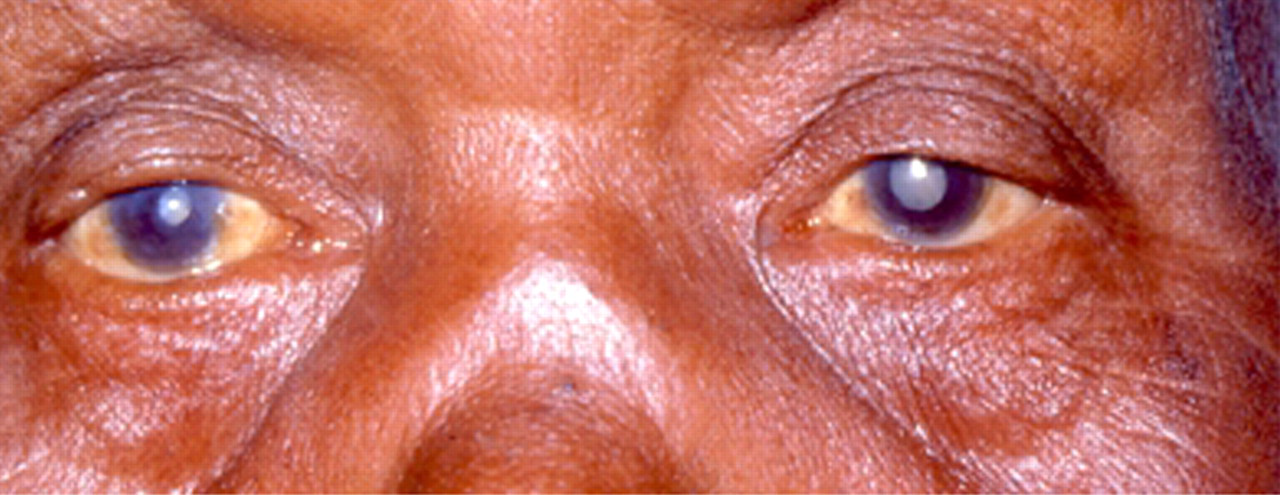
Photograph showing bilateral mature cataract case No. 1
Case 2
A 55-year-old man was brought to the mortuary for autopsy. It was alleged that the deceased, a pedestrian, suddenly crossed the road in front of a high school and was hit by a motor cycle and sustained injuries. He was admitted to hospital where he succumbed to his injuries. Autopsy revealed lacerations over the occipital area and right lower leg, and minimal abrasions over knee and both lower legs. Bilateral subdural haemorrhage and frontotemporal lacerations were present. Examination of both eyes revealed bilateral mature cataract (Figure 2).
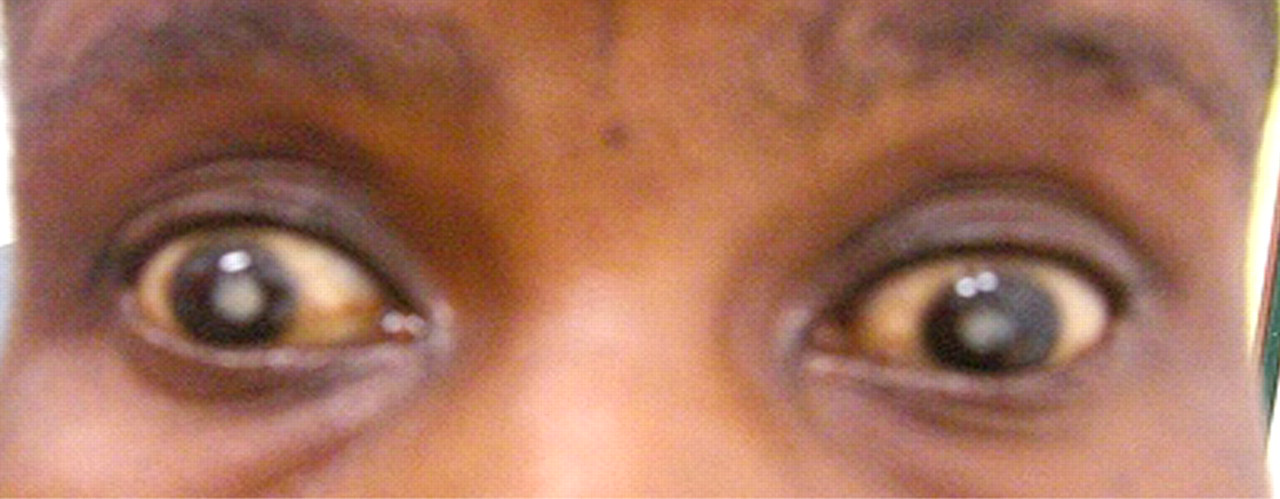
Photograph showing bilateral mature cataract case No. 2
In both cases, the drivers of the vehicles were charged with rash and negligent driving of the vehicle in public ways endangering human life (279 IPC) and causing death of a person by carrying out a rash and negligent act not amounting to culpable homicide (304-A IPC). The burden of proof in these cases was on the defendants who had to prove their innocence.
Both victims had bilateral mature cataract impairing their vision (in both cases, the deceased had tried to cross the traffic suddenly). There were no typical injuries like grazes or run-over injuries to suggest rash and negligent driving. The above facts and the evidence of eye witnesses suggested that the prosecution should withdraw the charges brought against the defendants.
Discussion
The road traffic accident rate all over the world is truly alarming. Worldwide there are almost 1.2 million deaths from road accidents annually; most of them occurring in developing countries. 5 India has one of the highest road accident rates in the world. There is an accident every 90 seconds and a fatality every seven minutes. 6 With a focus on road traffic accidents and the measures to prevent them, the slogan for the WHO day on 7 April 2004 was ‘road safety is no accident’. 7
In most cases, the driver of the offending vehicle is charged with causing death due to rash and negligent driving. Unfortunately there is little defence available for the accused. It is ruled that at pedestrian crossings, the pedestrian has the right of the way. According to Section 140 of the Motor Vehicle Act of 1988, which deals with liability to pay compensation in certain cases on the principle of no fault, it is ruled that where death or permanent disablement of any person has resulted from an accident arising out of the use of motor vehicle, the owner of the vehicle shall be liable to pay compensation in respect of such death or disablement. 2 On some occasions, nearby onlookers have captured the offending vehicle and set it ablaze, despite the fact that the pedestrian had been in the wrong.
While examining the victims of road traffic accidents, examination of the eyes is usually overlooked as the implications of the presence of blindness is often ignored. Examination of the eyes for any defective vision, especially in elderly victims, can help in dispensing justice in a better way. In the cases reported here, the detection of cataract definitely reduced the burden of proof on the defendants, which was further corroborated by the evidence of eye witnesses to the accident.
Examination of the eyes with respect to evidence of diminished vision does not find any place in any of the postmortem guidelines issued by the Government of India. Furthermore, none of the government-issued injury certificate formats contains any column on examination of the eyes. 8
Thus it is seen that examination of the eyes in victims for any evidence of diminished vision and simultaneous examination of the driver of the offending vehicle for any defective vision can solve many of the legal problems in road traffic accident cases. Cataracts due to causes other than senility also need to be considered during eye examination. The normal eye changes due to decomposition do not interfere with the diagnosis of cataract. However, we have yet to ascertain the fate of cataract in advanced stages of putrefaction.
Conclusion
When issuing injury certificates to accident victims, the doctor should have carefully examined the eyes. In any case where there is doubt, the expert opinion of an eye specialist can be sought. In all cases of autopsies done on road traffic accident victims, examination of the eyes should be done routinely to rule out any gross pathology. To settle disputes in road traffic accident cases, the examination of both the accused and the victim will be helpful. The concerned authorities should take the necessary steps to incorporate the examination of eyes in the injury certificate as well as in the postmortem format.