




Abstract
Background
The incidence of road traffic fatalities has been increasing at an alarming rate and is a global cause for concern.
Aims
To assess the age- and gender-based variations in the pattern of road traffic fatalities in Manipal, southern India and to provide an epidemiological profile of the population at risk.
Settings and design
Registry-based retrospective research on road traffic fatalities in Manipal, extending from 1994 to 2009, was conducted at the Department of Forensic Medicine, Kasturba Medical College, Manipal.
Material and methods
The data were collected from the autopsy files and information furnished by the police in the inquest papers. Road traffic fatalities were analysed, keeping the gender and age of the victim as co-variables.
Results and conclusions
Road traffic fatalities constituted the majority of autopsied cases (38.6%) and unnatural deaths (37.8%). Percentage share of road traffic fatalities with regard to unnatural deaths in Manipal did not show a definite trend during the last 16 years. Male preponderance was quite evident, male–female ratio being 7.2:1. Male mortality pattern peaked during the third decade followed by a gradual decline, whereas the mortality pattern among women was almost uniform from second to seventh decade. Overall, people in their third decade were most prone to road traffic fatalities (26.9%), a trend similar to that of male mortalities. The overall pattern of road traffic fatalities was quite similar to those in other parts of India and the world. The global problem with regard to road traffic fatalities remains the same irrespective of the difference in topography and demography of the region.
Introduction
‘Unnatural death’ means death of a person caused by suicide or by another, an animal, machinery, a motor vehicle or an accident, or under circumstances raising reasonable suspicion that some person has committed an offence or foul play. 1 An accident has been defined as ‘an unexpected, unplanned occurrence, which may involve injury’. A WHO advisory group in 1956 defined accidents as ‘an unpremeditated event resulting in recognizable damage’.
Motor vehicle crashes represent a major epidemic of non-communicable disease in the present century. With an ever increasing road traffic density, there is an obvious increase in the incidence of road traffic fatalities all over the world. About 3.5 million people die of unintentional (accidental) injuries each year, of which road traffic accidents alone claim 1.2 million lives. During the 1990s road traffic accidents were ranked ninth among the leading causes of death in the world. It is projected to become the second leading cause in the year 2020. Twenty-five percent of the global accidental deaths are estimated to occur in the Southeast Asia region. In Southeast Asia, road traffic accidents are the most common cause of morbidity, mortality and disability. 2,3
Kasturba Hospital is the premier teaching hospital of Kasturba Medical College, Manipal, situated in the Udupi district of coastal Karnataka in southern India. It is one of the largest non-Government health-care institutions to be located in a rural area in South India. Its health-care network, besides Karnataka, extends to the southwestern region including Goa and northern Kerala. In India, medico-legal autopsies are carried out at the request of the police or a magistrate with a primary aim to reveal the cause of death and to opine if the cause of death is in accordance with the postulated manner of death.
In rural India, age and sex are the two most important risk factors. We have studied the detailed profile of medico-legal autopsies conducted at the Department of Forensic Medicine, Kasturba Medical College, Manipal, South India from 1994 to 2009 with an aim to describe their detailed epidemiological characteristics, to understand the age- and gender-based variations in the pattern of road traffic fatalities over the last 16 years and to identify the population at risk in this part of the country so that preventive measures can be suggested and taken up accordingly.
Material and methods
This study is a registry-based retrospective research study on road traffic fatalities in Manipal, southern India for a period of 16 years extending from January 1994 to December 2009. This registry-based retrospective study, carried out in the Department of Forensic Medicine, Kasturba Medical College (KMC), Manipal, included a total of 2639 cases autopsied between January 1994 and December 2009. All unnatural deaths 1 and sudden natural deaths are autopsied in India. Total autopsied cases in our study hence comprise all sudden natural deaths and unnatural deaths autopsied in KMC. Road traffic fatalities are unnatural deaths and all the cases reported to the study centre were autopsied. The data were collected from the autopsy files and information furnished by the police in the inquest papers, registered in a database and analysed. Road traffic fatalities were analysed with gender and age as co-variables. The study period of 16 years is arbitrarily divided into four quarters (1994–1997, 1998–2001, 2002–2005 and 2006–2009) to study genderwise distribution of victims. The results of the study are compared with studies done elsewhere in India and abroad.
Results
In the 16 years that the study spanned, a total of 2639 autopsies were performed, of which 2585 were identified as unnatural deaths. Road traffic fatalities constituted 38.6% of total autopsied cases and 37.8% of all unnatural deaths. The other major causes of unnatural deaths included poisoning, burns, falls from height, hanging and drowning. Number of autopsied cases and unnatural deaths in each year shows a varied pattern during the study period. Percentage share of road traffic fatalities in relation to unnatural deaths was 39.2% in 1994 and became 44.1% in 2009. Minimum percentage share of road traffic fatalities was reported in 2000 (30%) and maximum in the year 2004 (51.6%). The overall percentage share of road traffic fatalities with regard to unnatural deaths in Manipal did not show a definite trend during the last 16 years (Table 1).
Pattern of road traffic fatalities (1994–2009)
RTF, road traffic fatalities; UD, unnatural deaths; autopsied cases = unnatural deaths + sudden natural deaths
Men outnumbered women all through the study period, with male victims accounting for 87.8% of the total road traffic fatalities. The overall male–female ratio was found to be 7.2:1. Genderwise distribution of the victims during the study period is shown in Figure 1. In our study, road traffic fatalities were reported in all the age groups (1st to 9th decade). Maximum number of victims belonged to 20–29 year age group, constituting 26.9% of the total fatalities resulting from road traffic mishaps. A rise in road traffic fatalities during the first and second decades of life, peak of road traffic fatalities in the third decade and a gradual decline after the third decade were evident as the age advanced. Minimum fatalities were reported in the extremes of ages (Figure 2).
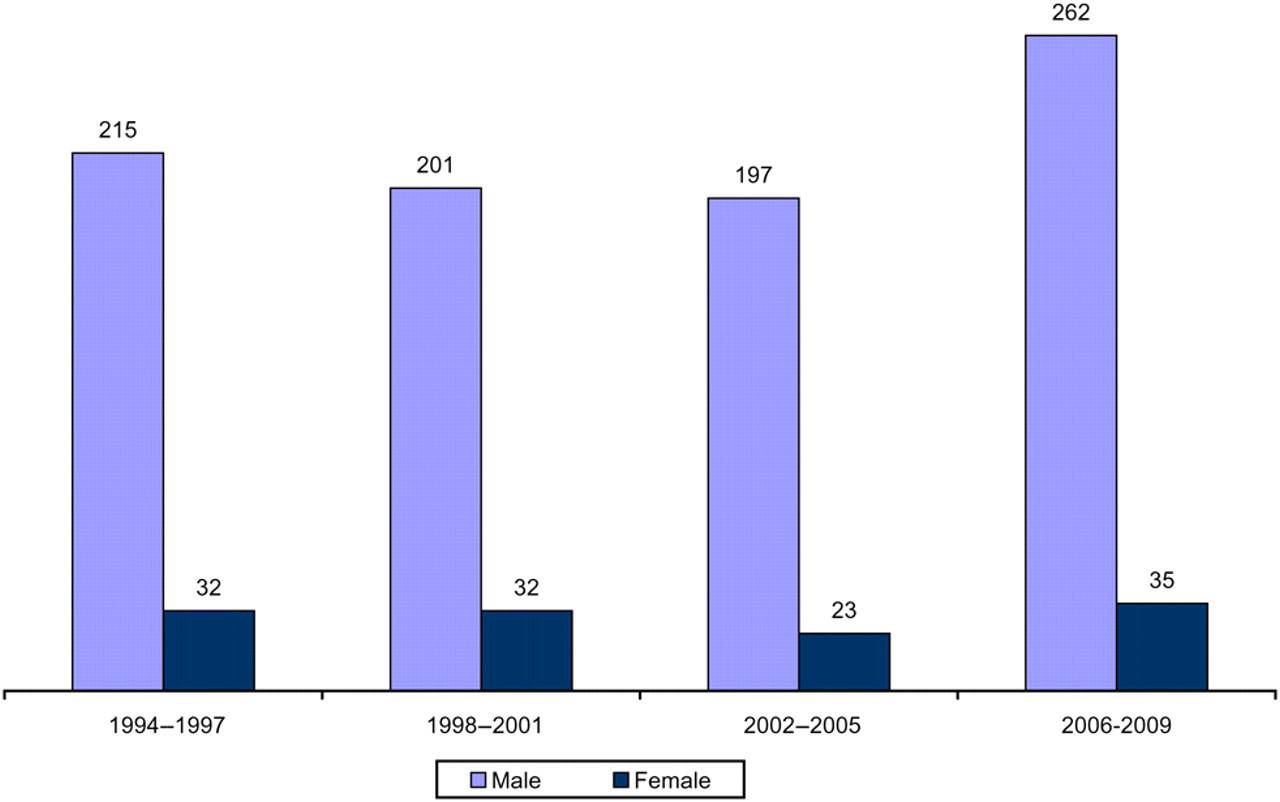
Genderwise distribution of cases
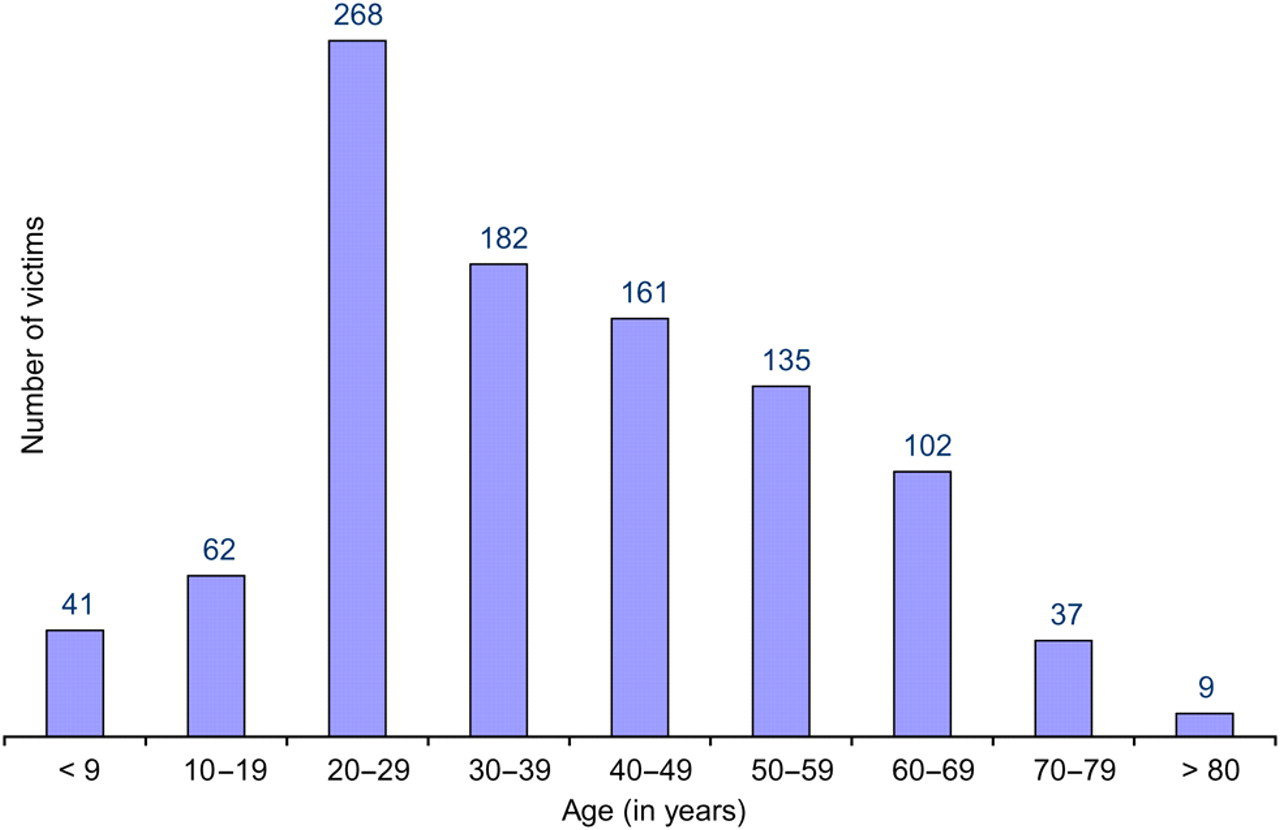
Age distribution of the victims of road traffic crashes
Men in their third decade were most prone to road traffic fatalities. Male mortalities peaked during the third decade followed by a gradual decline, an observation similar to that for the overall road traffic fatalities, whereas the mortality pattern among women was almost uniform during the second to seventh decade of life. Male–female ratio was found to be largest during the third decade, which is more than two times the overall male–female ratio in road traffic fatalities. Male–female ratio was least during the first and second decades of life (Table 2).
Decade-wise sex distribution of the victims of road traffic fatalities
During the study period, of the total male mortalities (n = 1901), 46.0% of the men died of road traffic mishaps. In women the incidence was remarkably low with road traffic fatalities accounting for 17.3% of all female mortalities (n = 704) (Table 3). No foul play was suspected in any case as per police investigations and autopsy findings. All road traffic fatalities were recorded as unintentional. Hence, the manner of death was designated as accidental.
Pattern of male and female mortalities
UD, unnatural deaths; RTF, road traffic fatalities
Discussion
During 2002, about 1.19 million lives were lost from road traffic accidents around the world. The global rate of deaths was about 19 per 100,000 people. 2 In England, the most common cause of major trauma – serious and often multiple injuries where there is a strong possibility of death or disability – is road accident. 4 In India, in the year 2000, 238,517 lives were lost from unnatural causes, of which 80,118 were due to road traffic injuries, whereas in the year 2002 road traffic fatalities rose to nearly 82,000. 2 It has been suggested that there could be 150,000 to 170,000 road traffic fatalities in the year 2015 in India. 5
Overall pattern of road traffic fatalities in our region was comparable with the studies done in eastern, western and northern parts of India, 6–9 Nepal, 10 Nigeria, 11 Norway, 12 Libya and Great Britain. 13 Although ours is a rural set-up, road traffic fatalities remain the leading cause, which is in accordance with the fact that in Southeast Asia, semi-urban and rural areas contribute 60–80% of road traffic injuries. 2 In our study, road traffic fatalities were responsible for 38.6% of total autopsied cases and 37.8% of all unnatural deaths, which is similar to studies done in other parts of the country and abroad. 6,8,9,13,14 A relatively higher incidence in Allahabad, Uttar Pradesh (42.3%) 15 and a lower incidence in Rohtak, Haryana (29.8%) 16 and Yawatmal, Maharashtra (13.9%) 7 has been noted. The higher incidence of road traffic fatalities in this region can be attributed possibly to the National Highway No. 17 being in the vicinity.
During the last 16 years, the percentage share of road traffic fatalities with regard to unnatural deaths in Manipal did not show any definite trend. National statistics show a rise in road traffic fatalities over the last few years. 17 A study in Chandigarh in northern India showed a declining trend probably due to the fact that Chandigarh is a well-planned city with good roads, less vehicle congestion on roads and better traffic sense among the people. 14 A rising trend of road traffic fatalities is also shown in studies from Nepal 10 and Nigeria. 11
During the study period, male preponderance was quite evident, similar to other studies. 6,8,13,18,19 Male–female ratio was 7.2:1, similar to eastern (Guwahati – 7:1) 6 and southern (Hyderabad – 5.85:1) 18 parts of the country. Male–female ratio was relatively high in contrast to the studies done in the northern part of India (Delhi – 5:1 and Allahabad – 3:1). 9,15 A female preponderance, however, has been reported in Norway. 12 Overall sex ratio of road traffic injuries, in India, is 4.5 men to 1 woman. 17 Men lead an active life thus are relatively more exposed to the hazards of traffic, whereas woman are more often confined indoors, more law-abiding and less inclined to risk-taking behaviour. This reflects the culture in rural India and is the probable reason for male predominance in the figures for this region.
Road traffic fatalities were more common in the young and productive age group, similar to the pattern in other studies. In our study, maximum mortalities were recorded in the 20–29 year age group with the third and fourth decades together accounting for 45.1% of the total road traffic mortalities, similar to studies in other parts of the country and world. 6,8,9,15,18,20 A review of several published studies from developing countries showed that young adults (15–44 years) account for 48–78% of road crash fatalities and injuries. 21 Death in this economically productive age group results in a huge economic burden on the society and nation. The direct cost of road crashes is estimated at 1–2% of the gross national product annually in low and middle income countries. 22,23 From the WHO database, it is estimated that up to 70% of the total years of life lost due to road traffic injuries is accounted for by this age group. 24
Extremes of age were least affected, similar to other studies in India. 6,18,20 People in child, adolescent and elderly groups were responsible for 2.2%, 2.6% and 4.9% of the total road traffic fatalities, respectively. This could be down to the fact that children and the elderly are less exposed to traffic as they spend more time indoors. Male–female ratio during the first two decades of life was similar to the overall male–female ratio (2.7:1) for all unnatural deaths. A higher number of mortalities has been reported in the elderly age group in our study as compared with the northern part of the country. 14 Among the elderly age group (those aged above 60 years), 68.9% mortalities occurred in the seventh decade. In India, retirement age in various organizations varies from 60 to 65 years, thus this age group is relatively more exposed and vulnerable to road traffic accidents.
When the patterns of road traffic fatalities were analysed with gender and age as co-variables, the male mortality pattern was similar to that of overall road traffic fatalities, whereas for women it was almost uniform in all age groups, similar to Hyderabad 18 and Delhi. 25 The overall trend of road traffic fatalities was thus determined by the pattern of male mortalities. During the study period, of all male mortalities from unnatural deaths, 46% men died of road traffic accidents, of which 47.8% were in the 20–39 year age group, as men in the third and fourth decades are the most active users of roads and vehicles, incline to risk-taking behaviour coupled with carelessness, and indulge in drugs and intoxication. 14 In women, however, incidence was remarkably low with road traffic fatalities accounting for 17.3% of all female mortalities from unnatural deaths.
Owing to the retrospective nature of this research, other associated risk factors in relation to the age and sex of the victims of road traffic fatalities could not be taken into account. Future prospective research is proposed to study the other co-variables associated with the age and sex of the victims of road traffic fatalities.
Conclusions
Road traffic accidents continue to be a growing menace. It is projected that on Indian roads, one person will die every three minutes in 2020.
3
The present research highlights the age- and gender-based variations in the pattern of road traffic fatalities in Manipal, South India.
Road traffic fatalities accounted for 38.6% of total autopsied cases and 37.8% of all unnatural deaths in this part of the country; Third, fourth and fifth decades, which are the most active phases of life, together accounted for 61.3% of the total road traffic fatalities, with maximum fatalities (26.9%) occurring in the 20–29 year age group; Men outnumbered women with the overall male–female ratio being 7.2:1; Of all male mortalities from unnatural deaths, 46% lost their lives due to road traffic accidents; Men in the third, fourth and fifth decades form the high-risk group accounting for 56.3% of total road traffic fatalities.
The overall trend of road traffic fatalities was quite similar to other parts of India and the world. The global problem with regard to road traffic fatalities remains the same irrespective of the difference in topography and demography of the region. Globally, mortality rate has been found to be higher in men (27.6 per 100,000) than women (10.4 per 100,000), with adults aged between 15 and 44 years accounting for more than 50% of deaths.
25
The authorities need to re-evaluate the effectiveness and impact of ongoing preventive activities. Road traffic fatalities are related to the activity of people, sense of traffic safety and the basic traffic construction. Rapid increases in the number of automobiles on the road, the tendency to violate traffic rules and chaotic traffic systems lead to increased road traffic fatalities. In most cases road traffic accidents are preventable. Strict implementation and enforcement of traffic laws, public awareness, especially with regard to safety measures, and stress management are the recommendations to be emphasized, to prevent this huge and tragic loss of precious human lives resulting from road traffic accidents.
DECLARATIONS
Footnotes
ACKNOWLEDGEMENTS
We wish to acknowledge the anonymous reviewers for their valuable and thoughtful suggestions.