




Abstract
The sound of a bullet hitting a target is sometimes discernable in an audio recording of a shooting event and can be used to determine the distance from shooter to target. This paper provides an example where the microphone is adjacent to the shooter and presents the simple mathematics needed in cases where the microphone is adjacent to the target. Spectrograms of the sound of bullet impact on a human-sized animal are also presented.
Introduction
With surveillance systems becoming more common, the number of shooting events being captured on audio is increasing. The sound of a bullet hitting a living target is loud and detectable from a distance. Determination of the distance between the shooter and the target is possible if the time of the muzzle blast and target strike can be determined from an audio recording. If the location of the target is known, this greatly narrows the possible locations of the shooter.
Method
With the permission of the Ohio Division of Wildlife, three wild male whitetail deer (Odocoileus virginianus) were shot with a muzzle-loading rifle shooting saboted .40 caliber pistol bullets impacting at velocities typical of the .40 S&W handgun cartridge (415 m/s for an 8.75 g bullet). An opening in a fence and a corn pile were used to aid in placing deer at a known range from the shooter (70–75 m), and nearly broadside. Achieving the desired impact velocities at this distance required loading the bullet (Nosler Inc., Bend, OR, USA; Part # 44852) to a muzzle velocity of 583.8 m/s, because it slows rapidly in flight due to a low ballistic coefficient of 0.093.
A system mimicking the terminal ballistics of the .40 S&W was chosen, because preliminary work with tissue simulants suggested that the sound of target impact would likely not be discernable at energy levels of less powerful cartridges (in particular, the 22 Long Rifle) once the microphone was more than 20 m from the target. Preliminary work also suggested that more powerful centerfire rifle bullets create much louder impacts, and are more likely to be discerned in audio recordings, though this depends on the acoustic environment and the magnitude of muzzle blast reverberations when the sound of the target impact reaches the microphone. Another consideration is that the terminal ballistics of the .40 S&W are near the lower end of what is considered humane for the taking of deer, at least in the local jurisdiction. Preliminary work suggested that the sound of target impact of a .40 S&W might be only marginally discernable with microphone placements beyond 50 m, so the experiment was designed in a manner to ensure humane demise of the target animal and to determine whether an inexpensive piezoelectric microphone comparable to those often used in cell phones and applicable surveillance equipment could detect the sound of target impact in a case that pilot work had suggested is marginal.
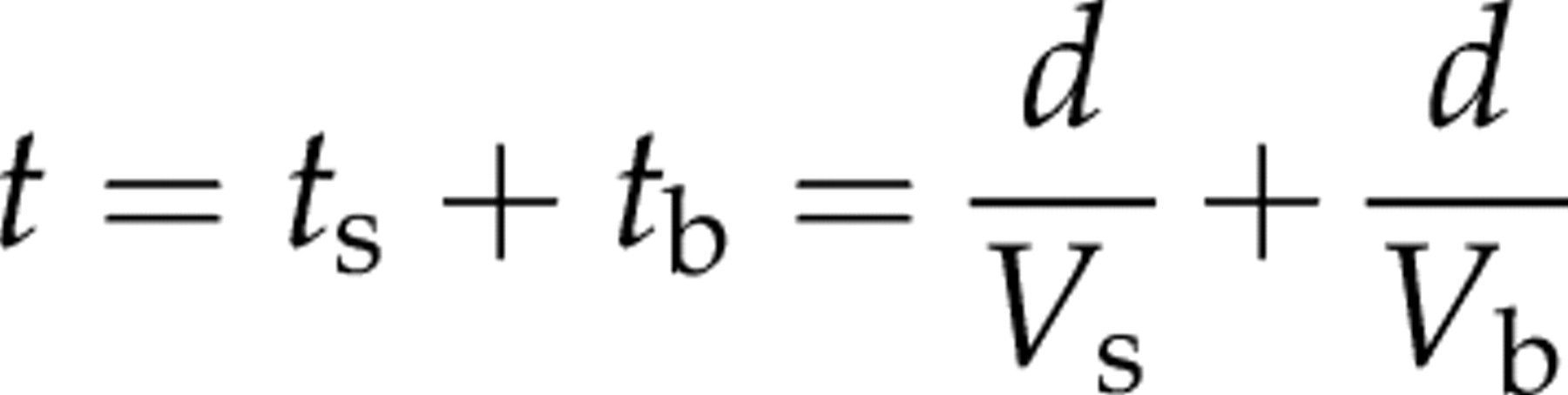
A microphone was placed a few centimetres from the muzzle to record both the muzzle blast and the sound of the bullet hitting the deer. The time recorded between the muzzle blast and the bullet striking the target represents the sum of the bullet time of flight (t
b) and the time for the sound to return to the microphone from the target (t
s),
Details of three cases showing agreement within 3% between measured and acoustically determined distances
Shock wave echoes and muzzle blast echoes from distant surfaces are relatively high-amplitude events that can be visible when inspecting an acoustic pressure waveform of a gunshot, but these events carry little acoustic energy and the energy tends to be at higher frequencies. In contrast, the sound of a bullet hitting a target carries a significant amount of energy and includes all the frequencies that are produced with a high-amplitude mechanical excitation of the target (hitting the target hard). To verify that the peak identified as the bullet impact is a high-energy event such as a bullet impact and not a high-amplitude, low-energy event such as an echo of the muzzle blast or shockwave from a distant surface, sound spectrograms are computed for each event to observe whether there is a significant increase in acoustic energy in the 5–10 ms after the peak identified with bullet impact.
Results
Figure 1 shows the sound waveform of a bullet hitting a deer in three separate cases. Sampling is triggered by the muzzle blast (t = 0). The microphone is saturated by the muzzle blast until t = 120 ms. Peaks from t = 120 ms until 250 ms represent reverberating echoes of the muzzle blast. The peaks marked with arrows represent the sound of the bullet hitting the deer in each case.
Sound energy (the square of the voltage from the microphone) versus time for the three cases. Zooming in on the sound waveform was used to determine the time corresponding to the sound of the bullet hit returning to the microphone, which is identified with an arrow in each case
The total time for the bullet to travel a given range and for the sound to return that same distance back to the microphone is computed for the ambient conditions of each case for ranges from 0 to 90 m in range steps of 0.9144 m (1 yard). The results for case A are shown in Figure 2. Due to the range and bullet slowing in flight, obtaining an impact velocity (418.9 m/s) comparable with the .40 S&W requires loading to a higher muzzle velocity (583.8 m/s). Treating the distance as an unknown, one can use the muzzle velocity, the ballistic coefficient (0.093), the speed of sound (339.0 m/s), the relative humidity (80%), the air temperature (12.2°C), the barometric pressure (752.9 mmHg), the altitude (335.3 m) and the measured time to impact (t
A = 0.34705 s) to compute a target distance of 71.2 m. The actual measured distance was 72.8 m. The error (2.3%) arises from shot-to-shot variations in the muzzle velocity (about 2%) and uncertainties in the ballistic coefficient and atmospheric conditions. This procedure was repeated for the recorded shootings of three separate deer, and in each case, the acoustic distance determination was accurate to within 3%.
The top line is the total time for the bullet to reach a target and the sound to return under ambient conditions for a given range. These curves must be computed separately for each case, because both the bullet velocity loss and the speed of sound depend on ambient conditions. Once the total time is determined from the sound waveform (Figure 1), the range is determined by interpolating between the closest two points in total time versus range. For case A, a total time of 354.65 ms implies a range of 71.2 m
Spectrograms of the bullet hitting the deer show that there is a significant increase in acoustic energy that lasts for 5–10 ms after the impact in the 2–7 kHz frequency range, as shown in Figure 3. These spectrograms show that the peaks identified with the bullet hitting the deer are consistent with a loud, energetic event such as a bullet impact rather than a high-amplitude, low-energy event such as a distant echo of a shockwave or muzzle blast.
Sound spectrograms for the three cases of a bullet hitting a deer. Impact times are shown with arrows for each case. Colour scale is logarithmic. There is a considerable increase in acoustic energy in the 2–7 kHz range for 5–10 ms after impact in each case. In case C, there is another increase in energy near 370 ms, which can also be seen in Figure 1. We hypothesize this is related to either the temporary cavity hitting the ribcage or its first collapse
Discussion
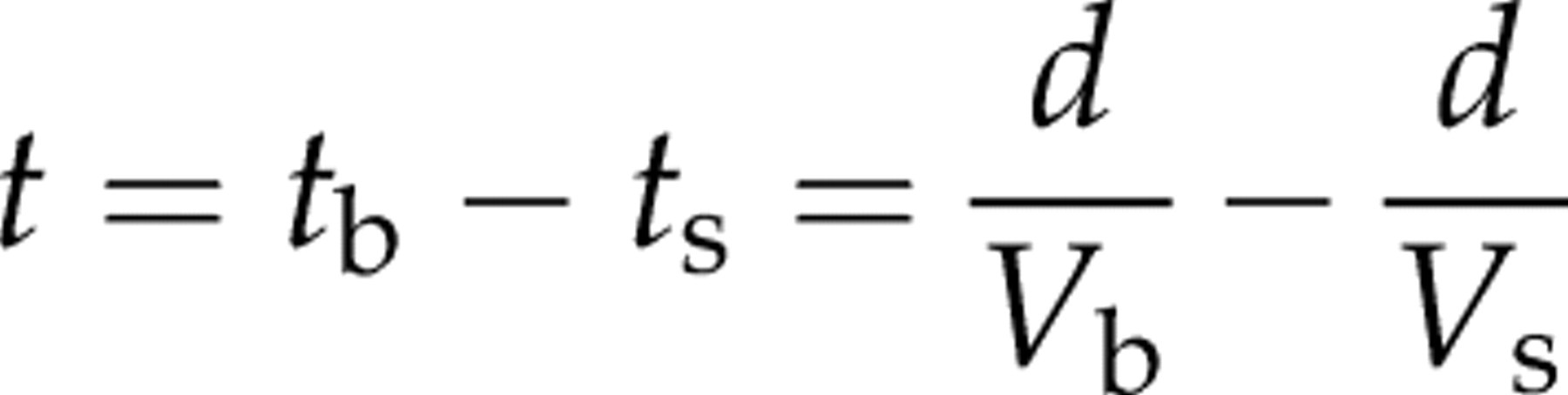
These results show that it is possible to use an audio recording of a shooting event to accurately determine the distance between the target and shooter. In cases where the location of the microphone is different, the mathematical details are different, but the ideas are the same. For example, if the microphone is adjacent to the victim (such as a 911 recording might be), the equation for determining the distance becomes
If the muzzle blast duration obscures the sound of the bullet hitting the target, simple inspection of the sound waveform is insufficient. Filtering techniques or spectrogram generation might recover the time of the target hit, 1 or determination of the target hit might not be possible. However, in cases where the microphone is adjacent to the target and the bullet is supersonic, the sound of the bullet hitting the target occurs first, and so it cannot be obscured by the muzzle blast.
Similarly, in many cases where the microphone is closer to the target than the gun, the sound of target impact will be simple to discern for center fire rifles with bullet velocities above Mach 2 because the sound of bullet impact will often reach the microphone before the sound of the muzzle blast. Consider the case where the gun–target distance is 100 m, the microphone is near the line of fire 25 m from the target and the average bullet velocity is 800 m/s over the distance. The bullet takes 0.125 s to reach the target and sound of impact takes an additional 25 m/(340 m/s) = 0.0735 s to reach the microphone, thus arriving 0.125 s + 0.0735 s = 0.1985 s after the shot. The sound of the muzzle blast takes 75 m/(340 m/s) = 0.2206 s and reaches the microphone after the target impact. This is always the case for supersonic bullets if the microphone location is beyond the target relative to the shooter. There are microphone locations between the shooter and the target where the muzzle blast arrives first and reverberations will make it impossible to discern the bullet impact.
A significant weakness in the study is the placement of the microphone near the muzzle of the gun, an unlikely location in most forensic cases, except for possible reconstructions of self-defence claims where the event is captured on a recording of the emergency call, officer-involved shootings where the event is captured on a duty radio or other nearby microphone, and cases where the distance to the target is important for determining whether a soldier followed the applicable rules of engagement. In the more common case where the shooter is a criminal aggressor originating or escalating the deadly force encounter from an unknown location with the target and microphone in known locations with a significant separation, the best that can be done with audio from a single microphone (even if target impact can be distinguished from muzzle blast reverberations) is reconstructing a circle on which the shooter's position can be located. With multiple microphones, multiple circles can be re-constructed, and determining the unique position of the shooter by the unique overlap of three or more circles is triangulation. Gunshot detection systems such as the Shot Spotter system (
Another important consideration is that this re-construction technique depends on accurate determinations of the position of either the shooter or the target and on accurate determination of the muzzle velocity. Commercial ammunition can vary as much as 5% in velocity, and this might lead to uncertainties as large as 5% in determination of the shooter–target distance. In cases where the ammunition shows even greater variation in velocity, or the bullet velocity cannot be determined (for example, if the type of ammunition remains unknown or is handloaded), the technique cannot be applied. Likewise, acoustic determination of the distance from the shooter to the target is of limited or no value if the location of the target cannot be determined due to the absence of blood spatter, reliable witnesses or other evidence. However, if the location of the shooter is known from other evidence (shell casings, surveillance video, reliable witnesses, etc.) determination of the distance to the target can help narrow the range of possibilities for the target location.
A number of questions remain for further study; perhaps most prominent is how widely applicable the technique is likely to be in real case work given the likely greater magnitude of muzzle blast reverberations in many urban environments where most criminal shootings occur, and how useful spectrograms are likely to be in distinguishing the target impact from reverberations of the muzzle blast. Other questions for further study include the lower limit of impact energy needed for detectability and whether spectrograms of bullet impacts might be useful to determine which shot impacted where in cases of multiple gunshot wounds.
DECLARATIONS