




Abstract
Circadian and seasonal rhythms have an impact on the risk of violent death in humans, with more evidence available in suicide than in homicide. This study set out to investigate the pattern of deaths by homicide in Italy, taking into account the month, the day of the week and the time of day when the homicidal incident happened. Data based on official statistics on deaths by homicide (n = 3894) from 2003 to 2008 were analysed by spectral analysis and circular statistics techniques based on the Rayleigh test. Homicides showed seasonal distribution with a bimodal pattern, with summer (July and August) and winter (December and January) peaks over the other seasons. Homicides also peaked on Sundays and Mondays and were at their highest at night-time (00:00 to 5:59 hours). These rhythms in homicide victimization could be accounted for by social factors – within the framework of the routine activity theory – by psychological factors, including those leading to domestic violence, and by biological factors, including those impacting on impulse dyscontrol. The identification of risk or protective factors involved in the victim's surviving or succumbing to an assault might be important for the prevention of the worst outcome of injury at large, suicides and accidents included.
Introduction
Circadian and seasonal rhythms have an impact on the risk of violent death in humans. A seasonal recurrence of suicides, with a peak in late spring/early summer in both genders and, sometimes, an additional peak in mid-autumn for women, was reported in both the northern and the southern hemispheres, principally in Western countries. 1 The seasonality of suicides was more evident in the suicides committed by violent methods than by non-violent methods. 1,2
Fewer data are available for homicide, with some studies reporting seasonal variations, and a peak in the summer months generally. 3–8 However, most studies on the seasonal recurrence of homicides found no seasonality at all. 9–17
This is at odds with the clear seasonality of assault. 13,18–23 Indeed, as early as 1841 Quételet 24 suggested that violent crimes were committed more often in summer and less often in winter.
Limits and inconsistencies in past investigations
In the past, most studies used rather simple statistical procedures to assess the occurrence of seasonality in homicide time series. For example, in a re-analysis of Brearley's 1932 data with more suited statistical tools, Rock et al. 8 found seasonality in the time series, with a peak in August (summer), while Brearley 9 had denied that homicides were seasonal in his time series. Recent studies, applying advanced statistical tools, were more likely to detect a seasonal variation in homicides than in the past, but this occurred more often in small-sample studies.
For example, a peak in homicides in the months from April to September (late spring/summer) was found in three US counties, namely Allentown (Pennsylvania), Youngstown (Ohio) and Cedar Rapids (Iowa), from 1994 to 1998. 25 Homicides occurred more frequently outside the decedent's home, mostly during the evening/night. The findings were interpreted according to the routine activity theory, which assumes that assaults are more likely when a valuable target is unguarded and the chances of escape are higher. 26 Studies in non-Western countries, too, reported evidence of seasonality in homicide time series. Ceccato 27 found that in São Paulo, Brazil, homicides from December 2000 to November 2001 took place mostly during the hot months of the year, in summer and autumn, giving credit to both the role of temperature in aggression, 28 and the routine activity theory. 26 A December peak was found in a large time series of homicides (1975–2003) in Medellín, Colombia, by applying ARIMA statistics. 29 However, Colombia has a tropical, isothermal climate, so the calendar summer, which includes December, is not relevantly different from other seasons, and reasons other than temperature or the sociological mechanisms implied by the routine activity theory must be taken into account to explain the results. Contradictory findings were reported from India, with peaks of homicides during the sunny months and in October at Nagpur, an urban district of Maharashtra, 30 a peak in winter months in Manipal (1993–2003), 31 and no seasonality at all in Delhi. 32 The varying impact of climate on biological, socioeconomical and cultural factors across the country is the most likely explanation for these inconsistencies.
Studies based on national statistics were less likely to observe seasonal variation in homicides. Rock et al. 33 found no seasonality in their time series of homicides from England and Wales (1993–1997). Laskey et al. 34 found no seasonality in the deaths by homicide of children (i.e. younger than 6 years) as identified in death certificates from five US states (Indiana, Ohio, Missouri, Oklahoma and Washington) in the years 1999–2006. Björkstén et al. 35 found no seasonal variation in homicides in Greenland from 1968 to 2002, nor was it detected in Bialystok, Poland, in the years 2004–2006. 36 Little or no seasonality at all in homicides was found in Japan, too, in national vital statistics from 1970 to 1999. 37 No seasonality and no link with other variables were found in Hong Kong. 38
Therefore the question of whether homicide has a seasonality component in its mechanics remains unanswered. Since the detection of a seasonal pattern in the behavioural causes of death can shed light on the reasons behind them and allow preventable strategies, a more in-depth investigation of the issue is worth the effort.
Other rhythms affecting homicide
Seasonality may interlace with other rhythms. For example, deaths by homicide tend to prevail during the weekend. 5,27,31,39,40 There is also robust evidence that alcohol is involved in the peak of homicides on Saturdays and Sundays, at least in Western countries 39,41 and in Russia. 42 Alcohol was proposed to be involved in the homicides that arise spontaneously from personal disputes. 41 Alcohol might also impair the victim's capacity to oppose an assailant; it might affect body functioning, too, and increase the chance that an injury ends up with the death of the assaulted victim. Therefore alcohol could be both the precipitant of homicide and the aggravating factor that produces the progression of an injury to death.
As for the time of day, homicides were more frequently reported in the evening and at night, 25,27,31,32,41 a sharp difference from suicide that generally peaks in the morning or afternoon according to the age of the deceased. 43
This study set out to investigate the pattern of deaths by homicide in Italy, taking into account the month, the day of the week and the time of day when the homicidal incident happened. Italy is a European country with a relatively homogeneous population under many variables that elsewhere affect the study of social correlates of homicide rates (race, interstate migration, linguistic identity, social inequality). Thus Italy is a suitable ground for the exploration of homicidal behaviour free from bias due to strong social differences. Based on past studies, we expected homicides to be more frequent in summer, during the weekend, in the evening and at night.
Methods
Italy is a peninsula in southern Europe that stretches into the middle of the Mediterranean Sea. It has a surface of 301,230 km2 and includes the islands of Sardinia and Sicily. Italy extends over 10° of latitude (between latitude 47°05′ North and 35°29′ North), and approximately 12° of longitude (between longitude 6°37′ East and 18°31′ East). Its population is approximately 60 million people, which makes it one of the 30 most populous countries in the world. At present there are 29,152,423 men and 30,892,645 women; non-Italian residents amount to 3,432,651 (5.7% of total residents).
Data sources were the Italian national statistics on the causes of death, as reported by the Italian National Institute of Statistics (ISTAT), and the homicide database of the EURES, as published in the EURES-ANSA annual reports (2005, 2006, 2009).
Data cover the interval from January 2003 to December 2008, the most recent available timeline. Classification of homicide deaths was recorded according to the World Health Organisation's International Classification of Diseases (ICD) and, more specifically, the deaths resulting from injury purposefully inflicted by another person (ICD, ninth edition codes: E960-E978; 10th edition codes: X85-Y09).
Information about the month, the day of the week and the presumed time of the homicide was drawn from court investigations. The sources of this information are police investigations and the forensic examination of the body (as for the presumed time of the homicide).
The available data were grouped by month (January to December, from 2004 to 2008), by day of the week (Monday to Sunday, from 2003 to 2008) and by time of day (four groups: 06:00–11:59; 12:00–17:59; 6:00–23:59; 00:00–05:59; from 2003 to 2008).
The monthly distribution of homicides is relatively easy to establish, even when the body is found some time after the homicidal incident, although if the body is discovered a long time after the death, it is less easy to determine the exact day of the week or the time when the homicide occurred. Data on day of the week and time inevitably contain some ‘unknown’ records, which were not entered in the temporal analyses. There is no reason to think that unknown data by day of the week or time of day occurred unevenly, so as to affect temporal analyses. However, there is no proof that they were not unevenly distributed by day of the week or time of the day.
Data analysis
Spectral analysis was used to test seasonal cyclic trend in the time series of homicides, according to Pocock. 44 Data were adjusted to a standard 31-day month, and linear trend was removed from the time series using ordinary least-squares regression. The model assumes that the monthly homicide variation in the time series results from the sum of sinusoidal curves, according to cycles, which repeated themselves each year. Harmonic analysis was applied, and the percentage of total variance attributable to seasonal as well as to the random and non-seasonal fluctuations in the monthly homicide data was calculated. The monthly totals may be considered as independent variables with a Poisson distribution under the alternative hypothesis that the variation is purely random. Details on these statistics and on their application to time series of suicides can be found in Micciolo et al. 45 A specific macro in VBA (Visual Basic) in Excel (Microsoft©) was prepared for this analysis.
The distribution of homicides by day of the week and time of day was studied with circular statistics techniques based on the Rayleigh test.
46
The basic idea of circular statistics is that each event (i.e. homicide) can be considered as a unitary vector on a circumference corresponding to the length of the period under investigation. The angle that each vector forms with the zero direction is proportional to the time of the event. The Rayleigh test uses the mean vector length as test statistics; it is defined as

In order to compare the heterogeneity of events distribution within years, weeks and days, the coefficient of variation (the ratio of the standard deviation to the mean) has been calculated. The coefficient of variation is a helpful statistic to compare the degree of variation from one series to another when the means are expected to be largely different or different variables must be compared.
Results
In the period from 2003 to 2008, 3894 homicides were recorded in Italy (yearly mean = 649; standard deviation = 52); the average yearly homicide rate was 1.12 per 100,000 inhabitants (standard error of the mean = 0.03). The temporal distribution of homicides during the investigated period is summarized in Table 1.
Distribution of data: homicides in Italy, 2003–2008 – aggregate in the period
SD, standard deviation
Unknown data were not entered in the analyses
Significance is reported for the percentage of unknown cases with respect of the total sample: for month: unknown=13 (0.3%); for day of the week: unknown=29 (0.7%); for time of the day: unknown=987 (25.3%)
Homicides follow a seasonal distribution with a bimodal pattern, with summer (July and August) and winter (December and January) peaks over the other seasons (Figure 1).
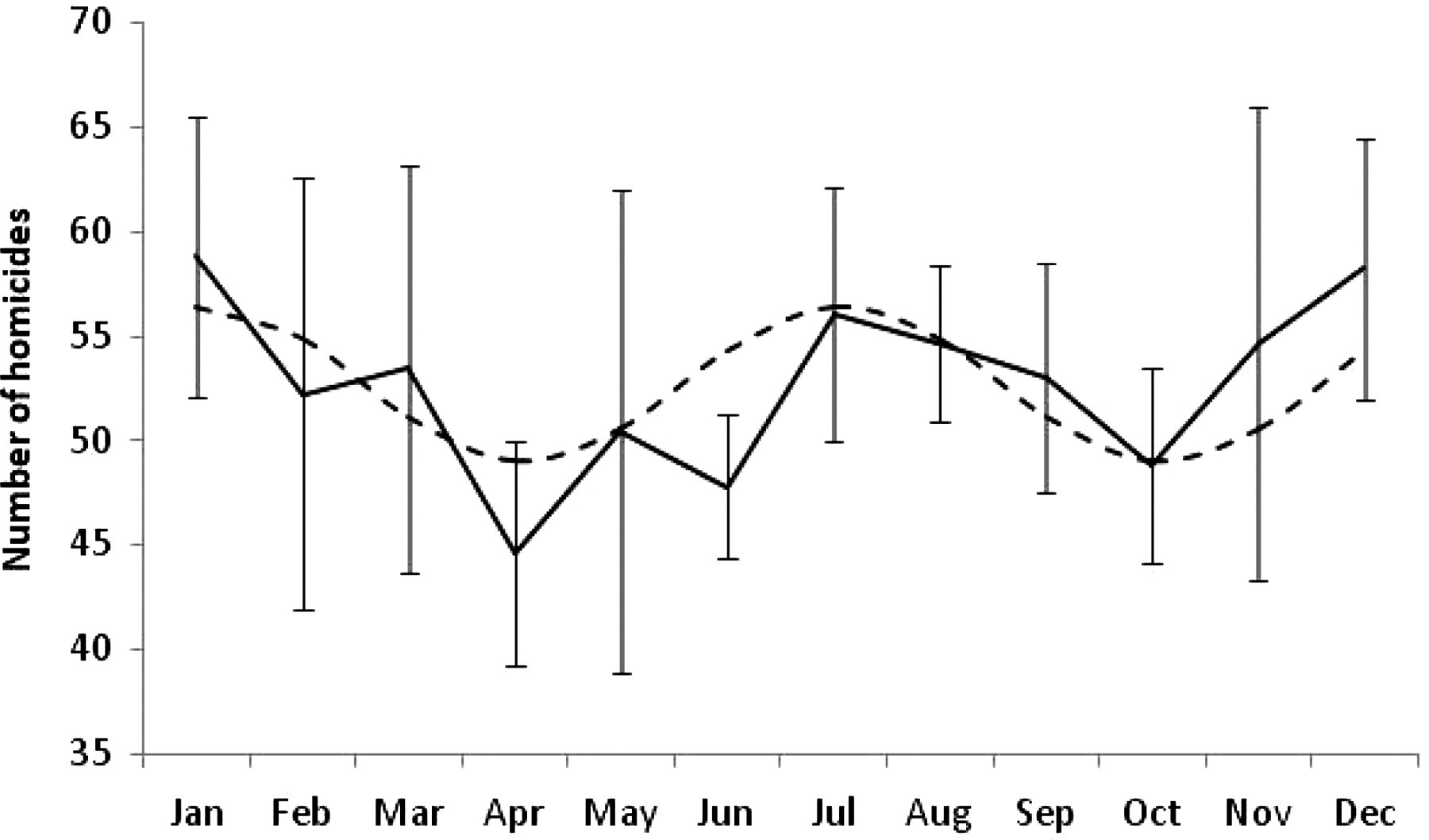
Aggregate monthly homicide frequencies in Italy. Monthly means of homicides are illustrated over one-year periods in Italy, 2004–2008. Data represent mean value for each month and related standard deviation across years. The dotted line (–––––) is the predicted distribution of homicides on the basis of a sinusoidal curve. Homicides in December and January are above the general trend in the sample, as are homicides in July and, marginally, in August. Because of the large standard deviation, homicidal incidents in March and November are not above the general trend in the sample
Homicides in January and in December exceed the expected average in the time series by 11.6% and 10.4%, respectively. Homicides in July, too, exceed the expected average by 6.3%, and in August the excess was 3.6%.
In the examined interval homicide variance depended on a six-month cycle (P = 0.027) and a bimonthly cycle (P = 0.045): other intra-annual cycles are less important, since they account for a scarce 9.4% of the total variance; less seasonal variance tends to be explained by these intra-annual cycles over time (Table 2).
Harmonic analysis of homicide data by month, Italy, 2004–2008
The asymptotic approximation in the distribution of the ratio of the deviance of each harmonic to the mesor of the time series was tested with χ 2 statistics
Coefficient of variation within years was 8%.
Homicides by day of the week, too, recurred cyclically across the 2003–2008 year interval (Rayleigh test: z = 4.95; P = 0.007). The highest risk of homicide was on Sundays and Mondays: indeed, mean vector direction is 9°, corresponding to a night peak between Sunday and Monday (Figure 2).
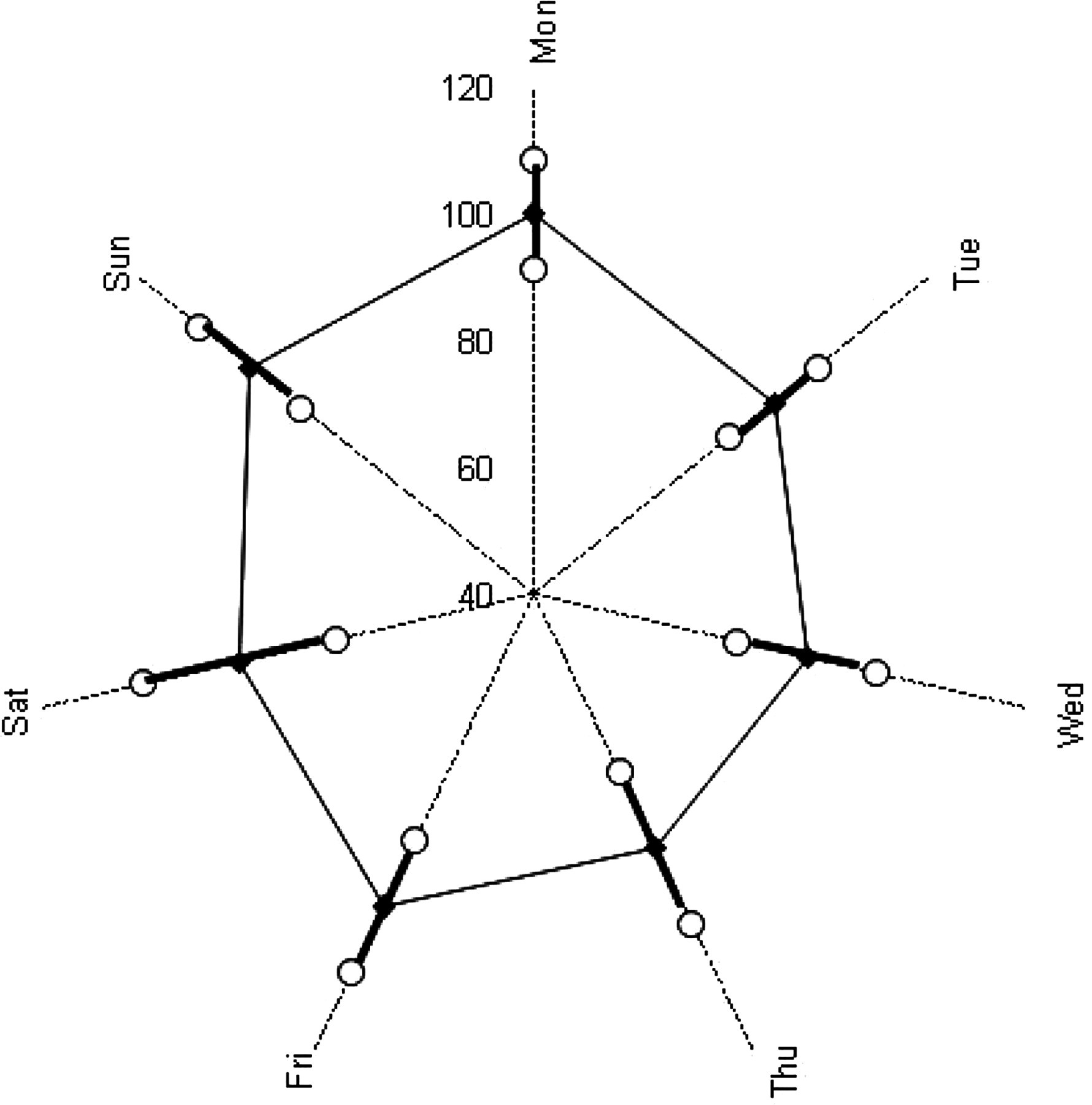
Aggregate homicide frequencies in Italy according to the day of the week. Daily means of homicides are illustrated over one-year periods in Italy, 2003–2008. Data are displayed on a polar graph, where the length of the module corresponds to the daily mean value for each year (standard deviation in bold)
Homicides on Sunday and Monday exceed the expected average by 7.1% and 9.8%, respectively. Coefficient of variation within weeks was 7%.
Finally, time of day showed a very evident unimodal circular distribution: Rayleigh test: z = 1013.04; P < 0.0001. The number of homicides greatly increased from the morning to the evening hours, until a peak at night-time (Figure 3).
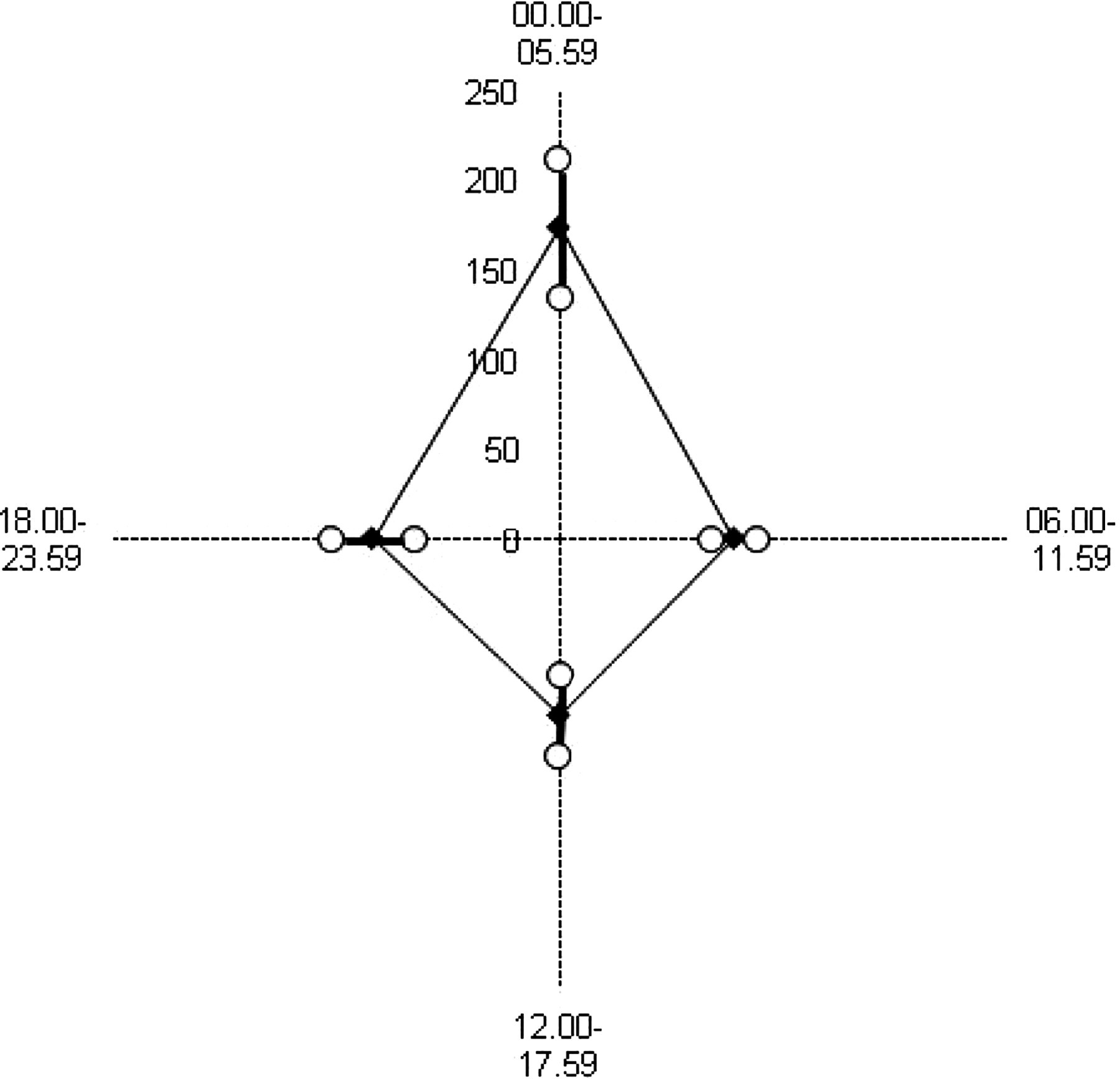
Aggregate homicide frequencies in Italy according to the time of day. Hourly means regarding homicides are illustrated over one-year periods in Italy, 2003–2008. Data are displayed on a polar graph, where the length of the module corresponds to the hourly mean value for each year (standard deviation in bold)
Homicides in night-time hours exceed the expected average by 46.5%. Coefficient of variation within days was 31%.
Discussion
This is the first report on the temporal distribution of homicides in Italy. Data from 2003 to 2008 showed that homicides had a seasonal component in Italy; they also peaked on Sundays and Mondays and were at their highest at night (00:00 to 5:59 hours).
Strengths and weaknesses of the study
Before extrapolating any conclusion from the results of this study, its limitations should be taken into account. The investigated data lacked details on the sex and age of the victims. In Italy, as elsewhere, the circumstances and the mechanics of the homicides with female victims are somehow different from the circumstances and the mechanics of the homicides with male victims. 47 As for age, it can influence the biological susceptibility to injuries, which could be affected by ambient temperature; elderly people were found to be particularly sensitive to ambient temperature, with greater mortality during periods of extreme and rapid changes in environmental temperature. 48–50
Another limitation is the lack of data on alcohol consumption by day of the week, and this prevents any test of the hypothesis that higher alcohol consumption during the weekend is a factor ecologically related to higher homicide rates in the weekend, as reported in past studies. 39,41,42 Lack of details on victim–offender relationship prevented the exploration of the different mechanisms that can be implicated in domestic and non-domestic homicides. Indeed, in Italy, as in other European countries, many homicides occur within the family, whereby a family member, generally a man, assaults and kills other relatives, often the spouse. 51 These circumstances are clearly different from those that accompany homicides by robbery or committed by criminal organizations, which could be partially explained by the routine activity theory. 26 Finally, data on homicides by time of day were available for a fraction of cases only (74% of total recorded cases).
Against these limitations, which could be addressed in future investigations on the topic, the study also has some strengths. It was based on national statistics and covers a time interval long enough to detect monthly, weekly and daily rhythms. The findings were also congruent with past studies on the topic.
Validity of findings: comparison with past studies
The night peak in homicides observed in this study was reported in other studies as well. 25,27,31,32,41 A prevalence of homicides during the weekend is a confirmation of what was found in other countries, suggesting that some risk factors implied in the circumstances leading to homicide recur across countries and cultures in relation to the weekend. 5,27,31,39,40
Instead, a bimodal pattern in the seasonal distribution of homicides was rarely reported. Ceccato 27 reported a bimodal pattern in the distribution of homicides in São Paulo, Brazil, with a peak in summer and another in autumn, but the study was based on a very limited interval (December 2000 to November 2001). In general, small-sample studies were more likely to find a summer peak in the homicides, 27,30,52 while studies based on national statistics more often found no seasonality in the time series of homicides. 13,16,17,33,37 When seasonality was found in time series analyses, the amplitude was small. In Finland, Tiihonen et al. 7 observed a 6% elevation above the expected homicide rate during the years 1957–1995, but contrarily to Italy, during winter the homicide rate was 6% below the expected rate. In Italy, too, frequency of events during the years showed modest changes, accounting for less than 10% of variation across the cycle, as those within the weeks, while variations within the days were more marked.
Explanations and hypotheses for research
The routine activity theory posits that the risk of victimization is higher when the potential victim is poorly guarded and exposed to a motivated offender. 26,53 Typical guardians are family members and friends, police and other public authorities, teachers and coaches, employers, and ordinary citizens nearby. The two seasonal peaks in homicides observed in Italy during the 2004–2008 interval correspond to two typical Italian holiday seasons: the summer holiday season, from the end of the school year (June) to its re-start (mid-September), and Christmas/New Year holidays, from mid-December to mid-January, when people are often out of their home shopping or partying. In both periods, valuable targets are more often unguarded, because they are out of their usual environment (home, work, school). This may favour the action of an assailant turning into homicide, both while committing a crime and during a brawl or a dispute. However, routine activity theory does not fit well with the peak of night and weekend homicides (since people are mainly at home, and there they should be well protected against dangerous strangers).
Higher consumption of alcohol during the weekend has been suggested as a factor that increases the chance of a dispute and decreases the ability of the victim to defend him/herself from an assailant. 39,41,42 However, illicit drug use in addition to alcohol should be taken into consideration. Indeed, there is robust evidence of the role of illicit drugs consumption in homicide, both in the offender, increasing the chance of aggression, and in the victim. 54,55
As for the night peak of homicides, it might be related to ongoing family conflicts and quarrels. Domestic homicides represent a large fraction of all homicides committed in Italy, about 30% in the most recent years with available data. 51 Additional factors involved in the night peak of homicides observed in this as in other studies is the disruption of circadian rhythms, which was often associated with impulse dyscontrol. 56,57 People with impaired impulse control might engage more often in a brawl or expose themselves to aggression.
Implications for clinicians or policy-makers
Temporal variations in homicides might be related to factors that are relevant on a clinical ground. For example, the thermal stress induced by hot and cold temperatures might decrease the chance of survival after an assault, as it was supposed to contribute to the seasonal peaks observed in Italy in unintentional acute intoxication by illicit drugs (overdose) 58 and in suicides. 59 Extreme weather affects people with limited adaptive responses and the susceptible population, including elderly people with chronic diseases and socially deprived groups. 48,49,50 These people are also exposed to a higher risk of homicide. 51,60 Therefore, injured people after an aggression must be more closely monitored during periods of heat waves or extreme cold, particularly when they belong to the susceptible population.
Additional biological processes, exposed to seasonal rhythms, might be involved in the differential survival of an assaulted victim. For example, coagulopathy is a predictor of trauma-related mortality, 61 and the seasonal variation of the factors involved in its occurrence was suggested to be involved in the seasonality of cardiac deaths, 62 and could be involved in the seasonal variation of homicides, too. 33
The investigation of the temporal variation in homicides reveals the complexity of the mechanics involved in death by aggression, whether planned or impulsive. Homicide is the outcome of events that imply victim–offender interactions, as well as the impact of the victim's biological risk and protective factors. Albeit speculative, some of the proposed explanations of this study's findings might inform policy-makers towards interventions that are not entirely based on police investigation and crime repression, since these interventions have a scarce or null effect on homicides within the family or caused by arguments/altercations between friends, acquaintances or strangers. Interventions aimed at decreasing alcohol or drug abuse and favouring access to the treatment of the related conditions, or aimed at reducing the impact of domestic violence, might be more effective in preventing homicides within the family or from arguments/altercations.
Unanswered questions and future research
Further investigation of temporal variation of homicide by season, week day and time of day should take into account the sex of the victim, the impact of temperature, in particular of the extreme weather that is occurring more and more often in European countries because of global warming, 63 and the role of the biological factors that might be involved in the victim's survival or succumbing to an assault. The identification of risk or protective factors might be especially important to prevent the worst outcome of injury at large (suicides and accidents included).