




Abstract
Introduction
Maltreatment and torture during custody is still an important problem in many countries. Both national and international regulations and the Istanbul Protocol are of great importance in terms of elimination of maltreatment and torture. In this study, we evaluated whether examinations for custody of immigrants were performed in accordance with the Istanbul Protocol.
Method
We retrospectively evaluated reports of forensic examinations for custody of 100 immigrants in Van-çaldıran Government Hospital in 2009. Data about nationality, age, gender, examination date, referring department, examination findings and departments to which the reports were submitted were collected.
Results
Fifty percent of the immigrants were Iranian and they were aged between 11 and 62 years. Ninety-nine immigrants were men and one was woman. Data about history of arrest were missing in forensic reports about all immigrants. Data about signs of trauma were present only for seven immigrants. Ninety-three immigrants were reported to have no signs of trauma. None of the immigrants underwent psychiatric examination. All forensic reports were found to be submitted to the police personally. Whether the immigrants were examined before or after the custody was not clear in the reports.
Conclusion
Evaluation of the data showed that none of the forensic examinations were performed in accordance with the Istanbul Protocol. It can be recommended that the protocol should be incorporated into the curricula for undergraduate, graduate and in-service training programmes in order to improve relevant forensic practices.
Introduction
There have been a considerable increase in problems about immigrants, forced to leave their country for many reasons particularly financial and political conditions and these problems do not only affect home and target countries but also the world as whole.1,2 When people flee from their countries, they seek asylum in the countries they move to. These asylum seekers are not considered as refugees until the United Nations conducts an examination and proves that they are refugees. They face many problems concerning their basic needs especially accommodation and food and also experience many psychological problems due to immigration.3,4
Several international organizations and countries have increased their attempts to solve problems due to immigration of people individually and in groups and several treaties have been signed. The two most important ones are The 1951 Refugee Convention held in Geneva and the 1967 Protocol which defines refugees. 5 Turkey signed the convention and the protocol on condition that geographical restrictions were kept so that the country was not affected by crises in neighbouring countries. 1 Accordingly, Turkey agreed to provide asylum for only immigrants from Europe, which was stated in a declaration. However, more favourable policies concerning immigrants have been created since 2003.6,7
In recent years, the immigrants applying individually for refugee status in Turkey have mostly been from Iran, Iraq and Afghanistan. A total of 62,500 immigrants, of whom 32 thousand were Iranian, 28 thousand were Iraqi and 2500 were Afghan, applied for refugee status between 1995 and 2007. 1 The restrictions kept in the 1967 Protocol caused Turkey to become a transit country between European and Asian countries especially Iran, Iraq and Afghanistan. The immigrants cross the east frontier of the country and reach the west frontier. They depict an irregular immigration. 8 They are arrested and legal procedures are followed as required by national laws. There have been several reports showing that they are kept in custody under inappropriate conditions. 8 In fact, maltreatment and torture under custody is still a serious problem in many countries. 9 So that medicolegal evaluations of maltreatment and torture should be made properly, international guidelines in the Istanbul Protocol for Inquiry and Documentation of Torture and other Cruel, Inhuman and Humiliating Treatment and Punishments were developed by many civil organizations and people specializing in medicine, law and other disciplines from 15 countries in 1999. 10 These guidelines are not only an important part of the protocol but also play an important role in several national and international regulations for elimination of torture.10,11
Contents of Istanbul Protocol and minimum evaluations which shall include at least the following
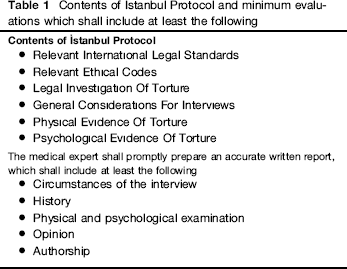
The Istanbul Protocol required the countries to take measures to prevent torture and maltreatment. Accordingly, the Turkish doctors who would perform forensic examinations of immigrants were offered education in 2009 so that they could fulfill the requirements of the protocol.2,12,13 This is the first study to evaluate reports about medicolegal examinations of irregular immigrants in terms of the Istanbul Protocol. The aim of this study was to investigate whether these forensic reports were appropriate to the protocol and to reveal what the doctors knew about these medicolegal examinations before education about the protocol was given.
Methods
The records of archive regarding medicolegal examinations performed in Van-çaldıran State Hospital between 1 January and 31 December 2009 were evaluated retrospectively. All medicolegal reports (n = 100) documented about immigrants under custody were included in the scope of the study. Reports of Turkish citizens were excluded. Data about nationality, age, gender, examination date, referring department, examination findings and departments to which reports were submitted were collected. The findings which had to be included in the reports according to the protocol were discussed. Descriptive statistics were used to analyse the data.
Results
A hundred immigrants, of whom 50 were Iranian (50%), 25 were Pakistani and 16 were Afghan (16%), were from seven different countries (Figure 1). Of 100 immigrants, 99 were men and 1 was woman. The mean age of the immigrants was 24 years (min: 11, max: 62), though two immigrants’ ages were not known. They mostly underwent examination in May and June (n: 46, 46%).
Nationalities of immigrants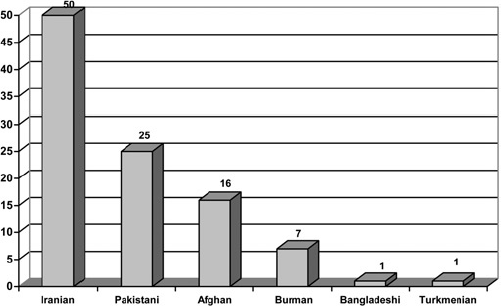
None of the reports included history of arrest. Only seven immigrants had signs of trauma and 93 had no signs of trauma. The signs of trauma detected in seven cases were ecchymosis 1 × 1 cm in the occipital region, oedema of the right foot, abrasion in the right lumbar region, ecchymosis in both eyes and laceration in the zygomatic region, abrasion and tenderness on the chest, abrasion on the left forearm and ecchymosed areas in the left gluteal region.
It was noticed that all of the doctors who performed these medicolegal examinations were general practitioners with basic clinical forensic medicine knowledge.
The evaluation of medicolegal reports revealed that there was no interpreter during the medicolegal examination. Furthermore, no informed consent was obtained before examination and no detention history was recorded on any of the reports. Interestingly, none of the immigrants underwent psychological examination. All the reports were found to be handed in to the police personally, and this was recorded in the copy of medicolegal reports in the archive of the hospital. It was not clear whether the immigrants underwent examination before or after being taken into custody. The reports had no information about the examination environment and the people available during examinations.
Discussion
Turkey is a transit country for immigrants and people seeking for asylum due to its geographical location. In fact, since it connects Asia with Europe and countries on the east of Turkey have poor socio-political conditions, it faces irregular movements of people seeking asylum. 14 According to the Turkish legal system, crossing the border without permission is considered as a crime. Therefore, individuals taken into custody for such action shall be prosecuted.
For this procedure medicolegal evaluation and reporting is of primary necessity, which is requested by public prosecutor. The whole expenses are provided by governmental resources. Physical inspections performed by official doctors in hospitals. If a positive finding of torture is determined in physical inspections, an investigation will be initiated by authorities and refugees transferred to a confident place.
The study setting was Van, a city located on the borders of Turkey and Iran where environmental conditions were convenient for illegal human movements. Indeed, people have been observed to pass the frontier illegally thanks to natural gates there. 15 Therefore, Turkey can be considered as a transit area for Afghan, Pakistani, Iraqi and Bangladeshi people migrating to European countries. They mostly cross the east frontier near Van on foot or riding on a horse over the hills. In addition, they may frequently hide in a lorry or a trailer truck to intrude into the country. 14 Thus, being the most frequently used area of entry for immigration the presented series strongly represent all the reports made in Van during 2009. Furthermore, the profile of immigrants in presented series was compatible with governmental statistics.
While crossing the frontier through illegal ways, 64,290 and 65,737 irregular immigrants were caught in 2007 and 2008 respectively. Of 300,666 irregular immigrants caught, 258,590 were deported between 2004 and 2008. 8
Turkey was still a country of immigration and emigration in 2009. Geographical restrictions in The 1951 Refugee Convention prevented still immigrants from settling in Turkey. 8 Irregular immigrants experience serious health problems during their passage through the frontiers and their stay in the country due to poor conditions of the places where they live. 4 According to data from the Ministry of Internal Affairs, 87 and 65 immigrants died at the frontiers in 2007 and in 2008 respectively. 8
Of all the immigrants caught while entering and leaving Turkey in 2009, 35.4% (5403) were Iraqi, 29.6% (4526) were Iranian, 18.9% (2897) were Afghan, 7.6% (1172) were Somalian and the rest were from miscellaneous countries. 8 Likewise, in this study, 50% were Iranian and 16% were Afghan. Since the study was conducted in a hospital near Iranian frontier, there were not any Iraqi immigrants.
Data from United Nations High Commissioner for Refugees Turkish Office, the refugees registered in the office were aged between 18 and 59 years by 31 May 2010. 8 In the present study, the immigrants were aged 21- 30 years, consistent with the literature.1,8 Dates of the reports show that most of the irregular immigrants (68%) entered the country between May and August, which can be attributed to good weather conditions in these months.
An interpreter has to be requested to accompany interviews with the immigrants although both interviewers and interviewees speak the same language since the information sought is so important that misunderstandings cause serious mistakes. 10 Medical evidence to be detected during forensic examinations is of great importance. 16 Deniz et al. reported that 25% of the immigrants knew little Turkish and stayed in Turkey for shorter than one year. It was emphasized that immigrants had difficulty in expressing themselves and problems with their daily life in the country they moved to. 1 In the present study, the immigrants staying in Turkey temporarily were irregular immigrants and had the same problem. In fact, we did not find that an interpreter accompanied the immigrants during forensic examinations.
The Istanbul Protocol required that informed consent should be obtained in forensic examinations. Physicians should also explain possible advantages and abstruse results of the medical examination and make sure that informed consent should be obtained without pressure from the police and jurisdiction. 10
It was striking that none of the immigrants were informed about the forensic examination or were requested consent. It was recommended in the Istanbul Protocol that history of arrest and maltreatment, under what conditions immigrants were arrested and kept in custody and what kind of torture and maltreatment they were exposed to should be investigated. 10 In the present study, there was not any information about psychosocial history and being detained by the police. Several studies revealed that immigrants may have both physical and psychological signs of maltreatment.17-19 It is stated in the Istanbul Protocol that psychological evaluation is of central importance in forensic examinations. 10 We found that none of the immigrants had psychological examination.
Findings from the physical examination revealed physical signs of trauma in only seven immigrants (7%, n:100). The lesions were the ones which could be cured with simple medications. An Iranian immigrant had ecchymosis around both his eyes and laceration on the zygomatic region, which can be considered as important signs of maltreatment. The lesions in other immigrants were not remarkable. The reports did not show how and why the lesions occurred and whether they were due to maltreatment. It was noticed that, the signs of trauma was assessed by inspection and no trauma scale was used for assessing presence or absence of signs of trauma. The İstanbul protocol requires that physicians performing the forensic examinations should record whether the lesions detected are due to torture or maltreatment. 10 It is stated whether the lesions are not consistent, consistent with, highly consistent, typical of or diagnostic of torture and maltreatment. 20 In fact, some lesions which could be cured with simple medications may result from torture and maltreatment. Considering that irregular immigrants live under unhealthy conditions, it should be kept in mind that the lesions can pose important health problems due to their risk for infections.19,21
It was noticed that none of the doctors who performed medicolegal examination were clinical forensic medicine specialists. Istanbul protocol training programme conducted in Turkey included all cities and Van as well; however, the presented study focused on cases examined previous to the training programme. In this respect, the present study might be a reference for the further studies evaluating the effectiveness of Istanbul Protocol Training Programme, in Turkey.
All the forensic reports were found to be submitted to the police who signed that they received the reports, since refugees were brought accompanying with police. It is also emphasized in the Istanbul Protocol that the reports should not be handed in to the police, but should be given to the legal authorities who conduct the interrogations. 10
In addition to the way of submission of the reports, it is of great importance that the lesions detected in the examinations should be photographed since they can be considered as evidence of maltreatment and so that they can be evaluated later. 22 It is necessary that the whole body including the lesion should be photographed and a close up photograph of the lesions accompanied by a colour scale and a ruler should be taken.10,22 Therefore, there should be appropriate equipment such as a computer, a camcorder, a camera and ultraviolet and infrared lamps in the centres where such forensic examinations are performed. 23
The Istanbul Protocol and relevant practices in Turkey
The protocol was prepared by researchers from various countries and in accordance with the articles of the protocol, there have been many attempts to prevent torture and maltreatment of immigrants in Turkey such as courses, symposiums and workshops.
Several education programmes have been launched to prevent torture and maltreatment since the early 1990s. The general practitioners in 11 cities were offered education programmes by the Society of Forensic Medicine Specialists between 1996 and 1998. The reason why these programmes were offered to the general practitioners is that the forensic examinations of the immigrants can be performed by the general practitioners due to the insufficient number of forensic specialists. 24 In addition, an Atlas of Torture was issued to provide guidance for physicians in writing the forensic reports and documenting lesions.21,25
The Training Program on the Istanbul Protocol Enhancing the Knowledge Level of Non-Forensic Expert Physicians, Judges and Prosecutors initiated in 2007 and was mostly funded by the European Union. The programme was organized thanks to the contributions of Council of Forensic Medicine, Ministry of Justice, Turkish Medical Association and International Rehabilitation Council for Torture Victims. The Training Programme on the Istanbul Protocol started on 20 May 2009, was offered to 100 groups of general practitioners and was completed on 18 November, 2009. Out of approximately 60,000 general practitioners in Turkey, 3450 attended the programme while participation of 4000 was targeted initially. 12 This programme was conducted by workshops and courses given by professional trainers such as forensic medicine specialist, lawyers and psychiatrists, in a number of regions to cover entire country. Then, the practitioners receiving education was considered as the consultant doctors for their districts, and organized symposiums and workshops for their local colleagues.
Civil organizations have had increased interest in problems with refugees. Human Rights Foundation of Turkey and United Nations High Commissioner for Refugees cooperated in conduction of education programs. Turkey signed a memorandum of understanding with the United Nations High Commissioner for Refugees Turkish Office on 3 August 2009. As required by this memorandum, a project was launched on 1 February 2010 to protect refugees’ and asylum seekers’ rights, to allow them to exercise their rights, to increase awareness of persons and organizations having relationships with refugees and asylum seekers, to increase public sensitivity to refuges’ and asylum seekers’ problems and to incorporate the principles adopted at the convention in Geneva into the national regulations. 26 Both civil organizations have made attempts and the government has adopted new regulations to allow immigrants accommodating in guesthouses to apply for refugee status and to prevent their detention. 8
Conclusion
Although international laws concerning human rights and humane law prohibited torture, it has not disappeared yet. Health professionals play an important role in investigations of torture and maltreatment. The results of this study revealed that none of the forensic examinations of immigrants was performed and none of the resultant reports was written in accordance with the principles adopted in the Istanbul Protocol. Data available in the reports are not sufficient to draw a conclusion that immigrants are not exposed to torture and maltreatment. Even this casts doubt on the accuracy of the reports. To eliminate this undesirable situation, the Istanbul Protocol should be incorporated into the curricula of undergraduate and graduate education programs and into the in-service training programmes and the principles of the protocol should be put into practice.
Footnotes
Declarations
Acknowledgement
The authors thank to General Direction of çaldıran State Hospital for giving permission to use records.