




Abstract
Background
Analysis of fingerprints and palm prints at the crime scene is vital to identify the suspect and establish a crime. Dermatoglyphics can even be valuable in identification of a dismembered hand during medicolegal investigations to establish the identity of an individual in cases of mass disasters/mass homicides.
Methods
The present research studies the variation in ridge density in different areas of the palm prints among men and women. The four prominent areas were analysed on the palm prints that included central prominent part of the thenar eminence (P1), hypothenar region; inner to the proximal axial triradius (P2), medial mount; proximal to the triradius of the second digit (P3) and lateral mount; proximal to the triradius of the fifth digit (P4).
Results
The mean palm print ridge density was significantly higher among women than men in all the designated areas in both hands except for the P3 area in the right hand. Statistically significant differences were observed in the palm print ridge density between the different palm areas in men and women in right and left hands. No significant right-left differences were observed in the palm print ridge density in any of the four areas of palm prints among men. In women, right-left differences were observed only in the P3 and P4 areas of palm prints.
Conclusions
This preliminary study indicates that though the palm print ridge density is a sexually dimorphic variable, its utility for estimation of sex in forensic identification may be limited owing to significant overlapping of values.
Introduction
Fingerprints and palm prints are the impressions of the dermal friction ridges present on the palmar aspect of the hand that appear in the intrauterine life and remain unaltered until death. When a person touches a surface or grabs an object, an impression of the friction ridge skin may be left behind. Detailed analysis of fingerprints and palm prints at the crime scene hence, becomes vital to identify the suspect and establish a crime. Often the prints collected from crime scenes, weapons of offence (knife hilts, gun grips), steering wheels and window panes are of palms and fingers. Fingerprints are usually recovered from the crime scenes. According to the study of Jain and Feng, 1 about 30% of the latent prints recovered from crime scenes are from palms. Hence, a growing need of palm print databases worldwide. The prints obtained from the crime scene are matched with the suspects to confirm their involvement in crime. If the sex of the perpetrator is established from the prints available at the crime scene, the burden of the investigating officer is reduced as their search of potential suspects will be restricted to a particular sex. The sex differences in palm print ridge density can even be valuable in identification of a dismembered hand during medicolegal investigations to establish the identity of an individual in cases of mass disasters/mass homicides. In this context, the sex difference in the ridge density in the fingerprints and palm prints becomes relevant.
A few researchers have explored the possibility of sex differentiation from fingerprints. Jantz 2 found sex and race differences in finger ridge-count correlations and Moore 3 pointed out that women have finer epidermal ridge detail than men. Acree 4 reported higher fingerprint ridge densities in women in Caucasian and African American population. His work was followed by Gungadin 5 and Nayak et al. 6 who reported similar observations in Indian population. Nayak et al. 7 further reported sex differences in the finger print ridge density among the Chinese and Malay population. In a study of fingerprint ridge density in Spanish population, 8 it is suggested that ridge density varies in fingerprints obtained from each finger and in different areas on each fingerprint.
Although researchers have attempted to estimate sex from fingerprint ridge density, to the best of our knowledge no systematic studies are available on the gender-related variations in the ridge density of palm prints worldwide. The pertinent research question was ‘Is there a sex difference in palm print ridge density?’ This preliminary study was hence, planned to evaluate the sex-dependent variations in ridge density in palm prints and its usefulness in discriminating sex in Indian population. The present research also aims to study variations in ridge density in different areas of the palm prints and comparatively analyse the palm print ridge density between the two sides.
Materials and Methods
This study was conducted in the Department of Forensic Medicine, Kasturba Medical College (KMC), Mangalore. A prior approval was obtained from the Institutional Ethical committee to conduct this research. The participants included in the study were not from any homogeneous population but represented a mixed population of India. Healthy individuals aged between 20 and 25 years were included in the study after taking informed consent. The subjects with any disease, deformity, injury, fracture, amputation or history of any surgical procedures of the hand were excluded from the study. A total of 131 individuals (73 men and 58 women) voluntarily participated in the study. Stature and maximum length of the palm print were measured in randomly selected 50 participants (25 men and 25 women) from the study group to analyse the male-female differences in these variables.
Materials
A plain glass plate of size 15 cm × 5 cm, black duplicating ink (Kores India make), roller, magnifying lens, white bond paper, transparent sheet, soap and dry towel were used in the study. A total of 262 palm prints (right and left hand) were collected by one of the authors (AKR) that formed the principal material of the study.
Technique and analysis of palm prints
A clean plain glass plate was uniformly smeared with black duplicating ink with the help of a roller. Each subject was asked to wash their hand clean with soap and water. The subjects were asked to apply their hand on the smeared plate and then transfer them on to a white paper. Regular pressure was applied to obtain the palm prints. Palm prints were obtained from both right and left hands.
Inter-observer and intra-observer error for the ridge count in the four study regions on the palm prints

Four areas (P1, P2, P3 and P4) were analysed on the palm prints (Figure 1). A 5 mm × 5 mm square drawn on a transparent film was placed on the obtained palm prints in the well-defined areas and in a specific manner to ensure minimum error and maximum reproducibility of the study methods and findings. Orientation of 5 mm × 5 mm square for ridge counting is based on the normal ridge patterns in the different areas of the palm and accordingly the 5 mm × 5 mm square was placed on the P1 and P2 areas in a normal orientation and with a 90° tilt in the P3 and P4 areas as shown in Figure 1. Four areas analysed in the study included:
Four designated areas on the palm prints that were analysed for the palm print ridge density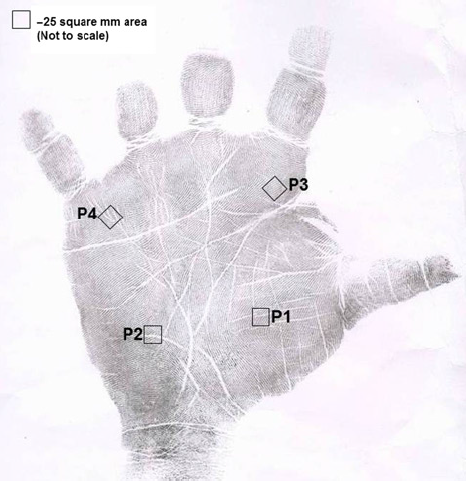
P1-5 mm × 5 mm square was placed on the central prominent part of the thenar eminence, orientation of the square being normal.
P2-5 mm × 5 mm square was placed medially to the proximal axial triradius on the hypothenar region with the lower vertex of the square placed on the proximal axial triradii.
P3-5 mm × 5 mm square was placed on the medial mount proximal to the triradius of the second digit, the uppermost vertex of the square placed on the triradii of the second digit.
P4-5 mm × 5 mm square was placed on the lateral mount proximal to the triradius of the fifth digit, the uppermost vertex of the square placed on the triradii of the fifth digit.
The areas on the palm prints where the ridges were clear and an accurate count was possible were included in the study. The print areas with unclear/smudged ridges were left out. The statistical analysis was then performed on P1 (men = 73, women = 58), P2 (men = 68, women = 58), P3 (men = 69, women = 54) and P4 (men = 60, women = 58) areas.
Statistical analysis
The data obtained were analysed statistically using SPSS (Statistical Package for Social Sciences, version 11.0) computer software (SPSS, Inc, Chicago, IL, USA). The male-female differences in ridge density were statistically analysed individually for each of the designated areas from the palm prints for both hands separately. Ridge density was compared between right and left hands for each of the designated areas. Ridge densities obtained from different areas were compared with each other. Statistical comparisons were made using Student's t-test. Statistical significance was defined at the standard 0.05 level.
Results
Stature of male participants ranged between 165.0 and 183.0 cm and between 148.0 and 168.0 cm in female participants. Mean stature in men (174.1 ± 5.2 cm) was significantly larger (t value = 12.597, P value <0.001) than mean stature in women (156.1 ± 4.9 cm). No significant side differences (right-left) were present in the palm print length in men (P = 0.963) and women (P = 0.611). Mean palm length was 16.8 ± 0.9 cm in men and 16.1 ± 0.7 cm in women. Palm print length was significantly larger in men than women on the right (P = 0.003) as well as left sides (P = 0.005).
Descriptive statistics: ridge density in men and women in the right hand
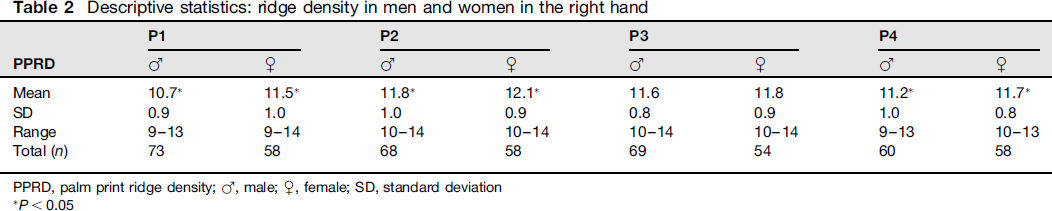
P< 0.05
Descriptive statistics: ridge density in men and women in the left hand
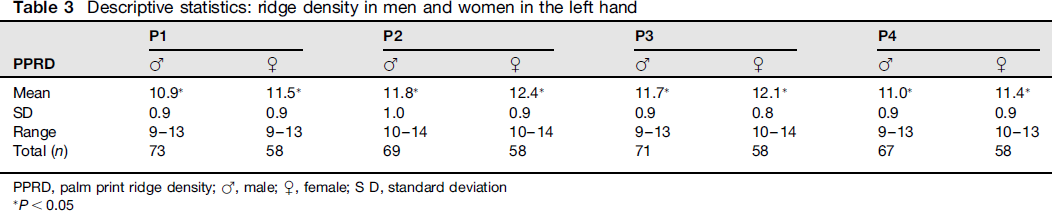
P< 0.05
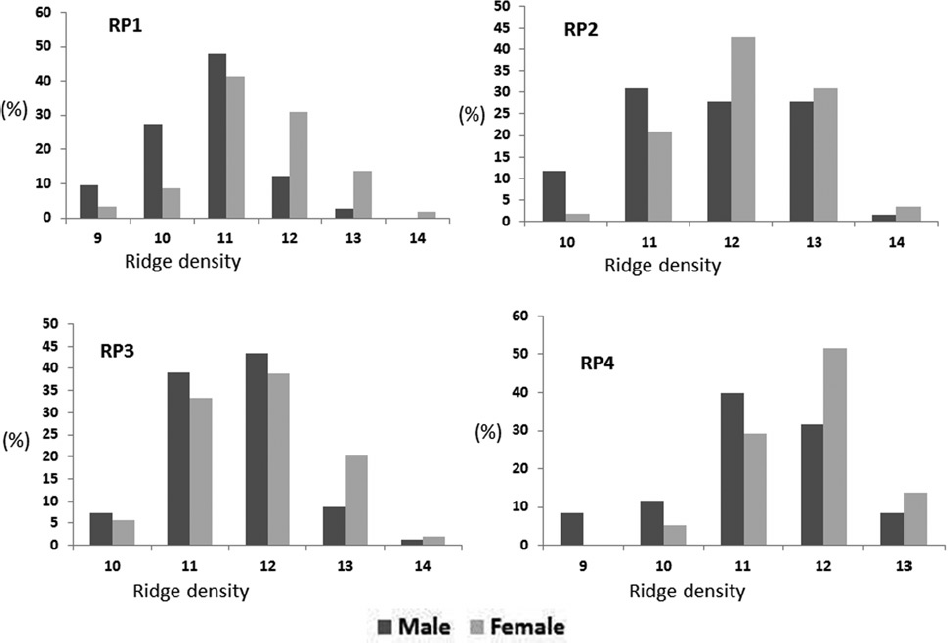
Frequency distribution of palm print ridge densities in the four designated areas of the palm prints among men and women in the right hand
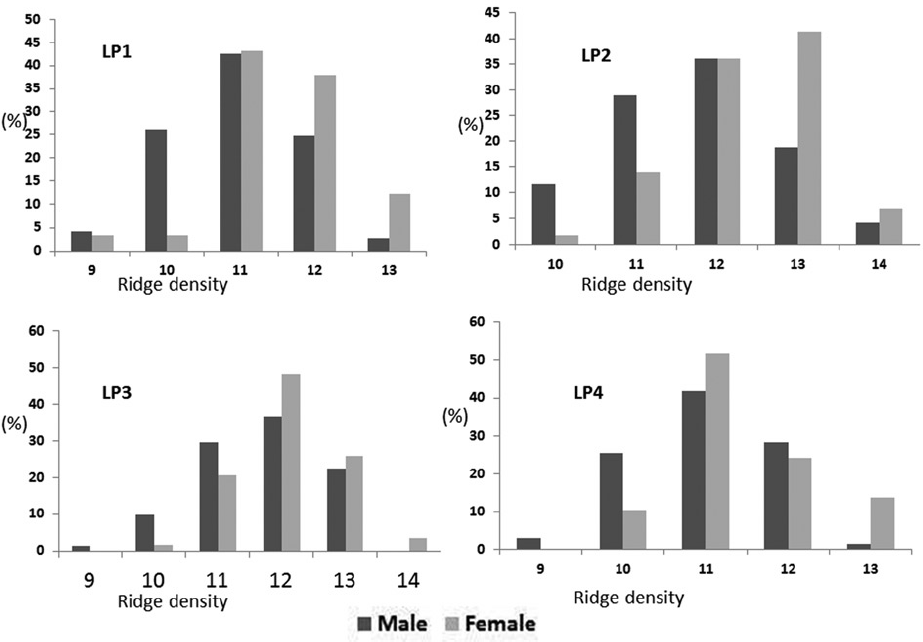
Frequency distribution of palm print ridge densities in the four designated areas of the palm prints among men and women in the left hand
From the frequency distribution it is evident that the palm print possessing a ridge density of 11 and less has a higher probability of belonging to a man whereas a palm print possessing a ridge density of 12 or more has a higher probability of belonging to a woman in the P1, P2 and P4 areas of the right palm. However, there is considerable overlapping of males and females with a palm print ridge density of 11 and 12. For a palm print ridge density of 14 in P1 and P2 areas, and 13 in the P4 area, there is an increased probability of a palm print to be of a female origin whereas for a palm print ridge density of 10 in P1 and P2 areas, and 9 in P4 area, the probability of a palm print to be of a male origin is larger. A considerably larger overlapping in male and female values is evident in the P3 area of the right palm (Figure 2). A palm print possessing a ridge density of 10 and less in P1 and P4 areas, and 11 and less in P2 and P3 areas has a higher probability of belonging to a men whereas a palm print possessing a ridge density of 12 and more in the P1 and P3 area, 13 and more in the P2 area, has an increased probability of belonging to a woman in the left palm. No clear pattern is evident in the P4 area where considerable overlapping is evident for the palm print ridge density of 11 and 12 (Figure 3).
Comparison of ridge densities in the four designated areas (t values are shown in the table)
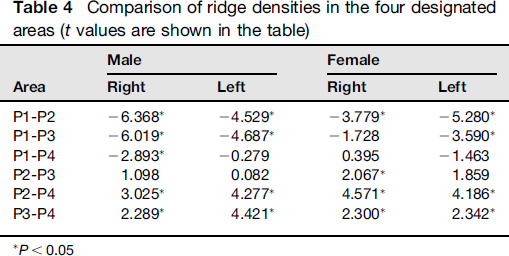
P< 0.05
Discussion
The results of the present study indicate that significant sex differences exist in the palm print ridge density. A higher palm print ridge density is observed in women than in men in all the areas except for the P3 area in the right hand. Ridge thickness and furrows are the two important factors which determine the density of ridges. Cummins et al. 9 and Ohler and Cummins 10 worked on ridge thickness in fingerprints and showed that men have coarser finger ridges than women and the difference is approximately 10% which suggest that men will have fewer ridges in a given area than women and thus lesser ridge density in a given area. Gutiérrez-Redomero et al. 8 attributed significantly lower fingerprint ridge density in men to the thicker ridges, possibly wider valleys or as a consequence of combination of both these features. Krishan et al. 11 proposed that the difference between the fingerprint ridge density in men and women in a given area may be attributed to the larger average body proportions of men than women. Possibly for this reason, the same numbers of ridges are accommodated among the men in a larger surface area resulting in a lower ridge density in men. An earlier study by Kanchan and Rastogi 12 in non-homogeneous population from North and South India has shown considerable sexual dimorphism in hand and palm dimensions: male dimensions being larger than females. Their study did not report any significant differences in hand measurements among North and South Indians. Our observations with regard to the size of palm prints among men and women suggesting that male dimensions are larger than females are similar to that reported earlier. 12 Sexual differences in fingerprint ridge density with respect to age and sex of the subjects have also been studied earlier. 13 Loesch and Czyżewska 14 found that sexual differences in ridge breadth are significant in the age group of 12-13 years. The present study was conducted in an adult population aged between 20 and 25 years and hence, age-based variations in palm print ridge density if any, could not be studied and remains an area of interest for future researchers.
There seems to be an indication that the total ridge count is influenced by the genetic component of the individual especially by the sex chromosome component. Jantz 2 on the basis of pattern of sex and race differences in his study confirmed that the sex chromosomes, particularly the Y chromosome, play a role in dermal ridge development. Krishan et al. 11 also proposed a probability that some associated genes of dermal ridges may reside in the X chromosome and thus, a strong penetrance in women. In other studies it is observed that the ridge breadth increases with the number of sex chromosomes 15 and that the Y chromosome affects the ridge breadth more than the X chromosome. 13 Considering the similar nature and origin of the fingerprints and palm prints, the same reasons could also be applicable to the variations in the palm prints among men and women.
To the best of our knowledge, sex differences based on palm print ridge density have not been reported earlier and hence the findings of our study cannot be compared per se. However, findings of our study are in accordance with earlier studies 4 8 on fingerprint ridge densities that report a higher finger print ridge densities in women than in men in different ethnic groups. When compared with the earlier studies by Acree, 4 Gungadin, 5 Nayak et al.6,7 and Gutiérrez-Redomero et al. 8 on fingerprint ridge density in different population groups, it is observed that on an average the palm print ridge density is lower than the fingerprint ridge density reported in the studies. Moreover, the sex differences in palm print ridge density are not as large as that reported in the fingerprint ridge density in the earlier studies. The reason for the variation in fingerprint and palmprint ridge density may be attributed to the fact that ridges on the palm are coarser than on the fingertips.9,10 According to Cummins et al. 9 and Ohler and Cummins, 10 the ridge widths are finest on the fingertips, coarser in the distal palm, and coarsest in the proximal palm. The ridges on the right hand are reported to be coarser.9,10 Our study did not observe any right-left differences in the palm print ridge density in any of the four areas among men. Significant right-left differences were observed in the P3 and P4 areas in women, palm print ridge density was higher on the left side in P3 area and on the right side in P4 area.
Different studies have suggested racial differences with respect to fingerprint ridge density and ridge breadth. Jantz and Parham 16 studied the ethnic differences in the ridge breadth among Yoruba students (Nigeria), English and Jews. Ethnic differences were found to be substantial in both the sexes. Loesch and Martin 17 also discovered that the ridge breadth on fingers III and IV in Polish and Australian men of European origin were different, i.e. 458.94 and 488.75 μm (for finger III), 438.71 and 460.1 μm (for finger IV), respectively. Nayak et al.6,7 reported a significant racial differences in fingerprint ridge density among Chinese, Malaysians and Indians. Similarly, population and ethnic variations in palmar dermatoglyphics have been reported in the literature. 18 21 The participants included in the study were not from any homogeneous population but represented a mixed population from India. The same may be considered as a limitation of the study. Estimation individually for each ethnic group is a valid exercise. However, the same in countries like India where various endogamous communities of diverse origins, languages, cultures and religions reside is difficult to achieve and seems impractical to derive standards for every ethnic group and caste in India, of which there are hundreds. Moreover, with population movements and intermixing of racial groups, its practical utility in medicolegal investigations may itself be limited. Given the nature of the issues being investigated it is valid to base an investigation on the examination of data collected from a representative sample group and from very carefully defined locations on the palms of these persons. Effort is made in this regard to define the four regions on the palm prints to ensure minimum error and maximum reproducibility in the future studies. While P2, P3, and P4 areas were relatively well defined and fixed in relation to the respective triradii, P1 area was not related to any fixed landmark and hence, the effect of variations with regard to palm print ridge density in the thenar region remain a possibility and needs to be explored.
Conclusions
The study reveals that significant sex differences exist in the palm print ridge density. The palm print ridge density is significantly higher among women than men in all the designated areas in both hands except for the P3 area in the right hand. It is evident that statistically significant differences exist in the palm print ridge density among the different areas in men and women in the right and left hands. Thus, the sex differentiation criteria developed in a particular area of palm print should be applied to any other part of palm print in general.
This preliminary research which studies the sex differences in the palm print ridge density for the very first time indicates that though the palm print ridge density is a sexually dimorphic variable its utility for estimation of sex in forensic identification may be limited owing to significant overlapping of male and female values. The study concludes that the sexing potential of palm print ridge density should be considered only as a supportive finding in estimation of sex of palm prints found at the crime scene. Besides, when facilities for DNA analysis are not available, the study findings may have implications in the forensic identification of human remains brought for medicolegal examination in cases of mass disasters, explosions and assault (criminal mutilation) where the body is dismembered to conceal the identity of the victim. The findings of this preliminary study need to be further explored on a larger sample and among different population and age groups.
Footnotes
Acknowledgements
The authors are grateful to the study subjects who voluntarily participated in the study. We wish to thank Ms Ritika Agarwal, Ms Shibani Hegde and Mr Rashid Ansari, Undergraduate students of Medicine for their help and support during collection of the study sample. Authors are grateful to the Dean, Kasturba Medical College, Mangalore and the Vice-Chancellor, Manipal University, India, for encouraging research and its publication in international journals of repute.