




Abstract
Introduction
This study has examined the impact of the World Health Organization's Research into Global Hazards of Travel (WRIGHT) Project's phase 1 report on the information given by airlines to their passengers regarding traveller's thrombosis.
Methods
Official websites of all airlines flying from Heathrow (UK) and John F Kennedy (USA) were located through links on the websites of these two busy international airports. In June 2007, each site was scrutinized by three independent researchers to identify if traveller's thrombosis and its risk factors were discussed and what methods of prevention were advised. This exercise was repeated a year after the publication of the WRIGHT report.
Results
One hundred and nineteen international airlines were listed in 2007 (12 were excluded from analysis). A quarter (27/107) of airlines warned of the risk of traveller's thrombosis. A year later, five airlines were no longer operational and there had been no increase in the discussion of traveller's thrombosis (23/102). Additional risk factors discussed in June 2007 versus September 2008: previous venous thromboembolism (16%, 15%); thrombophilia (14%, 15%); family history (11%, 9%); malignancy (12%, 14%); recent surgery (19%, 16%); pregnancy (17%, 16%) and obesity (11%, 12%). Prophylaxis advice given in June 2007 versus September 2008: in-flight exercise (34%, 42%); Hydration (30%, 34%); medical consultation prior to flying (20%, 18%); graduated compression stockings (13%, 12%); aspirin (<1%, <1%) and heparin (5%, 7%).
Conclusions
The majority of world airlines continue to fail to warn of the risk of traveller's thrombosis or offer appropriate advice. Alerting passengers at risk gives them an opportunity to seek medical advice before flying.
Introduction
Venous thromboembolism (VTE) following all forms of prolonged travel, traveller's thrombosis, has been reported. 1,2 Immobility, promoting venous stasis, is a recognized risk factor for venous thromboembolism in hospitalized patients and passengers on long journeys can also remain immobile for many hours. The duration of travel, the frequency of travel and the interval between journeys are all important factors. 3 Just as with hospitalized patients, many travellers will also have additional risk factors for the development of a venous thromboembolism (a deep vein thrombosis and or pulmonary embolism). 4
Most interest has surrounded air travel and the risk of traveller's thrombosis. The World Health Organization's Research into Global Hazards of Travel (WRIGHT) Project has now reported its phase 1 findings and recommends that there is a clear need for travellers to be given appropriate information about traveller's thrombosis. 3 The aim of this study was to examine the websites of the major airlines to see what information is currently being given to air passengers about traveller's thrombosis. In addition, we have looked to see what advice on prevention is currently being recommended.
Methods
Official websites of all airlines flying from Heathrow 5 (UK) and John F Kennedy 6 (USA) were located through links on the websites of these two busy international airports. In June 2007, each site was scrutinized by three independent researchers to identify if traveller's thrombosis and its risk factors were discussed and what methods of prevention were advised. This exercise was repeated a year after the publication of the WRIGHT report. 3
Many of the websites were available in multiple languages and in addition, requested the country of origin of the potential traveller. Therefore, for the purposes of this study all websites were searched in the English language and as if the researcher was a passenger travelling from the UK. ‘Health’ and/or ‘Wellbeing’ sections of each website were searched if present. A search within the website's search facility, if available, was also made for ‘deep vein thrombosis’ to identify if any information on this subject was contained within the site.
Information given regarding additional risk factors for venous thromboembolism, which may increase a passenger's risk, was also noted. Each airline's advice, if given, on methods of risk reduction/prophylaxis was also recorded. Data were entered into a Microsoft® Access 2000 database (Microsoft, Redmond, WA, USA).
Results
One hundred and nineteen international airlines were listed in 2007. Twelve of their websites were excluded from analysis as three sites were unavailable in the English language, four were unable to be accessed and five links redirected to parent airlines already analysed. All of the included airlines provided long-haul flights (>4 hours by the WRIGHT project definition 3 ).
A quarter (27/107) of airlines warned of the risk of traveller's thrombosis. The discussion of traveller's thrombosis on airline websites ranged from a simple statement to detailed information on the risks, additional risk factors and potential methods of risk reduction. All of those websites that contained information on traveller's thrombosis required the reader to actively explore the website to be made aware of this information.
A year later, five airlines were no longer operational and there had been no increase in the discussion of traveller's thrombosis (23/102). Only one of these five previously gave any traveller's thrombosis advice.
Figure 1 displays the additional risk factors for venous thromboembolism that may increase a passenger's risk of venous thromboembolism and the percentage of airlines that mentioned these. There was no dramatic increase in the discussion of additional risk factors following the publication of the WRIGHT report. Ten percent of the airline websites gave a warning of the risk of traveller's thrombosis, but did not give any further information on the additional risk factors that may put a traveller at high risk.
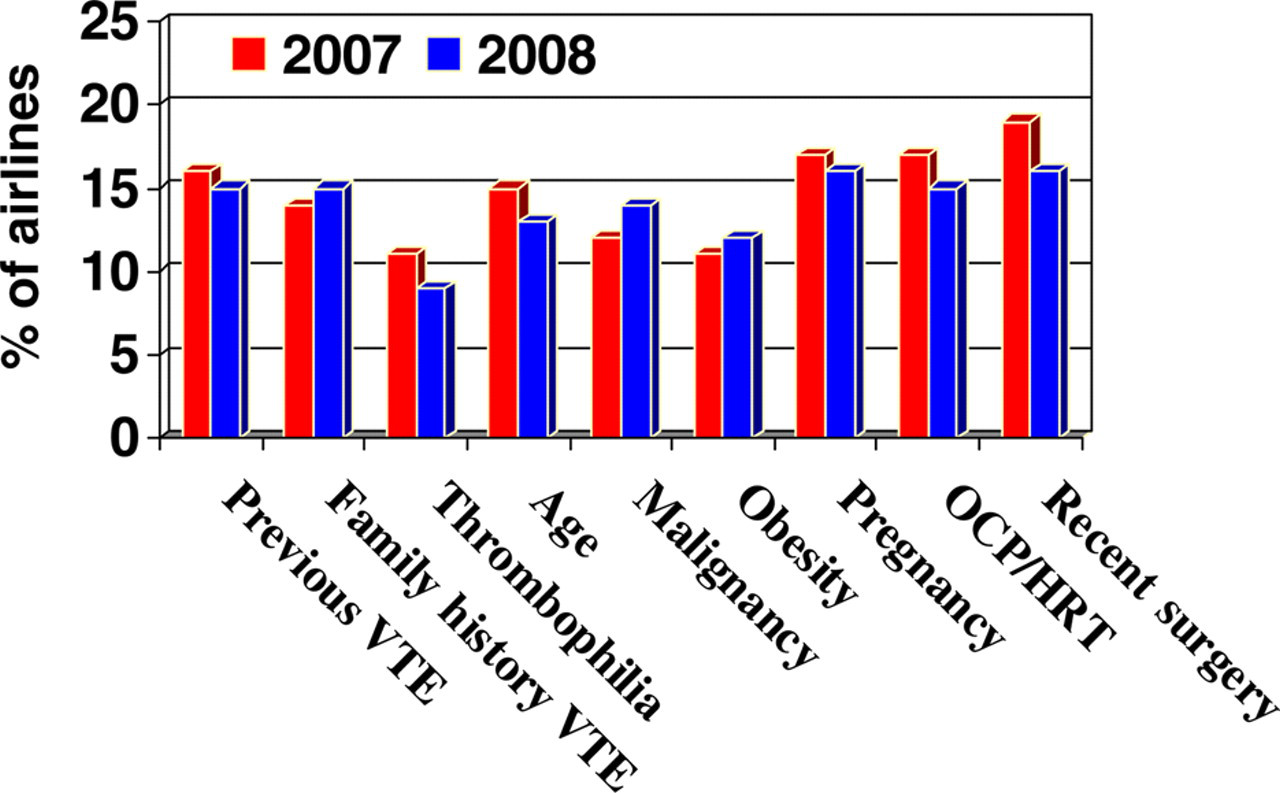
Additional risk factors discussed. VTE = venous thromboembolism; OCP = oral contraceptive pill; HRT = hormone replacement therapy
Figure 2 shows the methods of risk reduction that different airlines discussed or suggested. In 2007, more airlines gave advice about the importance of in-flight exercise and maintaining in-flight hydration than warned of the risk of traveller's thrombosis. The reason for these precautions was not therefore always linked to traveller's thrombosis prevention. This trend continued in 2008 when the percentage of airlines giving advice on in-flight exercise and hydration increased.

Prophylaxis advice given. GCS = graduated compression stockings; LMWH = low molecular weight heparin
Discussion
Heathrow is the world's busiest international airport with flights to over 180 destinations in over 90 countries. With 67.7 million passengers per year 5 the WRIGHT Project's estimate (of 1 in 6000) 3 would suggest >11,000 VTE events per annum in passengers transiting through Heathrow alone. Given these numbers and the fact that many travellers will have one or more known or unknown risk factors for thrombosis, traveller's thrombosis remains an important public health issue.
The authors felt that a year was a reasonable time period to expect all airlines to have been able to access the WRIGHT report, initiate a policy change and update their website. This study has demonstrated, however, that the majority of airlines are still not warning passengers of the potential risk of traveller's thrombosis on their websites. We have not examined whether supplemental information is provided by airlines when a ticket is purchased by a passenger. Some airlines do currently include information and warnings within their in-flight magazines and/or during their on board preflight briefings. We have not specifically look at this practice within this study. It could be argued, however, that once on the plane a passenger no longer has an opportunity to seek medical advice or obtain some form of prophylaxis if they suddenly realize that they have additional risk factors that increases their risk of developing a VTE.
A survey carried out by the UK's Department of Transport found that many travellers had little understanding of the risk factors associated with DVT. 7 This included female respondents who were taking the contraceptive pill, hormone replacement therapy or who were actually pregnant.
The current study has also identified that the majority of airlines are failing to give appropriate advice on preventive measures or seeking a medical opinion. Interestingly, there was an increase in 2008 in the advice to ‘maintain hydration’ and ‘exercise’ during flights but this was often not linked directly to the prevention of a venous thromboembolism.
Prevention
Recommendations for methods of prevention are largely based on what is known about the prevention of VTE in hospitalized patients. 4 Advice has varied between clinicians and country as seen by the survey of delegates at the XXth Congress of the International Society on Thrombosis and Haemostasis in 2005. 8 Table 1 summarizes the current advice to travellers. Phase 2 of the WRIGHT project will aim to look at methods of prevention.
Summary of current recommendations for traveller's thrombosis prophylaxis
LMWH = low molecular weight heparin; VTE = venous thromboembolism; GCS = graduated compression stockings
*Recommendation of American College of Chest Physicians 4
†Recommendation of International Consensus Statement 2
Maintaining in-flight hydration and mobility by exercise should be recommended and practised by all travellers. 2 The current literature would suggest that passengers with no other risks factors for venous thrombosis probably need to do no more. Concerned passengers with no additional risks factors can expect a substantial reduction in the incidence of symptomless DVT and leg oedema if they wear graduated compression stockings. 9
Foot exercise devices do promote the flow of blood through the deep veins 10 but no studies have yet been carried out to show that this exercise or the promotion of blood through the deep veins actually reduces the incidence of deep vein thrombosis. Lurie et al. 10 reported that calf muscle pump facilitating devices do not provide additional heamodynamic benefits compared with simple movements of the foot.
Passengers should be advised against the use of aspirin just for the prevention of traveller's thrombosis as there is no evidence of benefit and there are potentially serious side-effects (i.e. gastrointestinal bleeding). 2,4 Many travellers with cardiovascular disease will in fact already be on an antiplatelet agent. Alternative preparations are currently being investigated but have not yet been shown to prevent symptomatic traveller's thrombosis in randomized controlled trials. 11,12
Travellers with additional risk factors for VTE and those at high risk should seek medical advice before flying. 2,4 High-risk patients should be considered for low molecular weight heparin (LMWH) prophylaxis. 2,4 The passenger, or a travelling companion, can be instructed on how to administer this correctly to cover both the outbound and return flights. LMWH prophylaxis can be combined with graduated compression stockings or other methods of mechanical thromboprophylaxis in high-risk travellers just as in high-risk surgical patients. 4
Conclusions
The majority of airlines do not warn of the risk of traveller's thrombosis and thus are ignoring the advice of a WHO report. Airlines should be warning of this risk and be providing information on the simple preventive measures that the majority of travellers should be taking. In addition, all passengers should be provided with sufficient information to allow them to identify if they are at higher risk and therefore know to seek medical advice before flying. Airlines and the travel industry must be encouraged to provide sufficient information regarding traveller's thrombosis.