




Abstract
Objectives
To compare the interface pressure and stiffness between various combinations of compression material.
Methods
Using a stiffness-determining device, the interface pressure and stiffness were determined in several combinations of five elastic stockings and two elastic bandages.
Results
In the double stockings system, the interface pressure increased significantly and the highest stiffness was observed in double short-stretch stockings. When short-stretch bandages were applied over either short- or long-stretch stockings, a significant increase in stiffness was observed at any initial pressure compared with the single use of short-stretch stockings. In double bandage systems, when short-stretch bandages were applied over either short- or long-stretch bandages, the stiffness increased significantly. When long-stretch bandages were used over short-stretch bandages, the stiffness decreased significantly.
Conclusions
The stiffness is changeable according to the combinations of material, such as double stockings, double bandages and the wearing of bandages over stockings. The use of short-stretch bandages as the outside layer produces the highest stiffness at a high initial pressure.
Introduction
Compression therapy has been widely and routinely used as treatment for venous insufficiency and lymphedema of the limbs. However, in order to obtain the expected effects, compression therapy should be applied in accordance with the pathophysiology of diseases. Furthermore, the selection and combination of several elastic bandages and stockings are carried out in consideration of their advantages and disadvantages. Recently, the importance of measuring the interface pressure and stiffness to characterize the elastic properties of materials has been stressed with regard to both elastic bandages and garments. 1–4 Short-stretch stockings and bandages, characterized by marked stiffness, have shortcomings in comparison with long-stretch materials, such as a greater difficulty in applying them and their easier loosening over time, while they can augment the calf muscle pump. These findings indicate that short-stretch materials are more suitable for decongestive therapy, and preferable for the treatment of severe venous insufficiency and lymphedema, 5–8 suggesting that, in the clinical use of compression devices, the stiffness is taken into account in addition to the interface pressure. However, few studies 5,9,10 have been reported concerning the changes of stiffness when two compression devices are used together in various forms, such as double stockings, double bandages and the wearing of bandages over stockings, which are applied in clinical practice. 1,5,11,12
Stiffness can be assessed by either in vivo or in vitro measurements. 1,3,4 For in vivo tests, stiffness is determined by measuring the interface pressure applied to the human leg. Recently, Mosti et al. 10 reported a new, interesting in vivo device consisting of a pressure measurement system and plethysmography. In this technique, changes in the interface pressure during walking can be assessed in accordance with actual changes of the leg circumference. As the stiffness is calculated in a physiological state, this technique might be more widely applied in the future, especially in studies with a scientific interest. There are several in vitro tests for determining the stiffness, such as the Hatra, Hohenstein and Institute de Textile France methods. 3,7 However, these methods are far from the point of practical application because they are cumbersome to use. Furthermore, it is difficult to determine the stiffness of elastic bandages. Thus, we devised a new apparatus for determining the stiffness of elastic bandages as well as elastic garments using a leg mannequin and air-type analyser for measuring the interface pressure. 13 This method is very simple and quick, and the stiffness is determined in a comparatively physiological state, because this method uses a standard-figure mannequin of the leg. This method might be useful for making standardized products, or performing experiments in the laboratory concerning various kinds of compression therapy related to the elasticity of materials and stiffness. The reliability of this new method was verified by investigating the correlation of stiffness values obtained employing the Hohenstein method and this new method in our previous study. 13
In the present study, therefore, the stiffness was determined by employing the newly developed stiffness-determining device and several combinations of compression devices, such as double stockings, double bandages and the combined use of both bandages and stockings, and their advantages and disadvantages, were investigated, especially from the viewpoint of stiffness.
Materials and methods
In the present study, the stiffness was determined using a stiffness-determining device on the combined use of various kinds of stockings and bandages.
The stiffness-determining device is composed of a leg mannequin and air-pack-type analyser for measuring the interface pressure. 13 The mannequin was cut lengthwise on both medial and lateral sides, and the gap between the two halves could be enlarged by 5 mm by pushing down a lever. A 5-mm enlargement of the gap means a 10-mm increase in the circumference of the leg mannequin (Figure 1). To determine the stiffness of elastic stockings or bandages, after their application to the mannequin, the interface pressure under the stockings was continuously recorded by a pressure transducer (air-pack type analyser, Model AMI-3037; AMI Co, Tokyo, Japan), as described in a previous study. 7 The pack was placed on the medial area at level B1 of the leg mannequin, at the transition of the medial gastrocnemius muscle into the Achilles tendon in human legs, and pressure recording while the elastic stockings or bandages were applied was carried out continuously at intervals of 100 ms. During measurements, the circumference of the leg mannequin was increased to 1 cm by pushing the lever. An increase in the interface pressure was recorded as the stiffness (mmHg), as defined by the European Committee for Standardization. 14

Stiffness measurement system. The leg mannequin was cut lengthwise on both sides, and the gap was enlarged by 5 mm by pushing a lever, leading to a 10-mm increase in the circumference (a). Following the application of elastic stockings or bandages to the mannequin, stiffness was measured with a pressure transducer (b)
The stiffness was determined in several combined forms of five different brands of medical elastic compression stocking and two elastic bandages. They included various kinds of stocking 13,15 (Table 1): 20-mmHg round-knit stockings, classic class II round-knit stockings, classic class III round-knit stockings, firm class II round-knit stockings and firm class III round-knit stockings. The former three stockings were classified into long-stretch stockings and the latter two into short-stretch stockings in our previous study. 13
Elastic stockings and bandages tested
The two bandages, 10 cm wide and 6 m long, were a long-stretch bandage with a maximal tension of 170% and short-stretch bandage with a maximal tension of 90%. In all double bandages systems, each bandage was applied to the leg mannequin with two-thirds overlapping only one time without turning.
These compression materials were applied to the leg mannequin in single or combined form, as follows, and the stiffness was determined.
Double stockings system
Two stockings were used, in which one stocking was applied over the other, in the following two combinations:
Over a single classic class II round-knit stocking (long-stretch stocking), each of the following was applied as the second stocking in turn: 20-mmHg round-knit stockings, classic class II round-knit stockings, classic class III round-knit stockings, firm class II round-knit stockings and firm class III round-knit stockings; Over a single firm class II round-knit stocking (short-stretch stocking), the same stockings as mentioned above were used as the second stockings.
Combined-use system of stockings and bandages
The elastic bandages were applied over the elastic stockings in the following two combinations:
Over a single classic class II round-knit stocking (long-stretch stocking), the short-stretch bandages were applied at different initial pressures, determined with a pressure-measuring device. In the present study, four levels of initial pressure of elastic bandages were used: level 1: 25–34 mmHg, level 2: 35–44 mmHg, level 3: 45–54 mmHg and level 4: more than 55 mmHg; Over a single firm class II round-knit stocking (short-stretch stocking), the short-stretch bandages were applied in the same manner as mentioned above.
Double bandages system
Two bandages were used, in which one bandage was applied over the other, in the following two combinations:
A long-stretch bandage was applied to the leg mannequin with two-thirds overlapping as a basic layer at an initial pressure of level 1, 25–34 mmHg, which was determined with a pressure-measuring device, and the stiffness was measured; Then, the second bandage, long- and short-stretch bandages alternately, was applied with two-thirds overlapping over the basic long-stretch bandage at initial pressure levels 2–4 in turn, and stiffness measurement was repeated. The different pressure levels were achieved by stretching the bandages while monitoring with a pressure-measuring device; A short-stretch bandage was used as a basic layer instead of a long-stretch bandage, and the same procedures as described above were repeated.
In addition to the experiments concerning double bandages, the stiffness was measured on the single use of a short-stretch bandage at four levels of initial pressure, in the same manner as mentioned above, in order to compare the stiffness values between double and single bandages.
All measurements of the interface pressure and stiffness as described above were repeated 10 times on different days using the same material, and the mean values were used for comparison.
The results are expressed as the mean and standard deviation (SD). Statistical analysis was performed using the Mann-Whitney U test for unpaired and Wilcoxon-rank test for paired data. A P value of less than 0.05 was regarded as significant.
Results
Table 2 shows the results of interface pressure and stiffness measurements with the double stockings system. The interface pressure increased significantly according to the compression pressure of each stocking when two stockings were used. The interface pressure was nearly double when the same two stockings were applied. There was no significant difference in the increase of interface pressure between long- and short-stretch stockings.
Interface pressure and stiffness in double stockings system (mmHg)
Data expressed as means (standard deviation)
Interface pressure and stiffness were measured at point B1 of the mannequin leg
†Each stocking was applied over classic class II round-knit stockings
‡Each stocking was applied over firm class III round-knit stockings
Significance compared with basic stocking alone: *P < 0.05, **P < 0.01
In the observation of stiffness values in the double stockings system, a significant increase was observed when the other stockings, either long- or short-stretch stockings, were applied as the second stockings over the long-stretch stockings. However, over the short-stretch stockings, a significant increase in stiffness was observed only when the short-stretch stockings were used as the second stockings. On a comparison of the stiffness, the short-stretch stockings showed a significantly higher value than the long-stretch stockings in double as well as single stocking systems (P < 0.05). In double stockings, the highest stiffness was observed when short-stretch stockings were used over short-stretch stockings.
In Table 3, the results of stiffness measurements in combined-use systems of stockings and bandages are shown. On the single use of bandages, short-stretch bandages showed a significantly higher stiffness than long-stretch bandages (P < 0.01).
Interface pressure and stiffness in combined-use system of stockings and bandages (mmHg)
†Short-stretch bandage was applied over each stocking at different compression pressures
Significance compared with single use of stockings: **P < 0.01
Data expressed as means (standard deviation)
When the short-stretch bandages were applied over either the short- or the long-stretch stockings, a significant increase in stiffness was observed at any initial pressure compared with the single use of short-stretch stockings, and the significant difference in stiffness between the long- and short-stretch stockings disappeared, which was observed on the single use of stockings. Of the combined-use systems of stockings and bandages, the greatest stiffness was observed at the highest initial pressure with long- as well as short-stretch stockings.
Table 4 shows the results of stiffness measurements in the double bandages system. On the single use of bandages, no significant difference was seen in the initial pressure between two bandages, while short-stretch showed a significantly higher stiffness than long-stretch bandages (P < 0.01).
Interface pressure and stiffness in double bandages system (mmHg)
†A long- or short-stretch bandage was applied at the initial pressure of level 1 (25–34 mmHg), and the stiffness was determined. Thereafter, the second bandage was applied over the basic bandage at different initial pressures
‡Long- or short-stretch bandage was applied over long-stretch bandage at different compression pressures
§Long- or short-stretch bandage was applied over short-stretch bandage at different compression pressures
Significance compared with single use of bandages: *P < 0.05, **P < 0.01
Data expressed as means (standard deviation)
In the double bandages system, when short-stretch bandages were applied over either short- or long-stretch bandages as the second bandage, the stiffness increased significantly according to the initial pressure. In contrast to short-stretch bandages, when the long-stretch bandages were used as the second bandages over the short-stretch bandages, the stiffness decreased significantly. When the long-stretch bandages were used as the second bandages over the long-stretch bandages, only a slight increase in stiffness was observed. In the double bandages system, one short-stretch bandage applied over another showed the highest stiffness at level 4 compression.
In Figure 2, the highest stiffness values for each combination were compared which were obtained at almost the same initial pressure. The highest stiffness was observed in double short-stretch bandages, and the lowest stiffness was shown by double short-stretch stockings.
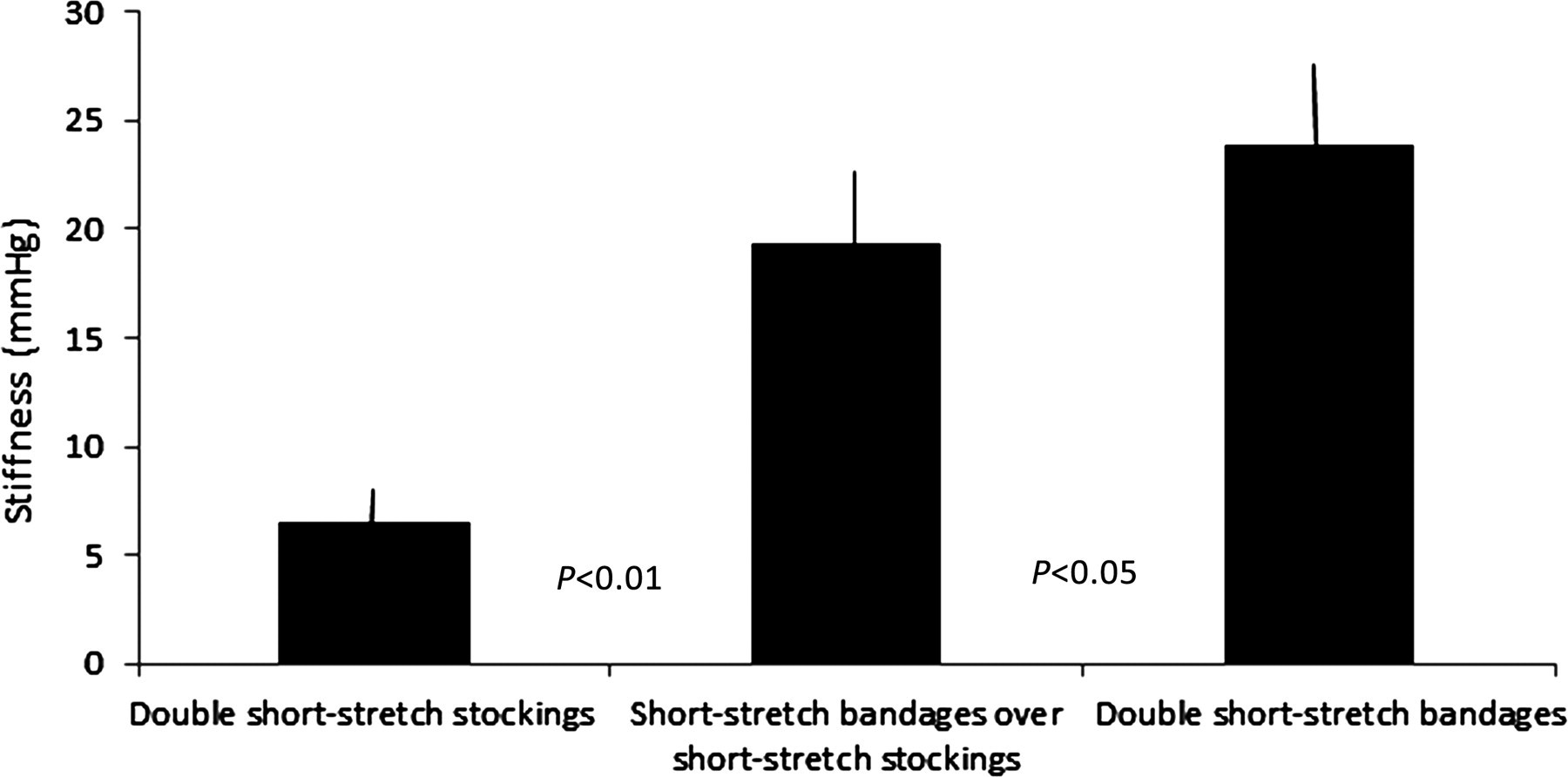
Comparison of the highest stiffness values in each combination of compression materials. The highest values were obtained at almost the same initial pressure; 66.1 ± 7.0 in double short-stretch stockings from double stockings system, 58.9 ± 1.9 in short-stretch bandages over short-stretch stockings from combined-use system of stockings and bandages, and 59.8 ± 3.4 mmHg in double short-stretch bandages from double bandages system. The highest stiffness was observed in double short-stretch bandages and the lowest was noted in double short-stretch stockings
The stiffness on the single use of short-stretch bandages increased significantly according to the initial pressure, the higher the initial pressure, the higher the stiffness; 17.0 ± 3.4 at level 1 compression, 19.1 ± 2.3 at level 2 compression, 24.3 ± 3.0 at level 3 compression and 27.2 ± 2.9 mmHg at level 4 compression. There was no significant difference in stiffness between double and single short-stretch bandages at any initial compression pressure.
Discussion
The present study revealed that the interface pressure and stiffness are changeable according to the combinations of compression material. 1,12 In the double stockings system, a significant increase of the interface pressure was observed with any combination of short- or long-stretch stockings. The level of increase in the interface pressure depended on the compression pressure of each stocking, and there was no significant difference regarding the interface pressure increase between short- and long-stretch stockings. The interface pressure was nearly double when the same two stockings were applied. In contrast to the interface pressure, the stiffness in the double stockings system was influenced by combinations of short- or long-stretch stockings. The short-stretch stockings always showed a significantly higher stiffness than the long-stretch stockings on single as well as double use. These findings indicate that, in the clinical use of the double stockings system, at least one short-stretch stocking should be included when high-level stiffness is necessary for treatment. Double stockings will enable many elderly patients to obtain the correct level of compression to achieve the desired effect because one strong stocking is too difficult for them to apply. 16 Furthermore, double stockings may improve the fashionability, because comparatively thin and colourful stockings can be used.
Although the highest stiffness is obtained when two short-stretch stockings are used, the stiffness of double short-stretch stockings was significantly lower than that on the combined use of stockings and bandages. These findings indicate the superiority of the combined use of stockings and bandages compared with the stockings system from the viewpoint of stiffness. Furthermore, the present study revealed that when short-stretch bandages were applied over the stockings, either over long- or short-stretch stockings, a predominant increase in stiffness was observed at any initial pressure, indicating that the stiffness is more markedly influenced by the elastic properties of the bandages than the stockings in the combined use of stockings and bandages. This may be explained by the fact that the stiffness of short-stretch bandages is originally far higher than that of short-stretch stockings. 1,7,13,17 Based on these findings, it may be concluded that the combined use of stockings and bandages will lead to marked stiffness when short-stretch bandages are applied, irrespective of whether long- or short-stretch stockings are used as a basic stocking.
Although the disadvantages of the combined-use system of stockings and bandages have been pointed out, such as less fashionability and greater difficulty in achieving a constant and precise compression pressure compared with the double stockings system, and a lower stiffness compared with the double bandages system, there are several advantages, such as higher-level stiffness compared with the double stockings system and less pressure loss on comparison with the double bandages system. 5,7,18 From these findings, it is suggested that the combined-use system of stockings and bandages might be more commonly employed in the future, especially for the treatment of severe venous insufficiency and lymphedema in the outpatient clinic, in consideration of the advantages and disadvantages. 5,12
The present study showed that short-stretch showed a significantly higher stiffness than long-stretch bandages on the single use of bandages, while the stiffness generated by the double bandages system was influenced by the elastic properties of both bandages used. When short-stretch bandages were applied as the second bandage over either short- or long-stretch bandages, the stiffness significantly increased according to the initial pressure. However, in contrast to short-stretch bandages, the stiffness decreased significantly when the long-stretch bandages were used over the short-stretch bandages as the second stockings, while short-stretch bandages over the short-stretch bandages generated the greatest stiffness in the double bandages system. These results indicate that the stiffness is influenced by the elastic properties of the second bandages as well as the basic bandages in the double bandages system. Furthermore, it is suggested from the results obtained here that the stiffness of double bandages might be influenced more strongly by the extensibility of the outermost layer. Then, the total extensibility may become greater than that of the single short-stretch bandages when long-stretch bandages are applied over short-stretch bandages, resulting in a low value of stiffness. These findings indicate that, although the long-stretch bandages may be selected rather than short-stretch bandages as the second bandages in order to avoid pressure loss over time, we must keep the decrease of stiffness in mind.
It has been suggested that a higher stiffness can be expected by wrapping several layers of elastic material over each other, increasing the friction between the different layers. 1,12,17 However, against such an expectation, the stiffness of double short-stretch bandages showed no significant difference compared with that of single short-stretch bandages at any initial compression pressure. This may be explained by the shortcomings of in vitro tests used in the present study. Generally, in vitro tests make it difficult to predict the total elastic properties when several bandages are combined. 9,10 Although the device used in the present study employing a mannequin can measure the stiffness of several combinations of compression material in a comparatively physiological state, the friction between the layers of bandages might be different from that on application to a human leg. The surface of the mannequin is harder and flatter than that of a human leg. The hard surface of the mannequin might produce higher values of interface pressure, which were observed in the present study, than those declared by the producers and measured on human legs.
Furthermore, the expansion of human leg muscles during exercise is not equivalent in every direction, while the mannequin in the present study is simply enlarged by 1 cm as a whole. In the present study, the pressure probe for measuring the interface pressure was attached in a relatively flat region of the curvature of the mannequin. These factors may reduce the influence of the friction between the layers of bandages. Further study using in vivo tests 9,10 may be necessary. In the future, furthermore, we expect the development of a leg mannequin which has similar skin, tendons, bone and muscles compared with the human leg.
The present study revealed that the use of short-stretch bandages as the outside layer generated the highest stiffness, and the increase in stiffness was dependent on the initial pressure, as reported by our previous studies. 13 As high-level stiffness can be expected to have more pronounced benefits for augmenting the calf muscle pump, compression with marked stiffness is used for the treatment of venous leg ulcers and severe lymphedema. 5–8 From these findings, it may be suggested that of different combinations of compression material, double short-stretch bandages with a high initial pressure 5,12,19 are the most useful for the treatment of severe venous insufficiency and lymphedema from the viewpoint of stiffness, although the compression level tolerated by the patient is selected in clinical practice. 6,19
From the findings in the present study, we may conclude that stiffness is changeable according to the combination of compression materials, such as double stockings, double bandages and the wearing of bandages over stockings. For appropriate selection of the combination, therefore, stiffness should be taken into account in addition to the interface pressure in consideration of their advantages and disadvantages.