




Abstract
A retrospective analysis was carried out on all day surgery admissions at Glasgow's Royal Hospital for Sick Children between 1993 and 2006. The aim of the study was to analyse the total number of operations per day, month and year; specialties involved; and age range of the children admitted, to examine how these factors changed over the 13-year study period. We also studied the specific operations performed in 2006 by each specialty.
Introduction
A total of 41,205 operations were recorded over the 13-year period. The number of operations showed a linear relationship (P < 0.001) with time, more than doubling over 13 years to 3795 procedures in 2006. The least productive months, April, July and December coincided with school holiday periods while Tuesdays and Fridays were found to be the busiest days of the week. Despite 12 different medical and surgical specialties identified as active within the unit, general surgery conduct 46.6% of the procedures, followed by dental (15.2%) and ear, nose and throat (ENT) (14.6%). In 2006, dental extraction was the most common surgical procedure (695 operations) followed by grommet insertion and then circumcision. Children from birth to the age of 22 were operated on, with the mean age rising over the time period.
Background
For over 100 years, paediatric day case surgery has been performed in Glasgow. At the forefront of the introduction of this service was James Henderson Nicoll (Figure 1), affectionately known as the Father of Day Surgery,
1
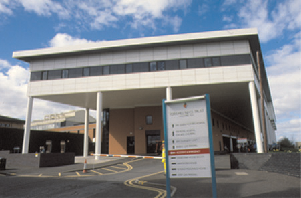
personally performing over 7000 day case operations in his career. In the time since, the Royal Hospital for Sick Children has continued to develop as a pioneer in this field (Figure 2).
James Henderson Nicoll Surgical Wing Royal Hospital for Sick Children, Yorkhill, Dalnair Street, Glasgow
Currently, children are seen in clinic by practice nurses in the week before their operation, saving time on the day of surgery. Recent evidence shows equivalence between nurse practitioner and junior doctor preoperative assessment. 2 Day surgery has several benefits over inpatient surgery. 3 The short duration of hospital stay minimizes stress for both child and parents.4,5 Financial implications of shorter hospital admissions are significant too, potentially saving considerable amount of money, which could be invested into other areas of service. 6 With improvements in surgical techniques and advances in anaesthetic practice (for example single use LMA for ventilation has replaced endotracheal intubation 7 ), operating and recovery times are continually decreasing. Even the simple act of rearranging operating list orders can make more effective use of time, placing those cases with the longest expected recovery time at the beginning of lists. 8 As patients are not exposed to the inpatient hospital environment, risks of developing hospital-acquired infection is also greatly reduced. Nursing staff home visits postoperatively, allow patients who would previously have needed to stay in hospital to be followed up in the community.
Constant pressure from governments to achieve shorter waiting times, save money and decrease required levels of staffing, have led to increased need for day surgery. 9
Aims
To identify how day surgery has changed the care pattern in paediatric surgery.
Methods
The details of over 40,000 procedures carried out over a 13-year period from 1993 to 2006 were retrieved from a locally held database and examined, concentrating on the number of operations performed daily; the specialties involved; the age range of children; and the specific surgical procedures performed in one year (2006).
Data were analysed using Excel spreadsheets and Minitab with the assistance of a statistician.
Results
Productivity
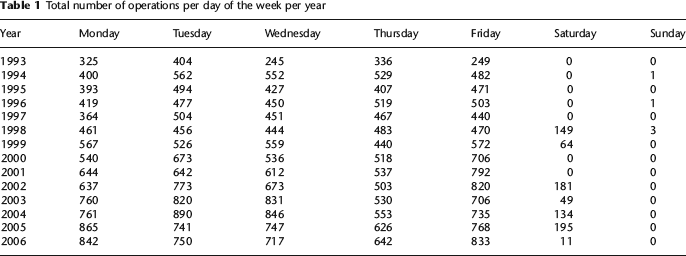
A total of 41,205 operations were recorded between 1993 and 2006. Over this period, the total number of operations performed increased linearly (P < 0.001) (Graph 1) from 1559 in 1993 to 3795 in 2006, with a peak in 2005 of 3942. The productivity per month remained consistent over the 13 years with March identified as the busiest month (mean 284) and lower numbers of operations in April, July and December, which coincided with school holiday periods. Tuesdays and Fridays were the busiest days of the week with mean numbers of 622 and 610, respectively, over the observed time (Table 1). From 1998 onwards, day surgery procedures have been carried out on a Saturday (mean 56) at Yorkhill, these lists represent a waiting time directive initiative.
Total number of operations per year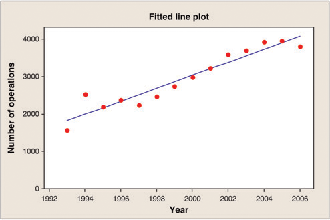
Total number of operations per day of the week per year
Specialties
A total of 17 different specialties utilize the Day Surgery Unit. General surgery, ENT, ophthalmology, orthopaedics, maxillo-facial and plastics are well recognized surgical specialties that would be found in both the adult and paediatric ambulatory service. In paediatrics, however, various medical specialties perform procedures normally carried out under local anaesthetic in adult services. Children require general anaesthetic for some investigations and the majority of invasive treatments including magnetic resonance imaging scans, scopes and joint injections. Therefore, the following medical specialties can routinely be found within the paediatric day surgery environment: dental, radiology, gastroenterology, rheumatology, respiratory and haematology.
General surgery is the most productive specialty in the unit, conducting an average of 1467 procedures a year, 46% (Graph 2) of the total admissions to the unit over the 13 years. Dental carry out 15% of the workload, closely followed by ENT at 14.6%.
Pie chart of percentage of operations per specialty
Operations in 2006
The specific operations conducted by each specialty during the year 2006 were analysed. In this year, general surgery conducted 32.5% of the procedures (Graph 3). Of these operations, 62% can be classified as inguino-scrotal-penile with the most popular operations being circumcision (213) and orchidopexy (188). All of the 6222 dental procedures were classified as dental extraction, making it the most common operation within the Day Surgery Unit in 2006. Forty-four percent of the ENT workload in ambulatory care was found to be Grommet insertion, with the same percentage in ophthalmology being dedicated to squint surgery. Haematology generally consisted of four procedures: intrathecal methotrexate, bone marrow aspiration, lumbar puncture and central line insertion or removal. Of interest, they were able to combine two of these operations in 65% of the cases and three in 17%.
General surgical procedures in 2006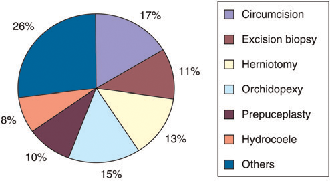
Age range
All graphs of the 13-year period show a similar bell-shaped curve with a skew to the right, with ages ranging from 0 to 22 and the majority aged less than eight years. This is illustrated graphically by box plots of each year (Graph 4). The trends highlight the mean age increasing and age range widening over the years, with growing numbers of older children, despite the upper age limit technically being 12.
Boxplot of age distribution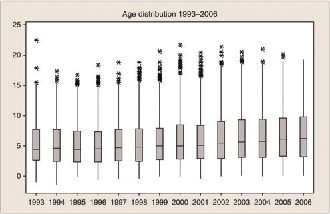
Conclusion
In conclusion, the productivity of the unit is increasing annually, but continues to be limited by a range of factors, including school holiday periods. General surgery, specifically urology, continues to be the foremost specialty involved, although medical departments also play an important role in paediatric day surgery. Increasing ages of patients, while encouraging, will stretch resources.
Ideally, every operation performed would be carried out as a day case, saving time, shortening waiting lists, decreasing medical and nursing staff requirements, saving money and most importantly, making surgery more pleasant for children by allowing them to return home as soon as possible.