




Abstract
Frostbite injury from cold exposure is not uncommon. The application of ice pack is well known in clinical practice; however, its improper use can pose danger to the patient. We report a case of frostbite injury due to prolonged use of ice packs in a ventilated patient.
Introduction
Therapeutic hypothermia is recommended in unconscious adults with spontaneous circulation after out-of-hospital cardiac arrest, to improve the functional recovery and reduce global cerebral ischaemia. 1 Indeed, therapeutic application of ice pack is widely accepted and easily accessible modality. However, improper and prolonged use of ice packs can pose danger to the patient. We report a case of frostbite injury due to prolonged use of ice pack in an intubated and ventilated patient, who was successfully resuscitated from ventricular fibrillation (VF) arrest.
Case report
A 56-year-old woman, with a history of ischaemic heart disease and hypertension, had chest pain and VF arrest at home. She was successfully resuscitated by attending paramedical staff and transferred to intensive care unit, where she was intubated and ventilated. The patient sustained inferior wall ST elevation myocardial infarction. Percutaneous interventional angiogram was performed, which showed > 95% stenosis at right coronary artery and subsequently stent was placed.
During admission at intensive care unit, the ice packs were applied to cool the patient for 24 hours. The ice packs were placed at head, neck, torso, both arms and both groins. The patient sustained mid-dermal, 1% total body surface area burn associated with blister to right arm (Figure 1). The patient was referred to the regional burns unit for further management. The blister was de-roofed and the wound was managed conservatively. She had an uneventful but protracted recovery. At one-year follow-up appointment she had a satisfactory outcome.
Frostbite to the right arm (after de-roofing the blister)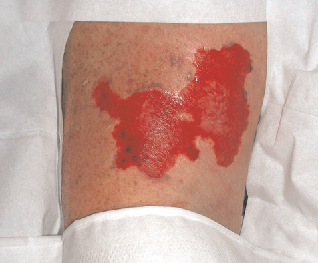
Discussion
Frostbite injury from cold exposure is not uncommon. It is commonly associated with sporting activities and exposure to extreme cold. 2 The application of ice to relieve pain in acute musculoskeletal injuries is widely accepted. Exposure to cold initially induces cutaneous anaesthesia, followed by the formation of intracellular ice crystals, which rapidly induces cell necrosis and tissue death. Endothelial injury exposes vascular basement membrane, which causes sludging and aggregation of platelets; this is exacerbated by local vasoconstriction. 2
Therapeutic hypothermia (32–34°C for 12–24 hours) is recommended by the American Heart Association and the International Liaison Committee on Resuscitation for unconscious adult patients with spontaneous circulation after out-of-hospital VF cardiac arrest. 1 It protects the brain after ischaemia by reduction of brain metabolism, attenuation of reactive oxygen species formation, inhibition of excitatory amino acid release, attenuation of the immune response during reperfusion and inhibition of apoptosis. 3 The induction of hypothermia after return of spontaneous circulation has been associated with improved functional recovery and reduced cerebral histological deficits in various animal models of cardiac arrest. 1
Numerous cooling methods are available, differing greatly in effectiveness, controllability, invasiveness and cost. An effective and easy method to initiate cooling is rapid infusion of cold (4°C) intravenous fluid. 4 Kennet et al. 5 showed that crushed ice and ice-immersed water has a greater cooling efficiency than gel pack and frozen peas; therefore clinically beneficial.
The frequency and duration of cold application has been studied in the past. Ho et al. 6 found decreases in blood flow after five minutes of cold application, which was increased to three-fold to four-fold with application of up to 25 minutes. The guidelines by Association of Charted Physiotherapists in Sports Medicine on the application of ice for Protection, Rest, Ice, Compression and Elevation (PRICE) recommend (1) most effective duration of application is 20–30 minutes, with 30 minutes maximum safe period; (2) a damp towel should be placed between the cooling agent and the skin; (3) care should be taken with application of ice on areas of little subcutaneous fat or muscle. 7
Therapeutic application of ice pack is widely accepted. It is also an easily accessible modality. In our case, the patient sustained a burn on an arm with little fat by application of an ice pack. This could have resulted in devastating consequences such as tangential excision, skin grafting and scarring.
In conclusion, we recommend that extra precautions and monitoring should be taken when using ice pack (or other cooling agents) as a form of therapeutic intervention. We believe immediate removal of cooling agent and early specialist referral should be made, if any signs of skin damage are noted.