




Abstract
The aim of this book, the author writes in his preface, ‘has been to examine what all types of medical people and their patients must experience in combat, and how that experience has developed and changed over the centuries – to understand the challenges that faced war surgeons and their teams.’
The author's aim is ambitious, especially as he has not the background of those of us in our own Military Medical Armed Forces, who had wounded patients brought before them on admission and later in the operating theatre.
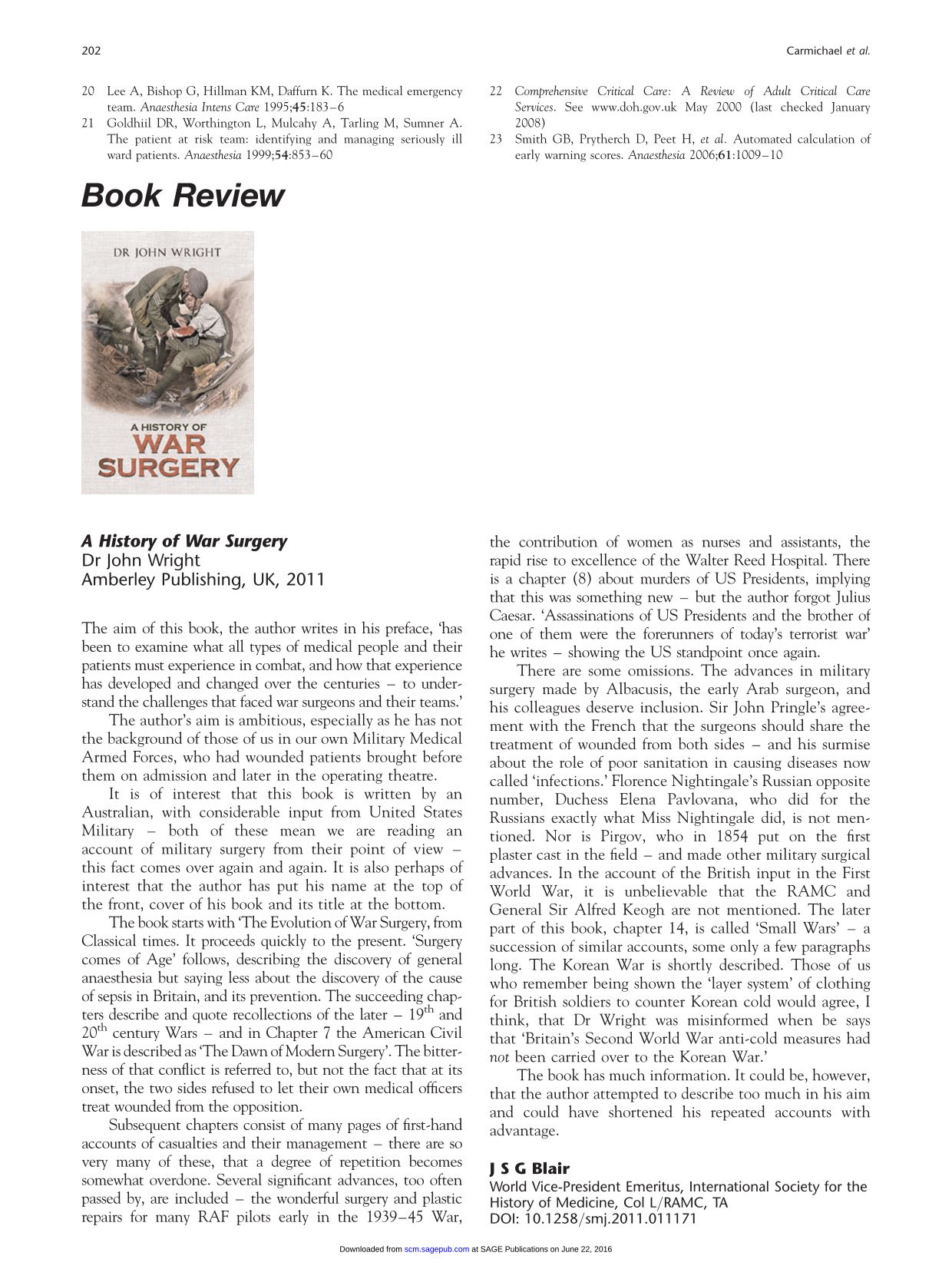
It is of interest that this book is written by an Australian, with considerable input from United States Military – both of these mean we are reading an account of military surgery from their point of view – this fact comes over again and again. It is also perhaps of interest that the author has put his name at the top of the front, cover of his book and its title at the bottom.
The book starts with ‘The Evolution of War Surgery, from Classical times. It proceeds quickly to the present. ‘Surgery comes of Age’ follows, describing the discovery of general anaesthesia but saying less about the discovery of the cause of sepsis in Britain, and its prevention. The succeeding chapters describe and quote recollections of the later – 19th and 20th century Wars – and in Chapter 7 the American Civil War is described as ‘The Dawn of Modern Surgery’. The bitterness of that conflict is referred to, but not the fact that at its onset, the two sides refused to let their own medical officers treat wounded from the opposition.
Subsequent chapters consist of many pages of first-hand accounts of casualties and their management – there are so very many of these, that a degree of repetition becomes somewhat overdone. Several significant advances, too often passed by, are included – the wonderful surgery and plastic repairs for many RAF pilots early in the 1939-45 War, the contribution of women as nurses and assistants, the rapid rise to excellence of the Walter Reed Hospital. There is a chapter (8) about murders of US Presidents, implying that this was something new – but the author forgot Julius Caesar. ‘Assassinations of US Presidents and the brother of one of them were the forerunners of today's terrorist war’ he writes – showing the US standpoint once again.
There are some omissions. The advances in military surgery made by Albacusis, the early Arab surgeon, and his colleagues deserve inclusion. Sir John Pringle's agreement with the French that the surgeons should share the treatment of wounded from both sides – and his surmise about the role of poor sanitation in causing diseases now called ‘infections.’ Florence Nightingale's Russian opposite number, Duchess Elena Pavlovana, who did for the Russians exactly what Miss Nightingale did, is not mentioned. Nor is Pirgov, who in 1854 put on the first plaster cast in the field – and made other military surgical advances. In the account of the British input in the First World War, it is unbelievable that the RAMC and General Sir Alfred Keogh are not mentioned. The later part of this book, chapter 14, is called ‘Small Wars’ – a succession of similar accounts, some only a few paragraphs long. The Korean War is shortly described. Those of us who remember being shown the ‘layer system’ of clothing for British soldiers to counter Korean cold would agree, I think, that Dr Wright was misinformed when be says that ‘Britain's Second World War anti-cold measures had not been carried over to the Korean War.’
The book has much information. It could be, however, that the author attempted to describe too much in his aim and could have shortened his repeated accounts with advantage.