




Abstract
Born in Romania of Greek parents and raised in Trieste, Constantin von Economo was educated and influenced by Vienna's medical and scientific tradition. Better known for his description of encephalitis lethargica, a disease bearing his name, he made several contributions to as varied themes as the cytoarchitecture of the cerebral cortex, sleep regulation, evolutionary brain development and, outside medicine, in aviation. While still a student he showed an aptitude for meticulous accuracy and a skill in combining animal experiments with microanatomical techniques. Nurtured in the formidable environment of Viennese histology he produced a monumental account of the cytoarchitecture of the human cerebral cortex. This, in an attempt to correlate structure and function, was unique in its quality of accuracy and paved the way for subsequent achievements two decades later. Despite an untimely death at 55 years, he remains one of the most talented pioneers of modern neuroscience.
Keywords
Introduction
At the turn of the 20th century German-speaking institutions were dominating the scientific advances in medicine. While neurology was not as yet a separate specialty and still taught as part of psychiatry, a few polymaths were to make their mark in this developing field. Such a polymath was Baron Constantin von Economo who, although mostly famous for his description of encephalitis lethargica, was instrumental in laying the foundations of the neurophysiology of sleep research and the histology and anatomy of the human cerebral cortex. His daring and inquisitive nature in the research laboratory was paralleled outside medicine with his pioneering achievements in the world of aviation. It is now just over 80 years since his death, an opportunity to revisit his contributions and achievements (Figure 1).
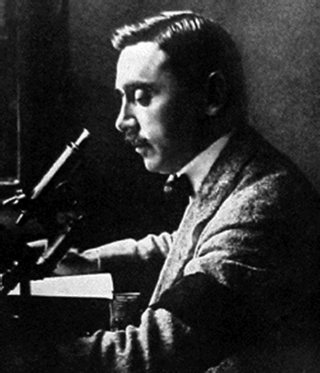
Baron Constantin von Economo (1876-1931)
Background and education
Constantin von Economo was born on 21 August 1876 in the Romanian town of Braila, not in Trieste as certain reports claim. 1 His family, which was of patrician Greek origin, moved in 1877 to Trieste. At the time, the prosperous port city was under Hapsburg rule and it was in its German-speaking schools that the young man obtained his education. Originally – though briefly – attracted to engineering, he enrolled at the University of Vienna Medical School in 1895. Graduating with an MD in 1901, he was by then deeply immersed in Austrian culture, adopting a broad-minded humanism and a fascination with nature, classical literature, philosophy and art.
The faculty at Vienna in 1900 included a formidable array of clinicians and scientists such as Meynert, Nothnagel and Billroth. The field of histology was especially strong with Theodor Meynert, Joseph Schaffer, Victor Ebner, Siegmund Exner and Heinrich Obersteiner, the founder of the Neurological Institute. While still a medical student Economo mastered the skills of hardening, staining and cutting microscopical preparations. Before even graduating, the prestigious Academy of Science published his work on the hypophysis of birds. 2 A year after graduating, there followed another presentation of his anatomical study on the central pathways of mastication and swallowing. 3
Young Economo had therefore displayed at an early stage an aptitude for meticulous accuracy and a skill for the combination of animal experiments with microscopical anatomy techniques. His pursuit of excellence is mirrored in his chosen path of postgraduate education in neurology-psychiatry. Starting with a year in Charcot's school in Paris, he then spent six months in Strasbourg with the neuroanatomical master Bethe, six months with Kraepelin in Munich, and finally studied under the neurologist Oppenheim and the psychiatrist Ziehen in Berlin. Upon his return to Vienna he became a volunteer assistant to Julius Wagner-Jauregg, who in 1927 received the Nobel Prize for the use of malaria inoculation to induce fever in syphilitic dementia paralytica patients. Economo himself was proposed three times for the Nobel Prize.
He remained loyal to his alma mater becoming Docent (lecturer) and Professor at the University of Vienna Medical School in 1913 and 1920, respectively. He was also very loyal to his research interests; to allow himself time to pursue his laboratory work, he declined an offer for his master's chair when Wagner-Jauregg retired in 1928. Married to the daughter of Prince Alois von Schönberg-Hartenstein, he was characterized by an idealistic pursuit of knowledge.
Early studies and encephalitis lethargica
Economo's main work was on the mesencephalon and diencephalon. He became acquainted with brainstem anatomy while working with Paul Karplus on experimental chorea brought about by severing of the cerebral peduncle, and writing his habilitation thesis on pontine tumours in 1911.
This knowledge was to prove instrumental when several patients over the winter of 1916-1917 and a further group of seven in April 1917 were admitted into Wagner-Jauregg's clinic with a variety of constitutional symptoms, but who had in common an ophthalmoplegia and a peculiar somnolence. Similar symptoms were reported in French soldiers by Cruchet in the winter of 1915-1916 and observed in Romania in 1915. Economo was extremely quick in reducing the multiple and confusing symptoms and extracting the unifying clinico-anatomical aetiology. As early as 17 April 1917 he presented to the Viennese Psychiatric Association his belief that the symptoms were due to an inflammation of the mesencephalic grey matter. On 10 May 1917 he reported his clinical investigations in Wiener Klinische Wochenschrift. By the end of that year he had described it as a disseminated encephalitis with a non-haemorrhagic and non-necrotic, but inflammatory reaction. Its infectious nature was established months later in an experimental model in monkeys. Economo's description was hailed for its precision when the disease was to reach epidemic proportions in Europe and North America by 1926. Economo devoted his time to the description of the disease, not only discussing its clinical features, but also its pathology and histology. He published 27 manuscripts on the subject and lectured widely in Europe and North America, culminating in a treatise in 1929 and leading to the eponymous ‘Economo's disease’. 4
Sleep theory
His observations on encephalitis lethargica and its related ophthalmoplegia and somnolence led Economo to derive assumptions about the theory of sleep. He postulated that in the periaqueductal grey matter – and therefore adjacent to the nuclei of the ocular muscles – must lie a ‘sleep control centre’. 5 The significance of this contribution lies partly on this first description of sleep as a complex biological function, with differentiation between bodily and cerebral sleep, and partly on the fact that Economo's theory led the way for the contemporary theories of sleep regulation.
Cytoarchitecture of the human cerebral cortex
‘Everything about this work has monumental dimensions; the intellectual content, the amount of energy and time spent on it and, last but not least, the presentation.’ These were Wagner-Jauregg's comments on Economo's landmark work, with the fellow Greek Koskinas, on The Cytoarchitectonics of the Human Cerebral Cortex. 6 This was an exhaustive account of the cellular architecture of the brain painstakingly compiled over the preceding 13 years. In its 810 pages there were 107 areas of the cerebral cortex with their histological structure, a result of thousands of sections, and accompanied by a companion volume with 112 plates of large scale photomicrographs (Figure 2).
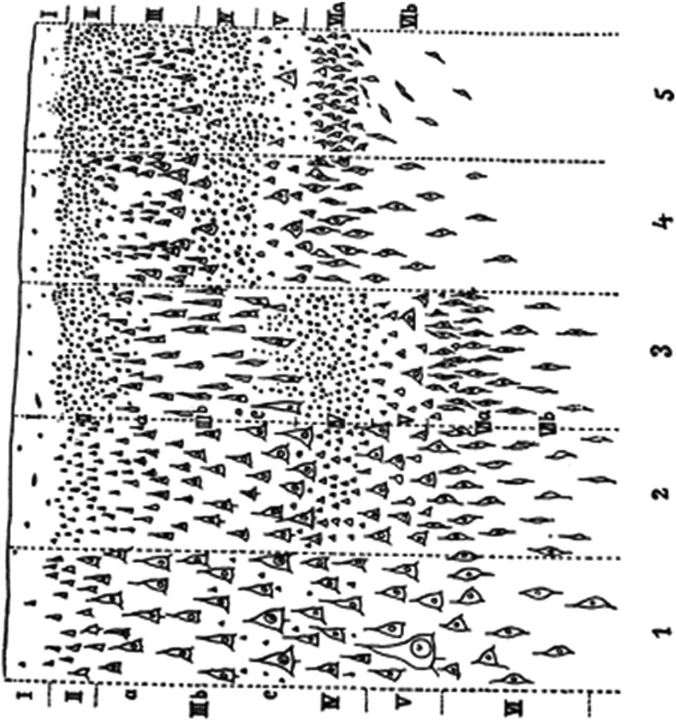
The five phenotypes of cerebral cortex described by Economo and Koskinas (1925): one agranular, two frontal, three parietal, four polar and five granular
By the end of the 19th century the correlation between architectural areas of the cortex and functional centres, such as that of the precentral gyrus, had been described. The morphological methods, however, were more advanced than physiological studies so techniques like Nissl staining gained strong support. Attempts were made to address function by trying studies into glio-, angio-, chemo- and other architectonics, but advances were more robust in the morphological cytoarchitectonics. Von Economo's technique differed from those of other researchers, such as Cecil and Oscar Vogts. He used a perpendicular axis of sectioning to the long gyral axis as opposed to serial sectioning through a hemisphere in the frontal plane. The predominance of cortical maps in the latter method had much to do with Economo's early and unfortunate death in 1931.
Economo and Koskinas were more accurate than Vogts in their quantitative analysis of cytoarchitectural specimens. They recognized the need for this if it were to be at all possible to correlate structure with function. In fact, they provided up to 200 subdivisions compared with Brodmann's 80 (Figure 3). Such painstaking analysis led Economo to publish his ‘Grauzellkoeffizient’ theory of correlation between cell density and neuropil. 7 After his death such detailed analysis did not become popular for another 20 years, such as by Haug and Scholl, but by then it had become evident that cerebral organization could not be explained in excessively detailed charting. 8 They did nonetheless set a high standard for subsequent neuroanatomists in later decades and, with the advent of evoked potentials, correlation of histological morphology with physiological recordings became possible. Neurophysiologists like Mountcastle and the Nobel laureates Wiesel and Hubel were then able to identify the columnar organization in the cerebral cortex of the cat and the primate.
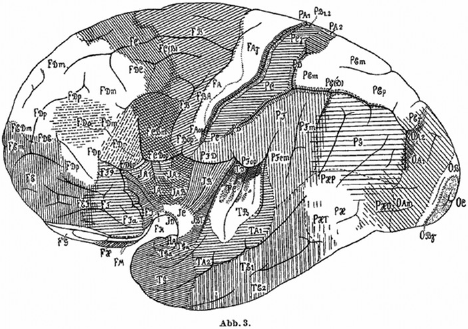
Lateral view of the left human hemisphere showing the nomenclature introduced by Economo and Koskinas (1925) who defined 107 cortical cytoarchitectonic areas
Economo privately funded the printing of this work, the bulk of which was carried out in Thomas Meynert's old microscopy room, which actually doubled as the general laboratory of a large clinic. He worked in this room, which dated back to 1870, until 1931 when he got his own department for cerebral research. His respect for Meynert is evident from his dedication of their book to the widely regarded father of cytoarchitectonics, whose tradition he aimed to continue in Vienna.
Economo's theory of progressive cerebration is one more area in which he furthered Meynert's ideas on the relationship between the development of the cerebrum and of mankind. In his progressive cerebration theory Economo postulated that the frontal and parietal lobes were later formations in the course of human evolution. This was in line with the contemporary theories on orthogenesis and irreversibility by the paleontologists Abel, Osborn and Dolo; once an organ had attained a particular direction of development, it would continue to evolve in the same direction. As part of his studies Economo studied the brains of gifted and talented individuals – such as musicians, a uniquely humanly evolved skill in his opinion – hoping to elucidate the evolution of the human cortex.
This attempt came to an abrupt end when on 21 October 1931, and only months after his new laboratory was set up, he died at age 55 after a coronary occlusion and cerebral embolism. A tribute to his volume of work on cerebral cytoarchitectonics can be found in the recent release of his work. 9
Aviation
When Constantin von Economo was not busy with histological studies, sleep theories, pathologoanatomic correlations and evolutionary studies, he found refuge in the skies. Fascinated by aeronautics he started in his early 30s to take balloon trips while in Paris; he obtained a licence in balloon flight in 1907. By 1910 he was a pioneer aviator and president of the ‘Osterreichischer Aeroklub’, a position he held until 1926.
In 1912 he obtained the first Austrian aeroplane pilot's licence. He was influential in the establishment of two airports near Vienna: Aspern and Wiener Neustadt. He was also the first ever reconnaissance pilot of the Austro-Hungarian Army, adding yet another diverse achievement to his name. Testament to his genius and foresight is his comment during the 30th anniversary speech at the Aeroklub, only months before his death, that ‘modern physics research indicates that we will have the means to utilize nuclear fission and thus place at our disposal forces that will allow us to surmount gravity’. 10
Epilogue
Constantin von Economo was a polymathic genius who showed outstanding promise while still a medical student. Although perhaps known more for his work on encephalitis lethargica, a disease that bears his name, he made significant contributions to as varied themes as the cytoarchitecture of the cerebral cortex, sleep regulation research, evolutionary brain development and aviation.
He is a worthy follower of Meynert, Wagner-Jauregg and Obersteiner, earning his place both in the history of the golden era of Viennese medicine and in the history of modern neuroscience.