




Abstract
There has been a dramatic increase in adult obesity in the Scotland during the past two decades, but little research has been undertaken into populations defined specifically by occupation. The aim of this study was to examine changes in the prevalence of obesity in a group of local authority firefighters arising early in their careers, between enlistment and initial examination for a large goods vehicle (LGV) licence. The body mass index (BMI) from initial LGV medical examinations of firefighters during a 30-month period up to the end of September 2005 was compared with that at enlistment. Enlistment and LGV BMI data were available for 114 firefighters, all men. Of 114, 77 (68%) of LGV examinations took place within five years of enlistment. None were obese (BMI ≥30) at enlistment, but by LGV medical the BMI of 88 (84%) had increased, and nine (8%) were obese. Assuming uniform accrual, BMI increased annually at rates varying between 0.06% and 2.25% (mean, 0.56; standard deviation [SD], 0.42). For the nine obese, this was 0.29-2.25% (mean, 1.06; SD, 0.61). In a population for which fitness is an essential selection criterion, the implied decline of fitness as measured by rising BMI in a short period should be cause for concern.
Introduction
In Scotland, the prevalence of adult obesity rose by almost 50% in the eight years up to 2000. 1 Similar changes have occurred in many other countries. Since obesity is associated with health problems such as osteoarthritis, 2 various malignancies 3 and type 2 diabetes in particular, 4 which in turn is associated with a rise in arterial disease. 5 These increases cause grave concern for future health-care provision. While the subject has been extensively researched, relatively few studies have used work-based populations, and even these have covered a wide range of different jobs (e.g. petrochemical workers, 6 hotel, hospital, school and garage workers 7 and civil servants 8 ). These surveys have demonstrated an association between obesity, sickness absence and raised employer costs. Most studies have been cross-sectional, although in 2000 a longitudinal study described an increase in the prevalence of obesity in a group of about 500 firefighters from 1.2% at enlistment to 17.2% at retirement after a career generally lasting 20-30 years. 9
More recent studies have also gathered longitudinal data, 6 8 although in view of the recent rapid rise in obesity, this paper studied changes in body mass index (BMI) over a short-term period in a population whose occupation was very precisely defined – wholetime local authority firefighters.
Methods
Firefighters undergoing a first large goods vehicle (LGV) medical between 2 March 2003 and 30 September 2005 (when the author left the organization) were identified from the Occupational Health Unit's day book. Data relating to dates of enlistment and LGV medicals, metric height and weight were extracted, anonymized and entered on an Excel 2003 spreadsheet (Microsoft Corp., Redmond, WA, USA). Since the data were accumulated for the purpose of audit and anonymized, it was not thought necessary to consult the local research ethics committees. All enlistment data were gathered by one nurse and all LGV data by the author, both using the same equipment.
BMI was calculated using the formula weight (kg)/height 2 (m). Descriptive and hypothesis testing statistics were calculated using Minitab v. 15.1.3 (Minitab Ltd., Coventry, UK).
Results
One hundred and eighteen firefighters (all men) underwent an initial LGV medical in 2.5 years; complete data were available on 114 (>97%). Age at enlistment varied from 18 to 30 years. Changes in weight between medical examinations ranged from −5 to +28 kg, mean 6.3 kg (standard deviation [SD], 5.3). Overall, this showed an annual change varying between –1.07 and +7.36 kg, mean 1.47 kg (SD, 1.32), presuming a steady rate of change. Table 1 shows time elapsed between examinations ranged from 1.4 to 12.6 years, median 3.7 years, modal period being from 3.0 to 4.9 years.
Lapse of time between enlistment and number of large goods vehicle medicals performed
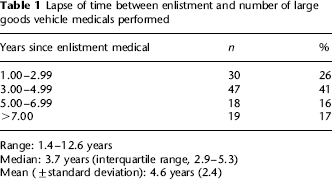
Range: 1.4-12.6 years
Median: 3.7 years (interquartile range, 2.9-5.3)
Mean (±standard deviation): 4.6 years (2.4)
Table 2 describes changes in BMI between the two examinations. Ten (9%) lost weight, six (6%) were static, 88 (84%) rose and in 9/114 (8%), their BMI exceeded 30. Where the BMI rose, assuming uniform accrual, it increased at an annual rate varying from 0.06 to 2.25% (mean, 0.56; SD, 0.42). The BMIs at enlistment of those whose BMIs were later >30 ranged from 23.4 to 29.3; five were <28.0. The percentage annual increase of BMIs of all nine varied between 0.29% and 2.25% (mean, 1.06%; SD, 0.61%). Five of nine (56%) became obese within five years of enlistment.
Comparison of aspects of body mass index between enlistment and large goods vehicle medical examination
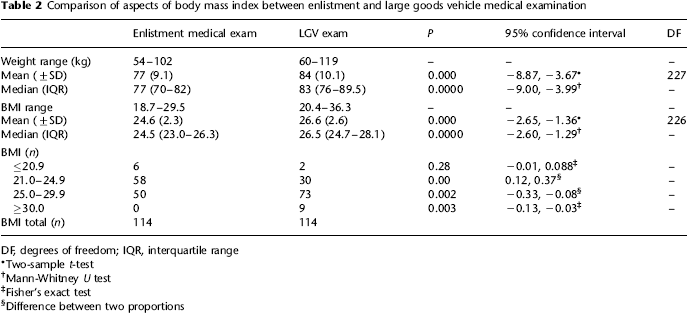
DF, degrees of freedom; IQR, interquartile range
Two-sample t-test
Mann-Whitney U test
Fisher's exact test
Difference between two proportions
Discussion
The strengths of this study relate to the completeness of data and observer consistency. There are two main weaknesses:
BMI is a crude measure and cannot distinguish between weight due to muscle or due to fat;
Similar data were neither gathered on recruit firefighters who did not seek to become drivers, nor on those who held an LGV licence at the time of enlistment.
Ide reported that the mean BMI of firefighters who retired between 1985 and 1994 changed from 23.4 at enlistment to 26.0 at retirement. 9 In contrast, this study showed a striking increase in the prevalence of obesity, which occurred over a short period of time early in the service of a group of workers recruited to specified fitness standards. 10 Anecdotally, many recruits were proud of their participation in strenuous sport, but information regarding the extent to which this interest was maintained was not collected for LGV medical purposes. The health problems mentioned earlier may significantly impact the UK fire and rescue services, given the recent pension changes that increase the age of retirement from a minimum age of 50-55. 11 Of more immediate relevance are the problems of obesity related to confined spaces, heat stress, 12 reduced carrying capacity for rescue equipment such as ladders, and of aerial ladder platforms and ‘cherry pickers’ if occupied by an obese firefighter. For drivers in particular, obstructive sleep apnoea may develop. 13 While somnolence is unlikely given the short distances driven from station to incident in urban areas, upon arrival the driver generally remains with the appliance to monitor communications and control the pumps. At a protracted incident, the chances of falling asleep would increase and the driver could miss important messages.
The Fire and Rescue Service to which these men belonged had a wholetime strength of about 2200 firefighters. In order to ensure that all the relevant appliances could be driven by suitably qualified drivers, it would be necessary for about a quarter of these firefighters to hold LGV licences. If these findings are representative of the workforce as a whole, then obesity is a substantial problem.
The results of this study can be set in a wider Scottish context by comparing them to findings arising from the West of Scotland 2007 study, a two-stage random clustered sample based on postcode sectors in the central Clydeside Conurbation. This project follows three cohorts, aged 15, 35 and 55 years at the time of the study's inception in 1987/1988. 14 A paper written in 1994 gave the mean weight of 15-year-old boys as 59.9 kg, rising to 70.0 kg when 18. Those aged 35 weighed 76 kg. Mean BMIs were 20.3, 22.6 and 25.3, respectively. 15 A longitudinal study followed over 450 men divided between two cohorts aged 39 and 59 in 1991 for nine years, measuring weight in 1991 and again in 1995 and 2000. Mean weight change over the nine years in the younger cohort was 5.3 kg (SD, 6.5), compared with 2.2 kg (SD, 6.4) in the older. 16 The firefighters’ mean weight gain was 7 kg over a mean period of 4.6 years. These papers from the 2007 study predated this firefighter survey by a number of years. The longitudinal study had dropout rates of 36% and 46% in the younger and older cohorts, respectively, and the oldest firefighter was at least five years younger. However, firefighters were recruited from an area that largely overlapped the geographical area from which the population for the 2007 study was selected. The rate at which weight gain is occurring would seem to be accelerating.
The Scottish Health Survey, performed in 2003, is a more contemporaneous cross-sectional survey, also based on postcode sectors but covering all Scottish Health Boards. 17 This found that 30% of men aged 16-24 and 60% in the 25-34 age group were either obese or overweight, although 44% and 34% in each age group, respectively, were not weighed. On this basis, the proportion of overweight/obese firefighters was higher than in the general population.
Further research should follow-up this cohort to observe weight changes over the longer term and to determine the effects of recently introduced fitness programmes. 18 Steps need to be taken where appropriate to encourage and retain weight loss in obese firefighters, especially if further studies show that this problem is widespread and involves firefighters other than drivers.
Footnotes
Acknowledgement
The author would like to thank Anne M M Ide for helpful comment.