




Abstract
Qhapa, a pest associated with skin irritations, was collected from children and adults as well as from underbrush, rain forest highlands, and coffee fields in the Nor Yungas region of Bolivia. The pest was examined by phase contrast and scanning electron microscopy. Morphological features, including number and position of setae on the segmented legs of the mite, were consistent with its identification as the larval form of the chigger mite Eutrombicula batatas. Recommendations are made on ways to decrease incidence of Qhaba bites to minimize the dermatitis and the resultant secondary bacterial infections.
In the Nor Yungas region of Bolivia a tiny pest, known locally as Qhapa, is causing health problems. The name, Qhapa, appears to be derived from Qechuan and has multiple meanings including ‘reddish louse’ and ‘trifling’. The effects on humans bitten by the pest are anything but trifling. During the coffee harvest, those collecting the beans, along with their children, come into contact with Qhapa and which can cause intensely itchy skin irritations. In children, the dermatitis can be severe with secondary bacterial infections caused by the children scratching their skin. Apart from anecdotal reports of chigger-like symptoms in humans, information on Qhapa, its taxonomy, life cycle and potential to transmit disease is lacking. We identified and collected Qhapa in order to provide information that would enable the development of community health measures for the control of the pest and for the treatment of the dermatitis.
All pests were collected in the municipality of Coroico, in Nor Yungas, Bolivia. The nursing faculty at Unidad Academica Campesina-Carmen Pampa (UAC-CP) worked with rural farmers to identify sites infested by Qhapa. The reddish-orange specimens were isolated from grassy meadows and rain forest highlands near San Pablo in May 2003, in tall grasses in San Pedro and new coffee fields in Carmen Pampa in June 2003, and in August 2005 from underbrush near San Pedro. Engorged specimens were removed by UAC-CP nursing students in May 2002 from children and adults exposed to the mite in coffee fields near San Pablo. Specimens were fixed in 65% ethanol, 5% acetic acid and 5% glycerol. A few Qhapa were examined by light microscopy and photographed for the first time at UAC-CP. The remaining specimens were transported to the USA where morphological data was collected using phase contrast and scanning electron microscopy (SEM). For SEM, specimens were air-dried on metal stubs, coated with gold and observed using a Zeiss DSM 960A scanning microscope.
Microscopy revealed that Qhapa was a mite and that all collected specimens had similar morphologies. Unengorged specimens averaged 154 × 217 μm compared to 285 × 387 μm for engorged mites. Structural features, described using the terminology of Goff et al. 1 included two pairs of eyes adjacent to the scutum and three pairs of legs, each with seven segments and terminating with two claws and an empodium (Figure 1a). The palpi had two-pronged claws and genu and femur with single, dorsal setae. Following the classification of Krantz, 2 these features place Qhapa in the Trombiculidae family. The number and position of dorsal setae (2-8-8-8-6-2), the presence of three mastitarsala and two mastitibialae on leg III, a tarsala and two tibialae on leg II and standard measurements of scutum and scutal setae (data not shown) were consistent with identification of the mite as the larval form of the chigger mite Eutrombicula batatas. 3 (This was confirmed by Dr Cal Welbourn of the Florida Department of Agriculture and Consumer Services.)
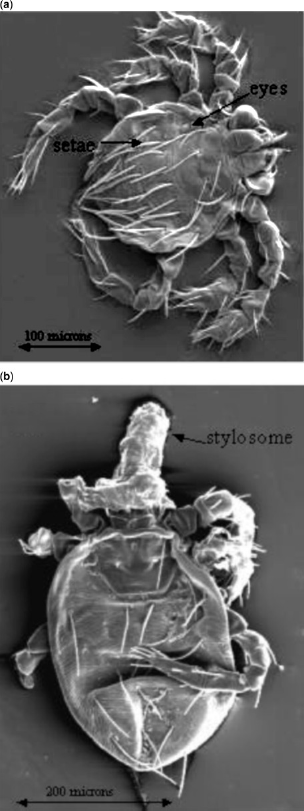
Electron micrographs of Qhapa collected in June 2003 near San Pedro in the Nor Yungas Department of Bolivia (
Although E. batatas is a mite species that has been found in Mexico, Central and South America4,5 and in the southwestern USA, 6 this may be the first report of it being collected in Bolivia. Previous descriptions of mites found in Bolivia have been sparse and mites that have been identified have been from families other than Trombiculidae. 5
People in Bolivia have for many centuries endured the dermatitis that follows being bitten by this mite. The life cycle of chiggers and their interaction with humans is wellunderstood 6 It is usually found in the soil in areas where there is an abundance of litter or brush and long grasses. Larvae usually feed on a range of hosts including reptiles, birds and rodents. As people walk through infested areas, they come into contact with the larvae. In the Nor Yungas region, the perception was that Qhapa was primarily associated with coffee trees. However, it is more likely that exposure to Qhapa occurs as people walk through thick vegetation to get to coffee trees or stand in infested underbrush while picking coffee beans. This is consistent with our collection of Qhapa from diverse habitats including open meadows, rain forest litter and recently disturbed soil. Treating infested areas with pesticide is not practical in this resource-poor region and avoidance of infested areas may be difficult. However, cutting or clearing the underbrush near coffee trees prior to harvest could reduce contact with the pest. One farmer described using small, smoky fires near coffee trees to reduce pest populations. As the mites require moisture and move from underbrush back into the soil as the sunlight increases during the day, picking the coffee beans in the afternoon rather than the morning might also reduce human exposure to the pest.
Unlike the Leptotrombidium genera of chigger mites in south-east Asia, India and northern Australia that transmit scrub typhus, 7 there is no evidence that E. batatas transmits infectious microorganisms. 6 Its medical importance lies in the dermatitis and severe itching that it provokes through enzymes in its saliva. These enzymes digest human tissue on which the mites then feed through a tube-like structure, the stylosome, that forms at the bite site (Figure 1b). Since avoidance of contact with the mite is unreasonable, and access to pesticide ointments such as diethyltoluamide limited and unaffordable for most people in the remote areas studied, efforts to remove Qhapa before it has firmly attached to the skin may be the most effective way to minimize the dermatitis. As even soapy showers are beyond the means of most families, an inexpensive alternative for mite removal would be a thorough rubbing down of the body, especially the axillary and groin areas, with a cloth shortly after leaving mite-infested areas. 6 The mites are fragile and rubbing exposed body surfaces with a dry cloth dislodges or crushes them. This simple treatment may be an effective way of reducing Qhapa bites and subsequent scratching in children, thereby lessening the chance of secondary bacterial infections. Nurses from UAC-CP make weekly visits to rural communities surrounding Carmen Pampa to treat illnesses, do prenatal check-ups and provide education on nutrition. They are beginning to disseminate this new information about Qhapa to help reduce the impact of the mite.
Footnotes
Acknowledgements
We thank the UAC-CP nursing students, UAC-CP volunteers Becky Monnens and Julie Balsman, Doña Regina and family, Jeff Thoele and Chas Conway of the Scanning Electron Microscope Facility, Macalester College, St. Paul, MN, and WC Welbourn. The study was supported by The Endowed Professorship in the Sciences, College of St. Catherine.