




Abstract
We examined the extent of Togolese users’ knowledge of the health risks associated with the regular use of bleaching agents. A massive underestimation of some of the main risks was discovered. The more frequent the use of bleaching agents, the higher the underestimation.
Introduction
We examined the risk perception of the regular use of bleaching agents among a sample of Togolese users. Since the 1980s, skin bleaching has become a public health concern in many African countries. In some of these countries, it is considered to be the third major health risk, after AIDS and malaria. Skin bleaching was found to be practiced by: 25% of the women in Bamako, Mali 1 ; 52% of the women and 28% of the men in Dakar, Senegal;2–4 and more than 75% of the men and women in Lagos, Nigeria. 5
The consequences of skin bleaching can be severe. It has been shown that skin bleaching is associated with higher levels of depression and identity disorders, 6 with premature ageing of skin and with subsequent skin cancers. 7 It has also been shown that pigmentation damage is frequently found among users. 8 In a sample of Togolese women using bleaching agents, 69% were found to be suffering from at least one dermatological problem. 9 It has been suggested that among Senegalese female, the long-term use of skin bleaching agents was responsible for a high rate of cutaneous adverse effects.2,10 Skin bleaching was also shown to be associated with higher levels of hypertension and diabetes. 2
Methods
Participants
Participants were recruited from people approached in the streets of Lomé. Overall, 541 people were approached: 368 were regular users of bleaching agents, and 300 of them (219 women and 81 men) agreed to participate in the study. All gave their informed consent. They were aged 15–50 (mean age 28.59, standard deviation 7.71): 41% had not completed primary education, 34% had completed primary education, and 25% had completed secondary education: 40% used the agent once a day, 18% used it five or six times per week and the remaining 42% used it one to four times a week. A quarter of the participants had started using bleaching agents at 16 years old or earlier, half started at ages ranging from 17 to 22, and the rest were older when they began using them. Ten dermatologists (two women and eight men [mean age 40 years]) working in the dermatology department in Lomé Hospital also participated in the study.
Material
We used a questionnaire in which responses were given on 10-point scale of which the anchors were ‘completely false’ and ‘completely true’. They were also asked about the frequency of their use of bleaching agents (which ranged from once a week to every day) and the age at which they had started using them; they were also asked for their demographic data.
Results and discussion
Table 1 shows the items for which a significant (P < 0.001) difference between the opinions of the participants and experts was observed. Participants clearly underestimated the association between skin bleaching and: (a) psychological troubles (depression, identity, body image, anxiety); (b) deterioration of the skin (pathological whitening, allergies, acne, cancer, ageing, hyperpigmentation); and (c) hypertension and diabetes. However, they overestimated the association with some skin disorders (hives, herpes, shingles, eczema). Overall, the more frequent the use, the greater the underestimation of its risks. The highest correlations were with pathological whitening of the skin and weakening/debilitation of the organism. Some correlations were, however, positive (for psoriasis and hyperpigmentation). There was no significant gender effect. Age was positively correlated with the items related to skin cancers, premature skin ageing and acne.
Significant differences between participants’ and experts’ opinions of the risks associated with skin bleaching and the significant correlation between the frequency of use and the age at which participants began bleaching
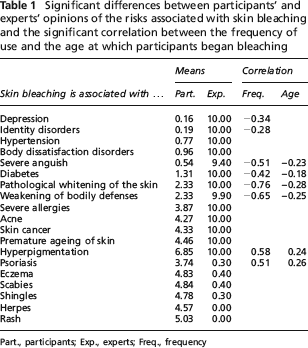
Part., participants; Exp., experts; Freq., frequency
Our results suggest that massive information campaigns on the risks associated with skin bleaching are urgently needed.