




Abstract
We undertook an interventional prospective study of truck drivers from a cement factory in Nigeria to assess their visual status after licensing. Out of 149 drivers, 122 (81.9%) were visuallyeligible to drive and 27 (18.1%) were not. Causes for failing the vision test included refractive error, cataracts, glaucoma, corneal leucoma and pterygia.
Introduction
Trucks have become important means of transporting goods in Nigeria due to a poor railway network and the location of factories far from the hinterland. The trucks travel long distances from the south of the country to the north, a distance of 200–1500 tkm. Truck drivers prefer to travel at night to avoid heavy traffic and therefore require good vision in order to see road signs and oncoming vehicles. The police reports for Ogun state in Nigeria, between July and September 2001, revealed that out of 373 motor accidents, 117 (31.1%) involved trucks and lorries. 1
Visual assessment at initial licensure entails assessing the driver's ability to recognize an identification mark on a vehicle situated 25 yards away with or without glasses. The driver's vision is not rechecked during the yearly renewal of licences. It is not uncommon for old age, ocular trauma and diseases to affect drivers’ sight during their careers. High inflation and unemployment has contributed to middle-aged and elderly men continuing to work as professional truck drivers later in life than previously in order to sustain their families. Previous reports have shown the adverse effects of older age on driving.2,3 The aim of this study was to assess the vision of truck drivers in Nigeria after licensure.
Materials and method
The study was prospective, and was approved by the ethical committee of Olabisi Onabanjo University Teaching Hospital. The demographic data was recorded during a short interview, after which visual acuity and colour vision were assessed and the ocular media were examined. To pass the vision test, 6/9 in the better eye and 6/12 in the worse eye was required. All drivers who did not meet this standard, and those with visual acuity less than 6/6, were refracted for visual improvement. Those with cupped discs (C:D greater than 0.5) had their intraocular pressures and visual fields measured. One driver with operable cataracts had cataract extraction and anterior chamber lens implanted and another with blinding pterygia had it excised. All drivers with refractive errors were given glasses. Timoptol 0.5% was prescribed for one driver who had glaucoma.
Results
A total of 149 drivers, all men, were examined. Their ages ranged from 22–63 years with a mean age of 39.49 ± 7.2 years. Their professional driving experience ranged from 2–27 years with a mean of eight years. None of the drivers were using glasses for distance vision: 122 were eligible to drive (81.9%) and 27 (18.1%) were not. The causes of reduced vision and ineligibility to drive are shown in Table 1. Refractive error was found in both eyes for 17 drivers (63%) and one eye each for three drivers with cataracts. Their corrected vision improved to at least 6/9 in the worse eye with the exception of the three drivers with cataracts.
Causes of failing eligibility test
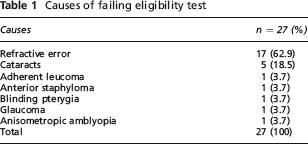
Cataract was found in five drivers (18.5%), although three of them benefited from refraction. None of them had glycosuria. One of them had secondary cataract from uveitis while the other four had age-related cataracts. Other causes of failure to pass the test are recorded in Table 1.
Among the eligible drivers 24 (19.7%) had ocular pathology, which included refractive error (20), early cataracts (1) and para-macular drusens (2) and one driver was a glaucoma suspect.
All together, astigmatism was the most common error in 51 eyes (66%), followed by hypermetropia in 19 (23%), and myopia in 7 (11%). One driver who was also myopic had green–red colour defect but in 148 colour vision was normal.
Discussion
Truck drivers in Nigeria are predominantly men, supporting the findings of previous workers 4 Although the average age of 39.9 years was lower than that found in similar studies, truck drivers did tend to be middle-aged. 4 The most common cause of failing the Snellen acuity test was refractive error. When wearing their glasses, all the 17 drivers became eligible to drive. None of the drivers had a comprehensive eye test prior to this study and so their refractive errors had not been detected. A simple pinhole visual acuity testing would aid in the detection of refractive errors in drivers, and corrective glasses could be prescribed.
Another important cause of failing the test was cataract. The older age of truck drivers predisposes them to acquiring age-related ocular diseases such as cataracts and macular degenerations. Although the vision of three drivers improved in this study after refraction, these men would still have to contend with the problems of glare. Several drivers had reported the difficulties with glare and the blurring of vision experienced by patients with cataracts.5,6 Indeed this was a frequent complaint of the drivers in this study since they travelled at night. We suggested daytime travelling and rest at night in the nearest town.
An ability to identify objects some distance away is a test of binocular vision which does not identify monocular eye defects. The assessment of vision with the Snellen chart enabled us to pick out monocular eye defects such as adherent leucoma from childhood measles infection in one driver, and secondary glaucoma in another. Drivers with monocular defects have a significant reduction in selected visual capabilities such as visual acuity under both low illumination and glare, and depth perception. 7 That some of the drivers who passed the test had ocular pathology confirmed that Snellen visual acuity should probably be supplemented with fundoscopy. Other tests such as visual field and contrast sensitivity are equally important. It has also been shown that it is possible to pass the driving vision test with 6/12 vision yet and fail the Snellen test, and vice versa. 8 It is necessary to provide a standard format for assessing vision post-licensure which will be applicable to all drivers.
Visual disability is all too often ignored in developing countries. As cataracts, ocular trauma and inflammatory eye disease can all occur after a driver has obtained a driving licence, visual disability amongst truck drivers will continue to be an important contributing factor in road traffic accidents. Therefore, regular post-licence eye examinations should be made obligatory.
Footnotes
Acknowledgement
We are grateful to the management of the cement factory for allowing us to publish this paper and for funding the cost of the drivers’ spectacles.