




Abstract
Shigellosis is a global health problem. However, developing countries, where there is poor hygiene and unsafe water supplies, are especially affected. In the last two decades Shigella isolates have become increasingly resistant to many commonly used drugs. We investigated the antibiotic susceptibility pattern of Shigella isolated from stool specimens processed over five years in the bacteriology laboratory of the University of Gondar Teaching Hospital in northwest Ethiopia. Stool specimens were processed using standard bacteriological methods and data on bacterial culture, isolation and antimicrobial sensitivity were collected in the laboratory logbook. From a total of 2891 cultures stool specimens, 214 yielded Shigella. The overall sensitivity of Shigella to the commonly used antibiotics was: gentamicin (92.1%), ciprofloxacin (91.1%), chloramphenicol (47.2%), cotrimoxazole (26.6%), ampicillin (20.1%) and tetracycline (14%). About 46% of the isolates were resistant to at least three of the most commonly used drugs and 1.4% were resistant to all the commonly used drugs. The results demonstrated continued sensitivity of Shigella to gentamicin and ciprofloxacin and widespread resistance to tetracycline, ampicillin and cotrimoxazole. It is recommended that the use of gentamicin and ciprofloxacin be strictly regulated in the treatment of severe cases in regions where shigellosis is endemic and where the occasional epidemics result in high mortality.
Introduction
Shigella still accounts for a significant proportion of bacillary dysentery in many tropical and subtropical countries.1,2 Since its first report in 1950s, multiple-drug resistance transmitted by plasmids among Shigella has been noted in many countries.3–5 Over the past two decades this resistance has increased. In Ethiopia, there have been reposts of resistant strains of Shigella from many parts of the country.6–8 However, to our knowledge, the only report on the antibiotic resistance pattern of Shigella in the Gondar was that of Assefa et al. in 1997. 9 Our study was carried out in order to determine the pattern of antimicrobial sensitivity of Shigella species to the most commonly used antibiotics in Gondar, northwest Ethiopia.
Materials and methods
This study was conducted in the bacteriology laboratory of Gondar Hospital, Gondar, northwest Ethiopia between September 2001 and August 2005. The antimicrobial sensitivity testing of Shigella isolates was carried out using the standardized agar disk diffusion techniques on Mueller Hinton agar (DIFCO) and the statistical analysis was made using SPSS version 11.5.
Results
A total of 214 Shigella species were isolated from stool specimens. The in vitro antimicrobial susceptibility pattern of Shigella isolates in the Gondar Hospital from September 2001 to August 2005 is shown in Table 1. About 46% of Shigella isolates were resistant to at least three of the commonly used drugs, and 1.4% were resistant to all the commonly used drugs. Many different patterns of resistance were observed but the three most predominant resistance patterns were A, T, Sxt (60.3%); A, T, C (46.3%) and A, C, Sxt (41.1%).
The in vitro antimicrobial susceptibility pattern of Shigella isolates observed in Gondar Hospital from September 2001 to August 2005 (n = 214)
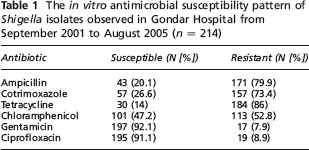
The three antibiotics to which there was the greatest resistance were ampicillin 171 (79.9%), tetracycline 184 (86%) and cotrimoxazole 157 (73.4%); the two to which there as the least resistance were ciprofloxacin 19 (8.9%) and gentamicin 17 (7.9%). From 2001 to 2005, there appeared to be no significant increase in resistance to the individual antibiotics tested.
Discussion
This retrospective study demonstrated a high level of antimicrobial resistance in Shigella species isolated from stools processed over a five-year period in Gondar. A low rate of resistance to gentamicin and ciprofloxacin has been observed in different studies.2,8
Our finding of a 73% resistance rate of the isolates to this antibiotic was in agreement with observations from Pakistan 1 and Iran 2 where resistance rates of 70.4 and 87.8%, respectively, to cotrimoxazole were reported.
In northwest Ethiopia, the resistance of Shigella to cotrimoxazole is high and has slightly increased since that previously reported in 1997 by Assefa et al. 9 (Table 2). Unfortunately, the drug is still commonly prescribed and used by the community for diarrhoea.
A comparison of resistance rates of Shigella to commonly used antibiotics in Addis Ababa (1980) and Gondar (1994–1996, 2001–2005)

See Reference 6
See Reference 9
Present study
Our study shows a fourfold increase (from 2 to 7.9%) in resistance to gentamicin from that reported by Assefa et al. (Table 2). Since this antibiotic is less commonly used than the orally administered antibiotics, in our study its rate of resistance was not found to be very high which concurs with recent studies from Bangladesh. 10 Gentamicin and ciprofloxacin are the only two commonly available antibiotics to which the majority of Shigella strains in Gondar area were susceptible. Although ciprofloxacin is contraindicated for those below 18 years of age, gentamicin can still be used in the settings where safer drugs are not available.
Of the Shigella isolates, 90.8% were resistant to one or more antimicrobial agents and 87.8% were multi-drug resistant. In our study the most common resistance was to tetracycline (73.5%) and cotrimoxazole (70.4%), as was the case in other recent studies.2,8 In our study, multiple drug resistance to as many as five or six antibiotics was observed: similar findings were seen in studies from other localities in Ethiopia.6–8
The measures used in the past to delay the development of resistance to cotrimoxazole hold true for the fluoroquinolones and for gentamicin today. Unless the unrestricted use of the currently potent antibiotics is stopped, the time when these antibiotics become ineffective in the treatment of severe shigellosis is not far off.