




Abstract
The study involved 180 Nigerian butchers and 180 traders (controls) selected by multistage stratified sampling who had their sera assayed for HBsAg (hepatitis B surface antigen) by enzyme-linked immunosorbent assay method. The butchers and the controls had an HBsAg sero-prevalence rate of 9.4% and 3.3%, respectively. Various risky practices were more common among the butchers but their hepatitis B antigenaemia was not related to the duration of their occupational exposure. The study shows that the butchers constitute a high risk occupation for hepatitis B viral infection.
Introduction
Viral infections are well known to be sustained by certain reservoirs, and hepatitis B viruses (HBVs) have been found in gorillas, chimpanzees and cows. 1,2 Butchers are generally at risk from knife-cuts and blood-letting, with the attendant risk of the transmission of blood-borne infections to their colleagues 2,3 and possible outbreaks of HBV infection. 4 The high prevalence of the HBV in the tropics calls for the identification of possible at risk groups, such as butchers, for targeted hepatitis B immunization. No study in Nigeria has focused on the risk constituted by butchers in disseminating HBV infection. The objective of this study was to investigate the prevalence of HBV among butchers and to estimate the risk its transmission.
Materials and methods
This prospective cross-sectional study was conducted at various markets that had abattoirs and at various meat selling points in Ibadan, Nigeria. The study received ethical approval from the Joint UI/UCH Ethical Review Board. It involved 180 butchers and 180 traders (controls) selected by multistage stratified sampling. Their biodata and risk factors for HBV were collected via a questionnaire and their sera were assayed for hepatitis B surface antigen (HBsAg) by the enzyme-linked immunosorbent assay method. The data were analysed using appropriate statistical instruments with significant differences in P values of ≤0.05.
Results
Various HBV transmissible risky practices such as cuts on hands and the sharing of knives and razors were more common among the butchers than the controls (P < 0.05; Table 1).
Data on hepatitis B viral infection among adult Nigerian butchers and controls
HBsAg, hepatitis B surface antigen
a P value lt; 0.05
HBsAg was detected in 3.3% of the controls compared with 9.4% of the butchers (P = 0.02, OR [odds ratio] = 3.02; Figure 1). It was also significantly higher among the men in both groups (P = 0.04, OR = 2.8). HBV infections were unrelated to their marital status, the number of sexual partners or the duration of occupational exposure.
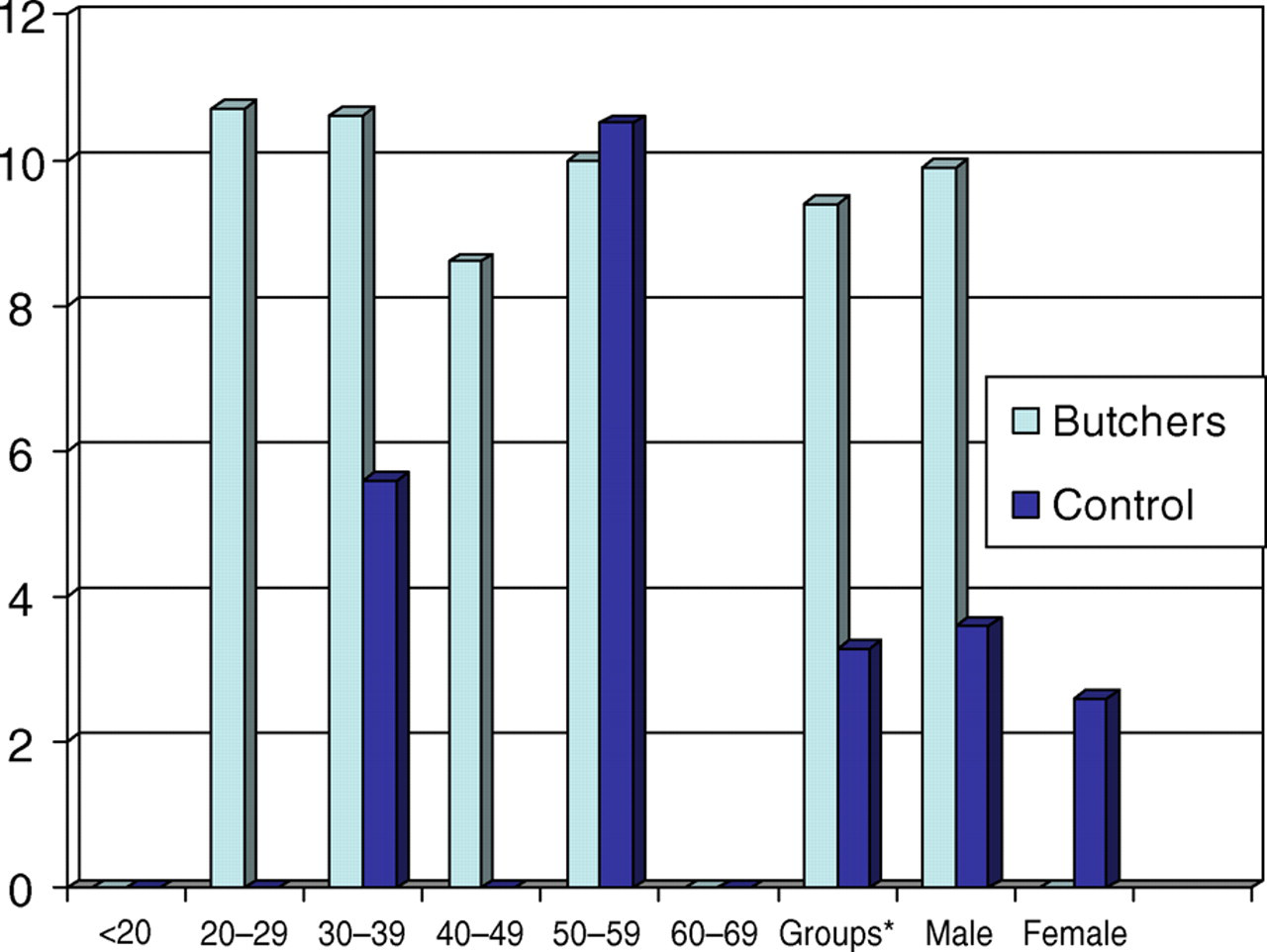
Hepatitis B surface antigen sero-prevalence and age groups (years) of 180 adult Nigerian butchers and 180 controls
Discussion
Most studies of HBV infection among possible high risk groups in tropical countries such as Nigeria have been hospital-based. 5,6 Our community-based study shows that HBV infection was significantly higher among the butchers than their controls, but it is relatively lower in reports using hospital-based controls. 5,7–9 This might be due to the elimination of the bias associated with the diverse risky practices of our butchers.
Men in all at risk groups – e.g. blood donors, 6 surgeons 7 and doctors 8 – have high infection rates. However, that does not mean that we should downplay the risk level of butchers. As butchers belong to all the productive age groups and thus are more readily exposed to the sick and healthy citizens via the sale of their meat. Furthermore, the infection could be spread by butchers to cattle which would increase the spread of infection throughout the community.
In conclusion, this study has shown that Nigerian butchers constitute a high risk occupational group for HBV infection and that they should be screened against the infection and, where necessary, given the appropriate treatment.