




Abstract
Summary
The prevalence of soil-transmitted helminthiasis is close to half the population in Central America, with the marginalized peri-urban poor disproportionately affected. Previous single province helminth surveys conducted in Nicaragua have shown Ascaris lumbricoides to be the predominant species. In 2005, we conducted a cross-sectional study of 880 children in 10 Nicaraguan primary schools located in four provinces. We aimed to establish the prevalence and intensity of soiltransmitted helminth infections and to investigate the factors associated with helminthiasis. Almost half (46%) of the children were infected with soil-transmitted helminths. Tichuris trichiura was the most common infective species (34.7%). The prevalence and intensity of helminthiasis was heterogeneous in the provinces, with children educated in peri-urban schools most affected. Healthy policies are required that favour the peri-urban poor who have inadequate and declining access to water and sanitation.
Introduction
The Pan American Health Organization estimates that approximately 30% of the Latin American population is infected with soil-transmitted helminths, while close to half the population in some Central American countries may be affected, with some communities disproportionately affected.1,2 Urbanization, where sanitation is inadequate and people overcrowded, such as in poor and often illegal settlements, is often thought to play a role in facilitating soiltransmitted helminth transmission. 3 Nicaragua is no exception to the global trend of growing urbanization, as demonstrated by the fact that an estimated 55.7% of the population live in urban settings in 2005 compared with 49.9% in 1980. 4 During the period from 1990 to 2004, the use of improved sanitation facilities in urban settings in Nicaragua (including peri-urban settlements) decreased from 64% to 56%. 5 Settings which are characterized by clustered high burden infections are epidemiological ‘hot spots’ 6 that require frequent, targeted intervention for effective control.
Patterns of aggregation, predisposition, clustering and geographical variation, as well as the impact of inadequate sanitation on species distribution, remain poorly understood. 7 Some evidence suggests that hookworm tend to be distributed more in rural settings while Ascaris lumbricoides and Tichuris trichiura tend to be more common in urban settings. However, the predominance of one species of soil-transmitted helminth over another (prevalence and intensity) may be due to multiple factors, including human exposure patterns and climatic, environmental, occupational and nutritional factors. 8 Studies conducted prior to the widespread mass-drug administration in Nicaragua found A. lumbricoides to be the predominant species of soil-transmitted helminth in terms of both prevalence and intensity.2,9
Aims
Our aim was to determine the prevalence and intensity of soil-transmitted helminth infections and to better understand their association with urbanization among children in 10 Nicaraguan primary schools.
Methods
We conducted a cross-sectional study of 880 children in 10 primary schools of the Friendly and Healthy Schools Initiative across four provinces of Nicaragua. This was conducted as a pilot study of the national soil-transmitted helminth control programme. Children aged between 6 and 14 years of age, undergoing primary education in schools in Chinandega, Estelí, Chontales and Granada were eligible to participate. The study protocol was reviewed by directors of the health and primary education departments and parental written consent was obtained.
The sampling frame consisted of the 183 schools participating in the Friendly and Healthy Schools Initiative in Nicaragua. We used non-random sampling to select 10 peri-urban and rural schools with year-round access. From the sampled schools, eligible children were identified from the class roll and invited participate. Following the World Health Organization (WHO) recommendations on sample size selection, 3 we aimed to recruit at least 800 children for the parasitological surveys.
Between September and November 2005, stool specimens were collected from children during the morning classes and transported to the departmental laboratory for processing the same afternoon. Stool samples were processed using the Kato-Katz technique. Data were reviewed and entered using EpiInfo 3.3.2 for Windows (Centers for Disease Control and Prevention, Georgia, USA). Data cleaning, coding and analysis were undertaken in STATA version 9 (Texas, USA). Infections were classified as light, moderate or heavy based on WHO criteria. 3 We used the chi-squared test and calculated the odds ratios with 95% confidence intervals for the statistical significance of associations between exposure variables and helminthiasis.
Results
Of the 880 children, 199 (23%) were from Chinandega, 211 (24%) from Chontales, 224 (26%) from Esteli and 246 (28%) from Granada. The average age of children was 8.4 years. Most (54%) were educated in rural schools and were female (54%). Half (46.0%) were infected with soil-transmitted helminths. T. trichiura was the most common infective species (34.7%), followed by A. lumbricoides (20.7%) and hookworm (1.4%) (Table 1). The prevalence of any infection ranged widely across the four provinces (20.6% to 87.4%). We found children educated in peri-urban schools were most affected by helminthiasis (Table 2).
The prevalence and intensity of soil-transmitted helminth infections, by species, in four provinces of Nicaragua, 2005

The association between a school's remoteness and various soil-transmitted helminth outcomes in 10 primary schools in Nicaragua, 2005
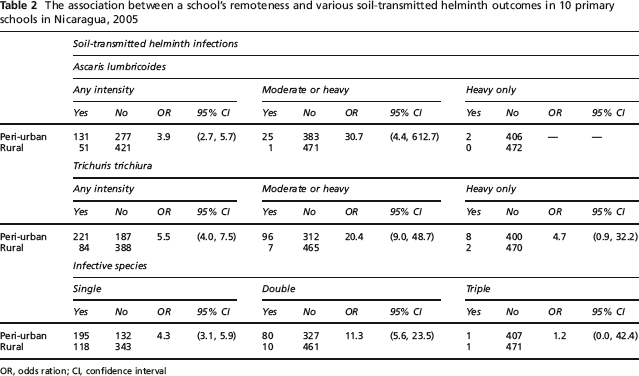
OR, odds ration; CI, confidence interval
Discussion
In 2005, de-worming had been conducted nationally approximately six months prior to our surveys. The prevalence of any infection ranged from 21% to 87% across the four provinces, with a national average of 46%. This level and heterogeneity of (re-) infection indicates that the pharmacological interventions required in these schools may not be uniform. In our study, children educated in peri-urban schools were more likely to have light soil-transmitted helminth infections, but much more likely to have moderate infections. Peri-urban children were also more likely to have single infections but far more likely to have double infections than those educated in rural schools. The recent decline in the use of improved sanitation in urban and peri-urban populations in Nicaragua 5 is of concern and is likely to affect the health and educational outcomes of this cohort of children.
There are several major limitations to this study. The 10 participating schools are not representative of primary schools in these provinces due to the non-random sampling methodology. Children were also not randomly selected, which may have introduced further entry level bias. However, almost all children of relevant ages attending the smaller schools were recruited.
Single-dose oral albendazole and mebendazole, that have been used for control activities globally, may be highly effective for curing A. lumbricoides infections but are far less effective for T. trichiura and hookworm. 10 Two previous surveys conducted in Nicaragua, both found A. lumbricoides to be the predominant species.2,9 Our study, which is the first over multiple provinces, is the first report of T. trichiura being identified as the predominant species, both in terms of prevalence and intensity in Nicaragua. This could be easily explained by geographic variability or the small sample size, in addition to the factors mentioned earlier. However, it is possible that species-specific drug effectiveness may have also contributed to our results.
Conclusions
The prevalence and intensity of helminthiasis was heterogenous, with peri-urban schools most affected. Healthy policies that favour the peri-urban poor who have inadequate and declining access to water and sanitation are required in Nicaragua.
Footnotes
Acknowledgements
We wish to thank the laboratory technicians of the Departmental Laboratories of Granada, Chontales, Chinandega and Esteli, as well as the functionaries of the Ministry of Health (MINSA), The Ministry of Water and Sanitation (ENACAL) and the Ministry of Education, Culture and Sports (MECD) who were involved in the survey design and implementation.