




Abstract
Scrotal haematoma and oedema are the most frequent complications of scrotal surgery and are associated with high morbidity. Through early postoperative compression on the scrotal sac these complications can be avoided. Compression can be assured by the following simple surgical method independent of the quality of the postoperative care: extending the scrotal sac over the abdominal wall and fixing it with skin sutures under tension at the lower abdominal wall over a pile of gauzes. This method was shown to be effective after hernia repair of scrotal hernias but also seems promising for other scrotal surgery.
Introduction
Lugala Lutheran Hospital in the rural district of Ulanga in central south Tanzania is a first referral level hospital with 137 beds. In 2010, 96 hernia repairs were performed. Due to the difficult financial, cultural and geographical accessibility of Lugala Lutheran Hospital, patients often present with advanced hernias and extensive scrotal hernias.
Scrotal haematoma and oedema are the most frequent complications of scrotal surgery.
1
Although extensive scrotal haematoma after scrotal hernia repair is rare, it is associated with a high burden of disease, prolonged stay in hospital and increased costs through consecutive surgical and supportive treatment.
2
Several techniques have been suggested that may avoid this complication:
Thorough intraoperative haemostasis is essential in order to reduce the occurrence of scrotal haematoma after scrotal hernia repair.
3
The lack of diathermy, which is not widely available in district hospitals in low-income countries, might hamper the results of intraoperative haemostasis and make it more time consuming; The resection of the complete scrotal sac as a preventive measure for scrotal haematoma has the disadvantage of being difficult and time consuming in chronic or recurrent hernia, where fibrotic tissue is largely present.
We describe a simple technique used at the Lugala Lutheran Hospital that has led to the avoidance of scrotal haematoma after a scrotal hernia repair.
Technique
After skin suture and the dressing of the surgical wound, the scrotum of the operated side is lifted cranially over a pile of gauzes onto the lower abdomen and fixed through two or three skin sutures to the abdominal wall. The scrotal sac is moderately compressed through the cranial lifting and fixation against the pile of gauzes (Figure 1).
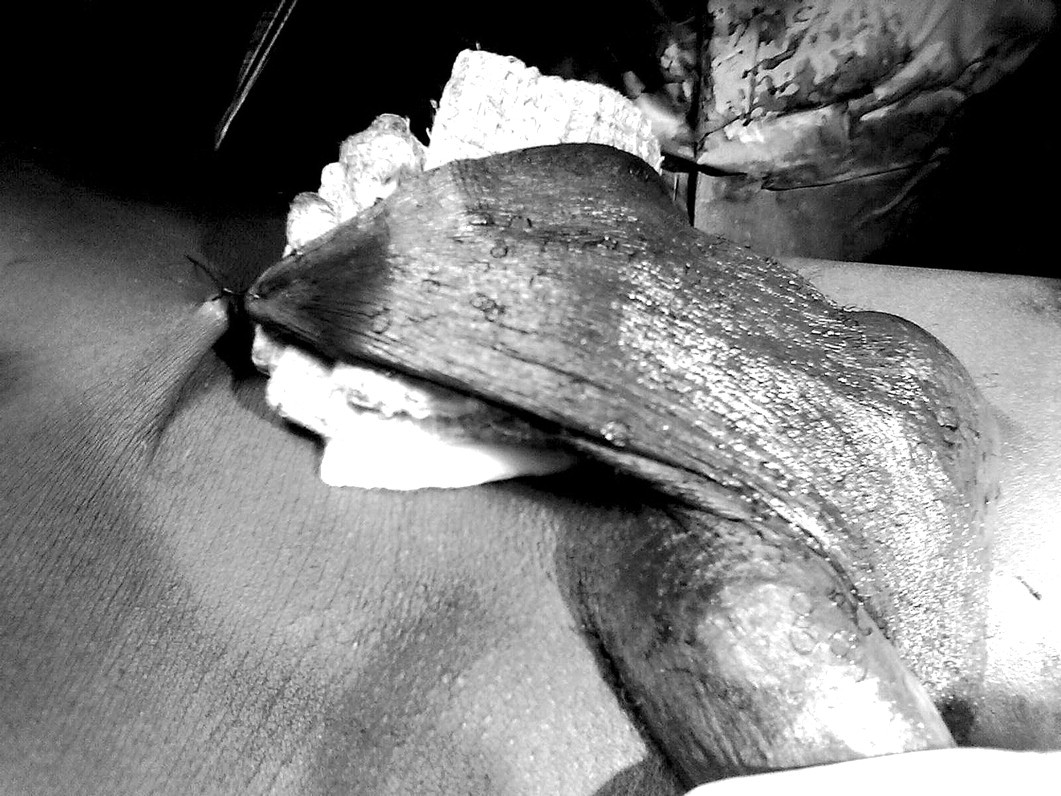
Scrotal compression through a scrotal-abdominal skin suture in a 42-year-old patient after repair of a combined hernia with a small medial hernia and an extensive obstructed lateral scrotal hernia with necrosis of the left testis, resulting in unilateral orchidectomy
This compression is left for three hours postoperatively, after which the skin sutures of the scrotal sac's fixation against the abdominal wall are removed. This technique is based on the rationale that haematomas usually form within the first few hours postoperatively.
Moderate compression of the pile of gauzes at the wound level against the abdominal wall has the additional effect of compressing the operated area and reducing the subcutaneous haematoma. The use of drains is unnecessary.
This technique has been performed in both spinal and general anaesthesia. The postoperative pain was well controlled with the usual regimen of postoperative analgesia used at Lugala Lutheran Hospital.
The technique can be used for all major scrotal hernia and independently of the hernia repair technique. It can be used with the testis left in situ as well as after resection of the testis in the case of a necrotic testis.
The use of this method might be extended to different surgical interventions of the scrotum where scrotal haematoma is a known postoperative complication.
Conclusion
This simple technique efficiently prevents scrotal haematoma after scrotal hernia repair. Furthermore, it can reduce post-operative subcutaneous haematoma at the side of the wound and renders the use of drains unnecessary.