




Abstract
This article recounts the development and implementation of an Advanced Practitioner Interventional Service, performing ultrasound-guided drainage procedures, in one National Health Service Hospital in the UK. The article details and explains the rationale behind implementation of the service, describes the training and supervision required to safely institute the service and documents the problems and limitations encountered during implementation of the service. The service is seen to be a natural progression for the advanced practitioner in ultrasound but with the proviso that there must be a robust support mechanism at all times.
Background
Within a National Health Service (NHS) hospital a single trained consultant radiologist was undertaking all ultrasound-guided interventional procedures which included both percutaneous pleural aspirations and drainages and peritoneal fluid aspiration, numbering an approximate total of 150 per annum. This presented a problem with continuity of the service to patients during the absence of the radiologist, as no other capable practitioner could fill the role. Under these circumstances, the service had to rely on the goodwill of others, e.g. the duty medical specialist registrar (SpR), who was often unable to perform the task due to other commitments. Moreover, the medical SpR was often inexperienced in the practice of ultrasound-guided percutaneous aspiration or drain insertion. A direct result was that patients often had their treatment delayed with the potential risk of increased morbidity. In the UK, an NHS Hospital Trust is held responsible for the effective use of available resources and for maximizing capacity to ensure an effective quality service. 1 Therefore, it was paramount that a more efficient service had to be devised and implemented to resolve this problem, without major resource implications. 2
An advanced practitioner already proficient in interventional breast procedures was targeted as an appropriate person to further extend the role to encompass an ultrasound-guided percutaneous ‘drainage’ service. The Royal College of Radiologists (RCR) actively promotes role extension in order to maintain the highest quality of care to the patient, 3 and the extended role of the advanced practitioner received the full support of the Radiology Department. The envisaged extended role also complied with Department of Health initiatives that encourage team working across professional boundaries to provide the optimum quality of care with realization of staff potential. 4 It was anticipated that as the advanced practitioner became more experienced and confident in performing these procedures, this would reduce the radiologist's workload, freeing him for utilization elsewhere in the department.
Training and supervision
Initially, a short document was drafted which outlined the rationale behind this role extension, the anticipated benefits the service would bring to the hospital and patient, and any risks that would be encountered and should be taken into consideration. The document was referenced from the available evidence-based literature as well as any work-based evidence. The document was presented to the Board of Directors of the Hospital for approval. This innovation to the service was well received at both management and medical levels and implementation was encouraged to prevent the possibility of clinical risk due to procedural delays.
As there was no formal or approved postgraduate course for advanced ultrasound practitioners performing image-guided percutaneous interventional procedures, the training had to be ‘in-house’ with the radiologist normally conducting these procedures being the named mentor. The remit of the radiologist was to provide continual mentorship throughout the training period and also to provide proof of support in the form of a signed agreement to the Hospital Board. The advanced practitioner had already completed the image-guided procedures of the Ultrasound Breast Module at a local university, which included the administration of local anaesthesia, patient consenting procedures, medicolegal issues, liability and conforming to protocols. 5 These generic aspects of any interventional procedure were readily transferable to this new area of clinical practice.
As for the implementation of any role extension there had to be written protocols and guidelines, training schedules, 6 technique recommendations and audit strategies in place before the commencement of training. These documents were devised and put into place with the approval of all interested parties. The advanced practitioner grade and minimum length of experience were also established, which in our hospital was stated as a minimum of five years postgraduate practice but other hospitals may have different requirements.
Furthermore, a training log book was devised, which upon completion had to be signed by the mentoring radiologist. This log book included the specific numbers of each procedure to be performed to indicate competency. A decision was made that the minimum required number of procedures to be completed were as follows: 10 supervised examinations, 10 with limited supervision and 10 unaided but with the radiologist in the department. This was proposed to the risk management department with copies of completion to be held by the advanced practitioner and the radiology department manager. When the number of procedures were completed to the satisfaction of all interested parties, the advanced practitioner was considered competent to work unsupervised. However, the protocol designed to cover this exercise states that medical cover must be readily available at the time of procedure in the event of any unforeseen complications. In the case of this hospital, with an experienced practitioner, the whole training period from initiation to competency took a total of six months. This training period may take longer in the case of a less experienced practitioner.
It must be emphasized that documentation has to be kept of all procedures performed with a record of the dosage of local anaesthetic administered and patient details. It was also agreed that a minimum number of procedures were to be performed each month, five in our case, but it was thought that, with experience and proven competence, this number would be decreased. An audit was to be undertaken yearly, with the outcome of five random cases investigated (Table 1).
Summary of audit results for radiographer-led invasive procedures
Technique
The actual technique should be reproducible, successful and proven with the patient always attending on a trolley for the procedure. The actual technique of insertion is the decision of the mentoring radiologist but this normally follows a well-established technique, with which the practitioner should be familiar. Our protocol for any form of percutaneous fluid drainage under ultrasound guidance is a three-step aseptic technique. This involves imaging a sheathed needle as it enters the fluid pool, with fluid return confirmed before insertion of a guide wire over which the drainage catheter is then introduced (Figures 1 and 2). This is then held in place by a drain fix dressing and bag attached.
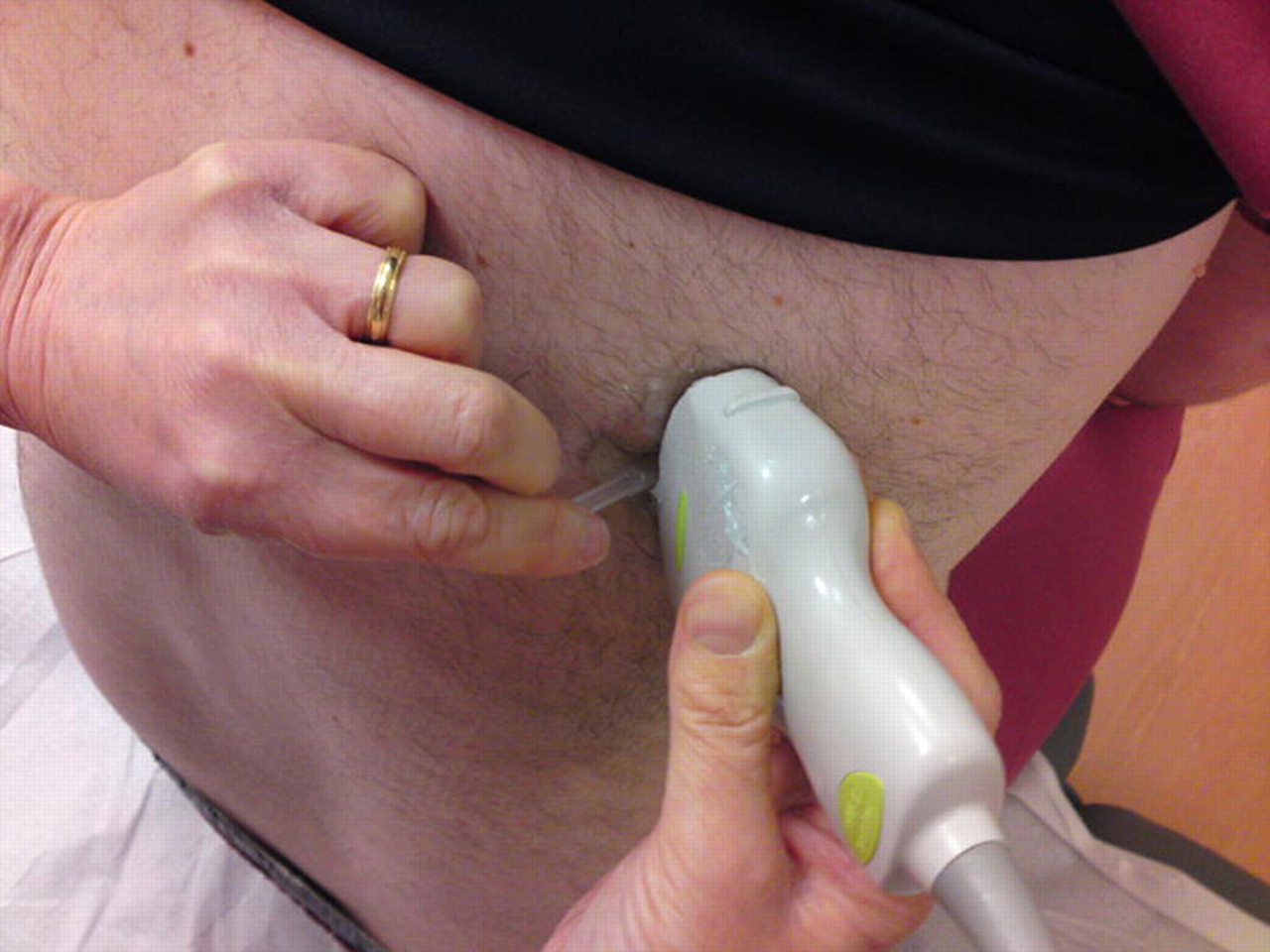
Localization technique under ultrasound guidance prior to chest drainage

Insertion of drain under ultrasound guidance
All necessary equipment should be prepared, ideally according to a protocol checklist and conveniently close before commencement of the procedure. Ideally, an assistant should be present to hand devices to the operator, and assist with general patient care.
A recent International Normalized Ratio in relation to blood coagulation should be available before the procedure is attempted. Our ceiling is 1.4 (normal < 1.2), agreed locally.
Warfarin should be stopped for at least three days prior to procedure unless otherwise clinically indicated. There should be advice available from the local Haematology Department with regard to management of patients on anticoagulation who need an interventional procedure.
Patients with any known allergies must be screened.
Written consent must be signed by the patient before attempting any procedure. In cases where this is not possible, e.g. unconscious patient/unable to communicate, it is the responsibility of the referring clinician to sign the appropriate legal forms to allow the procedure to go ahead.
Report
At the end of every case, a report must always be issued to include:
Amount and type of local anaesthesia; Site of catheter insertion; Type of catheter used; Success of the procedure; Colour and consistency of the aspirate; Any complications encountered; Any post procedure instructions if necessary.
Sample report:
5 mL of lignocaine 1% injected into the right side of the abdomen and an 8F catheter successfully inserted. There was free drainage of thick, cloudy yellow fluid postprocedure.
No immediate postprocedure complications.
Advantages
There are a number of potential advantages of an advanced practitioner-led ultrasound-guided interventional service. There is increased flexibility in scheduling of these procedures and radiologists can be released from the department to be utilized elsewhere. 2 Studies have indicated a faster recovery rate for patients with improved quality of clinical decisions; a potential consequence of a more immediate service. 6 With waiting times for the procedure reduced, there is the potential of a more rapid diagnosis from the samples taken. Arguably, a more experienced practitioner who performs many ultrasound-guided percutaneous drainage procedures, be it a sonographer, radiographer or radiologist, is less likely to encounter complications arising from a drainage procedure compared with an inexperienced practitioner less familiar with drainage and ultrasound techniques.
A current shortage of radiologists and difficulty in recruitment in the UK 7 has led to radiographers extending their skills in order to alleviate this problem. This allows for a more effective utilization of radiologist capacity and therefore a continuation of a quality service. 8 Improved career prospects and job satisfaction can be the reward for the advanced practitioner incorporating interventional techniques into their role. 9
In addition there are financial repercussions for the hospital trust. An advanced practitioner is more cost-effective when compared with a radiologist but caution must be exercised since the improved quality of service and patient care must remain the priority rather than reduced costs. 3
Disadvantages
The advanced practitioner is not a medically trained person and hence there may be reservations about the level of knowledge of the personnel performing an invasive procedure. 10 However, it has been suggested that personnel can, with proper training and systems in place, provide a service as accurate as a radiologist, 11 but strict adherence to the set-down protocols and role is essential. Acceptance by radiologists or the clinicians may be an issue, particularly if there is the prospect of an element of danger to a patient with an invasive procedure. However, in order to gain the trust of the remainder of the medical team involved with patient care, a high level of competence will rapidly lead to acceptance of this method of service to patient care. There should be no conflict of interest provided each member of the team understands their limitations and works within these.
Although our advanced practitioner is fully trained in cardiopulmonary resuscitation, if the patient experiences a rare cardiopulmonary complication, there should be rapid access to trained people in the hospital; the procedures should not be conducted in isolation.
An initial lack of confidence may be problematic for the practitioner, but this is likely to diminish as experience is gained. However, it should be stressed that the practitioner is legally accountable for their actions and should always be aware of their limitations. 12
Training cases may not always be available or suitable, e.g. heavily loculated collections, not enough fluid for safe drainage, low patient mobility and poor patient cooperation. Use of a phantom helps to overcome this problem. Inserting and advancing a catheter into a synthetic bath sponge is a good substitute for those just starting, and is encouraged.
Benefits to patient
The waiting time for procedures is reduced in keeping with NHS directives on diagnosis and treatment with improved patient outcomes. 4
There is improved continuity of individual patient care. 6 Some patients may return for repeat procedures and, as was often the case previously, may not see the same member of the medical team. Now, the advanced practitioner and the radiologist provide continuity of care. This familiarity may provide reassurance for the patient thus generating more cooperation and contributing to the successful completion of the procedure. Conversely, it can be emotionally challenging when a frequent attendee succumbs to their illness. 13
More importantly the number of percutaneous US procedures in all hospitals in the NHS in the UK will increase, and the re-distribution of the work will be paramount to maintain the service. Recent guidelines recommend that all drainage procedures should be performed under ultrasound guidance to minimize the risk of pneumothorax and bowel perforation. 14
Risks
Over- or under-confidence can be an issue, particularly in the early days of practice.
Unexpected haemorrhage cannot be avoided. Litigation is a possibility if something goes wrong but vicarious liability should be in place before training commences.
The current situation
After completing training in 2004 the advanced practitioner has now performed over 600 individual drainage/aspirations within the department and trained another advanced practitioner to also perform percutaneous ultrasound-guided drainage procedures. Both the practitioners aim to do the majority of the procedures within the ultrasound department, when the designated radiologist is unavailable. However, with the increase in the radiology establishment with both SpRs in training and newly appointed consultant radiologists, the number of procedures performed by the advanced practitioners has diminished. That said, the minimum number for competence stated earlier (5 cases per month) is still being met. This may have to be reassessed if the numbers of procedures decline.
Interestingly, from September 2010 there is a dedicated interventional postgraduate module in ultrasound available at the local university. 15
Since interventional fluid acquisition procedures should ideally be performed under ultrasound control, 13 if imaging departments are unable to meet demand and provide a timely service, clinicians may take matters into their own hands and purchase small hand-held inexpensive ultrasound machines to guide drainage. This would mean the procedures could be performed at the patient's bedside without travelling to the radiology department. This may be seen as an advantage to the patient but only if robust training and clinical governance are enforced.
The RCR 10 has recently highlighted the fact that advanced practitioners do not have a medical degree and question whether they should be taking on advanced role extension as they may not have the relevant clinical knowledge. However, the advanced practitioner here still has the continuing support of the local interventional radiologists. Although they are able to perform the procedures themselves, they are not available at most times within the clinical workplace, but are comfortable with the safe delegation of this procedure. A local understanding with the roles played by advanced practitioners should always be taken into account.
Conclusion
Performing ultrasound-guided drainage procedures is arguably the natural progression for the more experienced advanced practitioner. However, it must be reiterated that a good support network must be in place before the service commences.
There is an enormous amount of job satisfaction to be gained from performing these procedures and it is a rewarding progression for an advanced practitioner in radiography.
Footnotes
ACKNOWLEDGEMENT
Many thanks to the Ultrasound editorial team for their help in developing this paper.
DECLARATIONS
The authors have no conflicts of interest to declare.