




Abstract
Infections with Streptococcus equi zooepidemicus are rare and are associated with contact with animals or animal products. There are very few reports about infected vascular grafts or aneurysms with this etiology. We present two patients. The first is a 77-year-old man with an infected bifurcated graft four years after an open operation for an abdominal aortic aneurysm (AAA). The second is a 72-year-old man with a symptomatic mycotic AAA, treated with endovascular aneurysm repair. Both received prolonged treatment with bactericidal antibiotics and responded well. Follow-up time at present is 5.5 years for the first, and 4.5 years for the second, patient.
Introduction
Infections with Streptococcus equi zooepidemicus are rare and are associated with contact with animals or animal products. 1 5 So far, there have been very few reports about infected vascular grafts or aneurysms with this etiology. 6 8 We present two patients, one with an infected Y-graft four years after an open operation for an abdominal aortic aneurysm (AAA), and one with a presumably mycotic aneurysm of the abdominal aorta, treated with an endograft.
Case report
The first patient is a 77-year-old man, ex-smoker, with a previous history of gastroesophageal reflux disease, osteoporosis, chronic obstructive pulmonary disease, myocardial infarction, angina pectoris and paroxystic atrial fibrillation. He was living on a farm where he had daily contact with horses. He was operated for an AAA with a bifurcated graft in 1999. His current medication was warfarin, esomeprazol 40 mg once daily (o.d.), Isosorbidmononitrate 60 mg o.d., amlodipin 5 mg o.d., metoprolol 100 mg o.d. and nitroglycerine.
In November 2004, he was admitted to his local hospital, several days after onset of severe back pain and fever. His hemoglobin (Hb) was 9.8 g/dL and C-reactive protein (CRP) was 188 mg/L. His platelet count, white blood cell (WBC), Na, K, creatinine and serum cholesterol were normal. Four of four blood cultures showed growth of S. equi zooepidemicus. Urine cultures were negative. Echocardiography did not reveal pathological findings. Computed tomography (CT) showed a 42-mm abscess in the left psoas muscle and small gas bubbles between the bifurcated graft and the aneurysmal sac, indicating graft infection (Figure 1). Antibiotic treatment with tobramycin and penicillin (intravenous) was started upon admission. Metronidazole (intravenous) was added after the CT scan but discontinued because of the blood culture results.
Computed tomography (CT) scan of patient 1, showing an abscess in the left psoas muscle and close to the distal left anastomosis
Resistance testing (minimum inhibitory concentration [MIC]) showed sensitivity for ampicillin, doxycycline, erythromycin, penicillin G (0.023 mg/L), trimethoprim-sulfamethoxazole, vancomycin (1.0 mg/L) and linezolid (0.75 mg/L) and resistance for clindamycin (1.5 mg/L) and gentamicin (32 mg/L). Tobramycin, given to achieve synergy with penicillin, was discontinued.
The patient improved and CRP decreased. He was transferred to our hospital for further treatment of his graft infection. Coronary angiography showed good ventricular function, but significant stenoses in the left anterior descending artery and circumflex system. Percutaneous coronary intervention (PCI) was possible, but not advisable under ongoing infection. He was in generally poor health, and thus considered to be unfit for open surgical treatment of his vascular graft infection.
CT-guided drainage of the psoas abscess was performed three weeks upon admission to our hospital. Gram staining showed leukocytes, but no identifiable bacteria. Culture from the abscess cavity was negative. Intravenous penicillin was continued for one week thereafter and then replaced by penicillin 660 mg x 3 per oral. The patient improved steadily, and was discharged to his home after five weeks with otherwise unchanged medication. PCI was performed three months later with excellent initial results but his angina recurred nine months later. He was operated on for cataract 11 months after discharge.
Repeated follow-up investigations, including blood cultures and CT scans, were negative. Life-long antibiotic treatment with penicillin 660 mg x 3 per oral was intended, but after two years he developed severe diarrhea and was unwilling to continue. He was followed up for two more years without recurrence, but was then re-admitted because of fever and shivering. His CRP was 38 mg/L. His Hb, WBC, Na, K and creatinine were all normal. Blood cultures were negative. CT (Figure 2) did not show signs of recurrent graft infection, but the work-up did not reveal any other focus. Antibiotic treatment was started again and symptoms were resolved. Five years after onset of the infection, he lives in his own house without external help. He is still on antibiotic treatment. Recently, he had episodes with urinary tract infections with an extended-spectrum beta-lactamase (ESBL)-producing Escherichia coli, successfully treated with imipenem.
Computed tomography (CT) scan of patient 1, 3½ years later, showing no signs of ongoing graft infection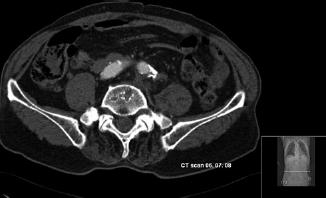
The second patient is a 72-year-old retired farmer, still living on his farm where he has daily contact with horses. He presented with a 56-mm symptomatic AAA (Figure 3) in May 2006, and was treated with a Zenith® (Cook Medical Inc., Bloomington, IN, USA) endovascular stentgraft. He had septic fever postoperatively and four of four blood cultures grew S. equi zooepidemicus. Resistance testing showed sensitivity to ampicillin, clindamycin, ciprofloxacin, doxycycline, erythromycin, gentamicin, penicillin G, trimethoprim-sulfamethoxazole and vancomycin. The MIC for ceftriaxon was 0.19 mg/L, interpreted as susceptible.
Computed tomography (CT) scan of patient 2, following endovascular aneurysm repair for mycotic abdominal aortic aneurysm
In retrospect, we believe that he had a mycotic aneurysm primarily and that his preoperative symptoms were due to infection. He responded well to antibiotic treatment with ceftriaxone 1 g × 1 intravenously for four weeks followed by penicillin V 1.3 g × 3 per oral for three months. He has been followed with annual CT scans (Figure 4), and has not developed signs of recurrence for four years.
Computed tomography (CT) scan of patient 2, done three years after endovascular aneurysm repair for mycotic abdominal aortic aneurysm
Discussion
Aortic graft infection is a severe complication with significant mortality. Optimal treatment normally includes removal of the infected graft and construction of a new bypass graft in uninfected areas, e.g. axillobifemoral graft or in situ reconstruction. 9 However, this represents a major trauma and a significant number of patients will be unfit for surgery.
S. equi subsp. zooepidemicus is an aerobic bacterium belonging to the group C Streptococci. It is of animal origin, causing infections especially in horses. Infections in humans are rare, mostly reported after contact with infected horses4,5 or after ingestion of contaminated dairy products. 2 Both our patients had daily contact with horses which was presumably the source of infection.
Diagnosis and treatment of our first patient appear quite time consuming, yet upon admission there were no tempting treatment options. We did not consider antibiotic treatment and drainage of the abscess cavity as sufficient, but after some weeks, the clinical course indicated that it might work for this particular patient. Bacterial culture from the abscess cavity was negative, but that was after several weeks of antibiotic treatment. We believe that recurrent symptoms in 2008 were due to the same infection, although there were no CT changes or positive bacterial cultures.
In retrospect, antibiotic treatment without open surgery probably was the best alternative for him, even though the repeated finding of an ESBL-producing E. coli could have been caused by selection because of long-term use of antibiotics.
Treatment of the second patient with endovascular aneurysm repair (EVAR) has so far been successful and similar results have been reported by other investigators. 10 In contrast, other authors 11,12 feel that EVAR should mainly be used as a bridging procedure in infected cases.
In conclusion, we have described a case of aortic graft infection with S. equi zooepidemicus, where the result of antibiotic treatment alone was acceptable. This should not change treatment of infected aortic grafts in patients fit for surgery, but in case of prohibitive co-morbidity for open surgery and aortic graft infection with this agent, prolonged treatment with bactericidal antibiotics seems to be an acceptable alternative to surgery. Further investigation is needed to determine if EVAR combined with long-term antibiotic treatment can be sufficient to treat selected mycotic aneurysms.