




Abstract
Public-private partnership (PPP) is regarded as an innovative way to the procurement of public projects. Models vary with PPP projects due to their differences. The evaluation criteria are usually complex and the judgments offered by decision makers (DMs) show the characteristics of fuzziness and uncertainty. Considering these cases, this paper first analyses the risk factors for PPP models and then proposes a new method for selecting them in the setting of single-valued neutrosophic hesitant fuzzy environment. To achieve these purposes, two single-valued neutrosophic hesitant fuzzy correlation coefficients are defined to measure evaluated PPP models. Considering the weights of the risk factors and their interactions, two single-valued neutrosophic hesitant fuzzy 2-additive Shapley weighted correlation coefficients are defined. When the 2-additive measure on the risk factor set is not exactly known, several distance measure-based programming models are constructed to determine it. Based on these results, an algorithm for evaluating PPP models with single-valued neutrosophic hesitant fuzzy information is developed. Finally, a practical numerical example is provided to verify the validity and feasibility of the new method.
Keywords
Introduction
Public-private partnership (PPP) is a holistic concept of project construction that is used in all aspects of the project life cycle including design, management, construction, financing, operation and management, maintenance, service, and marketing. With the rapid growth of China’s economy, PPP has been widely adopted by government in many infrastructure projects, such as flood disaster management (Yang et al., 2018), PPP housing project (Liu et al., 2018a), construction of rental retirement village (Liu et al., 2018b), water sector (Bao et al., 2018), selection of social capital partner (Liu et al., 2018c), expressway (Song et al., 2018), and evaluation of delay causes for build-operate-transfer (BOT) projects (Budayan, 2018). PPP can be defined as a long-term contract based on service outputs where significant risk transfers to the private sector. Generally speaking, this long-term contract involves design, major procurement, operation and maintenance of a facility. Yan et al. (2020) developed a decision-making model of concession period for constructing the PPP project in view of fairness preference using the Nash bargaining game solution and concluded that the developed decision-making model is helpful for infrastructure projects. Jin et al. (2019) discussed the properly designed length of concession period for PPP projects in view of fair risk allocation between governments and private investors via Monte Carlo simulation. Furthermore, the authors employed a PPP transportation project to show the concession period determination process. Kwofie et al. (2019) researched the nature of communication performance challenges in PPP projects. Using the deductive research design, the authors analysed the communication network of PPP projects in Ghana and South Africa and concluded that the communication challenges and information asymmetries are notable challenges. Shalaby and Hassanein (2019) discussed the renegotiation process of PPP contracts and designed an automated system to select the optimum renegotiation scenario.
The role of PPP is to reduce the risk of a project in the whole life cycle for achieving the highest benefits (Akintoye et al., 2003; Zhang, 2005). Although there are many advantages of PPP, various types of risk and uncertain factors restrict its application (Ke et al., 2010; Ogunlana, 1997), which usually has a significant impact for accomplishing a PPP project (Delmon, 2000). Osei-Kyei et al. (2017) researched seven important criteria for the success of PPP projects, including effective risk management, meeting output specification, reliable and quality service operation, adherence to time, meeting the need of public facility, long-term relationship and partnership, and profitability. Osei-Kyei and Chan (2018a) explored the perceptual differences of PPP stakeholders for the success criteria for PPP projects. Ahmadabadi and Heravi (2019) used the structural equation modelling to assess the risk in PPP-megaprojects by considering risk interaction and stakeholders’ expectations. Then, the authors studied the application of their model in Khoramabad–Polezal project. The results show that each stakeholder group considers effective risk management as the most critical success criterion.
The motivation of this paper is to develop a new method for PPP selection based on correlation coefficient in the setting of single-valued neutrosophic hesitant fuzzy sets (SVNHFSs), which is more powerful and flexible than that of the previous research. Compared with the previous research, the main advantages of the new method include: (1) The new method is based on SVNHFSs that can express the hesitancy, preferred, indeterminacy and non-preferred information simultaneously. Therefore, the new method is more flexible; (2) New single-valued neutrosophic correlation coefficients are defined that do not require compared SVNHFSs to have the same length, namely, new correlation coefficients do not change the original information offered by the decision makers (DMs); (3) The 2-additive Shapley weighted single-valued neutrosophic correlation coefficients are proposed that can deal with the situation where the weights of risk factors are interactive and can synchronously reflect the complementary, mutual, and independent interactions; (4) New correlation coefficients do not restrict to define the correlation between SVNHFSs on the ordered elements of the hesitant preferred, hesitant indeterminacy and hesitant non-preferred degree sets; (5) When the weighting information is incompletely known, models for determining the optimal 2-additive measure are built. This allows the new method to deal with the situation where the weighting information with interactions is incompletely known.
All in all, this is the first method for evaluating PPP models that considers the interactions between risk factors and can deal with the case where fuzzy measure is incompletely known. Furthermore, it overcomes the limitations of research about decision making with single-valued neutrosophic hesitant fuzzy information.
The rest of this paper is organized as follows: Section 2 briefly reviews decision making methods for PPP selection, decision making methods with SVNHFSs and correlation coefficient; Section 3 briefly reviews several basic notations and concepts that are related to the following discussion. Section 4 first defines two single-valued neutrosophic hesitant fuzzy correlation coefficients. Then, two single-valued neutrosophic hesitant fuzzy 2-additive Shapley weighted correlation coefficients are presented to reflect the interactions among the weights of risk factors. Section 5 first constructs several distance measure-based programming models for determining the fuzzy measure on the risk factor set. Then, a new algorithm for evaluating PPP models is developed. Section 6 provides a case study about evaluating PPP models for the high-speed rail to illustrate the concrete application of this new algorithm and compares it with Şahin and Liu’s method (Şahin and Liu, 2017). Conclusions are shown in Section 7.
Literature Review
This section contains four subsections. The first section reviews decision making methods for PPP selection and lists their restrictions to show the necessity to further study PPP selection; the second section reviews the risk factors for evaluating PPP models and three PPP models; the third part introduces decision making methods with SVNHFSs and shows their limitations; the fourth part reviews decision making based on correlation coefficients and points out the limitations of previous single-valued neutrosophic hesitant fuzzy correlation coefficients.
Decision Making Methods for PPP Selection
As shown in Table 2, there are many PPP models, and the final implementation effect of the project is largely dependent on the selected one. A wide range of studies has been conducted to assist decision making in PPP selection. John and Isr (2003) analysed thirteen PPP projects in North America and Asia and suggested that the project risks, project conditions, and availability of financing are the critical factors in PPP selection. Considering the reference function of similar past projects, Luu et al. (2005) proposed a conceptual framework for case-based PPP selection by integrating the client’s needs, the project characteristics, and external environment. To quantitatively depict the evaluation and selection of PPP projects, Mahdi and Alreshaid (2005) first constructed the index system for evaluating PPP models. Then, the authors proposed a multi-criteria decision-making methodology using the analytic hierarchy process (AHP) to assist the selection of PPP models. According to the degree of legal authorization given by the government to the project company, Ghavamifar and Touran (2008) discussed the selection of PPP, construction management (CM) and design-build (DB) models in transportation projects of all the 50 states in the United States. By taking schedule, cost, owners, project and external environment as input variables and taking cost, schedule, safety, quality and contract as output variables, Chen et al. (2010) constructed the data envelopment analysis (DEA) model to assist owners in selecting PPP models. Combined with modern portfolio theory (MPT) and multi-objective optimization, Weissenböck and Girmscheid (2013) introduced a method for PPP selection for construction firms in selecting highly suitable PPP projects. Dai and Molenaar (2015) presented a risk-based modelling approach to quantify the potential differences in project cost due to the selection of PPP models for highway design and construction. Feng et al. (2018) developed a multi-objective optimization model for balancing public and private interests for PPP models. Furthermore, the authors took Beijing No. 4 Metro Line to show the application of the offered model. Osei-Kyei and Chan (2018b) investigated the differences and similarities on the reasons for implementing PPP in developing and developed economies/countries through Ghana and Hong Kong. Pellegrino et al. (2019) adopted the Monte Carlo simulation as the option-pricing method to test how to ensure the maximum interest rate of private investors in PPP projects.
To deal with the uncertainty in the process of evaluating PPP models, Yuan et al. (2010) researched performance objective attributes in the perspective of different stakeholder groups and combined fuzzy entropy method and fuzzy TOPSIS method to develop an approach for selecting the performance objective levels for PPP models. Shakeri et al. (2015) combined Elimination et Choice Translating Reality (ELECTRE) and Strength, Weakness, Opportunity, Threat (SWOT) methods in fuzzy environment for evaluating private sector for water treatment PPP models in Iran. Valipour et al. (2016) presented a hybrid fuzzy method and a cybernetic analytic network process (CANP) model for identifying sharing risks. Its main principle is to transform linguistic information and expertise into systematic quantitative analysis and use CANP model to address the problems of dependency and feedback between criteria and barriers, as well as the choice of sharing risks. Combining with the local situation, Zhang et al. (2019) developed an indicator system. Then, the authors established an integrated decision-making framework using triangular fuzzy AHP analysis for selecting the suitable PPP model. Based on the theory of intuitionistic fuzzy sets, Wang and Qin (2015) provided an evaluation method to work out the score functions of intuitionistic fuzzy numbers with uncertain weights, which is then used to select appropriate PPP models. On the basis of interval-valued intuitionistic fuzzy set (IVIFS) theory, An et al. (2018) proposed a group decision making method for PPP model selection. Su et al. (2019) introduced the similarity measure with interval neutrosophic information, by which a PPP model selection method with interval neutrosophic set is proposed.
Based on the above literature review, one can verify that although they can deal with the problem of selecting PPP models with fuzzy information, there are some limitations in applications. For example, due to the complexity of PPP model selection, the hesitancy, preferred, indeterminacy and non-preferred information may simultaneously exist. However, none of the previous methods can deal with this case; (2) none of them can cope with the situation where the weights of risk factors are interactive.
Risk Factors and PPP Models
The government and the private sector should assess all potential risk factors throughout the whole life cycle of the project. To show the potential risk factors in the procedure of evaluating PPP models, Jang (2011) offered four primary risk factors and twelve secondary risk factors as shown in Table 1.
Risk factors for evaluating PPP models (Jang, 2011).
Risk factors for evaluating PPP models (Jang, 2011).
On the other hand, since PPP was first introduced by the British government in 1952, various types of PPP models have been proposed. According to the PPP style, Huang (2007) summarized thirteen main PPP models as shown in Table 2.
Thirteen types of PPP models and their descriptions (Huang, 2007).
To indicate their differences clearly, Table 3 shows the features of these thirteen types of PPP models. From the top to the bottom, the degree of privatization is deepening while the private risks are increasing (Huang, 2007).
The features of thirteen types of PPP models (Huang, 2007).
With the development of fuzzy decision-making theory, many types of generalized fuzzy sets are proposed, such as intuitionistic fuzzy sets (IFSs) (Atanassov, 1986), hesitant fuzzy sets (HFSs) (Torra, 2010), and neutrosophic sets (NSs) (Smarandache, 1999). It is noticeable that NSs are more flexible than IFSs and the latter can be seen as a special case of the former. Considering the advantages of NSs as well as their application in decision making, Wang et al. (2005) introduced the concept of single-valued neutrosophic sets (SVNSs) to express the preferred, indeterminacy and non-preferred information by using three independent variables in
Besides the above aggregation operator based decision making methods, Biswas et al. (2016a) and Şahin and Liu (2016) separately defined two generalized single-valued neutrosophic hesitant weighted distance measure and offered the associated decision making methods. Şahin and Liu (2017) further presented two similarity measures and showed their application in decision making. Ye (2018) used the weighted distance measure offered by Biswas et al. (2016a) and Şahin and Liu (2016) to give a weighted similarity measure. Then, the authors proposed a decision making method. Şahin and Liu (2017) researched correlation and correlation coefficient of SVNHFSs. It is notable that all of these studies employ the example offered by Ye (2015) to show the application of associated measures. Biswas et al. (2016b) offered a grey relational analysis method for decision making with single-valued neutrosophic hesitant fuzzy information based on the offered distance measure and discussed its application in selecting cars. Xu et al. (2019) developed the single-valued neutrosophic hesitant fuzzy TODIM method and discussed its application in venture capital.
Although there are many studies about decision making with single-valued neutrosophic hesitant fuzzy information, there are still several restrictions.
All of these methods are based on the assumption that the weighting information is completely known. Thus, none of them can deal with the case where the weighting information is incompletely known.
Although two references discussed the case where there are interactions among the weights of criteria, they employed the lamda-fuzzy measure based Choquet integral. There are two drawbacks of such type of aggregation operators:
The lamda-fuzzy measure can only reflect the complementary, mutual, or independent interactions among the weights of criteria. However, when there are interactions, these three cases may exist simultaneously (Meng and Chen, 2015a);
The Choquet integral only considers the interactions between two adjacent coalitions (Meng and Tang, 2013) that cannot globally show the interactions among criteria coalitions.
The previous distance measures, similarity measures, correlation coefficient of SVNHFSs (Biswas et al., 2016a, Şahin and Liu, 2016, 2017) all need the compared SVNHFSs to have the same length. Otherwise, we need to add extra values into SVNHFSs with the less numbers of elements the hesitant preferred, hesitant indeterminacy and hesitant non-preferred degree sets. This procedure in fact changes the original information offered by DMs;
The grey relational analysis method (Biswas et al., 2016b) is based on the offered distance measure that cannot ensure the distance measure between two SVNHFSs to be equal to zero if and only if they are identical.
From the above analysis for the new method, one can verify that it avoids all of the above listed limitations.
Correlation coefficient is an important measure for decision making, which has been widely researched and used in decision making with different types of fuzzy sets. For example, fuzzy correlation coefficient (Murthy et al., 1985), intuitionistic fuzzy correlation coefficients (Szmidt and Kacprzyk, 2010), hesitant fuzzy correlation coefficients (Meng and Chen, 2015a), and neutrosophic correlation coefficients (Ye, 2013, 2014b). As for correlation coefficient of SVNHFSs, we only find one reference (Şahin and Liu, 2017). However, the rationality of this correlation coefficient needs to be further discussed. For example, it can only deal with the situation where the compared SVNHFSs have the same length. Otherwise, we need to add extra values into the shorter SVNHFSs. However, this process in fact distorts the original information. Furthermore, Şahin and Liu’s method assumes that the criteria are independent and the weights are completely known. All of these aspects restrict its application.
Considering the limitations of previous research about selecting PPP models, decision making methods with single-valued neutrosophic hesitant fuzzy information and single-valued neutrosophic hesitant fuzzy correlation coefficient, this paper introduces a new correlation coefficient based method for selecting PPP models in the setting of SVNHFSs.
Basic Concepts
This section briefly introduces several basic concepts and definitions to simplify the following analysis.
NS is a general type of fuzzy sets that generalizes fuzzy sets (FSs) (Zadeh, 1965), interval-valued fuzzy sets (IVFSs) (Zadeh, 1975), and IFSs (Atanassov, 1986). However, NS is proposed from a philosophical point of view, which makes it unapplicable in practical decision-making problems directly. Therefore, Wang et al. (2010) proposed the concept of SVNSs as follows:
(See Wang et al., 2010 ).
Let X be a space of points (objects) with generic elements in X denoted by x. A SVNS A on X is characterized by the truth-membership function
From Definition 1, one can verify that SVNSs can express the preferred, indeterminacy and non-preferred information simultaneously. However, in some cases, there may be more than one value for a judgment, in other words, there are several possible values for a judgment. To address the hesitancy of the DMs, Torra (2010) introduced the below concept of HFSs.
Let
Taking the advantages of SVNSs and HFSs, Ye (2015) proposed the below concept of SVNHFSs:
Let
For convenience,
From Definition 3, one can see that SVNHFSs consist of three parts: the hesitant truth-membership degree set, the hesitant indeterminacy-membership degree set, and the hesitant falsity-membership degree set. Therefore, SVNHFSs support a more effective and flexible access to determine the judgments of the DMs.
Considering the application of SVNHFSs, based on Chen et al.’s hesitant fuzzy correlation coefficients (Chen et al., 2013), Şahin and Liu (2017) presented a correlation coefficient of SVNHFSs as follows:
Let
For any two SVNHFSs A and B, if the numbers of the values of their hesitant truth-membership degree sets, hesitant indeterminacy-membership degree sets, and hesitant falsity-membership degree sets are separately different, i.e.
Correlation coefficient is an effective tool for examining the relationship between two fuzzy sets, which has been widely applied in practical decision making problems including pattern recognition, supply chain management, and market prediction. In this section, several new single-valued neutrosophic hesitant fuzzy correlation coefficients (SVNHFCCs) are defined that avoid the limitations of previous correlation coefficients.
Two New SVNHFCCs in View of Geometric Mean and Maximum
Based on Meng and Chen’s hesitant fuzzy correlation coefficients (Meng and Chen, 2015b), this subsection proposes two new correlation coefficients of SVNHFSs, which have two advantages: (i) the lengths of compared SVNHFEs can be different; (ii) they are not limited to the ordered elements to define the correlation between SVNHFSs. Before offering the definition of new correlation coefficients, we first propose the following distances.
Let
If there is more than one value in
Based on the above defined distance measures, we next consider the correlation between SVNHFSs.
Let
Let
From (5), one can easily derive the conclusions. □
On the basis of the defined correlation between SVNHFSs, we further define correlation coefficients of SVNHFSs as follows:
Let
Correlation coefficients (12) and (13) neither consider the lengths of SVNHFEs nor arrange their possible values in an increasing order. Generally speaking, the optimistic DMs can apply correlation coefficient (12), while the pessimistic DMs could employ (13).
When correlation coefficients in Definition 7 are used to calculate the example in Section 3, one can obtain that
To show the rationality of correlation coefficients offered in Definition 7, we consider the following several desirable properties:
Let
For (i) and (ii), it is straightforward based on Definition 7. For (iii), it is obvious that
For the geometric mean based SVNHFCC and the maximum based SVNHFCC shown in Definition 7, we have the following relationship:
Let
Correlation coefficients offered in Section 4.1 are based on the assumption that all SVNHFEs have the same importance. When the finite set
Some scholars noted that the weights of elements in a set may be interactive (Meng et al., 2018; Xu, 2010). To cope with the situation, fuzzy measure (Sugeno, 1974) is an effective tool.
(See Sugeno, 1974 ).
A fuzzy measure on the finite set
In multi-criteria decision making,
Considering the fact that fuzzy measures are too complex in practical application, 2-additive measures introduced by Grabisch (1997) are a good choice that can reduce the complexity of fuzzy measures.
(See Grabisch, 1997 ).
The fuzzy measure μ on the finite set
Based on Definition 9, Grabisch (1997) proposed the following theorem to determine a 2-additive measure.
Let μ be a fuzzy measure on
Although 2-additive measure is powerful to reflect the interactions among the weights of criteria, it cannot be used as the weights directly. Considering this issue, the Shapley function (Shapley, 1953) is a useful tool. With respect to the 2-additive measure μ, the Shapley function can be expressed as in Meng and Tang (2013):
Based on the 2-additive Shapley function and correlation coefficients offered in Section 4.1, single-valued neutrosophic hesitant fuzzy 2-additive Shapley weighted correlation coefficients (SVNHF-2ASWCCs) are defined as follows:
Let
Note that correlation coefficients in Definition 10 have the properties for SVNHFCCs offered in Section 4.1.
Let
where
When there are no interactions between the SVNHFSs A and B, correlation coefficients in Definition 10 degenerate to the corresponding weighted correlation coefficients as follows: The geometric mean based weighted SVNHFCC: The maximum based weighted SVNHFCC:
where
Furthermore, when we have
Similar to correlation coefficients offered in Section 4.1, we obtain the following property:
Let
Noticeably, the pessimists can choose (12) or (14), while the optimists could adopt (11) and (13).
To verify the practical application of new SVNHFCCs, this section presents an approach for single-valued neutrosophic hesitant fuzzy multi-attribute decision making, which considers the interactive characteristics between elements. When fuzzy measure is incompletely known, we need to determine the weighting information on the attribute set firstly.
Models for Determining the Optimal Fuzzy Measure
Before introducing models for determining the optimal fuzzy measure on the attribute set, we define the following improvement normalized Hamming distance measure for SVNHFSs:
Let
To show the rationality of the Hamming distance measure listed in Definition 11, we offer the following property:
Let
For (i): Since
For (ii) and (iii): From (20), it is easy to get the conclusions.
For (iv): When we only consider the truth-membership hesitant degree. According to the triangle inequality
Considering a decision-making problem, let
Let
When μ is a 2-additive measure, we get
When the fuzzy measure μ on the criteria set C is incompletely known, model for ascertaining the optimal fuzzy measure μ is built as follows:
Similarly, we derive the following model for the optimal 2-additive measure μ on C:
Models (25) to (28) degenerate to corresponding models for the optimal additive measure on the criteria set C if there are no interactions.
This subsection introduces an algorithm for evaluating PPP models under single-valued neutrosophic hesitant fuzzy environment, which can deal with the situation where the weighting information with interactive characteristics is incompletely known. Based on the established models and the defined correlation coefficients, the main procedure is given as follows:
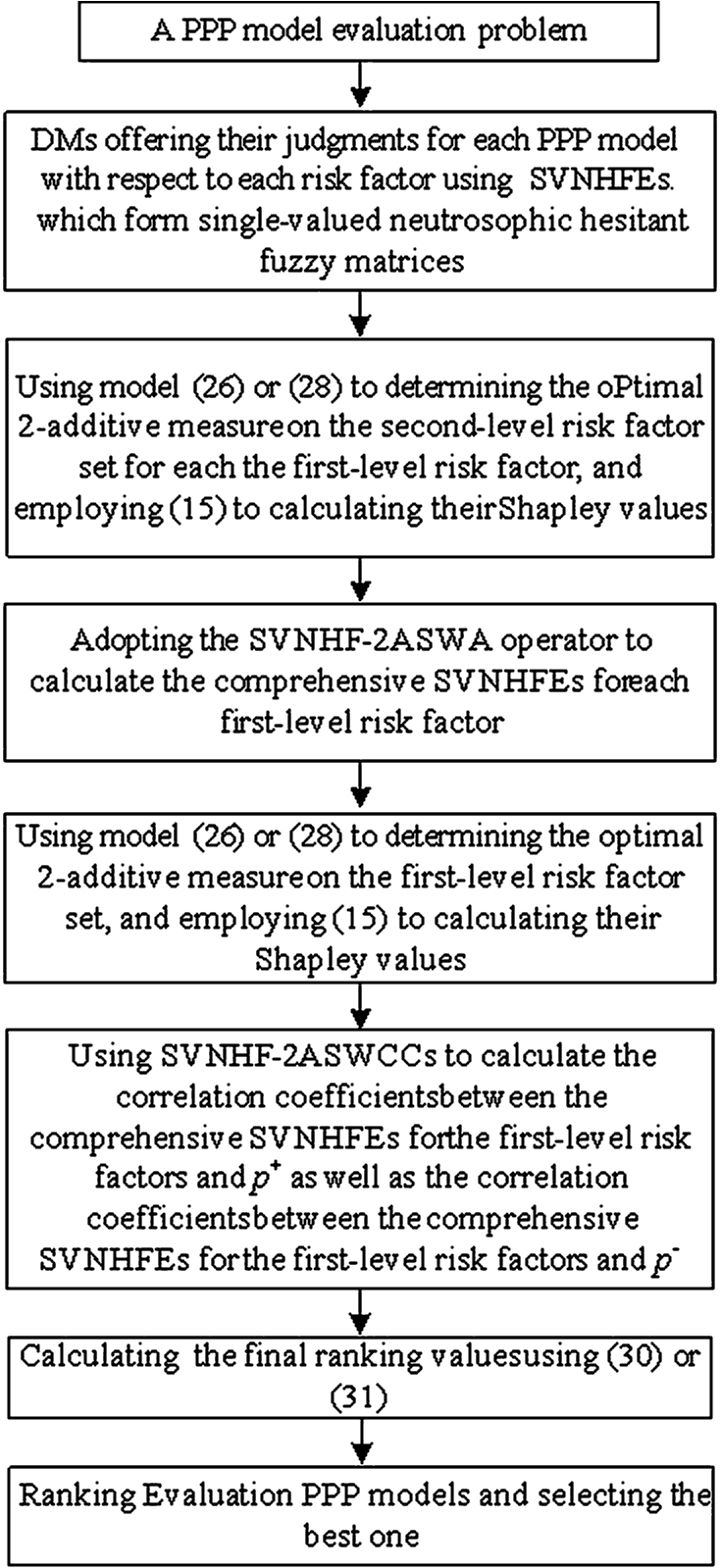
The procedure of the new method.
To show the procedure of the above algorithm clearly, please see Fig. 1.
To show the concrete application of the offered algorithm in Section 5.2, this part offers a practical example for evaluating PPP models for the high-speed rail. To promote the traffic condition, the Chinese government intends to build a high-speed railway, which spans two provinces of China with a total length of more than 600 kilometers and a planned total investment of 2 billion US dollars. Its design speed is 300 kilometers per hour. Due to the complexity of the project, the government needs to select the most suitable PPP model to complete the project according to the risk analysis. First, it needs to form an evaluation team, which includes 15 members composed by governor, mayor, railway minister, manager, sector managers, experts and scholars. To avoid interaction, they are required to provide their preferences anonymously. Because of the difference of their expertise and the complexity of the project, different preferred, indeterminacy and non-preferred judgments may be offered by different persons. To deal with this situation, SVNHFE is a good choice that can denote these three aspects using several values in The single-valued neutrosophic hesitant fuzzy decision matrix The single-valued neutrosophic hesitant fuzzy decision matrix The single-valued neutrosophic hesitant fuzzy decision matrix The single-valued neutrosophic hesitant fuzzy decision matrix The range of known weighting information. To select the most suitable PPP model, the following procedure is needed:
Solving model (32) using LINGO, we obtain Furthermore, the Shapley values are Similarly, the Shapley values of the second-level risk factors for the first-level risk factor
Ranking results based on different methods. In this example, when Şahin and Liu’s method (Şahin and Liu, 2017) is applied, the final ranking values are obtained as follows: Table 10 shows that different rankings are obtained based on different correlation coefficients. However, all of them show that the PPP model This example shows that different rankings may be obtained using different correlation coefficients. This is because their principles are different. The geometric mean based SVNHF-2ASWCC adopts the geometric mean of associated items to calculate correlation coefficient, and the maximum based SVNHF-2ASWCC uses the maximum of associated items to calculate correlation coefficient. Just as the above analysis, we suggest the pessimistic DMs to use maximum based SVNHF-2ASWCC and the optimistic DMs to employ geometric mean based SVNHF-2ASWCC. As for Şahin and Liu’s correlation coefficient, it needs to add extra values into SVNHFEs and calculate correlation coefficient based on the corresponding ordered values. Furthermore, new correlation coefficients employ the 2-additive Shapley values as the weights of risk factors that can reflect the interactions among their importance. Meanwhile Şahin and Liu’s correlation coefficient is based on the assumption that there is no interaction among the weights of risk factors and it uses additive measures. To show the differences between new method and Şahin and Liu’s method in view of their principles intuitively, please see Table 11. The comparison between two calculate correlation based decision making methods. There is an increasing popularity of PPP applications in infrastructure development. When PPP brings good opportunities for efficient public service and management, there are usually many types of risks due to different cultural, political, economic, and environmental problems. To minimize the risk of PPP application, it is imperative to find a suitable and comprehensive decision making method. To do this, this paper first analyses several types of PPP models and constructs a decision making index system by considering the risk factors. Then, SVNHFSs are applied to deal with uncertainties in the evaluation of PPP models. After that, two new correlation coefficients of SVNHFSs based on 2-additive measure and the Shapley function are introduced that can cope with the situation where elements in a set are interactive. Furthermore, a new algorithm is provided to evaluate PPP models. Finally, a case study is selected to demonstrate the feasibility and efficiency of this new algorithm. Compared with other methods, the main drawback of the new method seems to be more complicated when calculating the 2-additive Shapley value. However, with the help of software and the computer technology, this problem can be easily addressed. It is worth noting that we can follow new correlation coefficients for SVNHFSs to similarly study single-valued neutrosophic hesitant fuzzy distance measure and single-valued neutrosophic hesitant fuzzy similarity measure. In the future, we will continue to research the theory of decision making with single-valued neutrosophic hesitant fuzzy information. In terms of application, we only research the application of SVNHFSs in evaluating PPP models for the high-speed rail. Similarly, we can apply the new method in some other fields, such as project management (Mohamed and Mccoan, 2001), real estate investment (Ginevicius and Zubrecovas, 2009), ecological environment management (Huang et al., 2003), information system (Gudas and Lopata, 2016; Ai et al., 2016), and supply chain management (Brandenburg et al., 2014). In some cases, some judgments may be missing due to various reasons. Therefore, we shall explore multi-attribute decision making with incomplete information (Ureña et al., 2015; Capuano et al., 2018). Furthermore, we shall continue to research decision making methods with other types of fuzzy sets such as interval neutrosophic hesitant fuzzy sets (Ye, 2016) and interval neutrosophic linguistic sets (Ye, 2014a).
References