



Abstract
The performance evaluation of public charging service quality is frequently viewed as the multiple attribute group decision-making (MAGDM) issue. In this paper, an extended TOPSIS model is established to provide new means to solve the performance evaluation of public charging service quality. The TOPSIS method integrated with FUCOM method in probabilistic hesitant fuzzy circumstance is applied to rank the optional alternatives and a numerical example for performance evaluation of public charging service quality is used to test the newly proposed method’s practicability in comparison with other methods. The results display that the approach is uncomplicated, valid and simple to compute. The main results of this paper: (1) a novel PHF-TOPSIS method is proposed; (2) the extended TOPSIS method is developed in the probabilistic hesitant fuzzy environment; (3) the FUCOM method is used to obtain the attribute weight; (4) the normalization process of the original data has adapted the latest method to verify the precision; (5) The built models and methods are useful for other selection issues and evaluation issues.
Keywords
Introduction
Many management decision-making problems in the real world, such as logistics park location, supplier selection, medical service evaluation, fault diagnosis, etc., can be considered from the perspective of MADM (Garg et al., 2018; Akram et al., 2021; Waseem et al., 2019; Lu et al., 2021; Wei et al., 2022). As an important branch of management science and modern decision science, MADM theory and methods have been widely used in many practical decision-making problems (Yang and Pang, 2019; Xu and Zhang, 2019; Zavadskas et al., 2013; Ning et al., 2022). In the actual MAGDM process, due to the complexity and uncertainty of objective things, the limitations of human cognition and the ambiguity of thinking, it is difficult to use quantitative and accurate information to describe decision objects (Wang et al., 2022; Zhang H. et al., 2022; Liu et al., 2019; Li et al., 2021). In 1965, Zadeh (1965) was the first to define a novel fuzzy sets (FSs) to cope with information in the fuzzy new domain (Garg and Kumar, 2018; Garg, 2018b; Zhang and Xu, 2015; Su et al., 2022; Jiang et al., 2022; Lei et al., 2022). To extend the FSs, the intuitionistic fuzzy sets (IFSs) (Atanassov, 1989) were also defined. Subsequently, FSs and its related extension knowledges were predominantly exploited in decision analysis domains (Yu et al., 2017; Wan and Li, 2014; Zhang D. et al., 2022; Zhang et al., 2022a). Su et al. (2011) proposed the interactive method for dynamic IF-MAGDM. Arya and Yadav (2018) defined the intuitionistic fuzzy super-efficiency slack-based measure. Tian et al. (2017) studied the partial derivative and complete differential of binary IF-mathematical functions. Garg (2018a) proposed the improved cosine similarity measure for IFSs. Tan (2011) constructed the Choquet integral-based TOPSIS method for IF-MADM. Zhao et al. (2017) defined the Interactive intuitionistic fuzzy algorithms for multilevel programming problems. Li (2011) built the GOWA operator to MADM using IFSs. Buyukozkan et al. (2018) selected the transportation schemes with integrated intuitionistic fuzzy Choquet integral method. Joshi et al. (2018) defined the Jensen-alpha-Norm dissimilarity measure for IFSs. De and Sana (2018) defined the The
Then the hesitant fuzzy element (HFE) proposed by Xia and Xu (2011) is to solve the problem of determining the element’s membership to a set on account of the uncertainty between different numbers and then prove the intuitionistic fuzzy set and hesitant fuzzy set. With the proposition of the HFE, the idea of correspondent operators to aggregate hesitant fuzzy information was obtained. Not long after this, Xu and Xia (2011) raised the idea of the score function, deviation function and the comparison rule, and set the basis on the calculation. Xu and Cai (2010) provided the aggregating operators to integrate the hesitant fuzzy information. Nevertheless, HFE can be regarded as a particular equivalent form whose occurring probabilities of the possible value are equal. The probabilistic hesitant fuzzy set and the corresponding score function, deviation function and its comparison law were proposed by Xu and Zhou (2017). Moreover, the probabilistic hesitant fuzzy weighted averaging geometric operators were introduced by Xu and Zhou (2017) to process PHFE information. Then the improved PHFS was introduced by Zhang et al. (2017) to give more space for hesitation, the integrations of the improved PHES can be calculated by the improved operators. Farhadinia and Xu (2021) gave the comparison techniques of PHFEs. Krishankumar et al. (2021a) built the COPRAS approach to PHFSs. Krishankumar et al. (2021b) proposed to extend a well-known VIKOR method to the PHFS context. Lin et al. (2021) put forward a novel probabilistic hesitant fuzzy MULTIMOORA method. Liu et al. (2021) defined the DEA cross-efficiency with probabilistic hesitant fuzzy preference relations. Yang and Xu (2021) defined the measure of probabilistic hesitant I-fuzzy sets and decision making for strategy choice. Song and Chen (2021) extended the COPRAS method to solve MADM problems under probabilistic hesitant fuzzy environment. Liu and Guan (2021) devised a new PHFE comparison method and then defined the comprehensive characteristic distance measure based on four characteristics.
Technique for order performance by similarity to ideal solution (TOPSIS) was originally developed by Hwang and Yoon (1981) for the sake of addressing a MADM problem. Lai et al. (1994) expanded TOPSIS to deal with a diverse objective decision making problem for Bow River Valley water quality management. Chen (2000) proposed the TOPSIS approach for group decision-making within the fuzzy environment. Wang and Elhag (2006) employed the fuzzy TOPSIS approach on the basis of alpha level sets for bridge risk assessment. Taleizadeh et al. (2009) designed a novel method which combined Pareto, TOPSIS and genetic algorithm to solve the multi-product multi-constraint inventory control systems with random fuzzy replenishments. Zhang et al. (2022b) defined the TOPSIS method for spherical fuzzy MAGDM based on cumulative prospect theory. Wei (2010) developed the TOPSIS method to cope with 2-tuple linguistic MAGDM with incomplete weight information. Nilashi et al. (2019) used two MADM techniques, Decision Making Trial and Evaluation Laboratory (DEMATEL) and Fuzzy TOPSIS, to reveal the interrelationships among the factors and to find the relative importance of these factors in the decision making model. In this paper, we extend the TOPSIS method to probabilistic hesitant fuzzy (PHF) environment based on the FUCOM method to deal with the flexible and complicated decision-making circumstance. The following is the innovation of this paper: (1) a novel PHF-TOPSIS method is proposed; (2) the extended TOPSIS method is developed in the probabilistic hesitant fuzzy environment; (3) the FUCOM method is used to obtain the attribute weight; (4) the normalization process of the original data has adapted the latest method to verify the precision.
The whole thread of the article is as follows: Section 2 gives a simple introduction of the PHF information, Section 3 structures the model of TOPSIS and Section 4 illustrates an example for performance evaluation of public charging service quality to prove the practicability of this new method. Section 5 gives a sensitivity analysis and comparison analysis with other existing models.
Preliminaries
(Xu and Zhou, 2017).
Assume q is a fixed set, and probabilistic hesitant fuzzy sets on E, which range from 0 to 1, and the probabilistic hesitant fuzzy element (PHFE) is described as follows:
The first and significant step is the normalization process and we adapt the normalization approach proposed by Li et al. (2020) to break the limitation when processing multiplication of the sets which include different probabilities. Let
Calculate the score function = by Eq. (2): Compare
The Let The laws of PHF weighted geometric (PHFWG) operator are shown as follows: (Xu and Zhou, 2017).
The MAGDM decision matrix is
With the above conventions, the operation of the PHF-TOPSIS is as follows: the whole operation flow chart is shown in Fig. 1.

Framework of the proposed PHF-TOPSIS.
The full consistency (FUCOM) method proposed by Pamučar et al. (2018) is the latest model for weighting the coefficients of attributes. Compared to other methods, such as the best worst method (BWM) and the analytic hierarchy process (AHP) method, the FUCOM method can give more appropriate results when considering the relation between the criterions and the number of comparisons (only
The specific process to get the weight is as follows:
(i) Rank the criterions and get the set from
(ii) The comparison priorities between the adjacent attributes
(iii) Get the final weight coefficients of the attributes
The comparison priorities
The second condition is about the weight coefficients which should satisfy the following rule by using Eq. (10):
Thus, the inequality constraints for this model are shown in Eq. (11):
With the help of the MATLAB software, we get the final result of the weighting vector of the evaluation criterions for each DM. Then the integrated weight
The relative closeness of alternative
The final rank is determined by the value of relative closeness, and the sort rule is: the bigger the relative closeness is, the more appropriate the scheme is.
Public service is provided by the public sector to the public at a professional level according to its own social responsibility. In my country, public service is provided to the external public by government departments and institutions with public management functions according to the law. If there are public services, the problem of public service charges will inevitably arise. The public service charges mentioned here do not include taxes, but include administrative management fees, which mainly refer to the specific fees charged by the departments and institutions that provide public services to the public in need of services, so that they can enjoy the right to and benefits of public services. The logic of public service charging is roughly as follows: first, to provide public services, costs will inevitably occur, and fees can compensate for the cost input of public services; second, public services are public goods, and public goods are noncompetitive and non-exclusive, and their external effect is obvious, and it is easy to generate “free-rider” behaviour. Charging fees can curb waste in public service consumption and improve the quality and efficiency of public services. Social investment can increase funding sources for public services. However, since currently in our country public services are mainly provided by government departments, and the government is also responsible for the examination and approval of charging items and charging standards for public services, as well as supervising and inspecting charging behaviours, public services are basically monopoly industries. With low efficiency and poor quality, people feel that public service charges and public service utility are asymmetrical, so there are many criticisms about public service charges. The performance evaluation of public charging service quality is frequently viewed as the multiple attribute group decision-making (MAGDM) issue. In this paper, an extended TOPSIS model is established to provide new means to solve the performance evaluation of public charging service quality. The TOPSIS method integrated with FUCOM method in probabilistic hesitant fuzzy circumstance is applied to rank the optional alternatives and a numerical example for performance evaluation of public charging service quality is used to test the newly proposed method’s practicability in comparison with other methods. Therefore, to illustrate the method presented in this paper, we will give a numeric-based example for performance evaluation of public charging service quality using the PHFSs in this part. Five applicable new public charging service sections
Decision matrix
given by the first DM.
Decision matrix
Decision matrix
Decision matrix
Then, the PHF-TOPSIS method is used to deal with the performance evaluation of public charging service quality with PHFNs.
The standardized decision matrix by the first DM.
The standardized decision matrix by the second DM.
The standardized decision matrix by the third DM.
Calculate the criterion weight for DM 1.
(i) The DM 1 gives the ranking of significance of different attributes:
(ii) Table 7 shows the priorities of each attribute which is range from 1 to 4, based on the comparison in the former step. According to the data in Table 7, we get the comparative priorities as follows.
The priorities of criteria of DM 1.
(iii) A finite model for criterion weight coefficient meeting the condition which is introduced in the above:
Calculate the criterion weight for DM 2 (see Table 8).
The priorities of criteria of DM 2.
(i) The DM 1 gives the ranking of significance of different attributes
(ii) According to the data in Table 8, we get the comparative priorities as follows:
Calculate the criterion weight for DM 3 (see Table 9).
The priorities of criteria of DM 3.
(i) The DM 1 gives the ranking of significance of different attributes
(ii) According to data in Table 9, we get the comparative priorities as follows:
The final criterion weight is obtained by the integration weight combined with experts’ decision weight, and the result is
The integrated decision matrix.
The score of the integrated decision matrix.
The positive index
The positive index
The positive and negative distance.
Then the result is
In this section, TODIM (PHF-TODIM) method (Zhang et al., 2018), PHFWA operator (Xu and Zhou, 2017), PHFWG operator (Xu and Zhou, 2017) are utilized to compare with the PHF-FUCOM-TOPSIS method to test its feasibility and practicability. In order to compare the results more intuitively, we represent the result as a line chart in Fig. 2 and Table 15 where the original result is processed by the same manner in range 0 to 1.
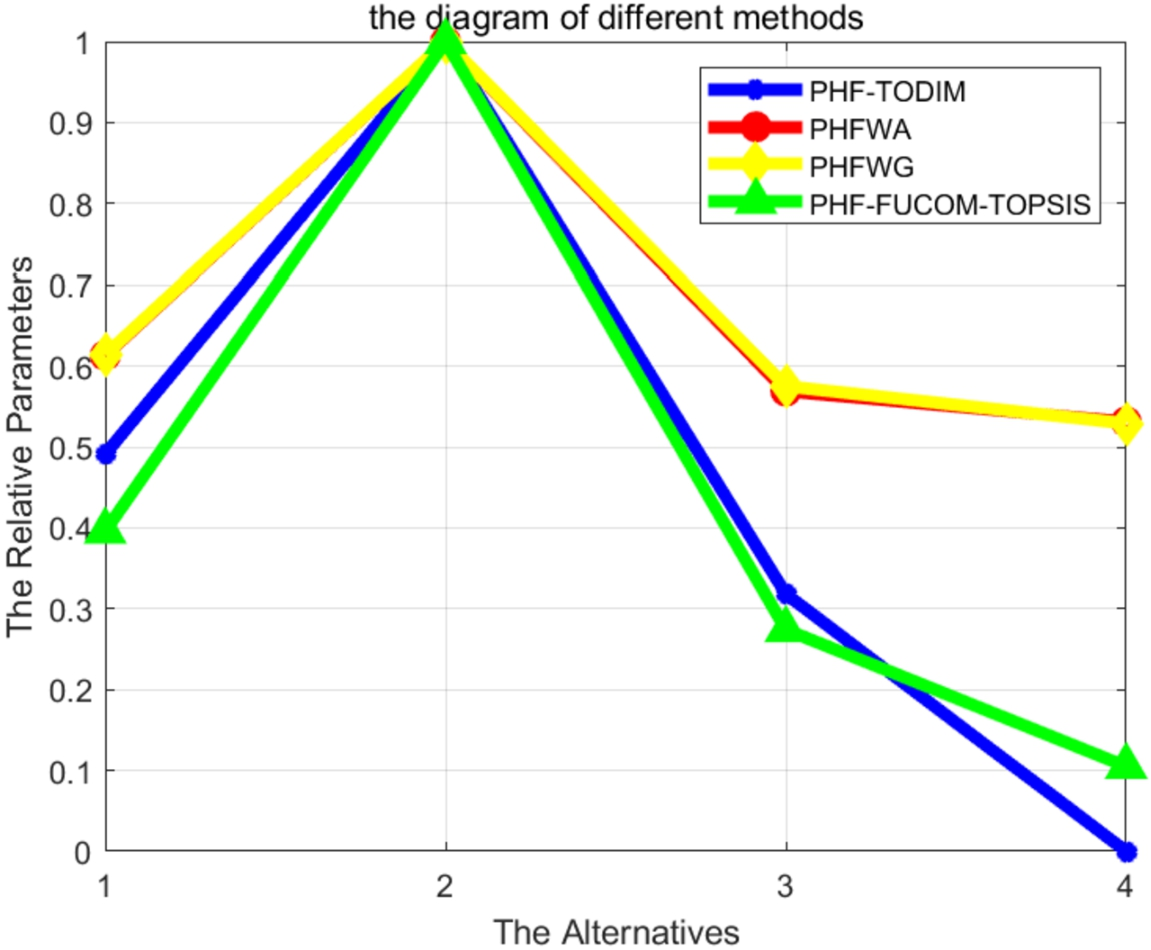
The comparison of different methods.
From the above detailed analysis, it could be seen that these four given models have the same optimal choice
The sequence from different methods.
In this study, we propose a new PHF-FUCOM-TOPSIS model for performance evaluation of public charging service quality and apply it in the probabilistic hesitant fuzzy environment. A novel extended TOPSIS model integrated with FUCOM method was proposed to evaluate green selection supplier. Finally, we apply this method in a numerical study for performance evaluation of public charging service quality and compare the results with other methods to test its validity. The specific contributions of it are as follows:
It integrates classical TOPSIS method and FUCOM method in the probabilistic hesitant fuzzy environment including more information to make the decision-making process more reasonable.
It extends the FUCOM method to calculate criterion weight in the probabilistic hesitant fuzzy environment.
In the future, we firmly believe that PHF-FUCOM-TOPSIS method will be applied in a larger number of fields. Meanwhile, we should consider the attributes of the actual situation when solving the performance evaluation of public charging service quality and apply this new model in more fields.