




Abstract
Caiman crocodilus, commonly called the spectacled caiman, is a very widely distributed resident of the western-hemisphere wetlands. Caiman bites to humans can cause trauma and infection. There are few reports of caiman bites; however, there is information about bites by other members of the same family, including Alligator mississippiensis. A case of acute caiman bite to the hand is described, including initial treatment and outcome. The bite resulted in multiple lacerations, interarticular fracture, and infection. One of the lacerations was closed, and the patient was started on moxifloxacin hydrochloride. Preventive care and treatment including wound care and antibiotics are discussed. The patient recovered with only a slight long-term functional deficit.
Introduction
Caiman crocodilus (Figure 1), commonly called the spectacled caiman, belongs to the family Crocodylidae and subfamily Alligatoridae. All caimans are quite violent during initial capture and are unpredictable when aggravated.1,2 Caiman bites to humans pose several clinical problems. 3 –10 The force of the bite itself produces crush injuries, fractures, and soft tissue injury. Bite force is proportional to animal size and complicated by head thrashing. 10 The teeth often leave multiple puncture wounds, and the animals tend to thrash once they have bitten down, leading to skin tears and further injury. The location of caiman habitat and attacks could lead to drowning. Delayed sequelae could include infection, tetanus, and retained foreign body.

Small spectacled caiman. Photograph by Gary Staab
Case report
The patient, a 37-year-old man, traveled to Brazil during January with a group of researchers doing collections and specimen study for an upcoming museum exhibit. They spent a part of their time on the Rio Negro section of the Amazon Basin, approximately 150 km south of the equator. The patient was involved in catch-and-release studies of caimans, concerned mostly with size data. While being captured in a wire snare, a 180-cm spectacled caiman bit down on the patient's left hand. The caiman, once closing its mouth, proceeded to shake and bite down a second time with more thrashing, followed by a voluntary release of the patient's hand. Control of the caiman was then gained. Scientific measurements were performed and the caiman was released. Immediate medical attention was available from an on-site physician. The patient had received a crush injury to the hand, as well as 12 puncture or tearing skin wounds to the fingers. All the wounds were smaller than 1 cm in length with the exception of a longer tear to the lateral portion of the forth digit. Clinically, the patient was neurovascularly intact but had a significant amount of pain. Tendon function was normal. Several punctures were at joint lines. Because of pain, evaluation for bony injuries was difficult; however, no obvious bone or ligament injury was seen. No radiographs could be performed secondary to the remote location of the group.
The patient was taken to base camp, which was a riverboat, for further treatment. Persistent bleeding continued from the fourth digit injury. A wedding band was present on this finger. Ring removal was difficult because of fairly immediate swelling and pain. A digital block was performed and the ring was removed. The large wound was explored and irrigated with 2 L of sterile water and then loosely approximated with 4-0 Prolene with simple interrupted sutures. Loose approximation was deemed necessary because of the large size of the wound. Bleeding then stopped. All other wounds were irrigated and explored. No foreign bodies were found.
The patient was started on moxifloxacin hydrochloride 400 mg orally per day. Bacitracin Zinc-Neosporin sulfate-Polymyxin B sulfate topical antibiotic ointment was applied in addition to bandages. Oral acetaminophen and oxycodone were also dispensed for pain control. The patient's tetanus immunization was up-to-date. Initially, no immobilization was used because of patient preference secondary to work activities. The patient was given instructions regarding limiting use, wound care, and daily re-exams with a group physician. Within 12 hours, the patient was experiencing increasing pain and edema. On exam, he had considerable edema and erythema to all the digits of the left hand. Range of motion was greatly limited because of pain and swelling. Most notable was the proximal interphalangeal joint of the third finger. No abnormal drainage was seen from any of the wounds. The patient's hand and wrist were immobilized in a short arm volar splint. During the following days he had persistent pain, edema, and erythema, which gradually decreased (Figure 2). He did not develop any fever, drainage, or lymph node swelling. On day 5, he reached an airport and began travel home. After arrival to the United States, he saw a hand surgeon on day 8.
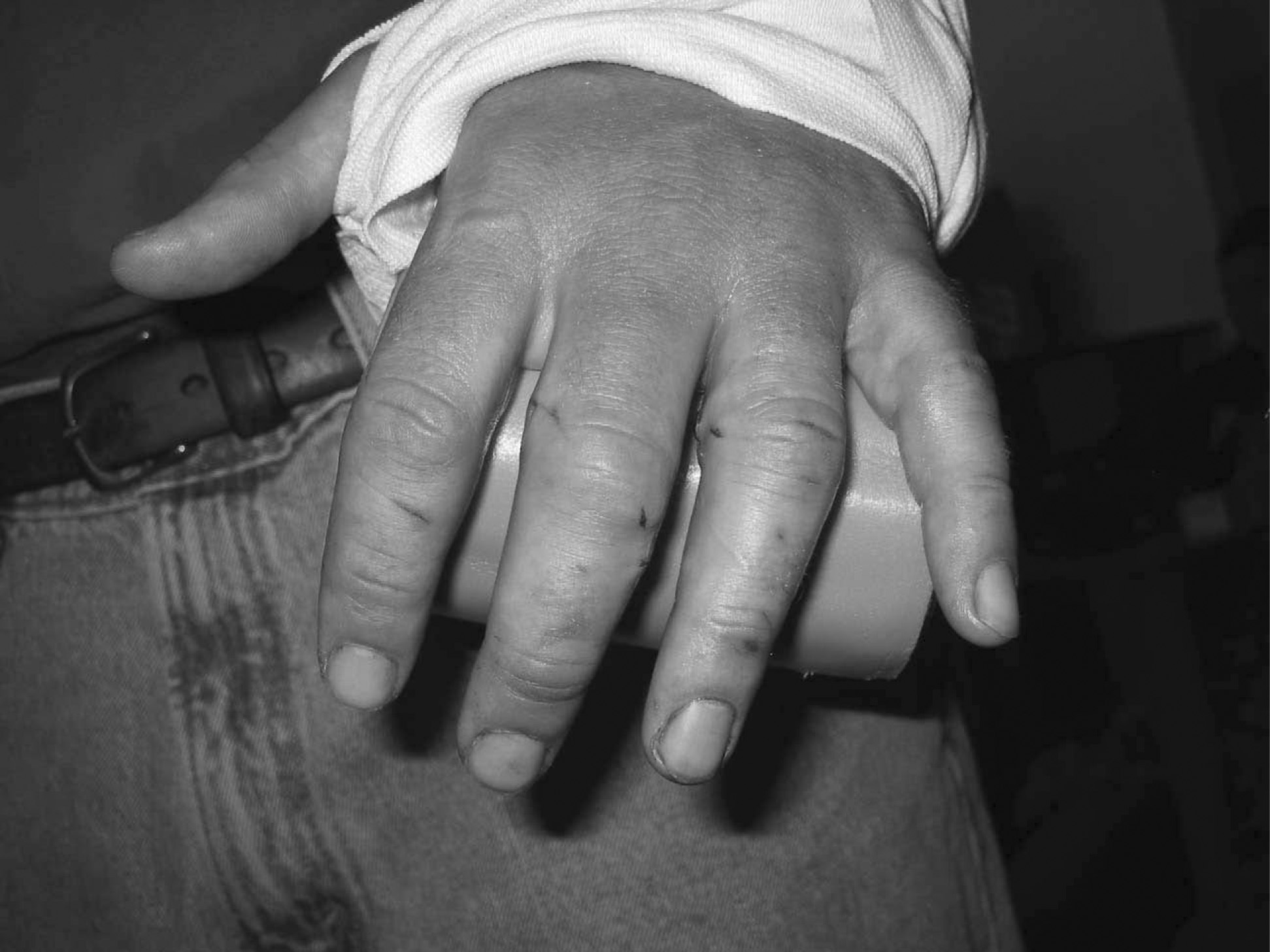
Caiman bite, day 6. Photograph by George Hertner
The patient was found to have an intra-articular fracture of the distal portion of the proximal phalanx of the third digit. No fracture was seen at the site of the large, partially closed laceration of the fourth digit. His pain and swelling had decreased, and he completed a 14-day course of the moxifloxacin hydrochloride. At 5 months postinjury, he has continuing problems with the use of this digit and is considering surgical repair secondary to decreased range of motion of the third digit of his left hand.
Discussion
Caimans are found throughout lowland, wetland, and river habitats of Central America and South America. C crocodilus has the widest distribution of any of the Alligatoridae. The endangered black caiman (Melanosuchus niger) and several subspecies of caimans share the same habitat. As adults, male C crocodilus are relatively small to medium sized, ranging from 2 to 3 m in length; adult females are slightly smaller. Adult caimans range from 1.5 m in the dwarf caiman (Paleosuchus palpebrosus) to 6 m in the black caiman. The common name (spectacled caiman) refers to a bony ridge between the front eyes that gives the appearance of spectacles. Dentition includes a range of 68 to 86 teeth. Teeth are often lost during feeding and are replaced. Caimans are aggressive hunters but tend to avoid human contact. Their carnivorous diet ranges from fish and invertebrates to large mammals and reptiles. Females are sexually mature at 1.2 m and between 4 and 7 years. They lay 14 to 40 eggs during the wet season of May to August and aggressively protect their nests from anything that approaches until hatching at near 90 days. Very little literature regarding caiman bites or attacks is available, especially from Central America and South America. More information is available about Alligator mississippiensis from studies in the southern United States. 3 –5,8 Information is also available about crocodiles from Australian and African studies.6,8 Two studies that specifically discuss black caimans concentrate on the description of the attack and are limited in any clinical information.11,12
Prompt and aggressive wound care is important for all bite wounds. Initial treatment should include providing a safe environment for the patient and care providers. Local wound care and immobilization at the scene should be followed by medical care. Care should include recognition of all injuries and appreciation for possible unseen problems. Exploration and radiographs for foreign bodies are paramount. Treatment should include tetanus prophylaxis and thorough wound irrigation and debridement. For most wounds, healing gradually by secondary intention or delayed primary closure will decrease incidence of infection. Some studies suggest wound culture,4,7 though this may apply more to obviously infected wounds. Little is published on the bacterial content of caiman bites; however, there is information about bites and oral flora of A mississippiensis: bacteria are predominately gram negative, and organisms include Aeromonas hydrophila, Proteus vulgaris, Pseudomonas, and Clostridium. 3 –6,8 If the flora is similar for caimans, it would be logical to treat with broad-spectrum antibiotics with good gram-negative coverage such as quinolones, third-generation cephalosporins, or antipseudomonal penicillins.
Conclusions
This case demonstrates the need for proper care of a patient after sustaining a caiman bite. A high level of suspicion for deep injuries and infection should be maintained. Certainly, caiman bites and attacks may be very similar to those of alligators and crocodiles, but little literature is available for the former. Additional studies would be required to determine if the oral flora, bite severity, incidence of infection, and frequency of attacks are different for caimans from other members of the family Crocodylidae. Educational points for potential victims would include avoiding nests especially during the wet season, avoiding handling or cornering caimans without proper experience and equipment, and seeking immediate medical attention for all bites. Most crocodilians, if given the chance, would choose to avoid humans. However, because of increasing human populations and an ever-widening ecological footprint, humans do not always give them that chance. In certain areas some types of crocodiles and alligators are considered nuisance animals and have to be destroyed or removed.