




Abstract
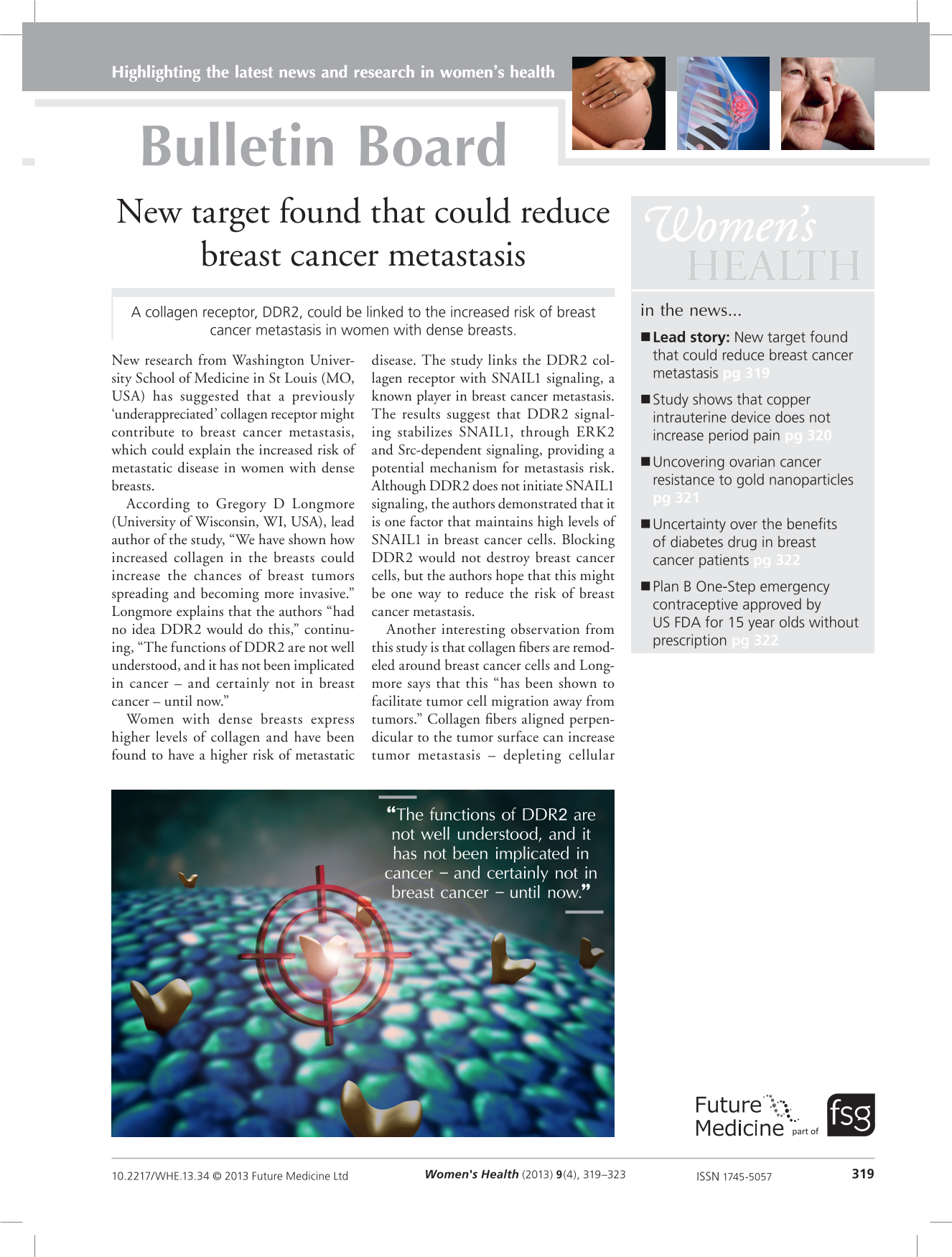
A collagen receptor, DDR2, could be linked to the increased risk of breast cancer metastasis in women with dense breasts.
New research from Washington University School of Medicine in St Louis (MO, USA) has suggested that a previously ‘underappreciated’ collagen receptor might contribute to breast cancer metastasis, which could explain the increased risk of metastatic disease in women with dense breasts.
According to Gregory D Longmore (University of Wisconsin, WI, USA), lead author of the study, “We have shown how increased collagen in the breasts could increase the chances of breast tumors spreading and becoming more invasive.” Longmore explains that the authors “had no idea DDR2 would do this,” continuing, “The functions of DDR2 are not well understood, and it has not been implicated in cancer – and certainly not in breast cancer – until now.”
Women with dense breasts express higher levels of collagen and have been found to have a higher risk of metastatic disease. The study links the DDR2 collagen receptor with SNAIL1 signaling, a known player in breast cancer metastasis. The results suggest that DDR2 signaling stabilizes SNAIL1, through ERK2 and Src-dependent signaling, providing a potential mechanism for metastasis risk. Although DDR2 does not initiate SNAIL1 signaling, the authors demonstrated that it is one factor that maintains high levels of SNAIL1 in breast cancer cells. Blocking DDR2 would not destroy breast cancer cells, but the authors hope that this might be one way to reduce the risk of breast cancer metastasis.
Another interesting observation from this study is that collagen fibers are remodeled around breast cancer cells and Longmore says that this “has been shown to facilitate tumor cell migration away from tumors.” Collagen fibers aligned perpendicular to the tumor surface can increase tumor metastasis – depleting cellular levels of DDR2 or SNAIL1 lead to a more parallel arrangement of collagen fibers.
“The functions of DDR2 are not well understood, and it has not been implicated in cancer – and certainly not in breast cancer – until now.”

“This whole notion of fiber alignment and the tumor interface is a hot topic right now,” Longmore continues. “Our coauthors at the University of Wisconsin have developed a scoring method for collagen alignment that correlates with prognosis. And the bad prognosis disappears when you take away DDR2.”
One important aspect of this work is that it is not directly linked to a gene mutation. The genes and proteins in this pathway, including both DDR2 and SNAIL1 are normal in 95% of the population, although DDR2 is only shown in 70% of invasive ductal breast cancers.
Longmore admits that this is not a normal cellular pathway, but emphasizes that not all targets for cancer drugs have to be related to mutations. “You have to be careful not to just focus on mutations in cancer. This is an example of normal genes put together in an aberrant situation.” Longmore continues to explain that “the change in the environment – the tumor and its surroundings – causes the abnormal expression of these proteins. It is abnormal, but it is not caused by a gene mutation.”
“This whole notion of fiber alignment and the tumor interface is a hot topic right now …”
Longmore is careful to specify that the results do not relate to risk of developing breast cancer, saying that “this work does not explain why women with dense breasts have an increased risk of developing breast cancer.” However, Longmore explains that “once they do, the pathway that we describe is relevant in causing their cancers to be more aggressive and more likely to spread.”
Longmore admits that, “Currently there are no DDR2 specific inhibitors,” but says that “there is great interest and work being done here and elsewhere to develop them.” The protein should also be a relatively easy target; as Longmore explains, “It is on the surface of the cells, which makes it very nice for developing drugs because it is so much easier to target the outside of cells.”
According to Longmore, the researchers are now looking for suitable drugs: “We are trying to develop drugs that block the interaction between DDR2 receptors and collagen fibers.” An alternative strategy would be to use “drugs already in the clinic that inhibit the enzyme activity of receptor tyrosine kinases, and that can inhibit the kinase (enzyme) activity of DDR2,” continuing to say that these “may be effective in the prevention of breast cancer metastasis.”
– Written by Alisa Crisp
Sources: Zhang K, Corsa CA, Ponik SM et al. The collagen receptor discoidin domain receptor 2 stabilizes SNAIL1 to facilitate breast cancer metastasis. Nat. Cell Biol. doi:10.1038/ncb2743 (2013) (Epub ahead of print); Washington University in St Louis press release: www.newswise.com/articles/discovery-helps-show-how-breast-cancer-spreads
Study shows that copper intrauterine device does not increase period pain
Researchers at Gothenburg University (Sweden) have recently reported in the journal Human Reproduction that a copper intrauterine device (Cu-IUD) does not affect the severity of dysmenorrhea (period pain) and a levonorgestrel-releasing intrauterine system (LNG-IUS) can actually reduce dysmenorrhea severity.
Many women are affected by dysmenorrhea and previous studies have reported that using a Cu-IUD can result in worse dysmenorrhea. In this longitudinal population study, the researchers compared the severity of dysmenorrhea in a 2102 women (random samples of 19-year-old women born in 1962, 1972 and 1982; n = 656, 780 and 666, respectively) over 30 years when they used either intrauterine contraception (LNG-IUS or Cu-IUD) or a combined pill. The researchers found that when the women used a Cu-IUD, their dysmenorrhea severity was no different to when they used other methods (e.g., condoms). However, when women used a LNG-IUS or a combined pill, it was found that their dysmenorrhea severity was reduced when compared with other methods (e.g. condoms).
Author Ingela Lindh from the Sahlgrenska Academy at Gothenburg University explained the significance of the study: “Research into period pain is sorely needed. Lowering the number of women who suffer from period pain will bring down absence from work and school and reduce the consumption of painkillers.”
The researchers concluded that this information could be of use to clinicians and users when deciding on an IUD. However, further research is needed into the effect of intrauterine contraception on the risk of developing abdominal pain between periods.
– Written by Natasha Leeson
Sources: Lindh I, Milsom I. The influence of intrauterine contraception on the prevalence and severity of dysmenorrhea: a longitudinal population study. Hum. Reprod. 28 (7), 1953–1960 (2013); University of Gothenburg press release: www.sahlgrenska.gu.se/english/news_and_events/news/News_Detail/?contentId=1168374
“… when women used a levonorgestrel-releasing intrauterine system or a combined pill, it was found that their dysmenorrhea severity was reduced.”
Uncovering ovarian cancer resistance to gold nanoparticles
An underlying cause of ovarian cancer cell resistance to positively charged gold nanoparticles has been uncovered by researchers at the Mayo Clinic (MN, USA). Published ahead of print in the Journal of Biological Chemistry, the study implicated a regulatory protein in mitochondria, MICU1, and is another step forward in developing nanoparticles for use in oncology. From imaging and supporting diagnosis to therapeutic delivery, gold nanoparticles have a variety of roles in the current and future directions of oncology. However, its future significant is dependant on researchers successfully defining and understanding nanoparticle-target cell interactions.
In this study, the positively charged gold nanoparticles were designed to cause an increase in cellular calcium levels; thereby, acting as a targeted destructor of ovarian cancer cells without harming healthy cells. However, the ovarian cancer cells demonstrate resistance to this. Resistance was identified as being due to MICU1 preventing cell death by buffering the increase in cellular calcium levels. Calcium is instead delivered to the mitochondria.
“This study identifies a novel mechanism that protects ovarian cancer cells by preventing the cell death or apoptosis that should occur when they encounter positively charged nanoparticles,” explained Priyabrata Mukherjee, senior author on the study (Mayo Clinic).
The researchers found that, by limiting the amount of calcium that the mitochondria can uptake, the positively charged gold nanoparticles are more effective in killing ovarian cancer cells. They believe that a greater understanding of mitochondrial transport mechanisms is crucial in the future design of targeted nanoparticles in cancer.
– Written by Natasha Galukande
Sources: Arvizo RR, Moyano DF, Saha S et al. Probing novel roles of the mitochondrial uniporter in ovarian cancer cells using nanoparticles. J. Biol. Chem. doi:10.1074/jbc.M112.435206 (2013) (Epub ahead of print); Mayo Clinic press release. How gold nanoparticles can help fight ovarian cancer: www.mayoclinic.org/news2013-rst/7474.html
“This study identifies a novel mechanism that protects ovarian cancer cells by preventing the cell death or apoptosis that should occur when they encounter positively charged nanoparticles …”

Uncertainty over the benefits of diabetes drug in breast cancer patients
Metformin, a popular drug for diabetes treatment, might not affect survival in breast cancer patients, according to new results.
A new population-based study, published in Diabetes Care, has not shown a difference in survival from metformin use – a result contrary to some evidence that suggests the drug improves survival in breast cancer patients.
“Although existing scientific literature suggests that [metformin] may prevent new cancers and death from breast cancer, our study found the drug did not significantly impact survival rates in our patients.”
Iliana Lega, first author of the study, explains that “Metformin is a drug commonly used by diabetic patients to control the amount of glucose in their blood.” She continues to explain the importance of these findings, saying “Although existing scientific literature suggests that [metformin] may prevent new cancers and death from breast cancer, our study found the drug did not significantly impact survival rates in our patients.”
Metformin, used to lower blood sugar levels in Type 2 diabetes patients, works by altering glucose production by the liver. According to other studies, metformin has previously been suggested to confer a reduction in cancer risk of up to 30%, as well as slowing tumor growth in breast cancer patients.
The study involved 2361 diabetic women over the age of 66, all diagnosed with breast cancer. The authors analyzed the associations between duration of metformin use and mortality in the population, broken down into all-cause mortality and breast cancer-specific mortality. Of 1101 deaths during the study period, 16.3% were breast cancer-specific, but there was no statistically significant association between cumulative metformin use and either all-cause or breast cancer-specific mortality in the study population.
This population-based study differs from others in that it assessed the cumulative dose of metformin over time. Lega explained this further, saying, “What makes our study so unique is that while the effects of metformin have been well documented, previous research has not examined the cumulative effects of the drug on patients, particularly breast cancer patients with diabetes.” Lega continued to say that “This is important given that diabetic patients may switch drugs over the course of their treatment.”
There are limitations to this study, as data on the stage of breast cancer and BMI were not included, and there were relatively short follow-up times (median follow-up time was 4.5 ± 3.0 years). However, in general, these results suggest that more research is needed to clarify the role of metformin in cancer.
According to Lega, “Understanding the effects of metformin on breast cancer patients is critical in helping address the gap in cancer outcomes in patients with and without diabetes.” Lega hopes that “The findings will help physicians inform treatment plans for patients with diabetes.”
– Written by Alisa Crisp
Sources: Lega IC, Austin PC, Gruneir A, Goodwin PJ, Rochon PA, Lipscombe LL. Association between metformin therapy and mortality after breast cancer: a population-based study. Diabetes Care doi:10.2337/dc12–2535 (2013) (Epub ahead of print); Women's College Hospital press release: www.womenscollegehospital.ca/assets/pdf/Lega_metformin_May%202013.pdf
Plan B One-Step emergency contraceptive approved by US FDA for 15 year olds without prescription
In December 2011, the US FDA declined the application by Teva Women's Health, Inc. (PA, USA) to make their Plan B One-Step (active ingredient levonorgestrel) emergency contraceptive available over-the-counter for all females of a reproductive age. However, as of the end of April 2013, the FDA approved an amended application submitted by Teva, to make Plan B One-Step emergency contraceptive available to women 15 years of age and older without prescription.
Plan B One-Step is an emergency contraceptive that is intended to reduce the possibility of pregnancy following sexual intercourse when another form of birth control (e.g., condom) failed or was not used. Plan B One-Step is most effective if taken immediately or within 3 days after unprotected sexual intercourse. It is taken as a single-dose pill (1.5-mg tablet); however, it will not stop a pregnancy if a woman is already pregnant.
FDA approval comes following a study and label comprehension data submitted by Teva that demonstrated that women age 15 years and older understood that the product was not for routine use. Margaret Hamburg, FDA commissioner, explained: “Research has shown that access to emergency contraceptive products has the potential to further decrease the rate of unintended pregnancies in the USA. The data reviewed by the agency demonstrated that women 15 years of age and older were able to understand how Plan B One-Step works, how to use it properly and that it does not prevent the transmission of a sexually transmitted disease.”
Plan B One-Step will be available in retail outlets with an on-site pharmacy, normally in the family planning or female health aisles, during the normal opening hours of the retailer, even if the pharmacy is not open. However, its packaging will prompt the cashier to verify the customer's age. If age cannot be confirmed, the customer will not be allowed to purchase the product.
– Written by Natasha Leeson
Source: US FDA press release: www.fda.gov/NewsEvents/Newsroom/PressAnnouncements/ucm350230.htm
“Research has shown that access to emergency contraceptive products has the potential to further decrease the rate of unintended pregnancies in the USA.”
About the Bulletin Board
The Bulletin Board highlights some of the most important events and research in the field of women's health. If you have newsworthy information, please contact:
Charlotte Barker, Commissioning Editor, Women's Health, Future Medicine Ltd, Unitec House, London, N3 1QB, UK,