




Abstract
Functional dyspepsia is relatively common yet poorly understood. The best accepted diagnostic criteria are the Rome III criteria. The epidemiology, healthcare seeking rates, impact and pathophysiology are reviewed with a focus on women. Treatment is limited with no clearly established regimen currently recommended. Duodenal eosinophilia may be found in a subset. Proton pump inhibitors and prokinetic agents represent the standard therapeutic regimen after Helicobacter pylori infection has been eliminated. Some novel agents such as the prokinetic acotiamide appear promising; however, the need for a safe and efficacious treatment remains largely unmet. This review also describes the currently available management options for functional dyspepsia.
Dyspepsia refers to a heterogenous group of upper gastrointestinal complaints but the major symptoms include epigastric pain or burning, fullness after meals, or the inability to finish a normal meal; other symptoms may include bloating, nausea, vomiting or anorexia and heartburn commonly coexists [1]. Given the broad range of symptoms patients with dyspepsia can report, there are a number of pathological or structural diseases which can be implicated as a cause of these symptoms, including gastroesophageal reflux disease, peptic ulcer disease, Helicobacter pylori infection and possibly coeliac disease [1]. As symptoms cannot discriminate, structural disease needs exclusion by appropriate testing including endoscopy [1]. Notably many patients will have no discernible structural cause for their dyspeptic symptoms, and this group falls within the consensus case definition for functional dyspepsia (FD) as outlined by the Rome III criteria for functional gastrointestinal disorders (FGIDs) [1].
Chronic unexplained epigastric pain or burning, or postprandial fullness or early satiety, labeled as FD, is a common disorder which adversely impacts the quality of life of sufferers [2]. Dyspeptic symptoms affect at least one in five people in the community with women and men affected similarly; over half of those who consult fulfill diagnostic criteria for FD [3]. Although not life threatening, FD affects the quality of life of patients to an extent similar to that of mild heart failure and menopause [2]. The economic impact of FD in western countries is also very significant. The Leeds HELP study found that the cost of investigating and treating dyspepsia was approximately GB£1 billion per year in the UK [2]. Treatment of FD is frustrating and unsatisfactory for both patients and clinicians [1].
There is a need to highlight the role of women when reviewing the literature on FD as it has been shown in several studies that females are more likely to report symptoms of FD and meet diagnostic criteria for FD [3]. Women are also more likely to continue to report FD symptoms over time [4]. Women with FD also experience greater distress from this condition compared with males and have higher associations with psychosocial factors including abuse [5,6]. While the majority of treatment studies do contain more females with FD than males, no studies have directly examined whether current treatments for FD are more effective in females versus males with the condition.
Diagnosis of functional dyspepsia
The Rome III consensus document provides a diagnostic framework for FD (Box 1) [1]. To make a diagnosis of FD, accepted organic causes of dyspeptic symptoms must be first excluded, and this is usually by means of the gold standard test to rule out disease, esophagogastroduodenoscopy (OGD). Ultrasound unless there is a strong clinical suspicion of underlying biliary or liver disease adds little diagnostic value, increases cost and may detect incidental findings that increase patient anxiety and lead to further tests of no value.
Rome III criteria for functional dyspepsia and subgroups.

Must include:
One or more of the following:
Bothersome postprandial fullness
Early satiation
Epigastric pain
Epigastric burning
And
No evidence of structural disease (including at upper endoscopy) that is likely to explain the symptoms
Criteria fulfilled for the last 6 months
Must include one or both of the following:
Bothersome postprandial fullness, occurring after ordinary-sized meals, at least several times per week
Early satiation that prevents finishing a regular meal, at least several times per week
Criteria fulfilled for the last 3 months with symptom onset at least 6 months prior to diagnosis
Must include all of the following:
Pain or burning localized to the epigastrium of at least moderate severity, at least once per week
The pain is intermittent
Not generalized or localized to other abdominal or chest regions
Not relieved by defecation or passage of flatus
Not fulfilling criteria for gallbladder and sphincter of Oddi disorders
Criteria fulfilled for the last 3 months with symptom onset at least 6 months prior to diagnosis
Reproduced with permission from [1].
Within the Rome III FD criteria, two subgroups are included. Postprandial distress syndrome (PDS) is characterized by postprandial fullness or early satiation [1]. Epigastric pain syndrome (EPS) is characterized by epigastric pain or burning [1]. However, a recent study [7] found that almost a third of patients with FD did not qualify simply for one of the two subgroups of FD. Recent evidence [8–10] also suggests that there are distinct pathological subsets of FD including post infectious FD where in a subset of people, FD develops after exposure to an acute enteric infection [8–10]. Duodenal pathology has recently been discovered in FD with duodenal eosinophilia identified in up to 40% of cases, in particular those with early satiety [11–13] (Table 1). Others have proposed that some patients with FD could fit best into a ‘functional somatic syndrome’ group [14].
Duodenal eosinophilia in functional dyspepsia.

While some argue that the Rome III criteria represents considerable improvement over earlier versions by avoiding the use of the term discomfort and identifying distinct subgroupings, others have reported that Rome III is no more superior than earlier versions [15,16]. The Rome III criteria for FD cannot distinguish organic from functional diagnoses, with the criteria only performing modestly with a sensitivity of 60% and specificity of 53% in discriminating FD from organic disease of the upper GI tract based on upper endoscopy and other tests [15]. In a large study in secondary care it was shown that Rome III criteria were not superior to previous definitions and 23% of initially uninvestigated patients with Rome III criteria in fact had organic disease [16]. Arguably the major challenge in the diagnosis of FD for clinicians is dissecting whether the symptoms are primarily due to the presence of common co-existing conditions for example, gastro-esophageal reflux disease (including functional heartburn or the larger group with what is termed non-erosive reflux disease [NERD]) or the irritable bowel syndrome (IBS), or whether to apply the FD label [17]. One study [18] has shown that 37% of patients fulfilling the criteria for EPS also had esophageal acid reflux as determined by pH monitoring despite a normal endoscopy [18]. While further validation of the Rome III criteria for FD is needed, it will be the unraveling of the pathophysiology of this condition which will see a shift towards a more objective classification of FD.
Epidemiology of functional dyspepsia
Dyspepsia is very common with a worldwide prevalence of approximately 20%, with the majority of these people having unexplained (functional) dyspepsia [17,19–22]. One Australian population based study [17] showed that in a sample of 4500 Australians 18% of people experienced symptoms of FD in the preceding month. While the majority of population based studies are not able to fully determine FD due to practical reasons, there are some studies that have investigated community subjects with OGD [20,23,24].
These studies have obtained a prevalence of between 11 and 30% depending on the criteria used to define FD. For example, El Serag performed OGD on half of the survey participants employed at the Houston VA Medical Center and found an FD prevalence rate of 29% (with reflux symptoms) and 15% (without reflux symptoms) [20]. This was similar to the Swedish Kalixanda study [22]. Of the 1001 subjects examined by endoscopy in this study, 202 (20.2%; 95% CI: 17.7–22.7) were classified as having uninvestigated dyspepsia and 157 (15.7%; 95% CI: 13.4–18.0) as having functional dyspepsia. FD is also very common in primary and secondary care. In a Japanese study of 381 out patients who complained of upper abdominal symptoms, approximately 45% were eventually labeled FD [25]. Baron and Sonnenberg reported a sevenfold increase in Scotland of annual hospital admissions and outpatient physician visit for nonulcer dyspepsia [26].
Very little is known about the incidence of FD but a recent Australian population based study [27] showed that among people free of a FGID at baseline, 4.7% met Rome III criteria for FD 12 years later [27]. The prognosis of FD is now better understood. In a recent systematic review [28] of patients from general practice and tertiary referral centers, a considerable proportion of patients with FD lose their symptoms or become asymptomatic over time [28]. Population-based data are scarce but one recent population-based study showed that the number of people who developed new onset FD was similar to the number of subjects whose symptoms resolved over the 12-year period, suggesting that the prevalence of FD in the community is relatively stable over time [27].
Gender distribution
Few studies have investigated the relationship between gender and dyspepsia in the general population. A recent meta-analysis by Ford et al. assessed the prevalence of dyspepsia according to gender in 55 studies and found a slightly higher pooled prevalence of dyspepsia in women compared with men (25.3 vs 21.9%) [3]. They also reported a higher likelihood of women with dyspepsia compared with men in certain countries including North America, northern European, southern European, the Middle East and southeast Asia, but not in Africa, South America, Australasia or Central America (Figure 1). The 1993 US Householder Survey of functional gastrointestinal disorders [29] provided a national snapshot of the prevalence of 20 functional gastrointestinal disorders in the USA. It was found that the prevalence of a number of FGIDs such as globus, constipation and the irritable bowel syndrome was increased in women, but this finding was not observed in FD [29]. Olafsdottir et al. in a population-based study however found that significantly more females reported functional dyspepsia at a 10-year follow-up than males [4].

Odds ratio for uninvestigated dyspepsia in women versus men according to geographical location.
A subsequent review article by a Rome Working Team [30] summarized the available prevalence data for dyspepsia in men and women but reported that the prevalence is strikingly inconsistent. For example, Johnsen et al. [31], in a Norwegian study of over 14,000 people found a significantly higher rate of FD in men compared with women (22.6 vs 18.1%; p < 0.05) [31], whereas Stanghellini in the DIGEST study of over 5500 people in Europe in 1999 observed that the ratio of FD in men compared with women was 23.7 versus 32.3% respectively [32]. While these gender differences remain modest, a recent meta-analysis of uninvestigated dyspepsia concluded the prevalence is significantly higher in women, smokers, NSAID users and H. pylori-positive individuals [3]. Others have also shown that more females with uninvestigated dyspepsia compared with males reported a history of childhood abuse [6]. Also the ratio of females to males is higher in people with overlapping functional dyspepsia and gastroesophageal reflux disease [33].
An important case–control study from Sweden [5] analyzed the impact on quality of life as assessed by the SF-36 of diagnosed FD in a group of men and women compared with sex matched controls after controlling for chronic comorbidities (e.g., heart disease, hypertension, rheumatic disease, diabetes, long-term pain, asthma, allergy); the group of women with FD suffered more significant impact on their quality of life across a number of tested domains in terms of physical functioning, physical role limitation, bodily pain, general health and vitality compared with sex matched controls. Women with FD compared with men with FD also had a significantly poorer quality of life with respect to physical functioning, physical role limitation and perception of general health (Figure 2) [5].

Higher rates of abuse have been reported in women with FD [34] and abuse is known to be associated with functional gastrointestinal disorders [35]. Women are more likely to seek healthcare for of FD [17]. Differences in the expectation of illness between males and females and psychosocial factors that modulate how men and women perceive and evaluate symptoms may also play a role in the reporting of FD symptoms [36].
Pathogenesis
FD symptoms have been ascribed to infectious and post infectious syndromes, impaired gut motility and sensation, and psychosocial factors including brain–gut dysfunction. Recent work [11–13] has also shown that duodenal eosinophilia, evidence of innate immune dysfunction is a reproducible finding in a substantial subgroup of FD patients [11–13].
An association between acute infectious diarrhea and dyspeptic symptoms at follow-up has been studied in a number of populations [8,37]. In a Spanish population exposed to a Salmonella outbreak, the relative risk of the development of dyspeptic symptoms at 1 year after exposure was 5.2 (95% CI: 2.7–9.8) [8]. In another, larger, study from Canada, of 1088 eligible individuals, the odds for dyspeptic symptoms at 8 years post-acute infectious gastroenteritis was 2.1 (95% CI: 1.58–2.78) compared with non-exposed individuals [37]. Kindt et al. [10] reviewed duodenal biopsies of postinfectious patients with FD and also performed gastric emptying studies on this cohort and compared this to a group of unspecified (non-postinfectious) FD patients. Compared with unexposed FD patients, postinfectious FD patients were found to have focal aggregates of CD8+ cells and T cells around the crypts and villi of the duodenum, and patients of this group were found in the same study to have delayed gastric emptying at an average of 18 months postinfectious exposure [10].
The symptom of early satiety is related to impaired gastric accommodation [38]. Gastric hypersensitivity to mechanical stretch is increased in a subset FD patients, who are unable to tolerate progressively larger volume loads [39,40]. The relationship between slow gastric emptying and symptoms such as postprandial fullness, pain or nausea is unclear but appears unlikely to important [41]; in a few cases, FD patients have fast rather than slow emptying for unknown reasons. Abnormal electrogastrography occurs in a subset with FD but is of uncertain relevance [42].
Anxiety, neuroticism, somatization and depression have been found to be more prevalent in both FD patients and people with FD from the community [22] and there is evidence that psychological factors can produce alterations in gastrointestinal physiology [43,44]. Recent evidence supports the concept that the central nervous system and gut interact bidirectionally in FGIDs [27]. Specifically in FD, Koloski et al., in a 12-year population-based longitudinal study showed that among those who did not report FD at baseline but who had high levels of depression were significantly more likely to develop FD 12 years later [27], implicating a central nervous dysfunction in this condition. These findings are in line with an earlier prospective study by Koloski et al. who found that psychological distress was significantly higher in those who reported having gastrointestinal symptoms including abdominal pain compared with those who did not at 8 and 12 months follow-up [45]. Participants from the Kalixanda study were also followed up 10 years later [46]. Anxiety at baseline, but not depression, increased the risk for development of FD by 7.6-fold in the next 10 years [46]. Thus it appears that higher levels of psychological distress may be a precursor to the subsequent development of FD symptoms.
Recent landmark studies [10,47] have demonstrated abnormal immune activation in FD. Increased eosinophil recruitment in the duodenum has been observed which is linked to increased T-cell trafficking to the gut, indicative of abnormal activation of adaptive immunity. In a population-based study of 1000 Swedish subjects who underwent upper gastrointestinal endoscopy and completed validated questionnaires, significantly increased duodenal eosinophilia was demonstrated in subjects reporting FD symptoms compared with controls [12]. These findings were replicated in a study of 155 endoscopy patients in London, UK [11], where there was observed a significant association between elevated duodenal eosinophil counts and postprandial distress, most notably with symptoms of early satiety where 47% had eosinophilia [11]. Similar results have now been observed in an Australian population [13] and in Europe [47]. Talley and Walker have hypothesized that eosinophil dysregulation secondary to food antigen exposure or infection is likely to be key in the development of symptoms of FGIDs in a subset. As part of this concept, it has been hypothesized that males have less robust T-cell function and responses, presumably androgen driven. Thus the same insult in a male from infectious gastroenteritis or food antigen exposure may induce less intestinal inflammation than in women leading to differential rates of FGIDs. This hypothesis now needs formal testing.
Genetics
Although familial clustering of functional dyspepsia has been reported [48], the role of genetics in functional dyspepsia is not clear. There are reports of associations between functional dyspepsia and gene polymorphisms including G-protein beta3 [49] and SCN10A [50] but these data need confirmation. Also how genetic factors may influence the clinical manifestation of FD patients needs to be determined.
Treatment of FD
To date, the therapeutic options for the treatment of FD remain largely unsatisfactory with high placebo effects [51] and guidance in the literature is limited in terms of what to do if initial therapy fails. Many of the pharmacologic interventions to be outlined here have been trialed with mixed results and while many of the treatment trials have contained more female than male participants with FD, no studies have specifically examined gender differences in response to treatment outcomes or adherence to treatments for FD.
Diet
Diet has been implicated in the pathogenesis of FD in those patients susceptible to pain possibly due to a failure of fundal stretch and gastroduodenal hypersensitivity after a meal. Pilichiewicz et al. reviewed food diaries from a group of FD patients against a control group and found that those with FD had overall a reduced caloric intake and smaller meal size and frequency compared with normal patients [52]. It is possible, therefore, that FD patients engage in food avoidance in an attempt to reduce symptoms. Currently there are no data to support the use of elimination or low allergic diets (e.g., gluten free) to assist in the management of FD.
Eradication of H. pylori
Prior gastrointestinal infection has been seen to precipitate the development of FD in susceptible individuals. Of gastrointestinal infections seen in a western population, H. pylori infection is one of the most common, and always initiates a gastric inflammatory response which may trigger FD. A 2008 Cochrane review [53] of 21 randomized controlled trials evaluating H. pylori eradication and its effect on the symptoms of FD showed a small but statistically significant improvement in symptoms of FD after treatment for H. pylori infection (relative risk reduction [RRR]: 10%) [53]. Moreover a 2011 study [54] of 404 FD patients found that nearly half of the group achieved the primary endpoint (50% improvement in symptoms) at 12 months after treatment for H. pylori compared with the group treated for 12 months with a PPI alone [54].
Proton pump inhibitors
Proton pump inhibitors are widely used for treatment of dyspeptic symptoms in primary care, however the evidence for their efficacy is inconsistent, and generally only convincing for those patients who had pain as a predominant feature of their FD syndrome. Talley et al. [55] found a modest benefit of omeprazole 10 or 20 mg once daily over placebo in a 4-week study; however, the benefit was not shown in those patients who had a symptom profile suggestive of dysmotility. These findings were reflected in a meta-analysis [56] of placebo-controlled RCTs of PPIs in FD which included over 3700 patients. Overall, PPIs were found to be superior to placebo with an NNT of 14.6; however, in a subgroup analysis, it was found that those patients who had predominately ulcer-like pain had better response to treatment than those with a dysmotility symptom profile [56].
Prokinetic agents
The use of prokinetic agents in those patients who have dysmotility like symptoms appears to be intuitively appealing; however, the evidence of effect is generally underwhelming. Although a comprehensive review of 14 trials and over 1000 patients found a significant decrease in dyspeptic symptoms (relative risk [RR]: 0.52; 95% CI: 0.37–0.73), the studies included were highly heterogeneous and mostly evaluated cisapride, which has been removed from the market because of concerns of cardiac toxicity [57]. A subsequent Japanese meta-analysis from 2008 [58] included studies of other prokinetic agents (metoclopramide, domperidone, trimebutine, cisapride, itopride or mosapride) of varying doses over 2–6 weeks. In this meta-analysis of 20 RCTs and seven crossover trials (1844 in the intervention group and 1591 in the placebo group), a statistically significant difference in outcome was found favouring the intervention, with an odds ratio of 0.295 (95% CI: 0.208–0.382; p < 0.001) [58]. However, the benefit for the use of prokinetic agents in this meta-analysis was limited to short-term studies and there is not yet clear and comprehensive evidence to support the long-term use of prokinetic agents in FD [58]. A meta-analysis of seven RCTs summarized the efficacy of acotiamide, approved in Japan for FD [59]. The greatest benefit was found in those patients with post prandial distress syndrome, with a RR vs placebo of 1.29, and therefore presents as a viable adjunct to other established treatments for FD [59].
Antidepressants
Although systematic reviews and meta-analyses have found tricyclic antidepressants (TCAs) and selective serotonin inhibitors to be useful for other functional gastrointestinal disorders such as irritable bowel syndrome [60] evidence for their use in FD is limited. Hojo et al. conducted a meta-analysis on patients with FD who were treated with centrally acting agents. The 13 articles, involving 1717 patients found that dyspeptic symptoms were improved significantly by anti-anxiety or antidepressant medication (pooled RR: 0.55; 95% CI: 0.36–0.85) [61] but the study needs updating. In a recent randomized trial, venlafaxine was not superior to placebo in FD [62]. The FD treatment trial funded by the NIH [63] showed escitalopram, a selective serotonin reuptake inhibitor was not superior to placebo in FD. The tricyclic antidepressant amitryptiline in low dose (50 mg) was superior to placebo but only in those with painful (ulcer-like) dyspepsia symptoms [63]; slow gastric emptying patients did not respond as well as those with normal gastric emptying.
Psychological therapies
While there is evidence that psychological factors may play a role in the etiology of FD, convincing data on the effectiveness of psychological treatment are lacking. A systematic review of four eligible trials of psychological interventions that included applied relaxation therapy, psychodynamic psychotherapy, cognitive therapy and hypnotherapy showed that FD symptoms were improved at the end of treatment and a 1-year follow-up compared with control treatments [64]. However, these studies included small samples sizes. Well-designed properly blinded studies controlling for attention bias are clearly warranted.
Other therapeutic options
The benefit of eosinophil stabilization is not established but in pediatric cases there are promising positive data that requires replication in adults in controlled trials [65]. The herbal combination product iberogast can relax the gastric fundus and may provide symptom improvement in FD although the mechanisms remain poorly documented and further trials are warranted [66].
Conclusion
FD is an extremely common condition in the community and medical practice, and there is a large unmet need for efficacious therapy.
While not life threatening it generally persists lifelong, resulting in significant personal and economic costs. It is not yet clear what causes this disorder although new insights into immune dysregulation and brain gut pathways are likely to hold the key and help guide new management strategies.
Future perspective
Functional dyspepsia is currently defined solely by symptoms but there is emerging evidence for underlying pathophysiology linked to disordered immune function, early life events and past gastrointestinal infection. As future research unravels definitive pathologies better methods for diagnosing this condition can be developed and symptoms can be targeted by definitive treatments rather than empirical therapies that are in use at present.
Executive summary
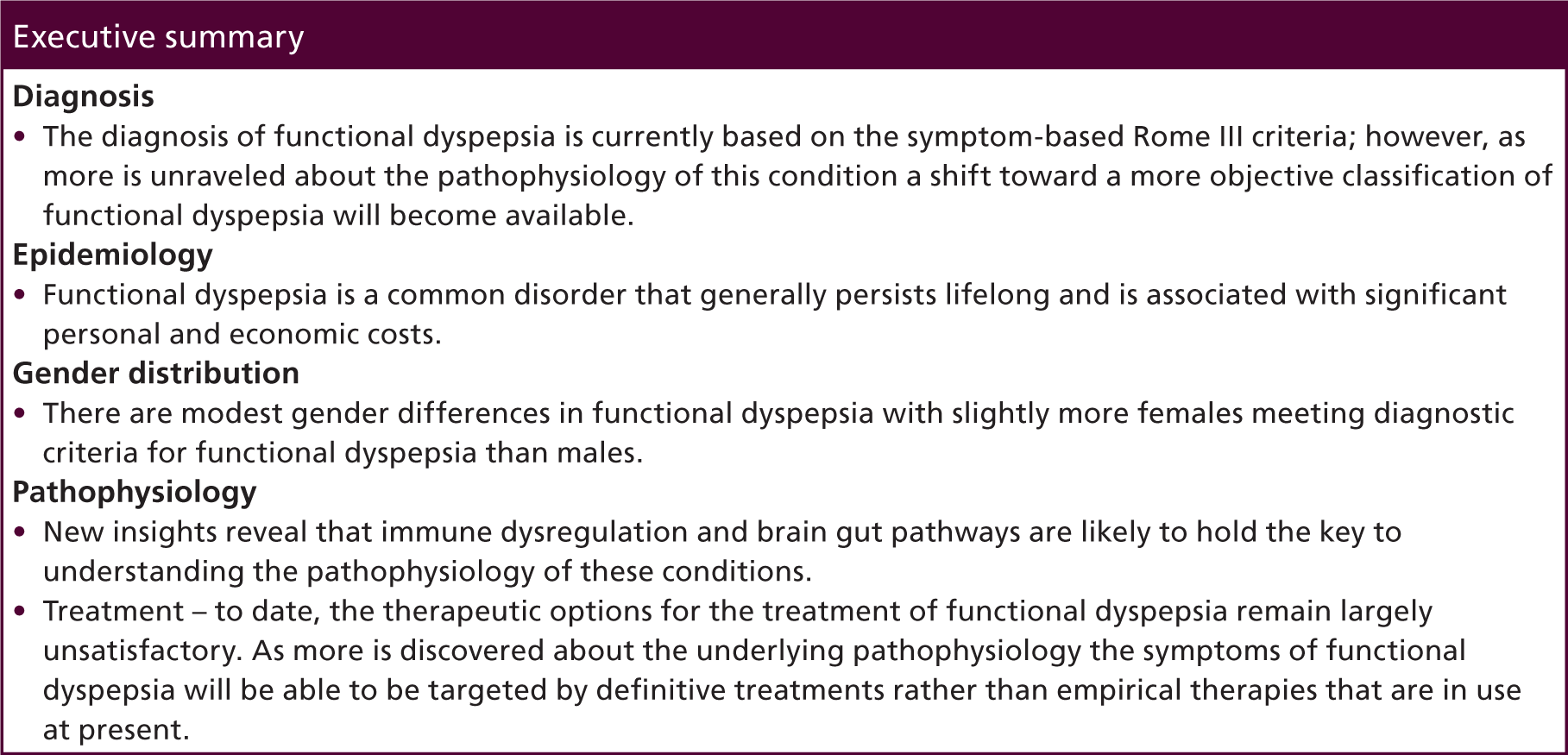
The diagnosis of functional dyspepsia is currently based on the symptom-based Rome III criteria; however, as more is unraveled about the pathophysiology of this condition a shift toward a more objective classification of functional dyspepsia will become available.
Functional dyspepsia is a common disorder that generally persists lifelong and is associated with significant personal and economic costs.
There are modest gender differences in functional dyspepsia with slightly more females meeting diagnostic criteria for functional dyspepsia than males.
New insights reveal that immune dysregulation and brain gut pathways are likely to hold the key to understanding the pathophysiology of these conditions.
Treatment – to date, the therapeutic options for the treatment of functional dyspepsia remain largely unsatisfactory. As more is discovered about the underlying pathophysiology the symptoms of functional dyspepsia will be able to be targeted by definitive treatments rather than empirical therapies that are in use at present.
Footnotes
The authors have no relevant affiliations or financial involvement with any organization or entity with a financial interest in or financial conflict with the subject matter or materials discussed in the manuscript. This includes employment, consultancies, honoraria, stock ownership or options, expert testimony, grants or patents received or pending, or royalties.
No writing assistance was utilized in the production of this manuscript.