




Abstract
Bypasses to the descending genicular artery (DGA) or the medial sural artery (MSA) have been performed with acceptable rates of midterm success. The arteriographic appearance of the DGA, the MSA, and the lateral sural artery (LSA) was described and the applicability of bypass to these vessels was investigated. The arteriograms of 45 patients who had occlusion of the below-knee popliteal artery were analyzed to determine the presence, dominance, and extension of collaterals for each perigeniculate branch, which were used to assess the applicability of a perigeniculate bypass. A dominant perigeniculate artery was found in 26 arteriograms and corresponded to 13 DGAs, 9 MSAs, and 4 LSAs. Of 14 applicable perigeniculate bypasses, 2 would be an obligatory bypass and 12 would be an alternative to a conventional infrapopliteal bypass. Although rarely an obligatory solution, a bypass to a perigeniculate branch artery represents a valuable alternative.
ADVANCED ARTERIAL OCCLUSIVE DISEASE in the lower extremity often shows short isolated segments of patent artery. The success of bypass to the isolated popliteal artery has been well documented and indicates that the popliteal branch arteries may develop a useful capacity of transporting arterial blood to the leg and foot. 1–3 The perigeniculate bypass to the descending genicular artery (DGA) or the medial sural artery (MSA) may be equivalent to a bypass to a short isolated popliteal segment with a single outflow branch and has yielded acceptable midterm outcomes. 4,5 However, there is a paucity of data on the suitability of the perigeniculate branches to receive a bypass. To fill this lacuna, analysis of arteriograms of patients with angiographically proven occlusion of the popliteal artery may be useful.
The objective of this study was to describe the arteriographic appearance of the DGA, the MSA, and the lateral sural artery (LSA); assess the collateral network distal to these arteries; and compare the applicability of the novel perigeniculate bypass with that of the conventional infrapopliteal bypass.
Methods
Patients
Arteriograms available for analysis corresponded to 45 patients who had extensive infrainguinal arterial occlusive disease. Of these patients, 25 were men, 32 had a positive history of smoking, 23 had diabetes mellitus, and 32 had hypertension. Twenty-four patients had ischemic tissue loss, whereas the other 21 patients had rest pain.
Criteria Of Inclusion And Exclusion
Based on available arteriograms and hospital records, total occlusion of the below-knee popliteal artery and the presence of chronic critical ischemia (Fontaine grade III or IV) in the target lower limb were used as entry criteria. Sixty-eight patients and their respective arteriograms satisfied the above criteria. Of these, 45 patients were finally included, whereas the remaining 23 patients were excluded because of poor arteriographic imaging of the leg and foot (n = 9), previous arterial reconstruction or major amputation in the target limb (n = 7), missing data on hospital records (n = 5), or images of aortoiliac aneurysm or occlusive disease at arteriography (n = 2).
Variables Of Interest
Arteriograms were first examined for the presence of the DGA, the MSA, and the LSA. Each of these arteries was then categorized as present when the site of origin, main trunk, and pattern of ramification were seen on the arteriogram or were absent otherwise. Next, dominance was assessed by applying the term dominant exclusively to the most developed or lonely present branch, either the DGA, the MSA or the LSA. On the other hand, the term nondominant implied a similar size for all present branches.
To assess the extension of the collateral network linked to one or more of the present perigeniculate branches, the expression long collaterals described a connection to a tibial or peroneal artery beyond the proximal two-thirds of the leg. On the other hand, short collaterals designated a connection above the distal third of the leg.
A perigeniculate bypass was judged applicable when there was a totally occluded superficial femoral artery (SFA), a dominant perigeniculate branch, and a well-identified perigeniculate collateral network. The term not applicable was used otherwise. An applicable perigeniculate bypass was judged obligatory when a conventional infrapopliteal bypass was not applicable.
A conventional infrapopliteal bypass was judged applicable when a usable segment of the main artery in the leg or foot was identified arteriographically. Otherwise, such a bypass was considered not applicable. Figure 1 shows the postoperative arteriogram of a recently treated patient in whom a DGA bypass was inserted. This bypass fed long collaterals linked to a posterior tibial artery (Figure 2). A long conventional infrapopliteal bypass was also applicable.
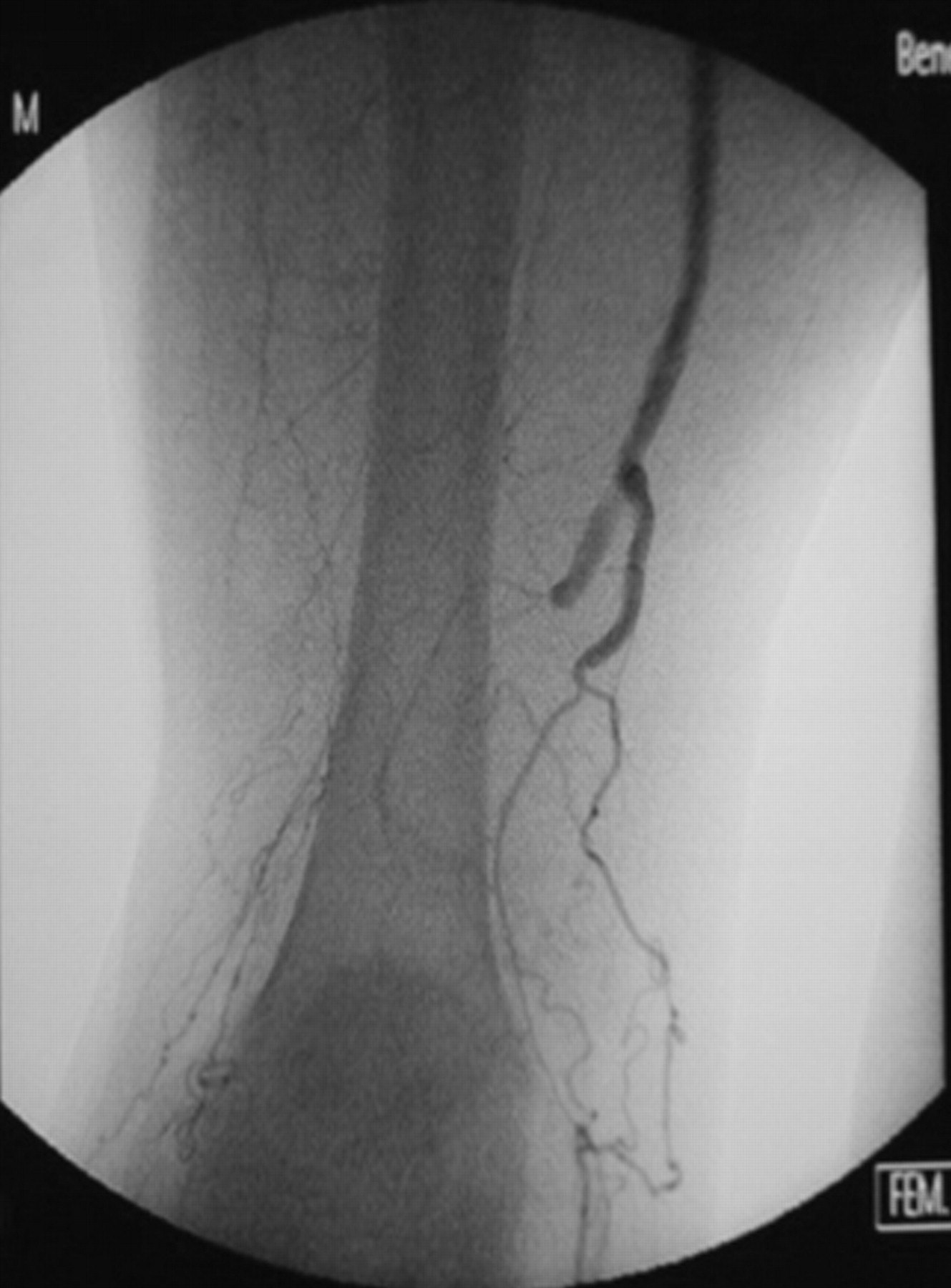
Postoperative arteriogram showing a short saphenous vein bypass graft inserted in the descending genicular artery.
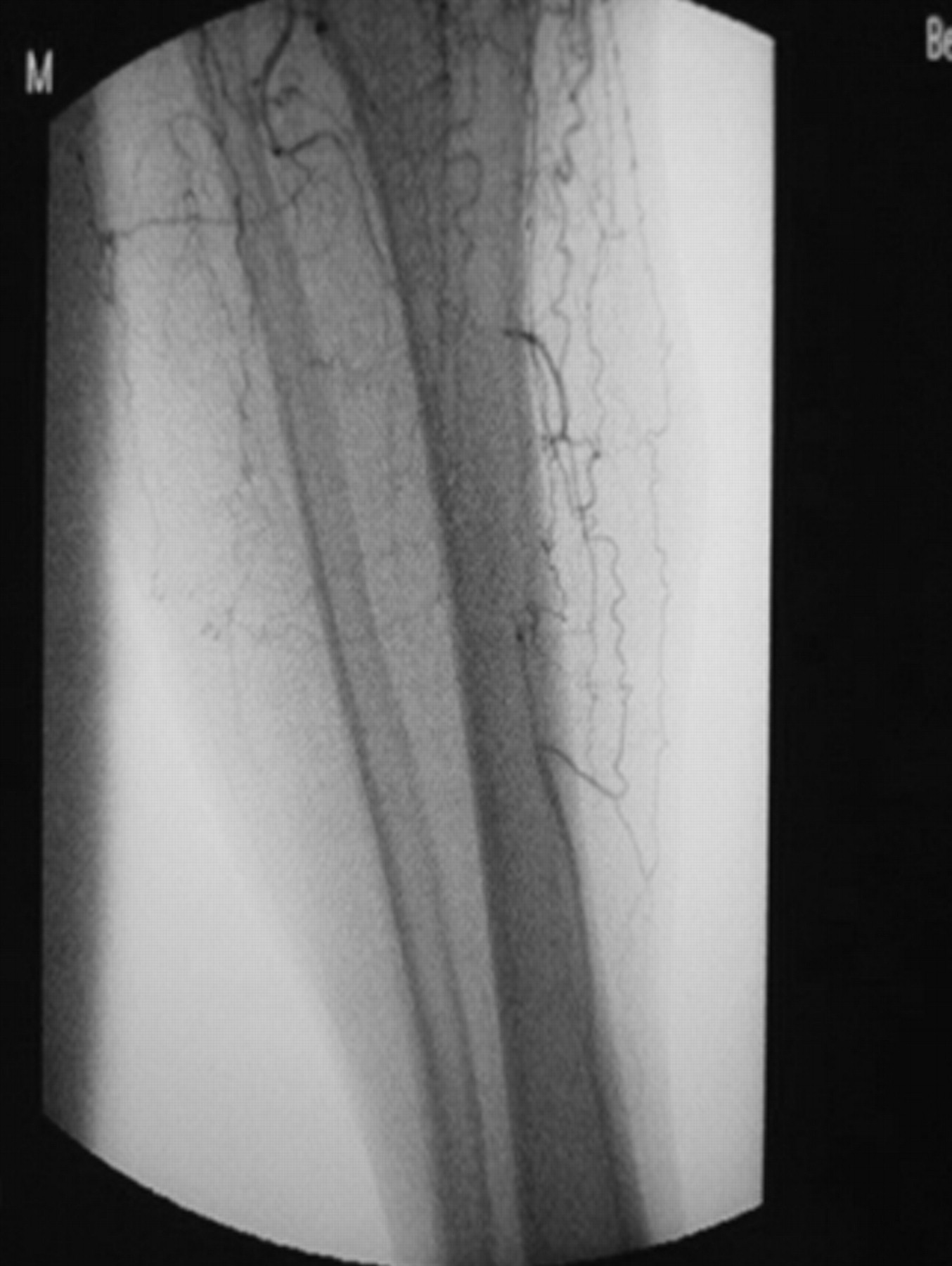
Same arteriogram of Figure 1. Long collaterals are connected to the posterior tibial artery.
The set of predictive variables included age, gender, target limb (right or left), tobacco use (smoker or nonsmoker), hypertension (present or absent), diabetes mellitus (present or absent), and degree of chronic ischemia (rest pain or tissue loss).
Data Collection
Because of the subjectivity involved, 150 arteriograms were analyzed separately by two authors (M.R. and M.K.), who filled in a standard instrument as part of the study protocol and resolved disagreements by discussion. When necessary, another investigator worked as a referee (M.A.).
Statistical Methods
Interobserver variation and intraobserver variation were determined for the assessment of arteriograms. By using the kappa technique to assess agreement, unweighted coefficients were determined for binary scales and weighted coefficients were determined otherwise (Table 1). 6 Approximate 95% confidence intervals were calculated for rates of interest, and logistic regression analysis assessed the influence of predictive variables on the results. 6
Agreement for the Assessment of Arteriograms
CI = confidence interval; DGA = descending genicular artery; LSA = lateral sural artery; MSA = medial sural artery.
Values are kappa coefficients and their respective 95% confidence limits.
Results
Agreement beyond chance was good in all but one assessment of interobserver variation and excellent in all but one assessment of intraobserver variation (see Table 1).
At least one perigeniculate branch was identified in 39 (87%) of 45 arteriograms, the DGA and the MSA more frequently than the LSA (Table 2), whereas long collaterals were more commonly associated with the MSA (Table 3). Twenty-six of 45 (58%) arteriograms revealed a dominant perigeniculate branch, which was the DGA more frequently and the LSA more rarely (see Table 3).
Presence of Perigeniculate Branches in the Arteriograms
CI = confidence interval; DGA = descending genicular artery; LSA = lateral sural artery; MSA = medial sural artery; SE = standard error.
Dominance of Perigeniculate Branches and Extension of the Collateral Network in the Arteriograms
CI = confidence interval; DGA = descending genicular artery; LSA = lateral sural artery; MSA = medial sural artery; SE = standard error.
The applicability was lower for the perigeniculate bypass than the infrapopliteal bypass. Six patients were deemed unsuitable for any type of bypass, whereas 12 patients could receive both types of bypass. In the latter, the perigeniculate bypass would feed four long collaterals and eight short collaterals. Two patients who had long collaterals would undergo an obligatory perigeniculate bypass, whereas the remaining 25 patients would receive an obligatory conventional bypass.
Logistic regression analysis for the presence of a perigeniculate artery showed odds of 5:1 for the DGA when hypertension was absent (p = .044), 7:1 for the MSA when diabetes was absent (p = .005), and 9:1 for the LSA when tissue loss was absent (p = .026). This analysis also showed that the odds for having at least one perigeniculate branch present decreases, whereas age increases (p = .026).
Discussion
The adoption of a convenient sample of arteriograms allowed the assessment of various changes imposed to the perigeniculate branch arteries when working as collaterals. With regard to the applicability of the perigeniculate bypass, the most relevant changes were an increased size of one individual branch and distal connection of a collateral network to reconstitute a named leg artery. 4 Multivariable analysis identified one independent predictor for the presence of each perigeniculate branch, but this was hardly interpretable. Perhaps more relevant was the negative influence of increasing age on the presence of at least one perigeniculate branch.
A dominant perigeniculate branch has been compared in size with a peroneal artery, classically a suitable recipient vessel for bypass. 4 Although dominance was the most prevalent for the DGA, such a dominant DGA fed long collaterals less frequently than did a dominant sural artery. This was hardly surprising as the more distal location of sural arteries naturally favors the reconstitution of leg arteries. Such interpretation agrees with the fact that bypasses have been done slightly more frequently to the MSA than the DGA. 4,5
The presence of long collaterals suggesting extensive tibioperoneal occlusion and the need for a long conventional bypass to the distal third of the leg or beyond may pose a real dilemma (see Figures 1 and 2) because whether such a long bypass fares better than a shorter perigeniculate bypass remains unknown. Reports on the perigeniculate bypass are rare. The graft patency rate at 1 year was 77% in Barral and colleagues' study and 73% in Brochado-Neto and colleagues' study. 4,5 Although still acceptable, these rates are inferior to those reported for series of infrapopliteal vein bypass grafts. 7
When hemodynamic improvement is considered, the perigeniculate bypass is comparable to the bypass to isolated arterial segments. 2,8 On the other hand, even the standard peroneal bypass occasionally undergoes hemodynamic failure. 7 Ideally, a balance should be met between the expected hemodynamic benefit and the particularities of each individual patient.
Assuming that long collaterals imply a long conventional bypass, the applicable perigeniculate bypass was ranked according to its relative need. Obligatory bypasses (n = 2) obviously ranked first. Next, one should rank optional bypasses accompanied by long collaterals (n = 4) and then optional bypasses accompanied by short collaterals (n = 8). Inapplicability (n = 31) ranked the last. Although the eight perigeniculate bypasses accompanied by short collaterals would not be strongly recommended, the largest published series described short collaterals for 14 of 22 perigeniculate bypasses. 4 Of course, reasons other than the arteriographic pattern of disease, such as shortage of vein and extensive skin lesion in the leg, may determine the resort to optional perigeniculate bypasses. 4,5
Less strict criteria of applicability would allow a higher number of suitable candidates for the perigeniculate bypass. Clearly, the exclusion of reoperations and the requirement of total occlusion of SFA were too restrictive. The reported series of perigeniculate bypasses have both included an appreciable number of reoperations and did not require a totally occluded SFA. 4,5 Indeed, one of these studies described a popliteal-to-MSA bypass inserted distally to a nearly normal SFA. 5
Due preference for the conventional infrapopliteal bypass has precluded a better understanding on what may be the proper role of the perigeniculate bypass. As the sampled 45 patients were selected from 150 others with all patterns of infrainguinal arterial occlusion, the true rate of feasibility for the perigeniculate bypass becomes 9%, which is a still relevant result.
Although based on retrospective data and hypothetical surgical decision-making, this study of patients with a chronically occluded below-knee popliteal artery showed that (1) the DGA and the sural arteries are frequently developed, (2) approximately one-third of these branches are suitable recipients for a perigeniculate bypass graft, and (3) such a bypass may represent a valuable, although rarely an obligatory, alternative.