




Abstract
During diagnostic workup for urologic malignancies, an abdominal aortic aneurysm (AAA) is identified in a proportion of patients. In the era of open AAA repair, these patients presented a surgical dilemma with regard to the sequence of the operations: cancer treatment first or AAA repair first? Previous assessments have concluded that irrespective of the followed strategy, the early and mediumterm mortality from the two operative procedures in this patient category was significant. With the introduction of endovascular aneurysm repair (EVAR), the mortality and morbidity associated with the treatment of both pathologic conditions may be more favorable than with open aneurysm repair. The objective of this study was to assess, in an institutional series of patients receiving EVAR, the early and long-term survival and complication rates in patients with urologic malignancies. In a series of 385 patients receiving EVAR, 14 had a concomitant urologic malignancy: renal cell carcinoma (5 patients), prostate carcinoma (6 patients), and carcinoma of the bladder (3 patients). The first-month mortality was nil. Long-term survival was 80%, 83%, and 67% for the three tumor types, respectively. EVAR offers improved treatment in patients with concomitant AAA and urologic malignancy and should be considered the first choice for these patients.
The frequent use of computed tomography in the assessment of a variety of pathologies has resulted in an increasing number of patients in whom abdominal cancer is diagnosed with a concomitant abdominal aortic aneurysm (AAA). In the era of open AAA repair, these patients presented a surgical dilemma because the optimal therapeutic strategy was uncertain. Surgeons had the choice between a combined treatment of both pathologies in one operative session or a staged procedure with treatment of one of the pathologic conditions at a time. At the current time, endovascular abdominal aortic aneurysm repair (EVAR) is preferred by many authors in patients with significant comorbidities, including a coexisting malignancy. 1–7 Of the different types of cancer, urologic malignancy represents an incidence of approximately one-third a frequent subset, which can be subdivided into three types of tumor: (1) renal cell carcinoma (RCC), (2) prostate carcinoma (PC), and (3) transitional cell carcinoma (TCC) of the bladder. Each of these tumors has a specific therapeutic approach, depending on its staging. The aim of the present study was to assess, in an institutional series of patients treated by EVAR, how the introduction of EVAR has changed conventional interventional options in patients with concomitant urologic cancer.
Patients and Methods
A retrospective assessment was done of all patients admitted for endovascular treatment of a nonruptured infrarenal AAA ≥ 50 mm and a concomitant urologic malignancy. Patient characteristics, comorbidities, and anatomic data regarding the AAA and adjacent vessels were prospectively collected and entered into the existing database as developed by the EUROpean collaborators on Stent-graft Techniques for abdominal aortic Aneurysm Repair (EUROSTAR Registry). 8 The inclusion period for this study was from January 2006 until December 2006. EVAR using a stent graft was the preferred treatment in our institution in patients with infrarenal AAA who had a suitable anatomy. EVAR was used in 59% of the total cohort with AAA in this period. During the study period, there was no fixed treatment protocol. The sequence and duration of interval between one or another procedure depended on regular hospital admission routines. Indications for EVAR were based on the EUROSTAR criteria. Tumor characteristics and details of localization and staging were retrospectively retrieved from hospital charts and pathology and radiology reports. These medical records were examined in detail to collect more relevant information about the diagnosis, treatment strategy, intraoperative complications, findings at follow-up, and duration of survival. Postoperative vascular surgical follow-up was protocoled with scheduled visits after 1, 3, 6, 12, and 18 months and annually thereafter. When data were missing, the patient or the general practitioner was contacted to update the information. Follow-up was completed until January 2009.
Results
The institutional EVAR database included 385 patients, of whom 14 patients were diagnosed with a concomitant urologic malignancy, for an incidence of 3.6%. Patient characteristics and comorbidities are presented in Table 1. All patients were male, and the incidence of current smoking was 29%. Comorbidities were categorized according to the Society for Vascular Surgery/International Society for Cardiovascular Surgery classification. 9 Risk factors for major abdominal surgery were present in seven (50%) patients. Four (29%) patients had had a previous laparotomy. Three (21%) were considered medically unfit for open AAA repair. Reasons for unsuitability for open AAA repair included severe cardiac comorbidity (one patient), severe chronic obstructive pulmonary disease (one patient), and a hostile abdomen (one patient). The overall group was subdivided into three categories according to localization and type of tumor: (1) RCC (five patients), PC (six patients), and TCC of the bladder (three patients).
Patient Characteristics and Comorbidities
AAA = abdominal aortic aneurysm; ASA = American Society of Anesthesiologists.
*Unless otherwise indicated.
†Society for Vascular Surgery/International Society for Cardiovascular Surgery classification. 9
AAA and RCC
The group of combined AAA and RCC consisted of five patients (Table 2). Four were treated by EVAR followed by nephrectomy, and in one, nephrectomy was performed first followed by EVAR (Figure 1). The aneurysm diameter varied between 54 and 70 mm. The operative procedure and the postoperative course were uncomplicated in all cases, except for one patient, who required a secondary operative procedure owing to postoperative hemorrhage from the field of the kidney resection.
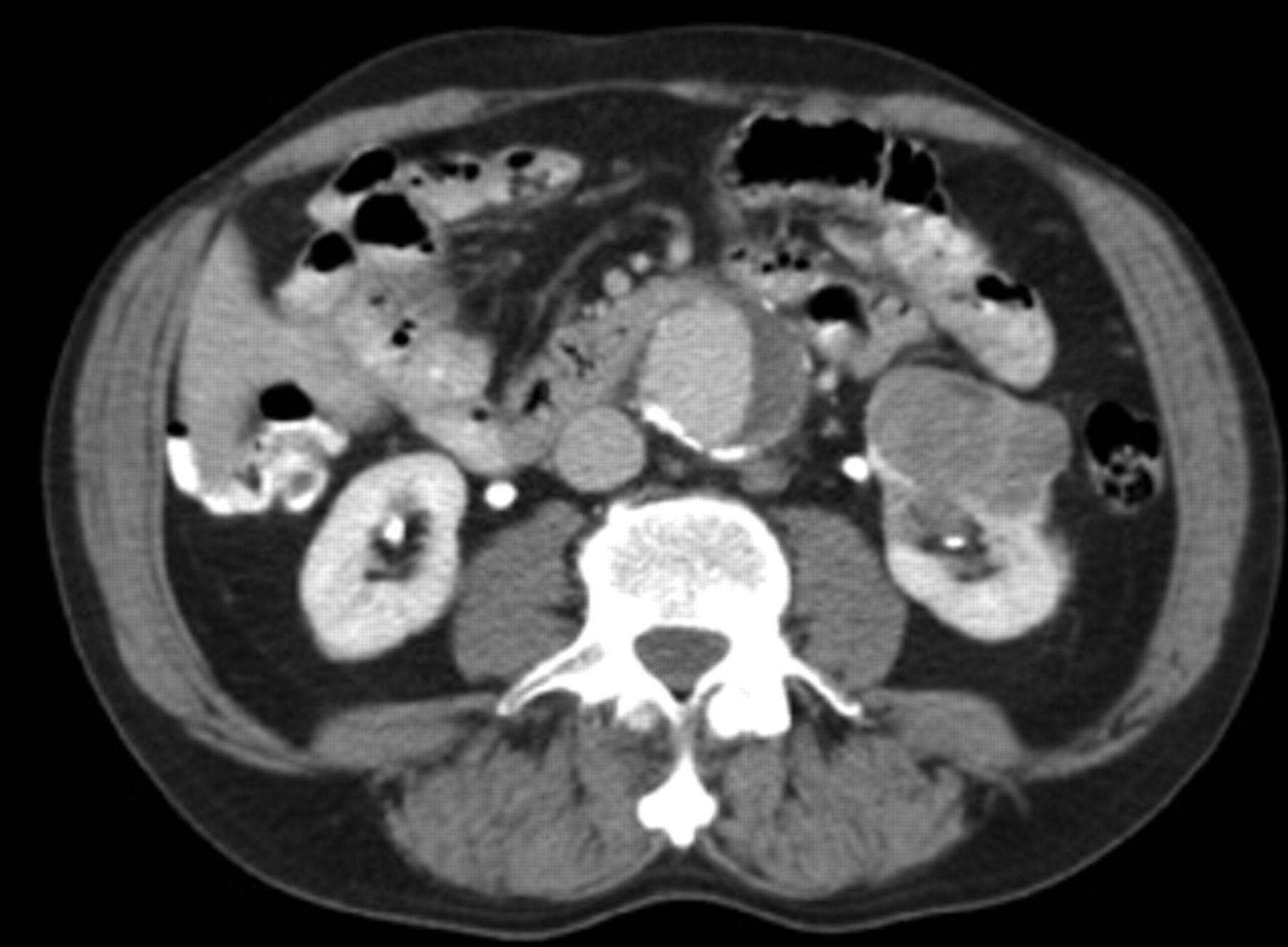
Infrarenal abdominal aortic aneurysm and renal cell carcinoma at the left side in one of our patients.
Abdominal Aortic Aneurysm and Renal Cell Carcinoma
AAA = abdominal aortic aneurysm; EVAR = endovascular aneurysm repair.
The treatment interval varied between 1 and 16 weeks (mean 8 weeks). During follow-up, one patient experienced thrombosis of an endograft limb, which was treated by a femorofemoral crossover bypass. One patient was treated with immunotherapy for rib metastases of the renal cancer. The mean postoperative survival after EVAR in this group was 62 months. During follow-up, one of the five patients died (20%). This patient, 74 years of age, died 30 months post-EVAR because of rupture of the AAA. The maximum diameter of the aneurysm at the time of the EVAR procedure was 58 mm. Tumor treatment in this patient had consisted of a radical nephrectomy before EVAR; no chemotherapy was given to this patient. The aneurysm neck had acceptable dimensions at the time of EVAR (diameter 19 mm and length 15 mm). A Zenith (Cook Inc., Bloomington, IN) stent graft was used, with a 26 mm inner diameter. The operative procedure and postoperative course were not complicated by endoleaks or migration. However, by the time of the aneurysm rupture, the neck diameter had increased to 24 mm and the length had decreased to 11 mm. The maximum diameter of the aneurysm was unchanged (57 mm) compared with the size at the time of the operation. The deteriorating neck characteristics most likely had presented a heralding sign for imminent aneurysm rupture. Conversion to open repair was not considered because of the patient's poor medical condition.
AAA and PC
The group of AAA and PC consisted of six patients. In four patients, EVAR was performed first, followed by treatment of the carcinoma, and in two patients, PC treatment was performed first (Table 3). The treatment of PC consisted of radiotherapy in one patient and radiotherapy and hormonal therapy combined in five patients. In none of the patients was a radical prostatectomy performed. The AAA diameter varied between 50 and 70 mm. The operative procedure and postoperative course were uncomplicated in all cases, except in one, who presented with an infection of the groin wound after EVAR. This condition was successfully treated with antibiotics. The treatment interval varied between 6 and 24 weeks (mean 12 weeks). The mean postoperative survival in this group was 56 months. During follow-up, one patient required a secondary endovascular procedure to resolve a type III endoleak owing to disconnection at an iliac limb. This treatment consisted of interposition of an additional iliac endograft. One of the patients in this category (17%) died during follow-up of a cause unrelated to the aneurysm or the initial malignancy after 24 months (acute leukemia).
Abdominal Aortic Aneurysm and Prostate Carcinoma
EVAR = endovascular aneurysm repair.
AAA and TCC of the Bladder
Three patients had an AAA and TCC combined (Table 4). Two patients received treatment for their TCC first followed by EVAR, and in one patient, the EVAR procedure was performed first. Treatment of TCC consisted of a transurethral tumor resection in two patients and a radical cystectomy and urine deviation in one patient. The aneurysm diameter varied between 50 and 61 mm. The operative procedure and postoperative course were uncomplicated in all cases. The treatment interval varied between 6 and 12 weeks (mean 10 weeks). The mean survival after EVAR was 65 months. One patient developed bone metastases of the TCC and was treated with palliative radiotherapy and chemotherapy. This patient died after 36 months owing to an intracerebral hemorrhage, which was not considered to be related to the disseminated cancer.
Abdominal Aortic Aneurysm and Bladder Carcinoma
EVAR = endovascular aneurysm repair.
Discussion
The incidence of concomitant malignancies of all varieties and AAA ranges between 3 and 13%. 7,10–13 In the present series, considering only urologic malignancies, the incidence was 3.6%, which corresponds to earlier observations. 7 In previous years, when open repair was the only option to treat AAA, the sequence of interventions for the respective pathologic conditions was frequently controversial. A one-stage procedure, including resection of the malignancy and vascular repair of the AAA during one procedure, offered several advantages. There were no delays, which minimized the risk of progression of either pathology, and the prospect of one rather than two operations was appealing for the patient. On the other hand, some operations, especially for RCC and radical cystectomy, may be associated with an increased risk of infection of the vascular prosthesis. These disadvantages are not relevant in patients with radiotherapy, hormonal treatment for PC, or bladder carcinoma of lower grading, which can be treated endoscopically. In our series, radical prostatectomy was not used; however, this procedure also may be associated with bacterial contamination of a simultaneously performed vascular reconstruction. When a two-stage procedure was chosen, the urologic-oncologic problem can be treated first, and the advantages here may include a lower risk of tumor progression. However, this scheme will cause a delay in the aneurysm treatment, whereas the risk of rupture in the interval may be further increased owing to weakening of the aneurysmal wall. The potential mechanism for this includes the catabolic postoperative state and nutritional deprivation of the patient. 14 Early treatment of the AAA may avoid this latter problem, and the risk of graft infection may be less. The disadvantage of this particular strategy, apart from tumor progression in the interval, includes a more complex oncologic resection owing to adhesions and retroperitoneal fibrosis. Finally, any two-stage procedure is associated with the patient receiving general anesthesia a second time and an overall prolongation of admission time.
The considerations above apply to open AAA repair. EVAR has been shown to be associated with a lower procedural mortality and morbidity, in addition to shorter admission times and a quicker recovery. 15–18 In a recent review of AAA treatment in patients with a variety of concomitant malignancies, the distinct advantages of EVAR were pointed out. 7 Porcellini and colleagues reported 25 patients of whom 12 had a urologic malignancy. In this study, open repair resulted in a significantly higher perioperative mortality than EVAR (21.4% vs 0%, respectively; p = not significant). The survival benefit in the EVAR group extended to the 1- and 2-year survival rates.
For urologic tumors, EVAR offers the possibility of excluding the AAA before treating the condition of the urinary system. This reduces the risk of interval AAA rupture without delaying treatment of the cancer. In open oncologic surgery, the risk of direct graft contamination appears to be markedly reduced, while at the same time the hazard of a secondary abdominal exploration is precluded. Our series included 14 patients with concomitant AAA and urologic malignancies. These latter pathologies were divided according to tumor type and localization into RCC, PC, and TCC. Neither the treatment of the tumor nor EVAR was associated with 30-day mortality. Complications in the early postoperative period were limited to two cases (14%), and both complications, a wound infection and postoperative intra-abdominal bleeding, were treated successfully. The mean survival during follow-up was 80%, 83%, and 67%, respectively, for patients with RCC, PC, and TCC. Only 3 of the 14 patients (21%) died during an overall mean follow-up period of 61 months. One of the three deaths was aneurysm related owing to “vanishing of the infrarenal neck” after 30 months of follow-up. This failure of the endograft procedure was not related to endoleak or chemotherapy. However, the catabolic state of the patient may have been associated with dilatation of the initially normal size neck with subsequent loss of proximal fixation of the endograft and rupture of the aneurysm. Continuation of inflammatory activity and proteolysis have been suggested as factors that may result in late deterioration of the aorta wall in the infrarenal zone. 19 In retrospect, we consider it doubtful whether the survival time of this patient would have been longer when initial open repair would have been performed. Further complications of EVAR included occlusion of an iliac limb, resolved by a femorofemoral bypass, and a type III endoleak, resolved by an interposition endograft.
The mean treatment interval between EVAR and the urologic procedure was 8 weeks in the RCC group, 12 weeks in patients with PC, and 10 weeks in patients with TCC. These treatment intervals were relatively long, and we now feel that the procedure for the urologic malignancies should be performed during the same hospital admission as EVAR. Radiotherapy or hormonal therapy of the urologic tumor also can start briefly after the vascular procedure without additional risks.
Weaknesses of the present study include a relatively small target group. Absolute survival rates were 80%, 83%, and 67% in the subgroups with RCC, PC, and carcinoma of the bladder and 79% in the overall group of patients with associated malignancies. This figure does not allow a meaningful comparison with survival in an overall group of patients with EVAR, which was 87% after 2 years of follow-up in the EUROSTAR cohort. 20 Our institution intensively participated in this registry. With these study limitations, we believe our series demonstrated that EVAR is the preferred method for excluding aneurysms, which are identified in the patient with a urologic malignancy. Most of the late complications in our study were related to the patient's oncologic condition. Treatment of the AAA is associated with similar low mortality and morbidity rates postoperatively and during follow-up, as in patients without a concomitant malignancy. Compared with the early mortality after open repair, which ranges up to 20%, 7 the 1-month mortality was 0 in our study with EVAR.
Conclusion
EVAR offers improved treatment in patients with concomitant AAA and urologic malignancy and should be considered the first choice for these patients.
Footnotes
Acknowledgment
Financial disclosure of authors and reviewers: None reported.